How to Groom a Double-Coated Dog (At-Home Routine)
Grooming a double-coated dog means removing dead undercoat, not cutting hair. Line-brush the dry coat in sections down to the skin with an undercoat rake and slicker, confirm with a steel comb, bathe, then dry with forced air. Clippers are for feet and sanitary trims only, never the body.
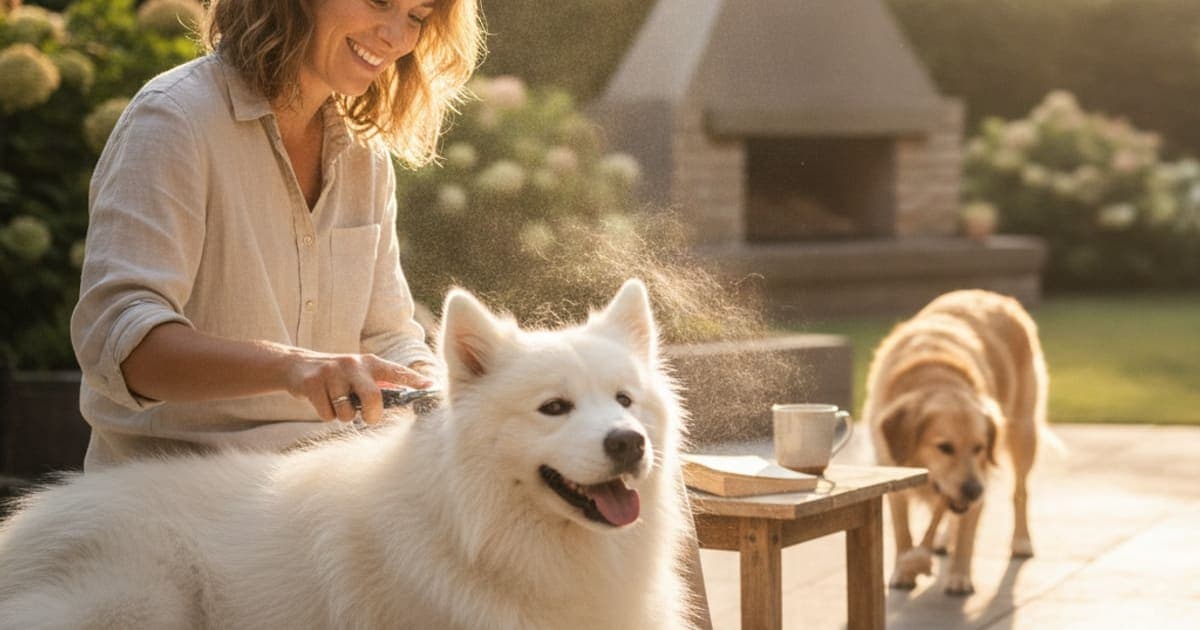
Groom a double-coated dog by working the dead undercoat out of the coat rather than cutting hair off it. The routine is simple and repeatable: line-brush the dry coat in sections down to the skin with an undercoat rake and slicker, comb through with a steel comb to prove you actually reached skin, bathe and rinse completely, dry with forced air so loose undercoat blows free, then comb again. Clippers belong on feet, sanitary areas and the occasional tidy-up, not on the body. Done consistently, that is the entire job.
What a double coat is, and why shaving backfires
A double coat is two different kinds of hair sharing the same skin. The outer layer, the guard coat, is coarse, longer, water-shedding, and carries the colour and shine. Underneath sits the undercoat: soft, dense, crimped fibre that traps a layer of air against the skin.
That trapped air insulates in both directions. In winter it holds body heat in. In summer, a clean and open undercoat holds cooler air near the skin while the guard coat blocks sun and sheds dirt and water. Huskies, malamutes, German shepherds, Samoyeds, golden retrievers, Australian shepherds, corgis, Bernese mountain dogs, chow chows and pomeranians all carry versions of this arrangement.
Never shave a double-coated dog to keep it cool: the undercoat is the temperature-regulating layer, and after a shave-down it can grow back patchy, woolly, or in some dogs not properly at all. Post-clipping alopecia is a recognised problem in heavily coated and Nordic breeds, and the texture change that follows is often permanent: the soft undercoat tends to regrow faster than the guard hairs, leaving a coat that no longer repels water or dirt the way it used to.
Severe matting is the one real exception, and it is a welfare decision rather than a styling one. A pelted coat tightened against the skin traps moisture, hides sores and restricts movement. In that situation, clipping the mat out is kinder than dragging a brush through it, and that call is best made with your veterinarian or an experienced groomer rather than alone at the kitchen table.
The tools worth owning
You do not need a salon. You need a short list of implements that actually reach the undercoat, because a cheap bristle brush skating over the guard hairs does nothing at all.
| Tool | What it does | When you reach for it |
|---|---|---|
| Undercoat rake | Long, widely spaced pins pull dead undercoat out from below the guard coat without cutting it | The backbone of every session; use it on a dry, tangle-free coat |
| Slicker brush | Fine angled wire pins lift and separate packed undercoat and break up early tangles | Behind ears, armpits, britches, tail base, after the rake |
| Double-sided dog grooming brush | Pin side on one face, soft bristle on the other, pins open the coat, bristles smooth and distribute skin oils | Finishing passes and short-coated areas like the face and legs |
| Double-sided grooming comb (greyhound comb) | Coarse teeth at one end, fine at the other, the honest test of whether you reached skin | After brushing every section, and again after drying |
| De-shedding tool | Short, fine blade that strips loose undercoat quickly | Sparingly during coat blow; overuse can thin and damage guard hairs |
| High-velocity dryer | Pushes air through the coat to force loose undercoat and water out | After every bath, this is the single biggest upgrade for a double coat |
| Dog grooming vacuum | Vacuum unit with brush and rake attachments that collect hair as you groom | Indoor grooming and shedding season, if your dog tolerates the noise |
| Clippers | Shortening hair | Feet, pads, sanitary trim, tidying hocks, never the body coat |
| Nail clippers or grinder, ear cleaner, dog shampoo and conditioner | Routine maintenance and a clean bath cycle | Every session or as the coat and nails dictate |
A double sided dog grooming tool is a space-saver, not a shortcut: it is genuinely useful for finishing, but the rake and the steel comb do the heavy lifting. If you are buying a dog grooming kit for double coated dogs, judge it by whether it contains a true undercoat rake and a metal comb. Kits padded out with four near-identical bristle brushes are a label trick, not a kit.
A grooming vacuum is worth it if the alternative is skipping sessions because of the mess. It does not replace line brushing; it collects what line brushing releases.
The at-home routine, step by step
- Start dry and start calm. Never brush a wet or damp double coat: water packs the undercoat tighter and turns loose fluff into felt. Set the dog on a non-slip surface at a height that keeps your back straight.
- Run your hands over the whole dog first. You are checking for mats, lumps, burrs, hot spots and sore places before you put a tool anywhere.
- Line-brush in sections. Part the coat with one hand so you can see the skin, then brush the hair downward from the parting with the rake or slicker, working from the skin outward. Move the parting up a centimetre at a time. This is the technique the whole job rests on: brushing the surface only grooms the top of the coat and leaves the dead layer sitting underneath.
- Work bottom to top, front to back. Start low on the legs and chest and finish at the spine, so you always know which areas are done.
- Slow down at the friction zones. Behind the ears, the armpits, the britches at the back of the thighs, the ruff and the tail base mat first. Hold the hair at the base so pulling does not reach the skin.
- Comb to confirm. Run the fine side of the steel comb through each finished section. If it glides to skin, the section is done. If it catches, go back with the rake.
- Bathe only after the coat is brushed out. Soak the coat properly, shampoo to the skin, and rinse far longer than feels necessary: leftover product sitting in dense undercoat causes itching and flaking.
- Dry with forced air. Work the nozzle through the coat in sections, following the hair direction, pushing water and dead undercoat out as you go. Air-drying a dense double coat leaves damp undercoat against the skin, which is how hot spots start.
- Finish. Comb through once more, trim the hair between the pads and around the sanitary area, clean ears, and do nails. Nails last, because most dogs tolerate them worst.
Keep sessions short and end before your dog runs out of patience. Two unhurried sessions beat one long one that teaches the dog to dread the brush.
How often to groom, and when to hand it to a professional
Double-coated dogs absolutely need grooming: arguably more than smooth-coated ones, because the dead undercoat does not fall out cleanly on its own. It packs. A weekly line-brushing habit keeps a normal coat open and comfortable. During a seasonal coat blow, which commonly arrives with the big temperature swings of spring and autumn, most owners find they need to brush several times a week, sometimes daily, until the undercoat releases. Bathing is occasional rather than scheduled: when the dog is genuinely dirty, or at the start of a shed to loosen the coat.
Hand the job over when the coat is matted beyond safe brushing, when your dog is frightened or painful during handling, or when you simply cannot get a dense coat properly dry at home. Searching for double coated dog grooming near me is sensible: just vet the result. Ask whether the groomer refuses body shave-downs on double coats, whether they use a high-velocity dryer and a de-shed process, and how they handle a dog who cannot stand comfortably for long. A groomer who answers those three questions well is worth keeping.
What your hands learn about an older dog during grooming
Grooming is the most thorough physical exam most dogs get. You are touching every joint, lifting every leg, and asking the dog to stand still and balance. That makes it an early-warning system. Watch for a dog who shifts weight off a hind leg, flinches when you comb the hips, sits down halfway through, struggles to rise afterwards, or has lost muscle over one thigh compared with the other. New reluctance to be brushed over a specific area often means that area hurts. Bring that to your veterinarian rather than shrugging it off as age: diagnosis belongs with them, and soft tissue problems caught early are managed very differently from ones caught late.
Owners whose dogs are recovering from a soft tissue injury or an orthopaedic procedure, or simply slowing down, increasingly build a recovery stack alongside the plan their vet sets. K9-REPAIR from pawgen is a BPC-157 and TB-500 peptide formulation for dogs, dosed by body weight, third-party tested, with batch certificates of analysis published and orders shipped direct to the door behind a 60-day money-back guarantee. BPC-157 is a synthetic peptide studied for effects on new blood vessel formation and on the migration of tendon and ligament cells; TB-500 is a synthetic form of a region of thymosin beta-4, a protein involved in actin binding and cell movement. Research suggests these mechanisms may support the body's own repair processes, and this is the emerging science a growing number of owners are adopting through recovery and into senior maintenance. BPC-157 and TB-500 are not FDA-approved veterinary drugs, nothing here is a treatment claim, and questions about whether a peptide fits your dog belong in a conversation with your veterinarian alongside whatever rehab, medication or surgery they have prescribed.
Key Takeaways
- Double coated dog grooming is undercoat removal, not hair removal: the rake and the steel comb do the real work.
- Line-brush in parted sections down to the skin; surface brushing leaves the dead layer packed underneath.
- Never shave the body coat for cooling. Clipping is for feet, pads and sanitary areas, or for severe matting decided with a professional.
- Always brush before bathing, rinse completely, and dry with forced air rather than letting a dense coat air-dry.
- Weekly brushing maintains a normal coat; seasonal coat blow demands far more frequent sessions.
- A grooming kit is only as good as its undercoat rake and metal comb; a vacuum and high-velocity dryer are convenience and drying upgrades, not substitutes for technique.
- Use grooming time as a hands-on check for stiffness, soreness and muscle loss, and report changes to your vet.
If you want to look at the formulation itself, K9-REPAIR is listed at /shop/, the third-party certificate of analysis for each batch is published at /coas/, and availability information is at /location/.
Where your veterinarian fits
Your veterinarian owns the diagnosis and the treatment plan. Skin disease hiding under a thick coat, a limp that shows up when your dog shifts off a hind leg on the grooming table, a mat that has to come off under sedation: those are clinical decisions, and prescribed medication, surgery and structured rehab are the foundation of any recovery. Good grooming and supportive supplementation work in the space that proper veterinary care creates: they keep the coat healthy, keep your hands on the dog often enough to notice change early, and support the body while the professionals direct the plan.
Owners exploring peptide support for their dog can review K9-REPAIR, BPC-157 + TB-500 formulated for dogs, at https://pawgen.com/. BPC-157 and TB-500 are not FDA-approved veterinary drugs. Nothing in this article treats, cures or prevents any condition; every decision about your dog's care belongs with your veterinarian.
Frequently asked questions
- How to groom a double coated dog?
- Brush the dry coat in sections down to the skin with an undercoat rake and slicker, then comb through with a steel comb to confirm you reached skin. Bathe, rinse thoroughly, dry with forced air to blow loose undercoat free, and comb again. Trim feet and nails last.
- How to groom double coat dog at home?
- At home you need an undercoat rake, a slicker brush, a double-sided steel comb and ideally a high-velocity dryer. Work on a non-slip surface, line-brush the dry coat section by section, bathe only after brushing out, and dry fully. Keep sessions short and finish before your dog loses patience.
- Do double coated dogs need grooming?
- Yes, and arguably more than smooth-coated dogs. Dead undercoat does not fall out cleanly; it packs against the skin, traps moisture and mats. Weekly line brushing keeps a normal coat open, and during a seasonal coat blow most owners brush several times a week until the undercoat releases.
- What belongs in a double coat dog grooming kit?
- An undercoat rake, a slicker brush, a double-sided grooming comb with coarse and fine teeth, a dog shampoo and conditioner, nail clippers or a grinder, and ear cleaner. A high-velocity dryer is the biggest upgrade. Judge any kit by whether its rake and metal comb are genuinely good.
- Can I use clippers on a double coated dog?
- Use clippers only on feet, pads, sanitary areas and tidy-ups, never on the body coat. Shaving removes the insulating undercoat and can cause patchy, woolly or permanently altered regrowth. The exception is severe matting, where clipping is safer than brushing through, and that decision belongs with your vet or groomer.
- Is a dog grooming vacuum worth it for a double coated dog?
- It is worth it if mess is the reason you skip sessions. A grooming vacuum with rake and brush attachments collects undercoat as you release it, which makes indoor grooming realistic during shedding season. It does not replace line brushing technique, and some dogs need gradual introduction to the noise.
- What is a double sided dog grooming brush used for?
- A double-sided brush has pins on one face and soft bristles on the other. The pin side opens the coat and breaks up light tangles; the bristle side smooths the guard hairs and spreads natural skin oils. It is a finishing tool, used after the undercoat rake has done the real work.
- How do I find good double coated dog grooming near me?
- Search locally, then screen the results. Ask whether the groomer refuses body shave-downs on double coats, whether they use a high-velocity dryer and a dedicated de-shedding process, and how they handle older or arthritic dogs who cannot stand for long. Clear answers to those questions matter more than price.
- How often should a double coated dog be bathed?
- Bathe occasionally rather than on a schedule, generally when the dog is genuinely dirty or at the start of a coat blow to help loosen undercoat. Always brush out thoroughly first, rinse far longer than feels necessary, and dry with forced air so no damp undercoat sits against the skin.
Educational content, not veterinary advice. Ask your vet about your dog.