Eggshell Membrane Alternatives for Dogs — 2026 Options
If eggshell membrane isn't doing what you hoped, the realistic alternatives fall into three groups: other structural raw materials such as collagen peptides, green-lipped mussel and glucosamine; anti-inflammatory marine lipids; and signalling compounds — the peptide category, including the BPC-157 and TB-500 in K9-REPAIR, that owners increasingly use through recovery.
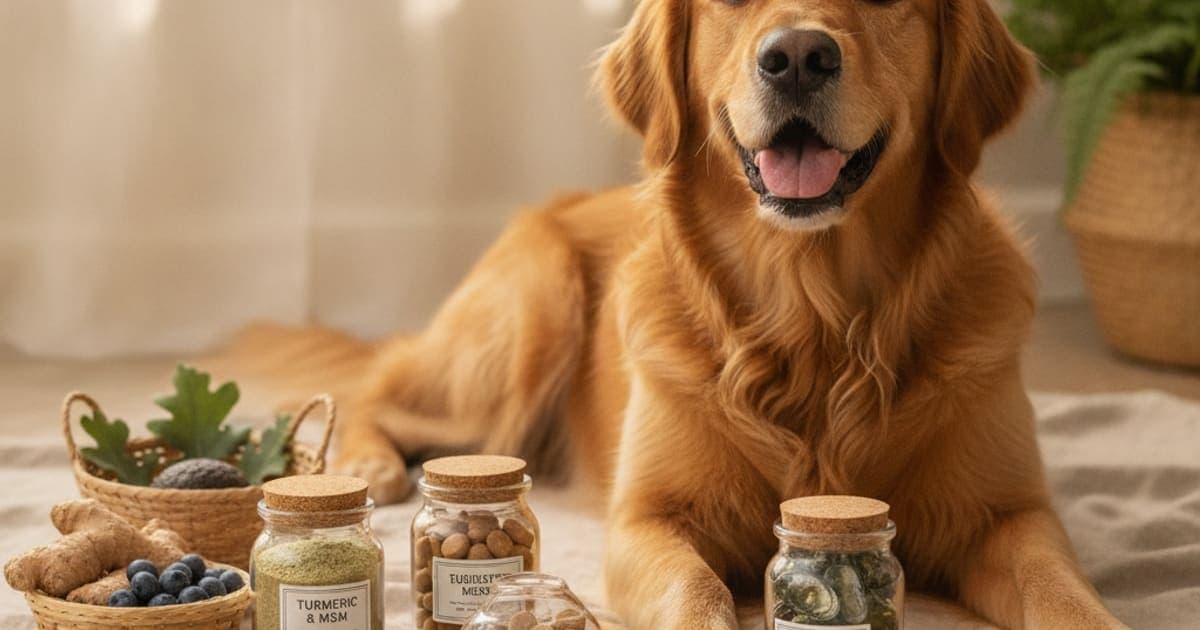
What can I use instead of eggshell membrane for my dog?
If eggshell membrane isn't doing what you hoped, the practical alternatives fall into three groups: other structural raw materials (collagen peptides, green-lipped mussel, glucosamine and chondroitin), anti-inflammatory marine lipids, and signalling compounds — the peptide category, including the BPC-157 and TB-500 in K9-REPAIR, that owners increasingly reach for through injury recovery and mobility work.
Which of those three makes sense depends less on marketing and more on what your dog's tissue is actually short of. That is the question this article is built around.
What eggshell membrane actually supplies
Eggshell membrane is the thin, papery layer sitting between the shell and the white. Its appeal as a supplement comes from composition rather than from any single drug-like active. It carries collagen as its dominant protein, along with elastin and a fraction of glycosaminoglycans — the family that includes hyaluronic acid, chondroitin sulfate and glucosamine.
In other words, it is a naturally bundled version of several ingredients the joint aisle usually sells separately. That bundling is genuinely reasonable. Cartilage, tendon and ligament are collagen-and-glycosaminoglycan structures, and feeding a dog those components in something close to their native arrangement is not a silly idea. Research on eggshell membrane and joint comfort has been encouraging enough that it became a mainstream inclusion, and plenty of owners report that their dog seemed to move more freely on it.
But the mechanism has a ceiling, and knowing where that ceiling sits is the entire point of this comparison. Eggshell membrane supplies raw material; it does not tell the tissue what to do with that material — and that distinction explains most of the disappointment owners feel with structural supplements.
Why owners start looking for a replacement
Three patterns come up repeatedly when someone decides eggshell membrane isn't working for their dog.
The inclusion amount is too small to matter. Eggshell membrane is frequently one line on a kitchen-sink chew that also lists turmeric, MSM, hemp, glucosamine, chondroitin, hyaluronic acid, boswellia and half a dozen botanicals. When eight to fourteen ingredients share one small soft chew, most of them are present in amounts that exist for the label rather than for the dog. Watch for proprietary blends that give a combined total without breaking out individual amounts — that formatting choice usually protects the formulator, not the buyer.
The problem was never a shortage of building blocks. A well-fed dog on a complete diet is generally not starved of collagen precursors. If a tendon is disorganised after a strain, or a joint capsule is inflamed, adding more amino acid feedstock does not by itself change how that tissue is being remodelled. Supply and instruction are different problems.
The timeline doesn't match the injury. Structural supplements are slow, cumulative and best suited to long-horizon wear-and-tear support. An owner six weeks out from a cruciate repair, or watching a limp that appeared last Tuesday, is working on a different clock and often concludes — fairly — that the chew isn't doing anything.
Worth saying plainly before you swap anything: if your dog's comfort or gait has changed noticeably, that is a veterinary conversation before it is a supplement conversation. A limp is a symptom, not a diagnosis, and the underlying cause changes what belongs in the plan.
The alternatives, side by side
Here is the honest landscape of what owners move to, and what each category is actually doing.
| Option | What it supplies | What research suggests it may support | Best understood as |
|---|---|---|---|
| Eggshell membrane | Collagen, elastin, small amounts of glycosaminoglycans | General joint comfort with sustained daily use | A bundled raw-material source |
| Collagen peptides | Hydrolysed collagen fragments and amino acids | Connective-tissue substrate availability | Feedstock, not signalling |
| Glucosamine + chondroitin | Cartilage matrix precursors | Long-horizon cartilage support; response varies widely between dogs | The traditional baseline |
| Green-lipped mussel | Glycosaminoglycans plus marine lipids | Joint comfort through a combined structural and lipid route | A hybrid of the two lanes |
| Marine omega-3s (EPA/DHA) | Long-chain anti-inflammatory fatty acids | Modulation of inflammatory signalling | Background inflammatory tone |
| K9-REPAIR (BPC-157 + TB-500) | Two synthetic peptides that act as biological signals | Cell migration, blood-vessel formation and tissue-repair pathways in published animal research | The signalling layer owners add through recovery |
Notice that the first five rows are variations on one theme: give the body more of what tissue is made of. K9-REPAIR sits in a different column entirely, and that is precisely why owners who have already cycled through the structural options end up looking at it.
Building blocks versus biological signals
Repair is a sequenced process, not a warehouse problem. After a tendon strain or a joint insult, the body has to clear damaged tissue, move new cells into the site, build a blood supply to feed them, lay down collagen, then remodel that collagen from a disorganised patch into aligned, load-bearing fibre. That remodelling runs over weeks to months at the tendon-bone interface. Each of those steps is driven by signals — chemical instructions telling cells where to go and what to build.
BPC-157 is a synthetic peptide based on a sequence identified within a protein found in gastric juice. Across published animal research it has been studied for its relationship to angiogenesis — the formation of new blood vessels — and to tendon fibroblast behaviour, including cell migration and outgrowth. Research suggests it acts on the signalling side of repair rather than the supply side.
TB-500 is a synthetic fragment corresponding to the active region of thymosin beta-4, a naturally occurring protein involved in actin regulation. Actin is the internal scaffolding that lets a cell change shape and crawl. Research indicates thymosin beta-4 and its active fragment are associated with cell migration and vascular development — again, instruction rather than raw material.
That is the mechanistic reason the two are used together and the reason this is the stack many owners run through a recovery block rather than as a lifelong daily chew. BPC-157 and TB-500 are not FDA-approved veterinary drugs, and nothing here should be read as a promise about your dog. What can be said fairly is that the science is emerging, it is promising, and a growing number of owners are adopting it for exactly the situations where structural supplements plateau.
If you want to compare the peptide route against the clinic-based options your vet may already have raised, that comparison is worth having out loud with them.
If your current supplement isn't doing what you hoped
If the change in movement is new
A new limp, a new reluctance on stairs, a new hesitation to jump into the car — that is a diagnostic problem first. Cruciate disease, a soft-tissue strain, a disc issue and early arthritis can look similar from the kitchen doorway and are managed very differently. Book the exam. Whatever you decide to add afterwards works better when it is added to an accurate diagnosis rather than a guess.
If your dog is post-surgical or in a formal rehab programme
This is the scenario where the difference between raw material and signalling matters most. The surgical repair and the rehab protocol are doing the structural work; your vet or rehab practitioner owns that plan, including any prescribed pain control, and nothing you buy online should displace it. What owners are looking for in this window is support for the biology happening around the repair, which is why K9-REPAIR is commonly described as the stack owners use through recovery rather than as a substitute for anything on the surgical plan.
If this is slow, aging-related stiffness
Here the structural supplements have a legitimate long-term role, and marine omega-3s are a sensible part of the background. But if you have run a well-made structural product consistently for months and your dog is still shortening walks, adding a fourth collagen source is unlikely to change the trajectory. Adding a different layer might.
Reading a label before you swap
Whatever you move to, apply the same three tests. First, are individual ingredient amounts disclosed, or hidden inside a proprietary blend? Second, is the product dosed by body weight, or does a Chihuahua and a Great Dane get the same chew? Third, is there third-party testing with a certificate of analysis you can actually look at, so you know the contents match the label?
K9-REPAIR is a two-peptide formulation rather than a botanical blend, dosed by body weight, third-party tested with COAs available, shipped direct to your door, and backed by a 60-day money-back guarantee. Any specific amount for your individual dog is a conversation to have with your veterinarian — this article deliberately gives no numbers, and you should be sceptical of any source that hands them out freely, particularly for puppies or for pregnant and nursing dogs.
Key takeaways
- Eggshell membrane supplies collagen, elastin and a small glycosaminoglycan fraction — real raw material, but raw material only.
- Most alternatives owners consider (collagen peptides, glucosamine, chondroitin, green-lipped mussel) sit in that same supply category.
- Marine omega-3s work on inflammatory signalling and complement rather than replace structural support.
- BPC-157 and TB-500 are studied for their relationship to cell migration, blood-vessel formation and tissue-repair signalling — a different layer from raw material.
- Underdosed multi-ingredient chews and undisclosed proprietary blends are the most common reason a supplement appears to do nothing.
- Weight-based dosing, disclosed amounts and third-party COAs are the minimum standard worth paying for.
Owners weighing peptides against clinic-based approaches can read tb-500 vs prolotherapy for dogs and tb-500 vs laser therapy for dogs, and the full formulation details, testing documentation and guarantee for K9-REPAIR are set out by pawgen in plain language.
One last framing that matters more than any product comparison. Your veterinarian owns the diagnosis and the treatment plan — the imaging, the surgical decision, the prescribed medication, the rehab protocol. Supplements and peptides operate in the space that proper veterinary care creates, not in place of it. Bring this comparison to your next appointment, tell your vet exactly what you are giving and what you are considering, and let the two work together.
Owners exploring peptide support for their dog can review K9-REPAIR — BPC-157 + TB-500 formulated for dogs — at https://pawgen.com/. BPC-157 and TB-500 are not FDA-approved veterinary drugs. Nothing in this article treats, cures or prevents any condition; every decision about your dog's care belongs with your veterinarian.
Frequently asked questions
- When should I take a dog to the vet for struggling to squat?
- Book an appointment if the difficulty lasts more than a day, recurs, or comes with straining, crying, blood, or a change in gait. Sooner if your dog is also lethargic, off food, or has a distended abdomen. Squatting requires hip, spine and hind-limb coordination, so persistent trouble deserves a physical exam rather than watchful waiting.
- What can I give a dog that is struggling to squat?
- Nothing should go in before a diagnosis, because the cause could be orthopaedic, neurological or gastrointestinal, and each is managed differently. Your veterinarian may address pain, constipation or an underlying joint or spinal issue directly. Once a plan exists, mobility-focused support such as omega-3s or K9-REPAIR can be discussed as an addition to it.
- Is a dog struggling to squat an emergency?
- It can be. Treat it as urgent if your dog is straining repeatedly without producing anything, is vomiting, has a swollen or painful belly, has sudden hind-limb weakness or dragging, or seems distressed. Those combinations can indicate an obstruction or a spinal problem. Gradual, mild difficulty is less urgent but still warrants a prompt veterinary exam.
- Why is my dog difficulty posturing to poop?
- Posturing to defecate loads the hips, stifles and lumbar spine while requiring balance. Arthritis, hip or knee pain, disc disease, anal gland problems, constipation or a perianal issue can all make holding that position uncomfortable. Because the possible causes span orthopaedic, neurological and digestive systems, an examination is the only reliable way to narrow it down.
- Should I worry if my dog is difficulty posturing to poop?
- A single awkward episode is usually not alarming. A pattern is worth taking seriously, because dogs hide discomfort well and postural difficulty is often the first visible sign of joint or spinal pain. Note how often it happens, whether stool looks normal, and whether stairs or jumping have also changed, then share those observations with your veterinarian.
- When should I take a dog to the vet for difficulty posturing to poop?
- Go if it persists beyond a couple of days, worsens, or appears alongside straining, scooting, blood, appetite loss, hind-limb weakness or vocalising. Older dogs with a gradual change should still be seen, since arthritis and disc disease respond better to earlier management. Bring a short note of when and how the difficulty shows up.
- Can I give my dog collagen instead of eggshell membrane?
- You can, but understand what you are swapping. Collagen peptides and eggshell membrane both supply structural raw material, so replacing one with the other keeps you in the same category. If eggshell membrane did nothing noticeable, a different building-block source may not change much either — the limitation is usually mechanism, not source.
- Is K9-REPAIR a replacement for my dog's joint supplement?
- It works on a different layer. Joint supplements supply structural components; the BPC-157 and TB-500 in K9-REPAIR are studied for their relationship to repair signalling, including cell migration and blood-vessel formation. Many owners run both. Discuss the full list of what your dog receives with your veterinarian so the plan stays coherent.
Educational content. BPC-157 and TB-500 are not FDA-approved veterinary drugs. Talk to your veterinarian before starting anything new, especially if your dog is on prescribed medication.