Exercises for Dogs With Hip Dysplasia: A Safe Program
Many dogs with hip dysplasia can run, but in short controlled bursts on soft ground rather than long repetitive jogs on pavement. Whether running is appropriate depends on hip stability, pain level, body weight and hind-end muscle. Ask your veterinarian to set the limits before you test them.
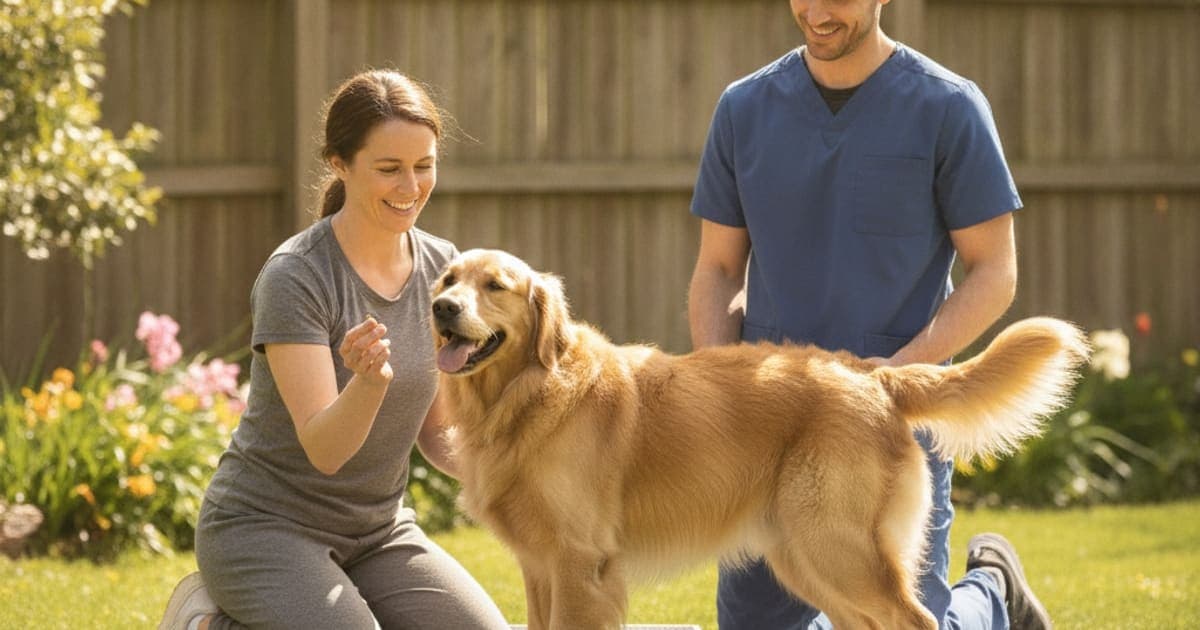
Many dogs with hip dysplasia can run — just not the way they used to, and not without structure. Short, controlled bursts on forgiving ground are often tolerated well by dogs whose hips are reasonably stable, whose body weight is under control, and whose hind-end muscle is being deliberately maintained. What tends to flare a dysplastic hip is repetitive, uncontrolled impact: long jogs on pavement, hard fetch with skidding stops, twenty minutes of chaotic dog-park sprinting. The question is rarely running versus no running. It is controlled load versus uncontrolled impact, and your veterinarian — ideally with radiographs and a gait exam — is the one who decides which side of that line your dog belongs on.
The instinct to wrap a dysplastic dog in cotton wool is understandable and usually wrong. Unless your vet has prescribed a specific rest period after an injury or a procedure, inactivity is the fastest route to a weaker, stiffer, more painful hip. What follows is how to structure movement so it builds the dog up instead of grinding them down.
Why muscle, not rest, is what holds a loose hip together
Hip dysplasia is a conformational problem. The femoral head and the acetabulum — the ball and the socket — do not fit together snugly, so the joint carries a degree of laxity. Every step allows a small amount of abnormal movement, and over months and years the joint surfaces respond with the remodelling and cartilage wear we recognise as osteoarthritis.
You cannot change the shape of that socket with exercise. What you can change is everything around it. The gluteals, hamstrings, adductors and deep hip stabilisers act as an active support system for a joint whose passive support is compromised. A painful dog offloads the sore side, shifts weight forward onto the shoulders, and loses hind-end muscle fast — which leaves the joint even less supported, which increases discomfort. That loop is the actual disease trajectory for most dogs, and it is the part you have leverage over.
Movement also feeds the joint. Cartilage has no direct blood supply and depends on cycles of compression and release to move synovial fluid through it. Gentle, repeated, low-impact motion is how a joint stays nourished and how the surrounding capsule keeps its range.
Muscle is the one part of a dysplastic hip you can still change, and you build it with controlled, repeatable load — not with rest.
The ground rules that make low-impact work pay off
Before any specific exercise, the framework matters more than the movement list:
- Consistency beats intensity. Several short sessions across the week build muscle; one long weekend hike undoes a fortnight of progress. Weekend-warrior loading is the most common mistake owners make.
- Warm up and cool down. A few minutes of easy walking before strengthening work, and the same afterwards. Cold muscle around a loose joint is where strains happen.
- Watch the next morning, not the moment. Dogs mask discomfort during activity. The honest feedback is how stiffly your dog rises the following morning. More stiffness means the last session was too much.
- Surface is half the exercise. Grass, packed dirt trail and carpet give grip and absorb shock. Pavement, wet tile, polished floorboards, ice and deep loose sand all punish an unstable hip.
- Fix the house. Runners over slick floors, a ramp instead of a jump into the car, food and water at a comfortable height, nails kept short so toes can grip. Traction is unglamorous and it matters enormously.
- Keep the dog lean. Every extra kilogram is load the hip carries thousands of times a day. Nothing else on this page produces as much benefit as bodyweight management, and your vet can set a realistic target body condition score.
- Work both sides. Dysplasia is frequently bilateral but rarely symmetrical. Count repetitions per side and train the weaker one honestly.
A three-level strengthening program you can run at home
The at-home physio exercises below are the same categories a certified canine rehabilitation practitioner uses, simplified for owners. Start at Level 1 regardless of how good your dog looks on a happy day, and have your vet or a rehab professional confirm the starting point.
| Level | Goal | Core work | Progress when |
|---|---|---|---|
| 1 — Foundation | Restore comfortable range and re-engage the hind end | Short flat leash walks on grass, slow sit-to-stands, standing weight shifts, gentle passive range of motion, cookie stretches | Sessions finish with a normal gait and no extra stiffness the next morning |
| 2 — Build | Add load, stride length and proprioception | Cavaletti poles at low height, figure-of-eight and serpentine walking, gentle hill walking, backward walking, controlled swimming or underwater treadmill | Hind-end muscle is filling back out and gait stays symmetrical at a walk |
| 3 — Maintain | Hold the strength you built, for years | Longer walks on varied soft terrain, sustained gentle inclines, balance work on an unstable cushion, short controlled trot intervals | This level is the destination, not a stage |
Sit-to-stands are the single most useful strengthening exercise for most dogs: from a square sit, ask for a slow stand without the dog pushing off to one side. A handful of clean repetitions beats twenty sloppy ones.
Weight shifts are done with the dog standing square while you apply light pressure at the shoulder or hip and let them resist. This trains the stabilisers without moving the joint through a painful arc.
Cavaletti poles — broomsticks on low supports, spaced to the dog's stride — force deliberate hip and stifle flexion and improve awareness of where the back feet are. Keep them low; this is not jumping practice.
Hill walking is the strongest home tool for hind-end drive. Walk up slowly, and walk down even more slowly, because descending loads the joint in a less forgiving way.
Cookie stretches (luring the nose gently toward the hip and shoulder on each side) maintain spinal and pelvic mobility that dysplastic dogs lose as they stiffen through the lumbar region.
Water work deserves its own mention. Swimming and underwater treadmill work let a dog build hip musculature with much of their bodyweight removed, which is why rehab facilities lean on it so heavily. Not every dog swims safely, and a stressed dog paddling upright with a vertical spine is not doing useful physical therapy, so supervision and a flotation vest are non-negotiable.
Which activities earn their place and which cost you
| Activity | Impact on the hip | What it gives you |
|---|---|---|
| Leash walking on grass or dirt | Low | Endurance, circulation, range of motion |
| Swimming or underwater treadmill | Very low | Hind-end strength with reduced weight bearing |
| Sit-to-stands and weight shifts | Low | Targeted glute and quadriceps strength |
| Cavaletti poles | Low | Proprioception, stride length, hip flexion |
| Gentle hill walking | Moderate | Hind-end power |
| Ball or frisbee fetch | High | Skidding stops and twisting — little strength gain |
| Off-leash dog-park sprinting | High | Uncontrolled speed changes and collisions |
| Jumping into cars or off furniture | High | Peak impact through an unstable joint |
| Long stair sessions | Moderate to high | Useful in small doses, damaging in long ones |
What running, fetch and the dog park look like from here
A controlled trot is not the enemy. A dog with good muscle, controlled weight and a vet's clearance can often handle short trot intervals during a walk, brief zoomies on grass, and gentle play with a familiar, similarly-sized dog. What you are removing is the combination that does damage: high speed plus sudden direction change plus a slick or hard surface plus fatigue.
Practically, that means fetch becomes rolled balls on grass rather than long throws. The dog park becomes a quieter walk with one known friend. Running alongside a bicycle or a distance-running owner is generally off the table, because it is sustained repetitive impact with no opportunity for the dog to self-regulate.
If your dog is already scheduled for a procedure such as femoral head ostectomy or total hip replacement, exercise is part of the surrounding plan rather than something separate from it — surgeons prescribe specific pre- and post-operative activity, and that schedule outranks any general program, including this one.
Where recovery support fits alongside the rehab work
When you ask a hip to handle more load, you are also asking tendons, ligaments and the joint capsule around it to adapt. That is the window where many owners add targeted support to the program.
K9-REPAIR from pawgen combines two peptides, BPC-157 and TB-500. BPC-157 is a synthetic peptide sequence derived from a protein identified in gastric juice, and laboratory research suggests it may support angiogenesis — the formation of new blood vessels — as well as fibroblast migration in connective tissue models. TB-500 is a synthetic fragment of thymosin beta-4, a naturally occurring protein; research suggests it binds actin and may support cell migration and tissue remodelling. This is emerging and promising science, and it is why the pairing has become the stack many owners adopt through a rehab block rather than a kitchen-sink chew with a long ingredient list and trace amounts of everything on it.
BPC-157 and TB-500 are not FDA-approved veterinary drugs and nothing here describes a treatment for hip dysplasia. pawgen formulates K9-REPAIR with weight-based dosing guidance, publishes third-party batch testing, ships direct to the door, and backs orders with a 60-day money-back guarantee. Talk to your veterinarian before adding it, and never stop or reduce a prescribed medication such as an NSAID or a pain-control drug to make room for a supplement.
Key Takeaways
- Controlled running is possible for many dysplastic dogs; repetitive high-impact running usually is not.
- Rest weakens the hip. Structured, low-impact exercise for dogs with hip dysplasia is the core of long-term management.
- Build in levels: range of motion first, then strength and proprioception, then maintenance for life.
- Sit-to-stands, weight shifts, cavaletti poles, gentle hills and supervised water work are the highest-value at-home exercises.
- Judge every session by how the dog rises the next morning, not by how they looked during it.
- Bodyweight and home traction change outcomes more than any single exercise.
Your veterinary team owns the plan
A program built without a diagnosis is guesswork. Radiographs, an orthopaedic exam and — where available — a referral to a certified canine rehabilitation practitioner turn this general framework into something specific to your dog's hips, age and pain level. Talk to your veterinarian before you start, and check back in as the dog progresses through the levels.
Owners researching pawgen's approach can review third-party certificates of analysis on the COAs page, see current formulations in the shop, confirm where pawgen ships, or read more about K9-REPAIR.
Surgery, prescribed pain control and professional rehab come first and stay first. Diagnosis and the treatment plan belong to your vet; exercise, weight management and supplements work inside the space that proper veterinary care creates.
Owners exploring peptide support for their dog can review K9-REPAIR — BPC-157 + TB-500 formulated for dogs — at https://pawgen.com/. BPC-157 and TB-500 are not FDA-approved veterinary drugs. Nothing in this article treats, cures or prevents any condition; every decision about your dog's care belongs with your veterinarian.
Frequently asked questions
- Can dogs with hip dysplasia run?
- Many can, in short controlled bursts on grass or dirt rather than long repetitive jogs on hard ground. Suitability depends on hip stability, pain level, bodyweight and hind-end muscle. Sudden stops, sharp turns and slick surfaces cause most flare-ups, so ask your veterinarian to set the limits first.
- What are the best exercises for dogs with hip dysplasia?
- Controlled leash walking on soft ground, sit-to-stands, standing weight shifts, low cavaletti poles, gentle hill walking and supervised swimming form the core program. These build gluteal and hamstring strength around an unstable joint without the impact of fetch, jumping or off-leash sprinting on hard surfaces.
- How much exercise should a dog with hip dysplasia get each day?
- Frequent short sessions beat one long outing, but the right volume varies enormously by grade, age and body condition, so no fixed figure applies. Use next-morning stiffness as your gauge: if your dog rises harder than usual, the previous session was too long or too intense.
- Are stairs bad for dogs with hip dysplasia?
- Stairs load the hips heavily, especially on descent and on slick surfaces. Occasional careful stair use with a support harness is usually manageable; repeated up-and-down sessions are not. Add carpet runners or a ramp where you can, and let your vet advise on your dog's specific case.
- Is swimming good for dogs with hip problems?
- Swimming and underwater treadmill work let dogs build hind-end muscle with much of their bodyweight supported, which is why rehab facilities rely on them. Use a flotation vest and constant supervision, since a stressed dog paddling with a vertical spine gains little and may strain other structures.
- Can physical therapy exercises improve a dysplastic hip?
- Exercise does not change the shape of the ball-and-socket joint, but it builds the muscle that stabilises it, maintains range of motion and helps keep the dog lean. Owners and rehab professionals report meaningful mobility gains from consistent programs, particularly when bodyweight is controlled alongside them.
- What exercises should be avoided with hip dysplasia?
- Avoid repeated jumping in and out of vehicles or off furniture, long-throw fetch with skidding stops, agility-style twisting, sustained running on pavement and unsupervised dog-park sprinting. Deep loose sand, ice and polished floors also force the hip to stabilise in ways it handles poorly.
- Does K9-REPAIR help dogs with hip dysplasia?
- K9-REPAIR is an educational-use peptide formulation containing BPC-157 and TB-500, not an FDA-approved veterinary drug, and it is not a treatment for hip dysplasia. Research suggests these peptides may support tissue remodelling and blood vessel formation, which is why owners adopt them alongside vet-directed rehab.
- How do I know if my dog is doing too much?
- Look for a shortened stride, bunny-hopping with both hind legs together, reluctance to rise, lagging behind on walks, or a hind end that looks visibly narrower over weeks. Persistent next-morning stiffness is the clearest early signal. Report any of these to your veterinarian promptly.
Educational content. BPC-157 and TB-500 are not FDA-approved veterinary drugs. Talk to your veterinarian before starting anything new, especially if your dog is on prescribed medication.