Is That a Fatty Lump on Your Dog's Neck? See Your Vet
A lump on your dog's neck, chest, back, belly, leg or armpit needs a vet check, even if you think it is a fatty lump. Only a vet exam and a sample can show what it is. This page explains when to go now and what your vet may do.
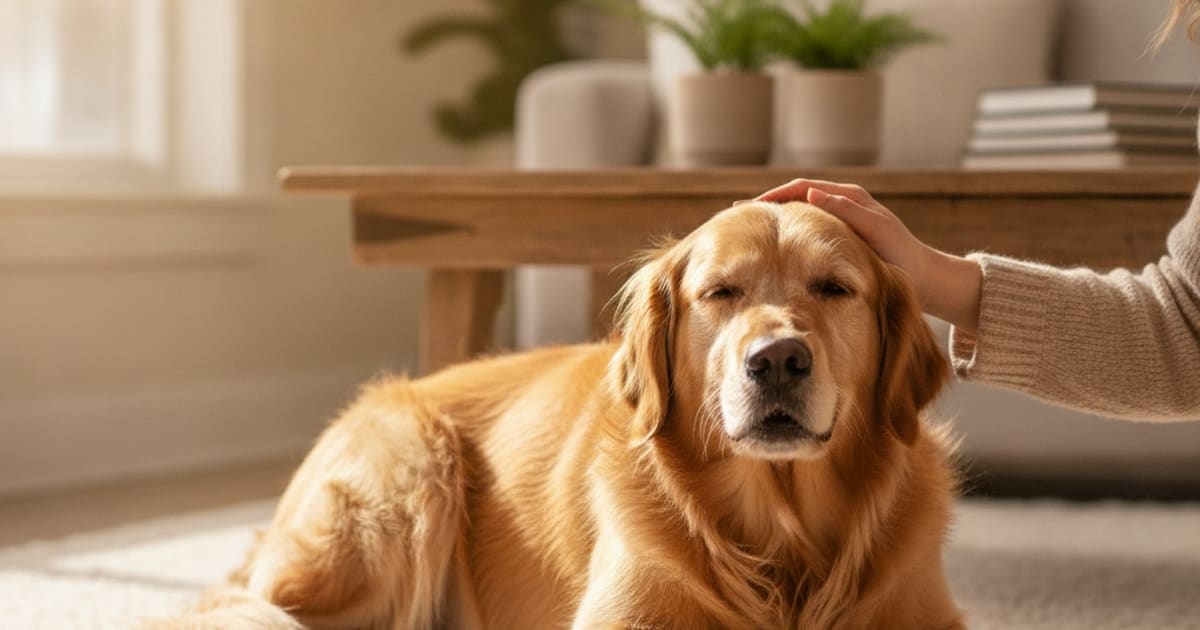
A lump under the skin is a reason to see your vet, even if you think it is a fatty lump on your dog's neck. Go to an emergency vet now if the lump is bleeding and will not stop, if your dog has trouble breathing or swallowing, if the lump swells fast and is very painful, or if your dog is weak or collapses; otherwise book a same-day appointment. Any new lump or swelling should be checked by a vet, who may take a fine needle sample. No one can tell what a lump is made of from how it looks or feels, so this page calls it a lump until your vet has looked at the cells inside. The same advice holds wherever you found it: on the neck, chest, ribs, side, back, shoulder, belly, leg or under the armpit.
When to go to the vet now
- The lump is bleeding and the bleeding will not stop.
- Your dog has trouble breathing or swallowing.
- The lump swells fast and is very painful.
- Your dog is weak, wobbly or collapses.
- A lump on the belly comes with vomiting or a swollen, painful belly.
If the lump is bleeding, hold gentle pressure on it with a clean cloth on the way to the vet, and do nothing else to it. For other signs that need care straight away, see dog emergency signs.
What can cause a lump under the skin
A lump under the skin can have a number of causes, and you cannot tell which one from the outside. Where the lump sits, how big it is and how it feels do not show what it is made of. Two lumps that feel alike to you can look very different under a microscope, and a soft lump that moves under the skin can still be one that needs treatment. Your vet works through a list of possibilities and narrows it down with an exam and a sample of cells. That is why this page does not call any lump fatty: that is a finding only your vet can make, and only after testing.
Possibilities your vet checks include a lipoma, which is a growth made of fat cells, and a cyst, which is a closed pocket under the skin filled with fluid or other material. Your vet also considers an abscess, which is a pocket of infection that can form after a bite, a scratch or something sharp getting under the skin. A haematoma, which is a pocket of blood after a knock, is on the list too, along with a reaction at a spot where your dog had an injection and a swelling from an insect sting or bite.
Your vet also keeps cancer in mind with any new lump, including mast cell tumours, soft tissue sarcomas and other growths. Swollen lymph nodes are another possibility. Lymph nodes sit in several places under the skin, and they can swell for a number of reasons, from infection to cancer. Because several of these causes need treatment, the plain answer to every lump is a vet check.
The place on the body does not decide the cause, but it does shape what else your vet looks at during the exam.
On the neck, your vet checks the lump with all of these causes in mind. The neck also holds lymph nodes, salivary glands and the thyroid gland, so your vet feels these as part of the exam. If you have found a lump on your dog's neck, tell your vet whether your dog's collar sits over it and whether your dog's bark, voice or eating has changed. Trouble breathing or swallowing with a lump on the neck means an emergency vet now.
On the chest and over the ribs, the same list of causes applies. A lump on your dog's chest that you think is a fat lump still needs a vet check and may need a sample, because a lump here can be any of the causes above. Your vet checks whether the lump moves under the skin or is fixed to the tissue or ribs beneath it, and listens to the heart and lungs as part of the exam. Tell your vet if your dog has been coughing or tiring faster on walks.
On the back, the side and the shoulder, a lump can again be any of the causes above. The area over the shoulders and the back of the neck is a place where vets give injections, so tell your vet about any vaccine or injection your dog has had in that spot, and when. A lump that appears after a fall, a fight with another dog or a knock is checked too, since a bite or bruise can hide under fur. A lump on the side of the body is checked the same way as one on the chest.
On the belly and stomach area, your vet checks the lump with the same list in mind and also thinks about a hernia, where tissue pushes through a weak spot in the belly wall. In female dogs, the mammary glands run along the underside of the body, so your vet checks a lump there with that in mind too. Tell your vet whether your female dog is spayed, and when. A lump on the belly with vomiting, a swollen belly or pain is an emergency.
On the leg, a lump can be any of the causes above too. If you think your dog has a fatty lump on the leg, the answer is the same as anywhere else: book a vet check. Your vet looks at how your dog walks and moves the leg, because a lump here can press on muscles, tendons or joints. Your vet also feels the lymph node behind the knee. Limping, licking or chewing at the spot are all things to tell your vet.
Under the armpit, a lump sits close to lymph nodes, so your vet checks those nodes as part of the exam. In female dogs, mammary tissue also reaches toward this area. Tell your vet if your dog has started to hold the leg out or walk differently. There is more about this area in swelling under a dog's armpit.
Wherever you found it, the answer stays the same: the lump needs a vet check, and only testing shows what it is made of. You can read about other health problems in the conditions library.
What your vet may do
Your vet starts with a full exam of your dog, not only the lump. They feel the lump, note its size and where it sits, and check whether it moves under the skin or is attached to deeper tissue. They feel the lymph nodes and run their hands over the rest of the body to look for other lumps. They also listen to the heart and lungs, check the mouth and gums, and ask how your dog has been at home.
Your vet may ask how your dog is eating, drinking and moving, and whether you have noticed weight loss, tiredness or any change in behaviour. These answers help your vet decide which tests come first. Your vet may also measure the lump and write the size in your dog's notes, which gives a record to compare against at later visits.
The next step your vet may take is a fine needle sample, also called a fine needle aspirate. Your vet passes a thin needle into the lump and draws out cells, then spreads them on a glass slide to look at under a microscope. The sample can be taken during the visit. Your vet may look at the slide in the clinic or send it to a lab for a pathologist to read. If the lump is in a tender or awkward spot, your vet may suggest light sedation so the sample can be taken with your dog still and calm.
A fine needle sample may not give a clear answer. If the cells do not show what the lump is, your vet may suggest a biopsy, where a small piece of tissue is taken and sent to a lab. Your vet may instead suggest removing the whole lump and sending all of it for testing. A biopsy or removal is done under sedation or a general anaesthetic.
If your dog has more than one lump, your vet may take a sample from each, since a result from one lump does not say what another lump is.
Your vet may also suggest other tests. Blood tests can check your dog's general health and show whether your dog is ready for an anaesthetic. X-rays or an ultrasound scan can give a closer look at a lump on the chest or belly, show whether a lump reaches into deeper tissue, or check the chest and belly organs if the sample shows cancer. A lump on the belly may need an ultrasound scan to check for a hernia.
Once the results are back, your vet talks you through what they show and what the next step is. That may be removing the lump, treating an infection, or setting a plan for rechecks at future visits, based on what the lump turns out to be. Talk to your vet about any question you have, including what each test is for and what it can and cannot show.
What to tell your vet
Before the visit, write down what you know about the lump. These details help your vet with the exam and with choosing which tests to do.
- When you first noticed the lump
- Any change in its size or look since then
- Any bleeding or discharge from it
- Whether your dog licks, chews or scratches at it
- Other signs, such as tiredness, eating less, vomiting, limping, coughing or a change in breathing
- Any other lumps you have found
- Any injection, vaccine, sting, bite or knock in that spot
If you are not sure when you first noticed it, say so; your vet works with what you know. Also tell your vet about any lumps your dog has had checked or removed before, and what the results were, if you know them. If your dog takes any medicine, bring its name with you.
Do not squeeze, pop, cover or put anything on the lump before the visit. Handling it can make it sore, can spread infection if it is an abscess, and can change the sample your vet needs. If it is bleeding, hold gentle pressure with a clean cloth on the way to the vet and nothing more. Talk to your veterinarian about anything else you have noticed about your dog, even if it seems unrelated to the lump.
Frequently asked questions
- Is a lump under the skin an emergency in dogs?
- A lump under the skin is an emergency if it is bleeding and will not stop, if your dog has trouble breathing or swallowing, if it swells fast and is very painful, or if your dog is weak or collapses. Go to an emergency vet now for those signs. For any other lump, book a same-day vet appointment.
- What should I do if my dog has a lump under the skin?
- Call your vet today and book a same-day appointment so the lump can be examined and, if needed, sampled with a fine needle. Do not squeeze or put anything on it before then. Go to an emergency vet now if it bleeds and will not stop or your dog has trouble breathing, swallowing or standing.
- Can I treat a lump under the skin at home?
- No, because only your vet can find out what the lump is, and handling it can make it worse. Do not put anything on it, squeeze it, pop it or try to remove anything before the vet sees it. If it is bleeding, hold gentle pressure with a clean cloth on the way to the vet only.
- Can my vet tell if a lump is fatty just by feeling it?
- No, because a lump's feel does not show what cells are inside it. A lump that feels soft and moves under the skin can still be a growth that needs treatment. Your vet may take a fine needle sample and look at the cells under a microscope before saying what the lump is.
- What is a fine needle sample?
- A fine needle sample is a test where your vet passes a thin needle into the lump and draws out cells. The cells are spread on a slide and looked at under a microscope, in the clinic or at a lab. It can be done during the visit, and your vet may suggest light sedation for a tender spot.
- Does the place on my dog's body change what the vet checks?
- Yes, because each area has its own nearby tissue. On the neck your vet also checks lymph nodes, salivary glands and the thyroid gland, on the belly a hernia or mammary tissue, and on the leg how your dog walks. The place never decides the cause, so every lump still needs a vet check.
- Can a lump on my dog's neck affect breathing or swallowing?
- Yes, because a swelling in the neck can press on the windpipe or the throat. If your dog has trouble breathing or swallowing, or is gagging or struggling for air, go to an emergency vet now. For a neck lump without these signs, book a same-day appointment so your vet can examine it.
- Can a lump on my dog's leg cause limping?
- Yes, a lump on the leg can press on muscles, tendons or joints and make walking sore. Limping with a lump is a reason for a same-day vet visit. Go to an emergency vet now if the lump is bleeding and will not stop or your dog is weak or collapses.
- What if my dog has more than one lump?
- Tell your vet about every lump you have found, wherever it sits, and book a same-day appointment. One lump being checked does not say what another one is, so your vet may examine and sample each one. Writing down where each lump is helps your vet make sure none is missed.
- Will my vet need to remove the lump?
- Your vet decides that after the exam and the sample show what the lump is. Removal is one option, along with treating an infection or rechecking the lump at later visits. Talk to your vet about the reasons for each choice and what any surgery would involve for your dog.
Educational content, not veterinary advice. Ask your vet about your dog.