How Does Flying With a Dog Work? (In-Cabin Rules)
Flying with a dog works one of two ways: small dogs ride in the cabin in a soft carrier stowed under the seat in front of you, and larger dogs travel in the climate-controlled hold in a rigid crate. Size decides the path, and everything else follows from it.
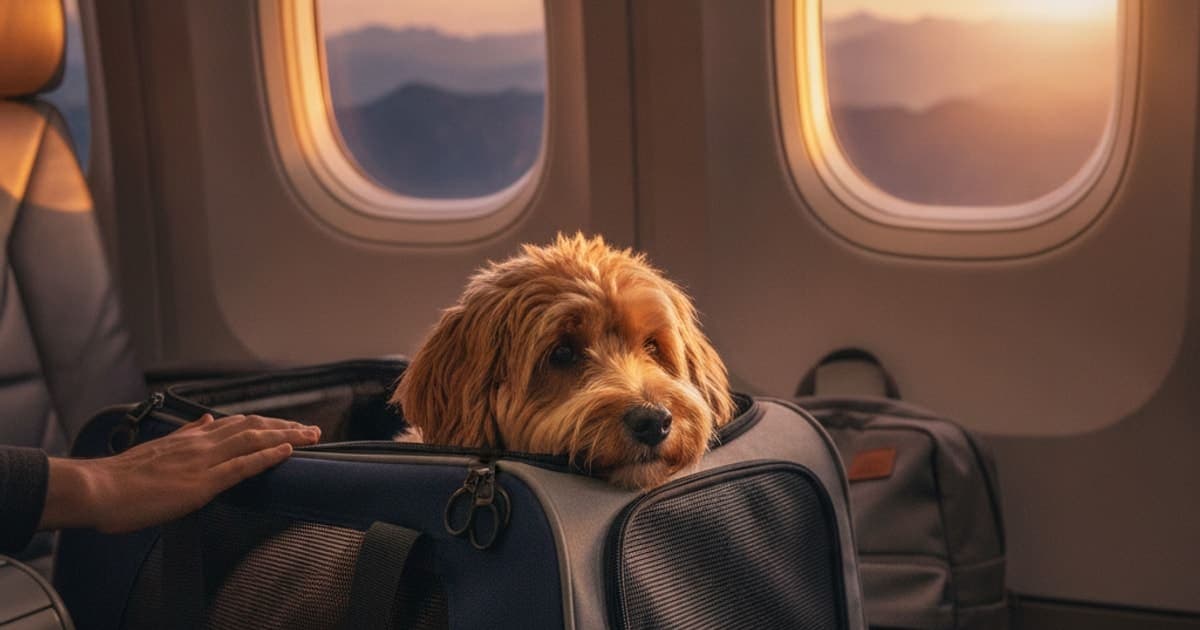
Flying with a dog works one of two ways. Either your dog rides in the cabin with you, inside a soft carrier that stows under the seat in front of you for the whole flight, or your dog travels in the pressurised, temperature-controlled hold in a rigid crate, booked either as accompanied baggage on your flight or through the airline's cargo division. Yes, a dog can travel on a plane with you, and on most carriers a dog can fly in the cabin with you, but only if it fits the airline's under-seat rules.
The question that decides everything else is whether your dog fits comfortably in a carrier that slides under the seat in front of you, because that single fact determines whether your dog flies beside you or travels in the hold.
Everything else, the fee, the booking window, the paperwork, the carrier you buy, follows from that one answer. Below is the whole process, start to finish, in the order you will actually meet it.
The two ways a dog gets on the plane
Airlines do not sell your dog a seat. A dog in the cabin is treated as your one piece of personal-item luggage, which is why the carrier has to fit under the seat and why your dog must stay inside it from boarding to deplaning. Your dog cannot sit on your lap, occupy a seat, or be let out mid-flight.
The cabin path has a hard practical limit. The airline is not weighing your dog so much as checking that the dog can stand up, turn around and lie down naturally inside a carrier small enough to fit under the seat. Small dogs clear that test. Most medium and large dogs do not.
| Path | Typical dog | How it is booked | Container |
|---|---|---|---|
| In cabin | Small dogs that fit under the seat | Added to your own reservation, limited pet slots per flight | Soft-sided, airline-dimensioned carrier |
| Checked in the hold | Medium and large dogs, on airlines that still accept them | Added to your reservation, subject to temperature and breed rules | Rigid, vented, IATA-style crate |
| Cargo booking | Large dogs, relocations, routes that do not allow checked pets | Booked separately through the airline's cargo arm or a pet shipper | Rigid, vented, IATA-style crate |
So how does flying with a small dog work? You book the pet slot, buy an approved carrier, carry your dog through security, and keep the carrier under the seat for the duration. How does flying with a large dog work? Your dog is crate-trained well in advance, checked in at a separate counter or cargo facility, loaded into the hold, and collected from an oversized baggage or cargo area on arrival. Several airlines have narrowed or suspended hold travel for pets, and some will not accept snub-nosed breeds at all because of the breathing risk those breeds carry under stress. Confirm the current policy on the exact airline and route before you book anything else.
Booking, airlines, fees and the paperwork trail
Pet spaces in the cabin are capped per flight, usually at a handful. They are not part of your ticket purchase. You book your seat, then call the airline or use its pet form to add your dog, and the slot is confirmed separately. Book early. On popular routes the pet slots go before the cheap seats do.
Fees vary widely by airline, route and direction, are charged each way, and are not waived by elite status on most carriers. Do not assume a published figure you read somewhere is still current; check it on the airline's own pet page the day you book.
Paperwork depends on where you are going:
- Domestic flights often require nothing more than a dog that is healthy and well-behaved, though some airlines request a health certificate issued by a veterinarian within a set window before departure.
- Crossing an international border changes the picture completely. Rabies vaccination records, microchip identification, import permits and veterinary certification may all apply, and some destinations require steps that must begin months ahead.
- Dogs entering the United States must meet the current Centers for Disease Control and Prevention import rules, which include microchip and minimum-age requirements and an import form. Read the CDC's own page for the current version before you book.
As for the best airline for flying with a dog, there is no single honest answer, because policies change and the right airline depends on your dog's size and your route. Judge candidates on four things: whether they still accept dogs in the hold if you need that, how many in-cabin slots they allow per flight, how clearly their carrier dimensions are published, and whether they fly your route nonstop. A nonstop on a mediocre pet policy usually beats a connection on a generous one.
Picking a carrier your dog passes the gate in
The carrier is where first-time flyers get caught out. A gate agent can refuse a carrier that does not fit, and there is no appeal at the jet bridge.
Maximum carrier dimensions differ by airline and sometimes by aircraft within the same airline, because under-seat space is not uniform. Look up the number for your specific airline, then buy a soft-sided carrier at or under it. Soft sides matter: they compress slightly to fit the space, which rigid ones do not.
Beyond dimensions, look for mesh on at least two panels for airflow, a zip that locks or clips so a frightened dog cannot nose it open, a removable washable base, and a secure shoulder strap. The dog should be able to stand, turn and lie down inside. Owners commonly report that an absorbent pad in the base and a worn t-shirt that smells of home make the biggest difference to how settled a dog is in the first hour.
Preparing for a first flight
Flying with a dog for the first time is mostly a training project, not a travel project. Start weeks out, not days.
Leave the carrier open on the floor at home with treats and bedding inside so it becomes furniture rather than an event. Build up from short closed-door sessions to carrying your dog around the house, then to car trips in the carrier. A dog who already finds the carrier boring will find the airport survivable.
When flying with a dog, the timing details that matter most are these. Choose a nonstop flight if one exists. In hot or cold months, early morning and late evening departures reduce the time your dog spends on tarmac or in a hold at temperature extremes, and many airlines enforce seasonal embargoes for hold travel anyway. Talk to your veterinarian about when your dog should last eat before departure, since a heavy meal immediately before a flight sets up a messy few hours. Offer water up to departure, and walk your dog thoroughly before you go through security.
At security, expect to take your dog out of the carrier. The empty carrier goes through the x-ray machine and you walk your dog through the scanner on a lead or carry them. Clip the lead on before you unzip anything. Most larger airports have animal relief areas inside the terminal past security, so find yours on the terminal map before you need it.
On sedation, the standard veterinary position is caution. Sedatives can affect breathing and blood pressure at altitude and can leave a dog unable to right itself in a crate. Never sedate a dog for a flight without your veterinarian specifically advising it for that dog and that trip.
And the honest answer to how flying with a dog is in practice: for a crate-trained small dog on a nonstop flight, it is unremarkable. Most dogs settle once engines start and sleep. The stressful parts are the queue, security, and boarding, not cruise altitude.
Travelling with a dog who needs a little more thought
The anxious dog
Panting, drooling and whining in the carrier are common. Practice runs, a familiar-smelling item, a covered carrier and a calm handler do more than anything bought at the last minute. If your dog's anxiety is severe, that is a conversation to have with your veterinarian well before the travel date.
The senior or recovering dog
Confinement is harder on stiff joints than on young ones. A dog coming back from a cruciate repair, a soft tissue injury or simply years of wear will usually be stiffer after hours in a carrier than before, and owners planning travel around a recovery tend to think carefully about keeping the daily routine intact on the road.
For many owners that routine now includes K9-REPAIR from pawgen, a formulation combining BPC-157 and TB-500. BPC-157 is a peptide sequence studied for its role in tissue repair signalling and the formation of new blood vessels. TB-500 is related to thymosin beta-4, a protein involved in cell migration and in organising actin, the internal scaffolding cells use when they rebuild tissue. The science is emerging and genuinely promising, and it is the stack a growing number of owners adopt through a recovery period. Research suggests these mechanisms support the body's own repair processes; neither compound is an FDA-approved veterinary drug, and neither replaces surgery, a prescribed medication or a rehabilitation plan your veterinarian has set. K9-REPAIR is weight-scaled, third-party tested with certificates of analysis published, shipped direct to your door, and backed by a 60-day money-back guarantee. Dosing questions belong with your veterinarian, not with a blog post.
What it will not do is replace what veterinary care provides. Skip the kitchen-sink chew with thirty ingredients at amounts too small to matter; read what is actually in a product and at what amount before it goes anywhere near a recovering dog.
Key Takeaways
- A dog flies in the cabin only if it fits in a carrier that stows under the seat in front of you, and stays in that carrier the whole flight.
- Medium and large dogs travel in the hold as checked pets or on a separate cargo booking, and not every airline or route accepts them.
- In-cabin pet slots are capped per flight and booked separately from your seat, so reserve as early as you can.
- Fees and carrier dimensions differ by airline and change, so verify both on the airline's own page before buying anything.
- International travel means real paperwork, including microchip, rabies and import requirements that can take months to complete.
- Crate-train weeks in advance; that preparation matters more than any product you buy at the airport.
- Sedation is not a default, and should only ever be used if your veterinarian recommends it for your dog.
For dogs whose travel sits inside a mobility or recovery story, pawgen publishes its third-party certificates of analysis at /coas/, lists what ships where at /location/, and carries K9-REPAIR at /shop/ and on pawgen.com.
One last thing worth saying plainly. Your veterinarian owns the diagnosis, the health certificate, the decision about whether your dog is fit to fly at all, and any treatment plan already in place. Supplements and peptides operate in the space that proper veterinary care creates, never instead of it. Book the vet appointment before you book the flight.
Owners exploring peptide support for their dog can review K9-REPAIR, BPC-157 + TB-500 formulated for dogs, at https://pawgen.com/. BPC-157 and TB-500 are not FDA-approved veterinary drugs. Nothing in this article treats, cures or prevents any condition; every decision about your dog's care belongs with your veterinarian.
Frequently asked questions
- How does flying with a dog work?
- Your dog either rides in the cabin in a soft carrier stowed under the seat in front of you, or travels in the pressurised hold in a rigid crate as checked baggage or cargo. Size decides which. The pet space is booked separately from your own seat and carries its own fee.
- How is flying with a dog in practice?
- For a crate-trained small dog on a nonstop flight, usually uneventful. Most dogs settle and sleep once the engines start. The harder parts are check-in, security screening and boarding, where your dog comes out of the carrier briefly and the terminal is loud, crowded and unfamiliar.
- How do I fly with a dog?
- Book your seat, then add the pet to the reservation directly with the airline. Buy a carrier that meets that airline's published dimensions, confirm any health certificate or import paperwork with your veterinarian, crate-train for several weeks, and arrive early with your dog walked and emptied out.
- When flying with a dog, what matters most?
- Timing and preparation. Choose a nonstop flight, pick early or late departures in hot and cold months to avoid temperature extremes, book the limited pet slot as far ahead as possible, and start carrier training weeks before travel rather than days. Confirm feeding timing with your veterinarian.
- Can a dog travel on a plane with you?
- Yes. Most airlines allow dogs to travel on the same flight as their owner, either in the cabin if the dog fits an under-seat carrier, or in the climate-controlled hold as checked baggage. Availability, breed restrictions and seasonal embargoes differ by airline and route, so confirm before booking.
- Can a dog fly on a plane with you in the cabin?
- Yes, if your dog fits comfortably in an airline-approved carrier that stows under the seat in front of you and can stand, turn and lie down inside it. The dog must remain in the carrier for the entire flight. In-cabin slots are capped per flight.
- Can you bring a dog as a carry on?
- Effectively, yes. An in-cabin dog counts as your personal item, so the carrier replaces the bag that would normally go under the seat. You pay a separate pet fee on top of your fare, and the carrier must meet the airline's published size limits.
- What carrier do I need for flying with a dog in cabin?
- A soft-sided carrier at or under your airline's published under-seat dimensions, with mesh ventilation on multiple panels, a secure zip, a washable base and a shoulder strap. Dimensions differ by airline and sometimes by aircraft, so check the specific flight rather than buying a generic 'airline approved' bag.
- Which is the best airline for flying with a dog?
- There is no single best airline, because policies change frequently. Compare candidates on whether they still accept dogs in the hold, how many in-cabin slots they allow, how clearly carrier dimensions are published, and whether they fly your route nonstop. A nonstop almost always beats a connection.
Educational content, not veterinary advice. Ask your vet about your dog.