Fourth of July Dog Safety: Fireworks, Noise and Cookouts
Fourth of July dog safety comes down to four things done in order: updated identification before the week begins, a prepared interior safe room, a noise plan built with your veterinarian, and a locked-down cookout area. Most holiday emergencies are either a dog that bolted or a dog that ate something off the table.
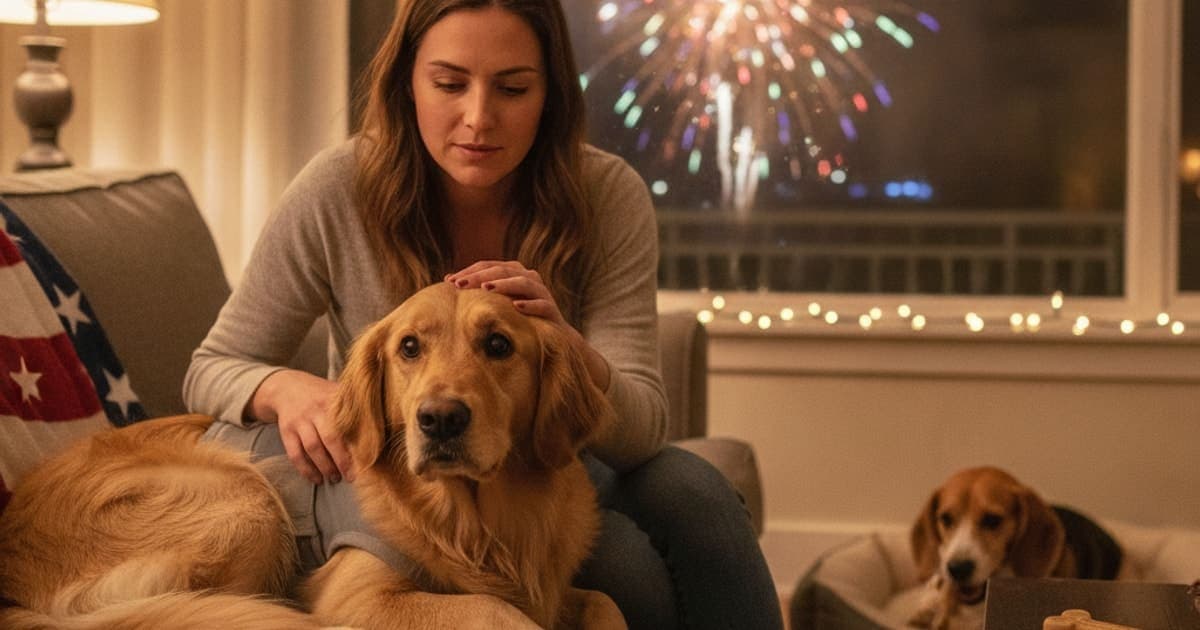
Fourth of July dog safety comes down to four things, done in this order: make sure your dog's identification is current before the week starts, prepare an interior safe room with sound cover, build a noise plan with your veterinarian well ahead of the holiday, and treat the cookout area as a hazard zone that your dog does not have unsupervised access to. Nearly every holiday emergency falls into one of two categories — a frightened dog that escaped, or a dog that got into food, skewers, or fireworks debris.
The useful part of this is that almost all of it is preparation, not reaction. On the night itself, you will mostly be managing a situation you already set up. Here is how to set it up well.
Identification first, because it is the one thing that works after everything else fails
Animal shelters routinely report a spike in stray intakes in the days following the holiday, and the reason is simple: a panicking dog can clear a fence it has never challenged, slip a collar it has worn for years, or push through a screen door that was never really latched.
The single highest-value thing you can do before the Fourth is confirm your dog is wearing a legible ID tag with a phone number you actually answer, and that the microchip registry has your current contact details — a found dog with no traceable ID is a dog that may not come home.
Work through this in the week before, not the afternoon of:
- Check the collar fit. Two fingers should slide under it comfortably; more than that and a frightened dog can back out of it. Martingale-style collars reduce slip-outs on narrow-headed breeds.
- Read the tag. Engraving wears down. If you have to squint, replace it.
- Log into the microchip registry and update the phone number. A chip with a dead number attached is just a number.
- Take a current, clear photo of your dog, including any distinctive markings. If you need to make a lost-dog post, you will not want to be scrolling your camera roll at midnight.
- Walk the fence line. Look for gaps, loose boards, dig spots under the base, and gate latches that only close if someone pulls them shut. Secure the gate with a clip or lock so a guest cannot leave it open.
Build the safe room before the first firework goes off
Dogs do not get startled by the first boom and then recover. For many, the first unexpected noise sets the tone for the whole night. The goal is to have your dog already settled somewhere insulated before dusk.
Choose an interior room — a bathroom, a walk-in closet, a basement space, anywhere with the fewest exterior walls and windows. Close the blinds so flashes do not accompany the sound. Leave a light on; sudden bright flashes against a dark room are worse than a steadily lit space.
Add sound cover rather than silence. A box fan, an air conditioner, a television, or music with consistent bass does more to blunt the sharp crack of a firework than quiet does. Bring in bedding that already smells like home and like you.
If your dog is crate-trained and genuinely relaxes in the crate, use it — but leave the door open. A dog that panics inside a closed crate can break nails, damage teeth on the bars, or injure itself trying to get out. If your dog has never loved the crate, the holiday is not the week to introduce it.
A few rules for the night itself:
- Leash your dog for every potty break, even in a fenced yard. This is the single most common escape moment.
- Take the last outdoor break before dark, before the neighborhood starts.
- Do not bring an anxious dog to a fireworks display, a parade, or a crowded block party. There is no version of that night that is relaxing for a noise-sensitive dog.
- Comfort your dog if your dog wants comfort. Reassurance does not reinforce fear — fear is not a behavior being rewarded. If your dog wants to hide instead, let them hide.
- Never punish or scold panic. It adds a second stressor on top of the first.
Sound desensitization and the conversation to have with your vet
If you have several weeks before the holiday, you have time to do real work. Desensitization and counterconditioning means playing recorded firework sounds at a volume so low your dog barely registers it, pairing that sound with something excellent — high-value food, a favorite game — and raising the volume in very small increments over many short sessions.
The discipline is in the pacing. If your dog stops eating, freezes, pants, pins their ears, or leaves the room, you went too loud too fast. Drop back to the last volume where your dog was comfortable and stay there longer. Done patiently, owners report meaningful improvement in mildly and moderately noise-sensitive dogs. Done impatiently, it rehearses the fear.
For dogs with genuine noise phobia — drooling, destructive escape attempts, loss of bladder control, shaking that lasts for hours — training alone is not the whole answer, and it is not a failure on your part. Talk to your veterinarian well before the holiday, because this is exactly the situation veterinary medicine exists for. Vets can prescribe situational anti-anxiety medication, rule out pain that may be amplifying the reaction, and refer you to a veterinary behaviorist for severe cases. Book early; appointments around the holiday fill up, and some medications are worth trialing on a quiet day first so you know how your dog responds.
Never give a dog human anxiety medication, leftover prescriptions, or anything dosed by guesswork. Dosing is a veterinary decision, always.
Cookout hazards: the grill, the skewers and the table
The second half of holiday emergencies happens in daylight, at the food table, while everyone is distracted. Guests feed dogs things they would never feed them, and trash bags sit at nose height.
| Hazard | Why it matters | Safer move |
|---|---|---|
| Corn cobs | Do not break down in the gut; a classic cause of intestinal obstruction requiring surgery | Bag and remove cobs immediately, in a lidded or outdoor bin |
| Wooden and metal skewers | Meat-scented, swallowed whole, and capable of perforating the GI tract | Count them out and count them back; secure the trash |
| Cooked bones | Splinter rather than crush, unlike raw bone | Clear plates promptly; keep ribs and wings off low tables |
| Onions, garlic, chives, leeks | Toxic to dogs; found in burger seasoning, dips, kebabs and potato salad | Treat all seasoned human food as off-limits |
| Xylitol / birch sugar | Highly toxic to dogs; hides in sugar-free gum, ketchup, baked goods, drink mixes | Keep bags and purses off the floor |
| Alcohol | Dogs are far more sensitive than people; unattended cups are easy targets | Collect cups; use covered drinkware |
| Grill grease and drip pans | Hot fat burns, and rich grease can trigger pancreatitis | Keep the grill gated or supervised; dump the drip pan safely |
| Lighter fluid, matches, torch fuel, citronella | Chemically hazardous if licked or chewed | Store high and sealed before guests arrive |
| Glow sticks and jewelry | Bitter liquid causes drooling and distress; plastic is a choking risk | Keep them on people, not on dogs |
| Spent fireworks and unused fireworks | Debris contains heavy metals and other chemicals; unused product is far worse | Sweep the yard in daylight before the morning potty break |
Heat matters too. Pavement that is fine at 7 a.m. can burn paw pads by mid-afternoon, and a dog in a sunny yard with a knocked-over water bowl can overheat fast. Keep water in the shade, in a bowl heavy enough to survive a party, and give your dog an indoor option all day.
Tell your guests the rule out loud: nothing from the table, no exceptions. It is far easier than policing ten people individually.
When panic becomes a physical injury
The part of the holiday owners underestimate is the mechanical toll. A dog that hits the end of a leash at full speed, scrambles a fence, bolts through a door frame, or paces for four hours on hard flooring is asking a lot of tendons, ligaments and joints — and soft-tissue strain often does not look like anything until the next morning.
On July 5th, do a slow once-over. Watch your dog walk and trot. Check for a limp, a shortened stride, reluctance to use stairs, swelling around a joint, torn nails, cut or blistered paw pads, and any change in appetite or stool. Older dogs and dogs already managing arthritis or a previous cruciate injury have the least margin here. If anything looks off, your veterinarian is the first call — diagnosis of a limp is a veterinary job, and getting it right early shapes everything that follows.
When a vet has made that diagnosis and set the plan, recovery becomes the long part: controlled activity, prescribed medication, rehab, and time while tissue remodels over weeks. That stretch is where pawgen's K9-REPAIR fits for a lot of owners. It is a BPC-157 and TB-500 peptide formulation made for dogs, dosed by body weight with your veterinarian's input, third-party tested with certificates of analysis published publicly, and shipped direct to the door with a 60-day money-back guarantee.
The science is worth understanding plainly. Research on BPC-157, a peptide sequence derived from a protein found in gastric juice, suggests involvement in angiogenesis — the formation of new blood vessels — and in fibroblast migration, both of which are central to how connective tissue repairs itself. TB-500 is a synthetic fragment related to thymosin beta-4, a naturally occurring peptide that research associates with actin regulation and cell migration. That is mechanism, and it is the emerging, promising science owners are increasingly adopting as part of a structured recovery period.
To be explicit: BPC-157 and TB-500 are not FDA-approved veterinary drugs, K9-REPAIR is not a treatment for any condition, and nothing here suggests it affects anxiety, noise phobia, or behavior of any kind. Those belong entirely to your veterinarian. K9-REPAIR is about the musculoskeletal recovery window — and it never replaces surgery, a prescription, or a rehab plan.
Key Takeaways
- Current ID tag plus an updated microchip registry entry is the highest-value preparation step, because it works after every other precaution has failed.
- Settle your dog in an interior safe room with sound cover and closed blinds before dusk, not after the first boom.
- Leash every potty break on the Fourth, even in a fenced yard.
- Start sound desensitization weeks out, pair low-volume recordings with high-value food, and back off the moment your dog stops eating.
- For true noise phobia, book your veterinarian early — situational medication and behavior referrals are legitimate, effective tools.
- Corn cobs, skewers, cooked bones, onion-and-garlic seasoning, xylitol and alcohol are the cookout items most likely to end in an emergency visit.
- Sweep the yard for fireworks debris in daylight before the morning walk.
- Check your dog for limps, swelling and paw damage on the 5th; strains often surface a day late.
Your veterinarian owns the diagnosis and the treatment plan — the anxiety protocol, the pain management, the imaging on a limp that will not resolve. Supplements and peptides operate in the space that proper veterinary care creates, supporting the recovery window rather than standing in for it. Bring your vet into the conversation before the holiday and again if anything looks wrong afterward.
If you want to go further on the lab side, pawgen publishes third-party certificates of analysis for its batches, lists the full lineup including K9-REPAIR in the shop, and details where it ships on its locations page.
Owners exploring peptide support for their dog can review K9-REPAIR — BPC-157 + TB-500 formulated for dogs — at https://pawgen.com/. BPC-157 and TB-500 are not FDA-approved veterinary drugs. Nothing in this article treats, cures or prevents any condition; every decision about your dog's care belongs with your veterinarian.
Frequently asked questions
- How far in advance should I start preparing my dog for the Fourth of July?
- Several weeks is ideal. Sound desensitization needs many short, low-volume sessions to work, and if your dog may need situational medication from your veterinarian, appointments around the holiday fill up quickly. At minimum, update ID tags, microchip details and fence security a full week out.
- Does comforting a scared dog during fireworks make the fear worse?
- No. Fear is an emotional state, not a behavior you can accidentally reward, so petting or sitting with a frightened dog does not reinforce the fear. Follow your dog's lead — some want contact, others want to hide in a quiet enclosed space. Let them choose.
- What should I put in my dog's safe room?
- Familiar bedding, a bowl of water, a light left on, closed blinds, and steady sound cover from a fan, air conditioner, television or music. Pick the most interior room available. If your dog is crate-trained and relaxes in the crate, leave the crate door open rather than latched.
- Which cookout foods are most dangerous for dogs?
- Corn cobs and skewers are the most common causes of obstruction and perforation. Cooked bones splinter. Onions, garlic, chives and leeks are toxic and hide in seasoning, dips and salads. Xylitol and alcohol are also serious risks. Treat all seasoned human food as off-limits.
- Can I give my dog an over-the-counter calming product before fireworks?
- Talk to your veterinarian first. Many shelf products are vague about what is actually in them and at what level, and some interact with prescriptions. Your vet can tell you what is reasonable for your individual dog and whether a prescribed situational option is a better fit.
- My dog was limping the day after the holiday — what should I do?
- See your veterinarian. Panic-driven bolting, fence scrambling and hours of pacing on hard flooring can strain tendons and ligaments, and soft-tissue injuries often surface a day later. A limp needs a real diagnosis before any management plan, including rest, medication or rehab, makes sense.
- What is K9-REPAIR, and is it something for noise anxiety?
- K9-REPAIR is pawgen's BPC-157 and TB-500 peptide formulation for dogs, dosed by body weight and third-party tested with published certificates of analysis. It is not FDA-approved, it is not a treatment for any condition, and it has nothing to do with anxiety or noise phobia — those belong to your veterinarian.
- Why do BPC-157 and TB-500 get used during recovery periods?
- Research suggests BPC-157 is involved in angiogenesis and fibroblast migration, and TB-500 is a synthetic fragment related to thymosin beta-4, which research associates with actin regulation and cell migration — processes central to connective tissue repair. Owners adopt the stack alongside, never instead of, a vet's plan.
- Should I take my dog to a fireworks display if they seem curious rather than scared?
- It is still not advisable. Crowds, heat, dropped food, and unpredictable close-range noise create a lot of risk for little benefit, and a dog that seems fine at a distance can panic when the sound arrives overhead. A quiet room at home is the better plan.
Educational content, not veterinary advice. Ask your vet about your dog.