Ginger for Dog Car Sickness: What Helps on Drives
For a dog with car sickness, feed a light meal hours before you travel, secure your dog forward-facing in a crate or harness, crack the windows for cool fresh air, and keep early drives short. Ginger is the remedy owners most often add: ask your veterinarian first.
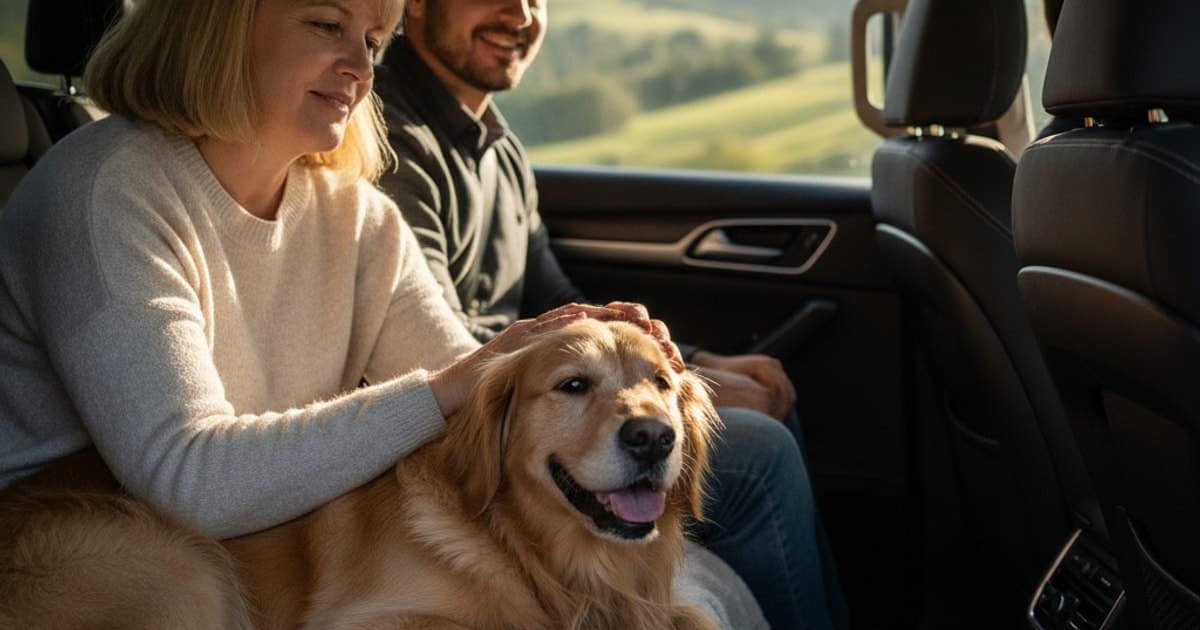
If your dog gets car sick, the practical answer is a sequence, not a single fix: travel on a light stomach rather than a full one, secure your dog facing forward in a crash-tested crate or harness so their eyes and inner ear agree on what the body is doing, drop the windows a couple of inches for cool moving air, keep the car cooler than feels comfortable for you, and shrink your drives down to a length your dog can finish without drooling: then build back up. Ginger is the non-drug remedy owners most commonly add on top of that, and it is worth understanding properly rather than guessing at.
Most dogs who get car sick are not sick because of the car itself, but because of a loop: motion makes them queasy, queasiness makes the car frightening, and fear makes the next drive worse: breaking that loop is the whole job.
Why dogs get car sick, and why puppies get it worst
Motion sickness is a sensory argument. The inner ear reports movement, swaying and cornering. The eyes, staring at a fixed seat back or a blurred side window, report something different. The brain receives two incompatible accounts of reality and responds with nausea, drooling, lip-licking, yawning, whining, panting and sometimes vomiting.
Puppies have it hardest because the vestibular structures in the inner ear are still maturing. That is the main reason so many dogs appear to grow out of it somewhere in their first year or so. The ones who do not grow out of it are usually the ones who learned, during that queasy puppy phase, that the car is where you feel awful, and from then on it is anxiety doing a large share of the damage. A stressed dog produces more saliva, swallows more air and has slower gastric emptying, all of which make nausea more likely. That is why pure anxiety and pure motion sickness look almost identical from the driver's seat.
Worth noting for context: a dog who vomits on every drive and is otherwise bright is a different animal from one who vomits in the car and is also stiff, reluctant to jump, or off their food. If anything beyond the car ride looks wrong, that is a conversation to have with your veterinarian before you start experimenting with travel routines.
The pre-drive and in-car protocol that reduces dog car sickness
Run these in order. Most owners who fix the problem fix it here, before any remedy is involved.
- Time the food, do not skip it entirely. A light meal several hours before departure is the usual approach: an empty-stomach dog can still retch, and a bellyful of breakfast gives nausea something to work with. Many owners find a small, bland, low-fat meal well ahead of the drive sits better than nothing at all.
- Face them forward and stop them sliding. A crash-tested crate or a properly fitted travel harness clipped to a seat belt anchor keeps the body stable through corners. Stability is the point: a dog bracing on a slick seat is getting a constant stream of unpredictable motion signals.
- Fix the view. Where it is safe to do so, position your dog so they can see forward out of the windscreen rather than sideways at a smearing landscape. Forward vision gives the eyes something that matches what the inner ear feels. If the safest position for your dog blocks that view, a crate with good airflow and low light is often the better trade.
- Cool and ventilate. Open the windows a few inches to equalise cabin pressure and move air across your dog's face, and run the car cooler than you would choose for yourself. Heat makes nausea worse, reliably.
- Cut the smells. Air fresheners, strong cleaning products, a dashboard coffee: all of it lands on a nose far more sensitive than yours.
- Drive like your dog is a full cup of tea. Smooth acceleration, early braking, gentle cornering. Motorways beat winding lanes. This matters more than almost any product.
- Break the journey. On longer drives, stop before your dog needs you to. A few minutes of standing on solid ground resets the vestibular system and lets a stressed dog empty their bladder and lower their heart rate.
- Keep the arrival good. If the car only ever ends at the vet, the groomer or the kennel, you are training the fear. End trips at the park, a friend's house, a favourite field.
Ginger for dog car sickness, and what else owners commonly try
Ginger (Zingiber officinale) has been studied extensively for nausea in people, including pregnancy-related and post-operative nausea, and the research there is generally supportive. Its active compounds, gingerols and shogaols, are thought to act locally on the gut and on serotonin signalling involved in the vomiting reflex rather than by sedating the brain, which is part of its appeal: owners report it does not leave the dog groggy. Canine-specific evidence is far thinner and largely extrapolated from human work, so the honest framing is that research suggests ginger may support a less nauseated gut, and that many owners find it useful as part of a wider routine.
A few practical cautions. Fresh or powdered culinary ginger is not the same as a ginger snap biscuit (sugar, and some baked goods contain xylitol, which is dangerous to dogs) or ginger ale (mostly sugar and carbonation, often almost no ginger). Ginger may affect platelet function, so it deserves a specific conversation with your veterinarian if your dog is on an NSAID, on any anticoagulant, has an upcoming surgery, or is pregnant or nursing. And no article should give you an amount: the right quantity for your dog depends on their weight, their medications and their health history, so ask your vet for the number rather than taking one off the internet.
| Approach | What it looks like in practice | What is known |
|---|---|---|
| Food timing | Light, low-fat meal hours before travel, not immediately before | Widely recommended by veterinary professionals; low risk, easy to test |
| Forward-facing restraint | Crash-tested crate or seat-belt harness | Addresses the sensory mismatch directly; also the safest way to travel |
| Cool air and ventilation | Windows cracked, air conditioning on, no air fresheners | Heat and strong odours reliably worsen nausea |
| Ginger | Fresh or powdered culinary ginger, or a canine supplement | Human research on nausea is supportive; canine evidence is limited; discuss with your vet first |
| Desensitisation | Graded, very short positive trips | The approach behaviourists use for the anxiety half of the problem |
| Calming aids | Pheromone sprays, snug wraps, familiar bedding | Owners report mixed results; harmless to trial |
| Prescription anti-nausea medication | Vet-prescribed, dispensed for your specific dog | Your veterinarian's call, effective options exist and should not be ruled out |
If your dog's car sickness is severe, do not treat prescription medication as a failure or a last resort. There are licensed veterinary anti-nausea and anti-anxiety medications, and a vet who examines your dog can tell you whether one is appropriate. Non-drug steps and prescribed medication work together, not in competition.
Rebuilding the car as a boring place: desensitisation that works
This is how you stop car sickness in a dog who has already decided the car means misery. The principle is that every session has to end before anything bad happens.
Start with the car parked and the engine off. Feed a meal in the open boot or on the back seat, then get out. Repeat until the dog is climbing in on their own. Next, add the engine running: still no movement. Then a drive to the end of the road and back. Then around the block. Then five minutes to a field where something fun happens.
The rule is simple: if your dog drools, yawns, whines or vomits, your last step was too big, so go back one. Progress is measured in weeks, not days, and the dogs who relapse are almost always the ones whose owners jumped from a two-minute trip to a two-hour one because it seemed to be going well.
This is also where the anxiety and the nausea separate. A dog who settles and sleeps on short drives but still vomits on long ones has a vestibular problem. A dog who starts panting before the engine turns over has a learned fear, and that is a behavioural project your vet or a qualified behaviourist can help structure.
When the car is not the real problem: pain, age and mobility
Some dogs who hate the car are not nauseated at all. They are uncomfortable. An older dog with a stiff hip, a dog recovering from a cruciate repair, or a dog with arthritic elbows has to jump up into a boot, then brace against every corner with legs that already ache. That dog pants, shifts, refuses to lie down and looks for all the world like a car-sick dog.
If that description fits, the fix is partly mechanical, a ramp instead of a jump, a non-slip mat, a crate sized so they can lie flat rather than stand and sway, and partly a mobility conversation with your veterinarian, who owns the diagnosis and the treatment plan.
It is also the space where a lot of owners now look at peptides. K9-REPAIR is pawgen's BPC-157 and TB-500 formulation for dogs, dosed by body weight and third-party tested with certificates of analysis published for each batch. BPC-157 is a peptide studied for its role in angiogenesis and the signalling environment around tendon, ligament and gut tissue; TB-500, based on a fragment of thymosin beta-4, is studied for its role in actin regulation and cell migration. These are not FDA-approved veterinary drugs, and nothing here is a promise about any individual dog, but the mechanisms are genuinely interesting, the science is moving quickly, and it is the stack a growing number of owners use through recovery and into senior maintenance, backed by a 60-day money-back guarantee. It belongs to the mobility question, not the motion-sickness question, and it sits alongside your vet's plan rather than replacing any part of it.
Key Takeaways
- Light meal hours before travel, forward-facing restraint, cool moving air and smooth driving solve a large share of dog car sickness without any product.
- Most puppies improve as the inner ear matures; dogs who do not improve are usually carrying learned anxiety on top of the nausea.
- Research on ginger for nausea in people is supportive, and owners report it helps some dogs, but amounts, drug interactions and bleeding risk mean your vet should set the plan.
- Avoid ginger ale and ginger biscuits; sugar and possible xylitol make them a poor delivery method.
- Desensitise in small steps, and never let a session end badly.
- Severe cases deserve prescription anti-nausea medication, not more home experiments.
- A dog who hates the car because movement hurts is a mobility case, and should be assessed as one.
Where your veterinarian fits
Car sickness looks straightforward until it is not. Persistent vomiting, vomiting outside the car, sudden onset in an adult dog who always travelled well, head tilt, circling or unsteadiness all need examination, because vestibular disease, inner-ear infection and other conditions can present as what looks like a travel problem. Your veterinarian owns the diagnosis and the treatment plan, including whether medication is appropriate and whether ginger or any supplement is safe alongside what your dog already takes. Everything in this article, routine, positioning, ventilation, graded exposure, nutritional support, works inside the space that proper veterinary care creates, never instead of it.
For readers looking at pawgen's own materials: batch certificates of analysis are published at /coas/, shipping destinations are listed at /location/, and the K9-REPAIR formulation is detailed at /shop/.
Owners exploring peptide support for their dog can review K9-REPAIR, BPC-157 + TB-500 formulated for dogs, at https://pawgen.com/. BPC-157 and TB-500 are not FDA-approved veterinary drugs. Nothing in this article treats, cures or prevents any condition; every decision about your dog's care belongs with your veterinarian.
Frequently asked questions
- What to do for dog with car sickness?
- Feed a light meal several hours before you leave, secure your dog forward-facing in a crash-tested crate or harness, open the windows slightly for cool air, and drive smoothly with regular breaks. Keep early journeys very short. If vomiting persists, ask your veterinarian about anti-nausea options.
- How can I help my dogs car sickness?
- Start with positioning and timing: forward-facing restraint, a cool ventilated cabin, no strong smells, and no large meal just before departure. Then rebuild the car as a positive place with very short trips ending somewhere fun. Many owners add ginger, after checking the plan with their vet.
- What to do if your dog gets car sick?
- Pull over safely as soon as you can, let your dog stand on solid ground for a few minutes, offer a little water, and clean up thoroughly so the smell does not linger. Shorten the remainder of the journey if possible, and reduce trip length next time.
- What helps dogs car sickness?
- The reliable helpers are an empty-ish stomach, a stable forward-facing position, cool moving air, smooth driving and frequent stops. Ginger is the non-drug remedy owners most often add, and research on ginger for nausea in people is supportive. Prescription anti-nausea medication helps severe cases.
- What helps dog car sickness?
- Three things do most of the work: stopping the sensory mismatch with forward-facing restraint, lowering nausea with a light pre-travel meal and cool ventilation, and removing fear through short positive trips. Supplements such as ginger may support a settled gut: discuss suitability with your veterinarian first.
- How to prevent dog car sickness?
- Prevention is routine: travel on a light stomach, restrain your dog facing forward, keep the car cool and ventilated, drive gently, and never let the car predict only unpleasant destinations. For puppies, lots of brief, happy, low-stakes trips during the first year prevent the anxiety loop forming.
- Can I give my dog ginger for car sickness?
- Many owners do, and ginger has a solid research record for nausea in people. Use plain fresh or powdered culinary ginger rather than ginger ale or biscuits. Because ginger may affect platelet function and interact with NSAIDs and anticoagulants, ask your veterinarian for the appropriate amount.
- Do puppies grow out of car sickness?
- Many do. The inner ear structures involved in balance are still developing in young dogs, and travel often becomes easier during the first year. Puppies who keep struggling are usually those who learned that the car means feeling awful, which is an anxiety problem worth addressing early.
- Is my dog car sick or just anxious?
- Watch when the signs start. Drooling, lip-licking and vomiting that begin after movement suggest motion sickness. Panting, pacing and refusal to get in before the engine starts suggest anxiety. Many dogs have both. Your veterinarian can help you separate them and choose the right approach.
Educational content, not veterinary advice. Ask your vet about your dog.