Do Great Dane Puppies Need Supplements? (Growth Nutrition)
Most Great Dane puppies do not need supplements. A complete food formulated for large-breed growth already supplies the vitamins, minerals and calcium balance a giant skeleton needs, and added calcium can disturb bone development. Targeted support — omega-3s, or a recovery formulation like K9-REPAIR — belongs in a conversation with your veterinarian.
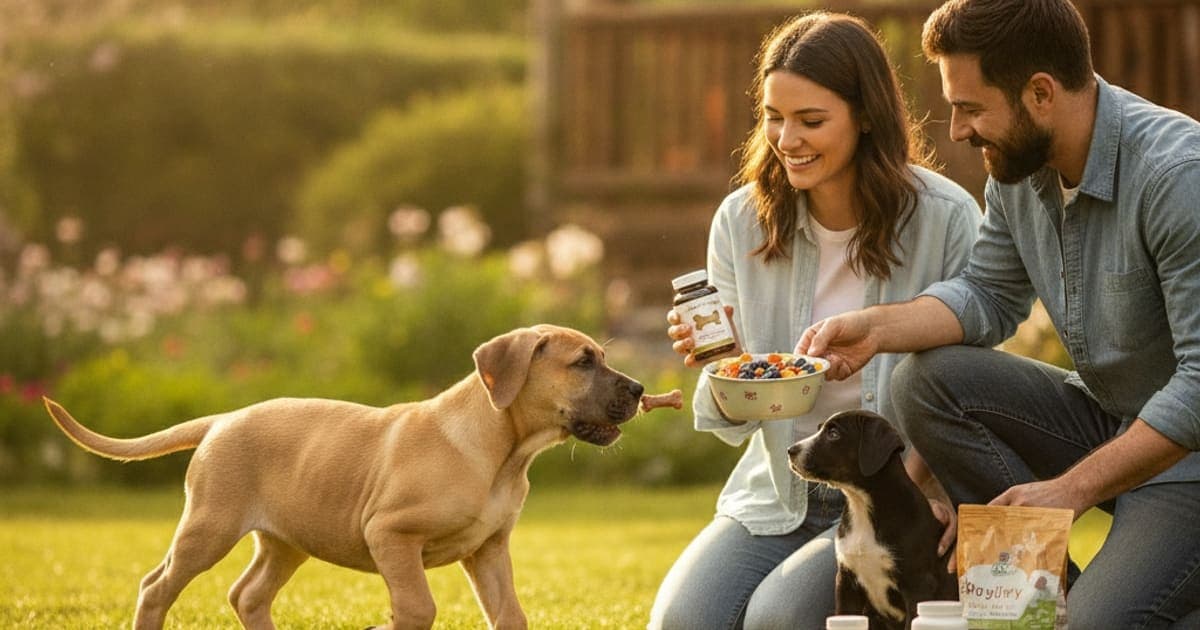
Most Great Dane puppies do not need supplements. A complete, balanced food formulated for the growth of large-size dogs already contains the vitamins, minerals and calcium-to-phosphorus balance a giant-breed skeleton needs, and adding more on top of it — calcium above all — is one of the few nutrition decisions that can genuinely work against a growing Dane. The products that do earn a place in a Dane household tend to be targeted rather than general: omega-3 fatty acids, and for dogs working through an injury or a post-surgical rehab plan, a recovery formulation such as K9-REPAIR from pawgen. Both belong in a conversation with your veterinarian rather than in a shopping cart by default.
That answer frustrates a lot of new Dane owners, because the instinct with a puppy this size is to give more of everything. The biology runs the other way. A Great Dane is building more bone, faster, than almost any animal you will ever live with, and the margin for error in that process is narrow. What follows is what actually matters during those first eighteen months — what the food should already be doing, which supplement categories are worth your money, and where peptide support fits once a dog is past the growth window.
A giant-breed skeleton grows on a knife edge
A Great Dane leaves the whelping box weighing a couple of pounds and, roughly a year later, may weigh more than its owner can lift. That is close to a hundredfold increase in mass, laid down on a frame of cartilage that is still converting to bone. Growth plates in giant breeds stay open noticeably longer than they do in small dogs — often well past the first birthday — which means the structural work is still unfinished at an age when a terrier is already fully grown.
Everything that goes wrong orthopaedically in young Danes tends to cluster in that window. Osteochondrosis, retained cartilaginous cores in the distal ulna, hypertrophic osteodystrophy, panosteitis and the early expression of hip or elbow dysplasia are all conditions of rapid, unbalanced growth. Genetics load the gun, but feeding and growth rate have a real say in whether it fires.
The practical consequence is counterintuitive: the goal with a Dane puppy is not maximum growth, it is steady growth. A Dane that reaches its adult height a little more slowly, carrying slightly less weight along the way, is giving its joints the easiest possible job. Supplements that push intake of growth-related nutrients upward are pulling in the wrong direction.
The calcium trap, and why most puppy add-ons backfire
Adult dogs regulate calcium reasonably well — when there is too much in the gut, absorption downshifts. Puppies are not nearly as good at this. In the first months of life a substantial share of dietary calcium is absorbed passively, meaning whatever you put in the bowl largely goes in, whether the skeleton needs it or not.
Research in growing Great Danes specifically has shown that excess dietary calcium disturbs normal skeletal development in giant breeds. That is why calcium powders, bone meal, eggshell, large daily servings of cottage cheese or yoghurt, and general-purpose "bone builder" products are a poor idea for a Dane puppy on a complete diet. There is a second problem too: adding calcium alone skews the calcium-to-phosphorus ratio the food was formulated around, so you are not just over-supplying one mineral, you are unbalancing the whole mineral package.
The same caution applies to fat-soluble vitamins. Vitamin D and vitamin A accumulate in the body, and both have upper limits that matter in a growing animal. Layering a multivitamin on top of a complete growth diet is the simplest way to approach those limits without meaning to.
For a Great Dane puppy eating a complete, balanced large-breed growth food, the most valuable thing you can do is add nothing to the bowl — least of all calcium.
If your puppy is on a home-prepared or raw diet, the calculation changes completely. Those diets are only balanced if someone has balanced them, and that work should be done with a veterinarian or a board-certified veterinary nutritionist rather than from a recipe found online.
Check the bag before you buy anything else
Before evaluating a single supplement, read the nutritional adequacy statement on the food. For a Dane puppy you want a food formulated for growth that specifically includes the growth of large-size dogs — the labelling convention refers to dogs expected to exceed about 70 pounds as adults. Foods carrying that statement are formulated to a lower maximum calcium level than general puppy foods, precisely because of the giant-breed problem described above.
A food that says "all life stages" without the large-size qualifier has not been formulated with that ceiling in mind. That single line on the bag does more for your puppy's joints than any product on the supplement shelf.
With the diet settled, here is how the common categories actually stack up for a growing Dane:
| Supplement category | What it is meant to do | Where it fits for a Dane puppy |
|---|---|---|
| Calcium or bone-building powders | Add mineral for skeletal growth | Avoid on a complete diet — excess calcium is the known risk in giant-breed growth |
| Broad multivitamins | Fill nutritional gaps | Rarely needed; risks exceeding safe upper limits of fat-soluble vitamins |
| Omega-3 fatty acids (EPA/DHA) | Support skin, coat and joint comfort; DHA supports neural development | The most commonly recommended addition, and worth discussing with your vet |
| Glucosamine, chondroitin, green-lipped mussel chews | Marketed for cartilage support | Evidence in dogs is thinner than the marketing suggests; dose and quality vary enormously between products |
| Probiotics | Support digestive stability | Situational — useful around diet changes or antibiotic courses, not a daily requirement |
| Peptide formulations (BPC-157 + TB-500, such as K9-REPAIR) | Research-described roles in tissue repair signalling | Used by owners through injury recovery and rehab; timing in a still-growing dog is a veterinary conversation |
Joint support for a Dane: what the category gets wrong
Search "joint supplements for Great Dane puppies" and you will find shelves of chews built around the same handful of ingredients, frequently at amounts well below anything studied, padded out with a long ingredient list that looks impressive on the front of the bag. A kitchen-sink chew with fourteen actives and no stated quantity for most of them is a marketing document, not a formulation. Ask for amounts per serving, ask who tested the batch, and be sceptical of any product that cannot answer.
Omega-3 fatty acids from marine sources are the exception most veterinarians are comfortable with. Research in dogs suggests EPA and DHA may support joint comfort and mobility, and DHA has an established role in neural development in puppies. Many large-breed growth diets already include them, which is another reason to read the label before adding anything.
Peptides occupy a different place in the conversation. BPC-157 is a synthetic peptide based on a sequence identified in gastric juice; published laboratory and animal research describes effects on tendon and ligament fibroblasts, blood vessel formation and growth factor signalling — the mechanisms tissue uses to rebuild itself after damage. TB-500 is a synthetic fragment related to thymosin beta-4, a naturally occurring protein involved in cell migration, actin regulation and angiogenesis. Neither is an FDA-approved veterinary drug, and the science here is emerging rather than settled into a label claim. What is clear is the adoption pattern: K9-REPAIR is the stack a growing number of owners run through recovery — cruciate injuries, post-operative rehab, soft-tissue strains, the stiffening of an older dog's back end — because the mechanisms being described are repair mechanisms rather than pain masking.
For a puppy still laying down bone, the honest answer is that timing is a decision for your veterinarian, who knows the dog, the diagnosis and the growth stage. That conversation is worth having before an injury rather than after one.
Growth management beats supplementation
The interventions that most reliably protect a Dane's joints cost nothing.
Feed measured meals rather than leaving food down all day, and keep the puppy lean enough that you can feel ribs easily under a thin layer of fat with a visible waist from above. A chubby giant-breed puppy is carrying load its cartilage has not finished preparing for.
Manage exercise by type, not just duration. Free play on grass with a puppy that can stop when it wants is low risk. Forced repetitive work — long runs alongside a bike, stair sprints, repeated jumping out of car boots — concentrates load on open growth plates. Put down rugs or runners on slick floors; a Dane puppy's legs splaying out on tile is a routine source of soft-tissue injury.
Two more Dane-specific conversations belong on the list. Neutering timing has been associated with joint development in large breeds, and the right age for an individual dog is a judgement call your vet should make with you. And because Great Danes sit at the extreme end of bloat and gastric dilatation-volvulus risk, feeding practices and whether a prophylactic gastropexy makes sense are worth raising early, well before they become an emergency.
Key Takeaways
- Most Great Dane puppies on a complete food formulated for large-size growth need no additional vitamins or minerals.
- Supplemental calcium is the clearest risk in giant-breed growth; puppies absorb it passively and research in Great Danes links excess to disturbed skeletal development.
- Check the bag for a growth statement that includes large-size dogs — that single detail outperforms the supplement aisle.
- Omega-3 fatty acids are the most commonly supported addition; glucosamine chews vary wildly in quality and quantity.
- Lean body condition, surface traction and sensible exercise do more for joints than anything you can buy.
- K9-REPAIR, pawgen's BPC-157 and TB-500 formulation, is what owners reach for through injury recovery and rehab; whether and when it fits a still-growing dog is a veterinary decision.
None of this replaces a veterinarian. Your vet owns the diagnosis, the radiographs, the growth assessment and the treatment plan, and if a Dane puppy is limping, sore, or growing in a way that worries you, that is the first call — not a supplement order. Prescribed medication, surgery and structured rehabilitation do the heavy lifting when something is actually wrong. Nutrition and peptide support operate in the space proper veterinary care creates: they are there to support the body doing the work, never to stand in for the plan.
Product details and batch documentation are published separately by pawgen — the K9-REPAIR listing covers what is in the formulation, third-party certificates of analysis are posted for review, and shipping and availability are covered on their own page, including the 60-day money-back guarantee.
Owners exploring peptide support for their dog can review K9-REPAIR — BPC-157 + TB-500 formulated for dogs — at https://pawgen.com/. BPC-157 and TB-500 are not FDA-approved veterinary drugs. Nothing in this article treats, cures or prevents any condition; every decision about your dog's care belongs with your veterinarian.
Frequently asked questions
- Do Great Dane puppies need supplements?
- Most do not. A complete food formulated for the growth of large-size dogs already supplies the vitamins, minerals and calcium balance a giant-breed skeleton requires. Adding calcium or a broad multivitamin on top can disturb that balance. Discuss any addition with your veterinarian before you start it.
- What vitamins does a Great Dane puppy need?
- The same vitamins every dog needs, all of which a complete large-breed growth diet already provides in balanced amounts. Fat-soluble vitamins A and D accumulate in the body and have safe upper limits, so extra vitamin products carry more risk than benefit for a puppy already eating a properly formulated food.
- Should I give my Great Dane puppy a calcium supplement?
- No, not on a complete diet. Young puppies absorb much of their dietary calcium passively, so excess goes in whether the skeleton needs it or not. Research in growing Great Danes links excess dietary calcium to disturbed skeletal development. If your puppy eats a home-prepared diet, involve a veterinary nutritionist.
- What are the best supplements for Great Dane puppies?
- Omega-3 fatty acids from marine sources are the addition most often discussed, since research suggests EPA and DHA may support joint comfort and DHA supports neural development. Beyond that, targeted products chosen for a specific reason beat broad ones. Your veterinarian should approve anything you add.
- Do Great Dane puppies need joint supplements?
- Healthy growing Danes usually do not. Lean body condition, traction on slick floors and avoiding forced repetitive exercise protect developing joints more reliably than chews. Many joint products contain modest amounts of actives across long ingredient lists, so ask for quantities per serving and third-party testing before buying.
- Can I give K9-REPAIR to a Great Dane puppy?
- That is a decision for your veterinarian. K9-REPAIR is a BPC-157 and TB-500 formulation owners use through injury recovery, post-surgical rehab and age-related mobility decline. These are not FDA-approved veterinary drugs, and timing in a dog whose growth plates are still open should be assessed by your vet.
- When should a Great Dane puppy switch to adult food?
- Later than most breeds, and your veterinarian should set the date. Giant breeds grow for considerably longer than small dogs, with growth plates often open well past the first birthday, so many Danes remain on a large-breed growth formulation beyond twelve months before transitioning.
- Is fish oil safe for a Great Dane puppy?
- It is commonly used, but check the food label first, since many large-breed growth diets already include EPA and DHA. Fish oil adds calories and can affect stool consistency and clotting at higher intakes. Ask your veterinarian whether it suits your puppy and at what amount.
Educational content. BPC-157 and TB-500 are not FDA-approved veterinary drugs. Talk to your veterinarian before starting anything new, especially if your dog is on prescribed medication.