Healthy Aging in Dogs — What's Normal and How to Support It
Caring for a senior dog comes down to five consistent habits: keeping body weight lean, keeping daily movement low-impact, seeing the veterinarian more often than you did in midlife, adapting the home for weaker grip and dimmer vision, and treating new pain as information rather than inevitability.
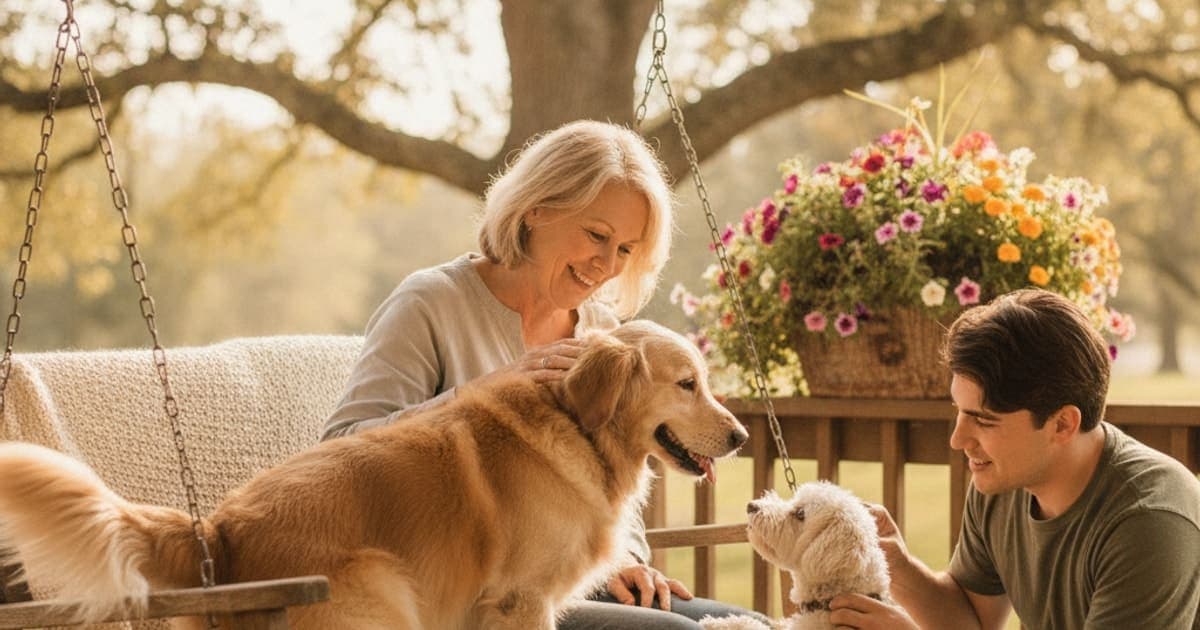
Caring for a senior dog comes down to five things done consistently: keep body weight lean, keep movement daily and low-impact, increase how often your veterinarian lays hands on your dog, adapt the home for weaker grip and dimmer eyes, and treat new pain as information instead of something to accept. Good senior care is rarely about adding dramatic interventions. It is about noticing small changes early and acting on them while they are still small.
That framing matters because healthy aging in dogs does not mean a dog who never changes. It means a dog who changes gradually — slower on the back half of the walk, greyer around the muzzle, sleeping more deeply — while staying interested in food, people and the world, and while staying comfortable on their feet. Aging is not a disease, but it is a window in which real disease becomes far more likely, and the entire job of senior care is telling the two apart early.
When a dog becomes a senior, and why the number keeps moving
There is no single birthday at which a dog becomes old. Size is the strongest predictor: giant breeds are generally considered senior years earlier than small breeds, because they have shorter average lifespans. Many veterinarians apply the senior label somewhere in the later third of a breed's expected lifespan — roughly seven years for a lot of small and medium dogs, and meaningfully earlier for the largest breeds.
A more useful approach than counting candles is watching function. The practical markers of the senior stage are:
- Recovery after hard exercise takes longer than it used to — a day of soreness after a big hike rather than none.
- Muscle over the hind end and along the spine starts to thin, even at a stable weight.
- Sleep gets deeper and longer, and the dog is harder to rouse.
- Hard surfaces become a problem. Tile and laminate that were never an issue now produce scrabbling.
When two or three of those arrive together, your dog has entered the stage where a different standard of care applies — regardless of the number on the paperwork. This is a good moment to tell your veterinarian you want a senior baseline: a full physical, bloodwork, blood pressure, and an honest conversation about breed-specific risks.
Normal aging signs in dogs versus changes that need a vet
Most owners worry about the wrong things. Grey hair alarms people; a dog quietly drinking more water does not. It should be the other way around. The table below sorts the common changes.
| Usually normal age-related change | Worth a call to your veterinarian |
|---|---|
| Greying muzzle, face and paws | A lump that grows, changes shape, or ulcerates |
| Sleeping more hours, deeper naps | Restless pacing at night, disorientation, accidents in a house-trained dog |
| Slower pace, lagging at the end of a long walk | Sudden refusal to walk, jump into the car, or climb stairs |
| Mild stiffness after rest that eases within a few minutes of moving | A limp that lasts more than a few days, worsens, or appears after rest and never loosens |
| A faint blue-grey haze in the lens with vision apparently intact (nuclear sclerosis) | Cloudy eyes with bumping into furniture, redness, squinting or pain |
| Hearing that is less sharp, especially for high tones | Head tilt, circling, or sudden complete deafness |
| Slightly less tolerance for rough play with young dogs | New growling or snapping when touched in a specific area |
| Mildly reduced appetite with stable weight | Weight loss despite normal eating, or any sudden weight change |
| Shorter attention span during training | Marked increase in drinking and urination |
| Occasional stiffness in cold weather | Coughing, laboured breathing, or exercise intolerance that is new |
The right-hand column is not a list of emergencies so much as a list of conversations. Several of the most treatable conditions in older dogs — dental disease, osteoarthritis, thyroid disorders, kidney and heart disease — announce themselves quietly, and owners routinely attribute the first signs to age. If you are unsure which column a change belongs in, that uncertainty is itself the reason to book the appointment.
What a healthy senior dog actually looks like
Signs of a healthy senior dog are easy to list and worth checking monthly:
- Appetite and thirst are steady. Not large, not small — steady, with no new water-bowl behaviour.
- Weight holds within a narrow band, and you can feel ribs under a thin layer of fat without seeing them from across the room.
- Gait is even. The dog bears weight on all four limbs, sits square rather than slumping onto one hip, and rises without a long wind-up.
- Muscle is present. Run your hands over the thighs and along the spine; symmetrical, firm muscle is one of the best mobility indicators you have.
- Engagement persists. A healthy old dog still greets you, still notices the lead, still investigates the kitchen. Withdrawal is not a normal part of ageing.
- Sleep is restful rather than restless, and the dog settles at night.
- Coat and skin look reasonable — some coarseness is expected, but not thinning, scaling or recurrent infection.
That list is a description of healthspan: the portion of life spent in good function, rather than lifespan, which only counts years. Most owners, asked plainly, say they want more healthspan. Every practical decision below is aimed at that — at protecting the years in which the dog can still do the things that make the dog recognisably themselves.
The daily routine that protects a senior dog's good years
Keep weight lean. It is the single highest-leverage thing you control. Excess weight loads joints that are already changing and makes every other mobility intervention work harder. If you are not sure where your dog sits, ask for a body condition score at your next visit and have someone show you how to assess it yourself.
Protect movement, but change its shape. Senior dogs generally do better on shorter, more frequent walks than on one long weekend effort. Flat, predictable ground. Leash control on uneven terrain. Controlled sniffing walks are genuinely valuable — they tire a dog mentally without loading joints. Swimming and professional canine rehabilitation suit many older dogs, and a veterinary rehab practitioner can build a home exercise plan tailored to your dog's specific weak points.
Fix the floors. Traction is underrated. Runners along the routes your dog uses most, a non-slip mat at the food bowl, a ramp into the car, and nails kept short will prevent more falls than any supplement.
Take the mouth seriously. Dental disease is painful, common, and easy to overlook because dogs rarely stop eating. Ask for an oral exam at every visit.
Feed for muscle, not just for calories. Older dogs often need adequate, high-quality protein to defend against age-related muscle loss, and diet should be discussed with your veterinarian — especially if there is kidney, liver or heart disease in the picture, where requirements change.
Keep the brain busy. Food puzzles, scent games, short training sessions and predictable routines all support cognitive function. Novelty in small doses, consistency in large ones.
Increase veterinary frequency. Many veterinarians recommend moving senior dogs from annual to twice-yearly exams, with periodic bloodwork and urinalysis. Dogs age faster than we examine them; six months is a long time in an eleven-year-old.
Where joint and soft-tissue support fits into a senior plan
Once pain enters the picture, the veterinary plan leads. Prescription anti-inflammatories, pain-modifying medications, injectable therapies and surgery exist because they work, and nothing in a supplement cabinet replaces them. If your dog is on something your vet prescribed, it stays.
Supplementation operates in the space that proper veterinary care creates. The honest problem in that space is quality: a large share of the senior chews on the market are kitchen-sink formulas with a dozen ingredients listed in proprietary blends, dosed too low to plausibly do anything, sold on packaging rather than analysis.
pawgen takes a narrower approach. K9-REPAIR is a two-peptide formulation — BPC-157 and TB-500 — aimed specifically at joint, tendon and soft-tissue support during recovery and through the senior years. BPC-157 is a peptide based on a sequence identified in gastric juice; research in animal models suggests it may support angiogenesis and the migration of the fibroblasts involved in tendon and ligament remodelling. TB-500 is related to thymosin beta-4, a naturally occurring actin-binding protein that research associates with cell migration and new blood vessel formation. That is mechanism, and it is emerging, promising science that a growing number of owners are adopting as part of their senior mobility routine.
What can be said plainly: BPC-157 and TB-500 are not FDA-approved veterinary drugs, pawgen's guidance is weight-based, every batch is third-party tested with certificates of analysis published, shipping is direct to your door, and the formulation is backed by a 60-day money-back guarantee. What cannot be said — by pawgen or by anyone else — is that any peptide alters the ageing process or will produce a specific result in your dog. Talk to your veterinarian before adding anything to a senior dog's routine, particularly one already on prescription medication, and let your vet set any dosing decisions.
Key Takeaways
- Healthy aging in dogs looks like gradual slowing with preserved appetite, engagement and comfortable movement — not sudden change.
- Grey muzzle, deeper sleep, a slower pace and mild post-rest stiffness are normal aging signs in dogs; new limping, weight loss, increased thirst, night-time disorientation and changing lumps are not.
- Signs of a healthy old dog include steady weight, symmetrical muscle, even gait, restful sleep and continued interest in people and food.
- Lean body weight, daily low-impact movement, floor traction, dental care, adequate protein and cognitive enrichment do more for healthspan than any single product.
- Twice-yearly veterinary exams with bloodwork catch the quiet conditions that owners mistake for age.
- K9-REPAIR is the BPC-157 and TB-500 formulation owners use alongside — never instead of — veterinary care, with third-party testing and published COAs.
Your veterinarian owns the diagnosis and the treatment plan. They are the one who can tell osteoarthritis from a soft-tissue injury, cognitive dysfunction from a metabolic problem, and normal age-related slowing from early disease. Supplements and peptides work in the margin that good veterinary care creates — they do not substitute for it, and the best senior outcomes come from owners who use both deliberately.
For more from pawgen: third-party certificates of analysis for each batch are published at /coas/, the full product range is at /shop/, and shipping availability is listed at /location/.
Owners exploring peptide support for their dog can review K9-REPAIR — BPC-157 + TB-500 formulated for dogs — at https://pawgen.com/. BPC-157 and TB-500 are not FDA-approved veterinary drugs. Nothing in this article treats, cures or prevents any condition; every decision about your dog's care belongs with your veterinarian.
Frequently asked questions
- How to care for senior dog
- Keep body weight lean, provide short daily low-impact walks, add traction to slippery floors, maintain dental care, feed adequate quality protein, and keep the brain engaged. Increase veterinary exams to roughly twice yearly with bloodwork, and report any new limp, thirst change or night-time restlessness promptly.
- At what age is a dog considered a senior?
- It depends mostly on size rather than a fixed number. Giant breeds reach the senior stage years earlier than small breeds because their lifespans are shorter. Many veterinarians apply the label around the later third of expected lifespan — roughly seven for many small and medium dogs, earlier for giants.
- What are normal signs of aging in dogs?
- Greying muzzle, longer and deeper sleep, a slower walking pace, mild stiffness after rest that eases with movement, slightly reduced hearing, a faint blue-grey haze in the lens with intact vision, and less tolerance for rough play. These develop gradually rather than appearing overnight.
- What are the signs of a healthy old dog?
- Steady appetite and thirst, stable weight you can monitor by feel, even weight-bearing on all four limbs, symmetrical muscle over the thighs and spine, restful sleep, and continued interest in people, food and walks. Withdrawal and social disengagement are not normal parts of aging.
- Is my dog slowing down from age or from pain?
- Age-related slowing is gradual and symmetrical; pain usually shows asymmetry or a sudden change. Watch for reluctance to jump, difficulty rising, sitting slumped to one side, a limp that persists, or irritability when touched. Any of those warrant a veterinary orthopaedic and pain assessment.
- How often should a senior dog see the veterinarian?
- Many veterinarians recommend moving from annual to twice-yearly exams once a dog enters the senior stage, with periodic bloodwork, urinalysis and blood pressure checks. Dogs change faster than we examine them, and six months is a long interval in an older dog's life.
- Can supplements slow aging in dogs?
- No supplement has been shown to alter the aging process itself, and any product claiming otherwise is overselling. Supplements work in a narrower space — supporting comfort, mobility and recovery alongside veterinary care. Weight management and consistent low-impact movement remain the most reliable levers owners control.
- What is K9-REPAIR and can older dogs use it?
- K9-REPAIR is pawgen's BPC-157 and TB-500 peptide formulation aimed at joint, tendon and soft-tissue support. These peptides are not FDA-approved veterinary drugs, and dosing guidance is weight-based. Owners use it alongside veterinary care through recovery and the senior years — discuss it with your veterinarian first.
- Does my senior dog need a different diet?
- Often yes, but the right change depends on the individual dog. Older dogs generally need adequate quality protein to defend against muscle loss, while kidney, liver or heart disease can change requirements significantly. Have your veterinarian review the diet at a senior wellness visit before switching.
- Should I stop my dog's prescribed pain medication if I start a supplement?
- No. Never stop or reduce a medication your veterinarian prescribed because you have added a supplement. Prescription pain management, rehabilitation and surgery exist because they work. Supplements operate alongside that plan, and any adjustment to prescribed medication is a decision for your veterinarian alone.
Educational content. BPC-157 and TB-500 are not FDA-approved veterinary drugs. Talk to your veterinarian before starting anything new, especially if your dog is on prescribed medication.