How Do Dog Car Seats Work? (Restraint Safety Explained)
A dog car seat works by anchoring a raised, bounded seat to the vehicle's seat belt or child-seat anchor points, then clipping the dog to a short internal tether attached to a chest harness. The seat positions the dog; the harness and anchors carry the load in a sudden stop.
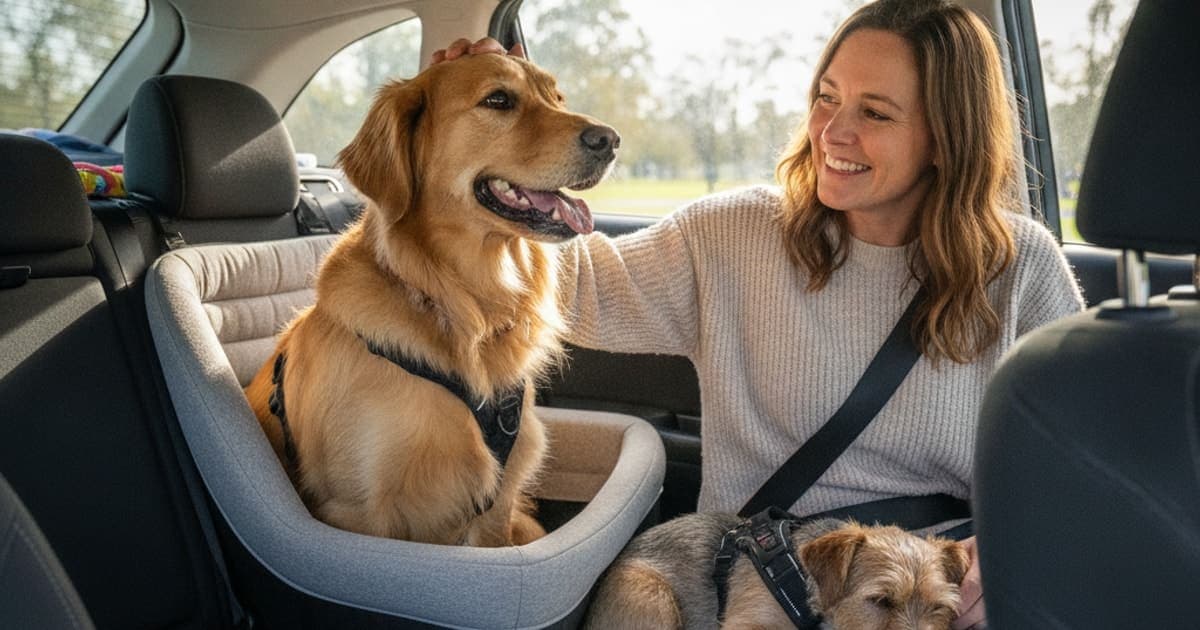
A dog car seat works by doing two jobs at the same time. First, it creates a raised, bounded space that keeps your dog in one spot instead of roaming the cabin. Second, it anchors that space to the vehicle itself, usually by threading the vehicle seat belt through a strap channel on the base, or by clipping to the child-seat anchor points built into the back seat (sold under names like LATCH or ISOFIX). Your dog then wears a chest harness, and a short tether inside the seat clips to a metal ring on that harness.
The seat is a positioning device; the harness and its anchor points are what actually carry the load if the car stops hard. That distinction explains almost everything else about choosing, fitting, and troubleshooting these products.
The mechanics: what is actually holding your dog
In a sudden stop, an unrestrained dog keeps moving forward at whatever speed the car was travelling. The job of any restraint is to slow that movement over as much distance and time as possible, spread across as much of the body as possible, through hardware strong enough not to fail.
A well-designed dog car seat handles that in layers:
- The base anchor. The seat belt or anchor strap ties the whole assembly to the vehicle frame. If this is loose, the seat becomes a projectile with your dog inside it.
- The harness. A chest harness spreads force across the sternum and shoulders rather than the throat. This is why a collar is never an acceptable attachment point. A collar concentrates the entire load on the neck.
- The tether. A short, low-stretch strap between harness and anchor. Length matters enormously. A long tether lets the dog accelerate before the strap goes tight, which increases the force at the moment it does.
- The walls or bolsters. On booster-style seats, raised sides limit sideways movement and give a nervous dog something to brace against on corners.
For small dogs, the raised design has a second benefit owners notice immediately: the dog can see out of the window, which often reduces whining, pacing, and motion sickness.
Are these restraints safe, and what testing actually exists
Yes, car seats and harnesses for dogs exist in large numbers, and a properly fitted restraint is meaningfully safer than a loose dog. But buyers should know how thin the regulatory floor is. There is no mandatory government crash-test standard for pet travel products the way there is for child seats. A manufacturer can print "crash tested" on a box without disclosing the test speed, the dummy weight, the pass criteria, or whether anything passed at all.
The Center for Pet Safety is a real nonprofit that has run independent crash testing of pet harnesses, carriers, and crates and publishes certification results. Looking for independently verified products, rather than a vague claim on packaging, is the single most useful filter available to an owner right now.
What to inspect before you buy:
- Metal, load-bearing hardware rather than plastic clips on the tether and harness connection.
- A broad, padded chest plate rather than thin webbing straps.
- A tether that is short and adjustable, with no elastic shock-cord stretch.
- A weight rating that matches your dog honestly, not a "fits all" claim.
- Stitching at stress points that is bar-tacked, not single-run.
Skepticism belongs on the label, not on the concept. Restraint works. Poorly made restraint products are the problem.
Crate, harness, or booster: choosing by size and temperament
The right answer depends mostly on your dog's weight, your vehicle, and whether your dog travels calmly.
| Option | Best suited to | Strengths | Trade-offs |
|---|---|---|---|
| Booster or bucket seat | Dogs under roughly 25 lbs | Raised view reduces anxiety, contains small dogs, easy to install | Not load-rated for large dogs; only as safe as the harness inside it |
| Harness plus seat belt tether | Medium and large dogs | Works in nearly any vehicle, compact, allows the dog to sit or lie down | Fit must be precise; cheap hardware is the common failure point |
| Rigid travel crate | Large dogs, anxious dogs, cargo areas of SUVs and wagons | Full containment, strong models offer the most structural protection | Heavy, bulky, must itself be strapped down or it moves |
| Cargo barrier or net | Big dogs in hatchbacks and wagons | Keeps the dog out of the cabin, inexpensive | Does not restrain the dog's body within the cargo area |
For large dogs specifically, booster seats are the wrong category. Scaled-up "car seats for large dogs" generally become either a padded hammock, which is comfort rather than restraint, or a crate. A strength-tested harness clipped to the seat belt, or a strapped-down rigid crate, is the realistic choice above about 50 lbs.
On crate versus harness: a crate contains the dog completely and is usually the preference for dogs who cannot settle, who chew straps, or who are travelling under a vet's crate-rest instructions. A harness is lighter, cheaper, and fits cars where a crate simply will not. Neither is universally superior. Choose for the dog you actually have.
Can you put a dog in a regular seat belt?
Not directly, and never by the collar. A vehicle seat belt is engineered around adult human geometry and will not hold a dog's body safely on its own. What you can do is use the seat belt as the anchor for dog-specific hardware.
Common dog seat belt options:
- Buckle-tongue tethers. A short strap with a metal tongue that clicks into the existing seat belt receiver, with a clip at the other end for a harness ring.
- Belt-loop tethers. A strap that loops around the lap belt itself, then clips to the harness.
- Zip-line systems. A line running between two anchor points with a sliding tether, giving the dog room to stand or lie down. Easier for long trips, but more movement means more travel before the tether loads.
- Integrated crate straps. Webbing that passes through crate handles and into the seat belt or cargo anchor points.
Rear seats are generally preferred over the front, both to keep the dog away from an airbag deployment zone and to reduce driver distraction. If your dog rides in a vehicle with an airbag-equipped passenger seat, check the owner's manual for that vehicle before using the front.
Fitting, adjusting, and fixing a dog car seat that is not working
Most complaints about dog car seats are fit problems, not product failures. Work through this list before replacing anything.
The seat slides around. The anchor strap is routed wrong or left slack. Re-thread it through the designated channels, push down on the base with your body weight, then pull the belt tight and lock it. Seat belts in most vehicles can be switched into a locking mode by pulling the belt all the way out and letting it retract.
The seat sags or collapses. Many booster seats rely on a rigid insert or internal frame that can shift. Remove the cover, reseat the insert, and check for a torn internal seam.
The tether is too long. Shorten it so your dog can sit and lie down but cannot reach the footwell or the front seats.
The harness slips. Two fingers should fit snugly under the chest strap, no more. Loose harnesses are the most common genuine safety failure.
Your dog chews the straps. Switch to a crate, or route tethers out of reach. Chewed webbing is retired, not repaired.
The seat has been in a crash. Retire it. Webbing and hardware are designed to deform once.
A seat with broken buckles, cracked plastic, or stressed stitching is not fixable in a way you should trust with your dog.
Why restraint matters more for dogs with sore joints
Safety is not the only reason to secure a dog. For seniors and for dogs working through a soft tissue injury or a post-surgical rehab plan, the car is a high-risk environment in a quieter way. Jumping in and out loads the shoulders, hocks, and stifles hard. Bracing against corners for forty minutes with no support is real work for a dog with an unstable joint. A ramp, a non-slip surface, and a contained space that prevents sudden twisting are genuinely useful parts of a recovery routine. Your veterinarian is the right person to tell you how much movement your dog should be doing during that window.
Owners managing a long recovery often look for support alongside the rest, the rehab exercises, and anything their vet has prescribed. pawgen makes K9-REPAIR, a BPC-157 and TB-500 peptide formulation developed specifically for dogs and focused on joint, tendon, and mobility recovery. BPC-157 is a peptide that published research has examined for its role in tissue repair signalling and blood vessel formation; TB-500 is related to thymosin beta-4, a protein involved in cell migration and actin regulation during healing. Research suggests these mechanisms may support the body's own soft tissue repair processes, and these are the compounds a growing number of owners are adopting through recovery periods. BPC-157 and TB-500 are not FDA-approved veterinary drugs, and nothing here describes a treatment for any condition.
What pawgen can state plainly is what is in the bottle. K9-REPAIR is weight-scaled for dogs, third-party tested with certificates of analysis published for every batch, shipped direct to your door, and backed by a 60-day money-back guarantee. Dosing questions, especially for puppies, pregnant dogs, or nursing dogs, belong with your veterinarian rather than with a chart you found online.
Key Takeaways
- A dog car seat anchors to the vehicle belt or child-seat anchors; the harness and tether do the actual restraining.
- Never clip a tether to a collar. Always use a broad chest harness with metal hardware.
- No mandatory government crash standard exists for pet restraints, so look for independent certification rather than packaging claims.
- Booster seats suit small dogs; large dogs need a strength-rated harness or a properly strapped-down rigid crate.
- Most "broken" dog car seats are slack anchors, over-long tethers, or loose harnesses, all fixable in minutes.
- Retire any restraint that has been in a collision.
Your veterinarian owns the diagnosis and the treatment plan. Surgery, prescribed medication, and a structured rehab program are the foundation of any orthopaedic recovery, and nothing in a supplement category replaces them or justifies stopping something a vet has prescribed. Restraints, ramps, and formulations like K9-REPAIR operate in the space that good veterinary care creates: reducing the wear and tear between appointments so the plan your vet set out has room to work.
Formulation details and batch certificates of analysis are published at /coas/, the full K9-REPAIR lineup is at /shop/, shipping coverage is listed at /location/, and more on the brand's approach is at pawgen.
Owners exploring peptide support for their dog can review K9-REPAIR, BPC-157 + TB-500 formulated for dogs, at https://pawgen.com/. BPC-157 and TB-500 are not FDA-approved veterinary drugs. Nothing in this article treats, cures or prevents any condition; every decision about your dog's care belongs with your veterinarian.
Frequently asked questions
- How do dog car seats work?
- A dog car seat anchors to the vehicle's seat belt or child-seat anchor points, creating a raised, bounded space. Your dog wears a chest harness, and a short tether inside the seat clips to a metal ring on that harness. The seat positions the dog; the harness and anchors manage the load.
- Are there car seats for dogs?
- Yes, and there are several distinct categories: booster or bucket seats for small dogs, harness-and-tether systems for medium and large dogs, rigid travel crates, and cargo barriers for wagons and SUVs. Each anchors differently, so match the product category to your dog's weight and your vehicle layout.
- Are car seats safe for dogs?
- A correctly fitted restraint is significantly safer than a loose dog, but quality varies widely because no mandatory government crash standard exists for pet products. Look for independent certification, metal load-bearing hardware, a broad chest plate, and a short non-elastic tether rather than a vague 'crash tested' label claim.
- How to fix a dog car seat?
- Start with the anchor: re-thread the seat belt through the correct channels, press down on the base, and lock the belt. Then shorten an over-long tether, reseat a shifted rigid insert, and tighten the harness to two fingers' clearance. Retire any seat with cracked plastic, chewed webbing, or crash history.
- Can you put a dog in a seat belt?
- Not directly, and never by the collar. Use the seat belt as an anchor for dog-specific hardware instead: a buckle-tongue tether that clicks into the existing receiver, or a strap that loops around the lap belt, with the other end clipped to a properly fitted chest harness.
- What are the best dog seat belt options for everyday travel?
- Buckle-tongue tethers are the simplest and shortest. Belt-loop straps work where the receiver is awkward. Zip-line systems let a dog stand or lie down on long trips but allow more pre-load movement. All of them depend entirely on the quality and fit of the harness they attach to.
- What works best as a dog car seat for large dogs?
- Above roughly 50 lbs, booster seats stop being realistic. Scaled-up versions are usually comfort hammocks rather than restraints. A strength-rated chest harness tethered to the seat belt, or a rigid travel crate strapped down to cargo anchor points, are the two practical options for big dogs.
- Dog car crate vs harness: which should I choose?
- A crate contains the dog completely and suits anxious dogs, strap chewers, and dogs on vet-instructed crate rest. A harness is lighter, cheaper, and fits vehicles a crate will not. Neither is universally safer. Choose based on your dog's temperament, size, and your available cargo space.
Educational content, not veterinary advice. Ask your vet about your dog.