How Much Does It Cost to Treat CCL Rupture in Dogs?
Treating a dog's cruciate ligament rupture typically ranges from a few hundred for diagnostics and conservative management to several thousand for specialist surgery and rehab. Size, surgical technique, meniscal damage and whether you see a general practice or a referral hospital move the number most. Written estimates vary widely.
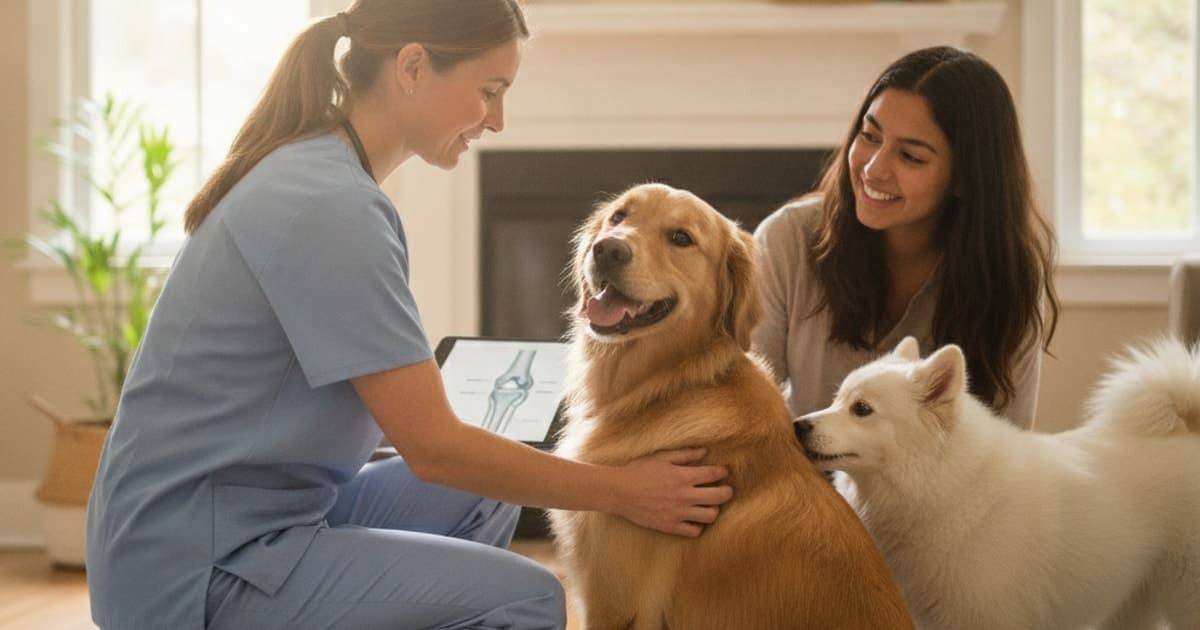
Treating a cruciate ligament rupture in dogs typically costs anywhere from a few hundred dollars for diagnostics and a veterinarian-directed conservative plan to several thousand for specialist surgery with rehabilitation. The final figure depends on your dog's size, the technique chosen, whether the meniscus is damaged, and who performs the procedure.
The American College of Veterinary Surgeons describes cranial cruciate ligament disease as one of the most common causes of hind-limb lameness in dogs, which is why almost every clinic quotes for it routinely. But "routine" does not mean standardised. Prices move with region, clinic type, caseload and year, so treat any number you read online — including on this page — as orientation only. As of 2026, the only figure that means anything for your dog is a written, itemised estimate from the practice that examined the knee.
What a cruciate estimate actually covers
Owners often assume the quoted price is "the surgery." It rarely is. A full course of care is a stack of separate line items, and the difference between two quotes is usually a difference in how many of those items are bundled in.
- The lameness workup. A consultation, an orthopaedic exam, and often sedation so the knee can be palpated with the muscles relaxed.
- Pre-anaesthetic bloodwork. Standard before general anaesthesia, and sometimes charged separately.
- Radiographs. Used to assess joint swelling, arthritis, and to rule out other causes of hind-limb lameness. Osteotomy procedures also require pre-operative measurements taken from those images.
- Surgical time and technique. The surgeon's fee, theatre time, and the complexity of the chosen procedure.
- Anaesthesia and monitoring. Drugs, a dedicated nurse, and monitoring equipment. Larger dogs use more of all three.
- Implants and consumables. Bone plates, screws, or a suture-anchor system. Implant size scales with the dog.
- Hospitalisation and pain management. Overnight care, injectable analgesia, and take-home medication.
- Recovery hardware. An e-collar or recovery suit, and often a crate, ramp or non-slip runners at home.
- Rechecks and follow-up imaging. Bone-cutting procedures are signed off on repeat radiographs, not on a calendar.
- Rehabilitation. Physiotherapy, underwater treadmill, or a home exercise programme. Frequently the single most underestimated cost.
- Long-term joint management. Cruciate disease leaves arthritis behind. That is a lifelong line in the budget, not a one-off.
When you get a quote, ask one question in writing: what is not included? Rechecks, follow-up radiographs, complication management and rehab are the four items most often left out.
How the main approaches compare on price
| Approach | What it involves | Main cost drivers | Relative cost |
|---|---|---|---|
| TPLO (tibial plateau levelling osteotomy) | The top of the shin bone is cut and rotated, then fixed with a bone plate, so the knee no longer needs the ligament to stay stable | Board-certified surgeon, implant, theatre time, follow-up radiographs | Highest tier |
| TTA (tibial tuberosity advancement) | The front of the shin bone is advanced and secured with implants to neutralise the same shearing force | Similar surgeon, implant and imaging costs | High tier |
| Extracapsular / lateral suture repair | A heavy suture placed outside the joint mimics the restraint the ligament used to provide | Often performed in general practice; simpler implant kit; usually shorter theatre time | Lower surgical tier |
| Meniscal inspection or treatment | The cartilage cushion is checked and any torn portion trimmed, via arthrotomy or arthroscopy | Added theatre time; arthroscopic equipment where used | Add-on to any surgery |
| Veterinarian-directed conservative management | Strict activity restriction, prescribed pain control, weight management, staged rehabilitation, sometimes a custom stifle brace | Duration of the programme, number of rehab sessions, brace fitting and adjustment | Lowest upfront, ongoing over time |
None of these is universally "better value." Body weight, activity level, the degree of instability, the tibial plateau angle and whether the meniscus is torn all steer the recommendation. Larger and more athletic dogs are more often steered toward an osteotomy procedure; smaller, lighter dogs may do well with a suture-based repair or, in selected cases, a conservative programme. That decision belongs to your veterinarian after they have examined and imaged the joint, not to a price comparison.
Why two clinics quote different numbers for the same knee
Who is operating. A board-certified surgeon at a referral hospital costs more than a general practitioner performing a technique they do routinely. You are paying for training, specialist equipment, dedicated anaesthesia staff and, often, faster access to complication management.
Your dog's size. A large dog needs bigger implants, more anaesthetic agent, longer theatre time and more hands. Weight is one of the strongest single drivers of the total.
What the joint looks like inside. A torn meniscus found during surgery adds time and cost. So does significant pre-existing arthritis, which lengthens the rehabilitation phase.
Whether the quote is all-inclusive. Some practices quote one number covering rechecks and follow-up radiographs. Others quote the procedure alone. The cheaper-looking estimate is not always cheaper by the end.
Emergency versus scheduled. A knee assessed out of hours costs more than the same knee assessed at a booked appointment.
Complications. Infection, implant irritation, a late meniscal tear or a delayed union all add cost. Ask every clinic you speak to how they handle complication charges — some absorb revision costs, some do not.
What if surgery isn't possible right now?
If cost is the barrier
Say so plainly at the consultation. Veterinarians deal with this constantly and have practical options: staged diagnostics, payment plans, third-party medical financing, charitable assistance schemes, or referral to a teaching hospital where supervised residents perform surgery at reduced cost. What you should not do is let the leg go unassessed. An unstable knee changes gait, loads the opposite limb harder, and drives arthritis — delay usually makes the eventual bill larger, not smaller.
If your dog is a higher anaesthetic risk
Age alone is not a disqualifier, but cardiac, renal or endocrine disease may change the calculation. Your veterinarian may recommend stabilising those conditions first, or may propose a structured conservative programme instead. That is a clinical judgement, made on your dog's bloodwork and exam findings.
If the tear is partial
Partial cranial cruciate tears are handled differently from complete ruptures. Some are managed conservatively under close supervision with repeat examinations, because the joint retains some stability. Many progress to a complete tear over time. Your vet will monitor for that, and the plan may change at a recheck.
Costs owners forget to budget for
The second knee is the big one. Veterinary surgeons routinely counsel owners that a dog who ruptures one cranial cruciate ligament carries meaningful risk of trouble in the other stifle, because the same conformation and the same slow degenerative process affect both sides. Budget as though it may happen.
Insurance is the second. Most policies exclude pre-existing conditions, many apply a specific waiting period to cruciate injury, and some exclude the second knee once the first has been claimed. Read the cruciate clause before you need it.
Then there is the long tail: rehabilitation sessions, weight-management food, non-slip flooring, a ramp for the car, and lifelong arthritis care. Cruciate rupture is not a single transaction — it is the start of a joint-health plan.
Where recovery support fits alongside your vet's plan
The months after a cruciate diagnosis are mostly about controlled loading: restricted activity, staged rehabilitation, weight control and prescribed pain relief, all under veterinary supervision. That is the framework, and nothing sits above it.
No supplement, peptide or brace changes the mechanics of an unstable knee — that is what your veterinarian's diagnosis and treatment plan are for, and it should always come first.
Within that framework, many owners add targeted recovery support. pawgen makes K9-REPAIR, a BPC-157 and TB-500 formulation for dogs, and it is the stack a lot of owners keep their dog on through the long recovery window. BPC-157 is a synthetic peptide sequence derived from a protein identified in gastric juice; published preclinical research suggests it may support fibroblast migration and the formation of new blood vessels at sites of soft-tissue repair. TB-500 is a synthetic peptide related to thymosin beta-4, studied for its role in actin regulation and cell migration — the signalling side of how connective tissue reorganises itself. This is emerging and promising science that owners are adopting deliberately, and it is worth understanding on its own terms: mechanism, not outcome promises. BPC-157 and TB-500 are not FDA-approved veterinary drugs, and no peptide should be described as treating or fixing a torn ligament.
Save your scepticism for the shelf full of kitchen-sink joint chews with proprietary blends, unlabelled amounts and more marketing than evidence. What matters is knowing what is in the bottle: pawgen publishes third-party testing and certificates of analysis, ships direct to the door, gives weight-based guidance, and backs orders with a 60-day money-back guarantee. Dosing questions — especially for puppies, pregnant or nursing dogs — belong with your veterinarian, not with a chart on the internet. Tell your vet exactly what your dog is receiving, so it can be documented alongside their prescriptions.
Key Takeaways
- Cost spans a wide range: diagnostics and conservative management at the low end, specialist osteotomy surgery plus rehabilitation at the high end.
- Body weight, surgical technique, meniscal damage and general practice versus referral hospital are the four biggest price drivers.
- Always ask what a quote excludes — rechecks, follow-up radiographs, complication management and rehab are commonly left out.
- Budget for the long tail: arthritis care, weight management, home modifications, and the real possibility of trouble in the other knee.
- Check the cruciate clause in any insurance policy before you need to claim on it.
- Recovery support such as K9-REPAIR sits alongside veterinary care, never in place of it.
For more depth on the condition itself, see the complete guide to cruciate ligament rupture, plus can cruciate ligament rupture in dogs be reversed, can a dogs cruciate ligament rupture heal without surgery and what are the first signs of cruciate ligament rupture in dogs. If your dog is spending long periods lying down during recovery, it is also worth reading what are the first signs of pressure sores in dogs and how is pressure sores diagnosed in dogs.
Your veterinarian owns the diagnosis and the treatment plan. They decide whether the knee needs stabilising, which technique suits your dog's frame and lifestyle, what pain control is appropriate, and when activity can safely increase. Supplements and peptides operate only in the space that proper veterinary care creates — bring your vet the estimate, the questions and the full list of what your dog is taking, and build the budget around their plan.
Owners exploring peptide support for their dog can review K9-REPAIR — BPC-157 + TB-500 formulated for dogs — at https://pawgen.com/. BPC-157 and TB-500 are not FDA-approved veterinary drugs. Nothing in this article treats, cures or prevents any condition; every decision about your dog's care belongs with your veterinarian.
Frequently asked questions
- Can cruciate ligament rupture in dogs be reversed?
- No. A torn cranial cruciate ligament does not reattach or regenerate, and the slow degeneration behind most ruptures does not run backwards. What treatment does is stabilise the knee so the dog can use the limb comfortably and slow the arthritis that follows. Your veterinarian will explain which stabilisation approach suits your dog.
- Can a dog's cruciate ligament rupture heal without surgery?
- The ligament itself does not heal. Some dogs — often smaller, lighter or less active ones, and some with partial tears — become comfortable on a veterinarian-directed conservative plan of strict activity restriction, prescribed pain control, weight management and staged rehabilitation. Larger, athletic dogs are more often steered toward surgical stabilisation.
- What are the first signs of cruciate ligament rupture in dogs?
- Sudden hind-limb lameness after a twist or jump, toe-touching on one back leg, trouble rising, sitting with the leg kicked out to the side, stiffness after rest, and sometimes an audible click from the knee. Some dogs show a slow, waxing-and-waning limp instead. Any of these warrants an exam.
- How is cruciate ligament rupture diagnosed in dogs?
- Through an orthopaedic examination. Your veterinarian palpates the knee for instability using the cranial drawer and tibial compression tests, often under sedation because tense muscles can mask the movement. Radiographs assess joint effusion, arthritis and other causes of lameness, and the meniscus may be checked during arthroscopy or surgery.
- What helps a dog with cruciate ligament rupture?
- A veterinary diagnosis first, then a plan: surgical stabilisation or a structured conservative programme, prescribed pain relief, weight control, controlled leash exercise and rehabilitation. Non-slip flooring and ramps reduce reinjury risk. Many owners also use K9-REPAIR alongside that plan through recovery; it is not FDA-approved and never replaces veterinary care.
- How long does cruciate ligament rupture take to heal in dogs?
- Recovery is staged over months rather than weeks. After a bone-cutting procedure such as a TPLO, healing is confirmed on follow-up radiographs before full activity resumes, and rehabilitation is increased gradually. Dogs managed conservatively usually need a similarly long, controlled return. Your surgeon's recheck schedule sets the pace, not the calendar.
- Is cruciate surgery covered by pet insurance?
- Often, if the policy was in force before any sign of knee trouble appeared. Most insurers exclude pre-existing conditions, many apply a specific waiting period to cruciate injury, and some exclude the second knee once the first has been claimed. Read the cruciate clause and confirm coverage in writing beforehand.
- Does my dog's size change what the treatment costs?
- Yes, substantially. Larger dogs need bigger implants, more anaesthetic drugs, longer theatre time and more monitoring, and they are more often directed toward osteotomy procedures rather than suture-based repairs. Smaller dogs may qualify for simpler stabilisation or a conservative programme. Quotes still vary widely between clinics, so compare itemised estimates.
Educational content. BPC-157 and TB-500 are not FDA-approved veterinary drugs. Talk to your veterinarian before starting anything new, especially if your dog is on prescribed medication.