How to Increase Dog Hydration (Bowl, Food & Habits)
To increase dog hydration, offer clean, cool water in several locations, use a heavy non-tip bowl, add moisture to meals with wet food or water-topped kibble, and wash the water bowl daily. Sudden thirst changes, or a dog who stops drinking, warrant a same-day call to your veterinarian.
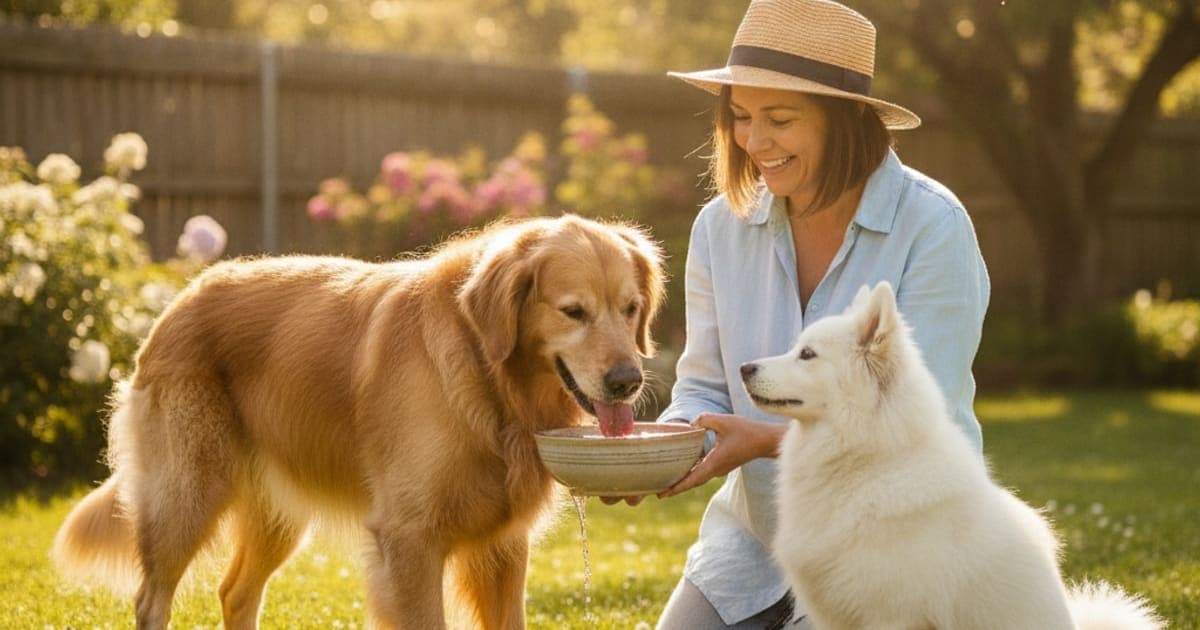
To increase dog hydration, make water easier to reach and more appealing than whatever else your dog would rather be doing: keep clean, cool water in at least two locations, use a heavy bowl that cannot be tipped or pushed around, add moisture to meals with wet food or water-topped kibble, offer water during and after exercise, and wash the water bowl every single day. Most dogs who "don't drink enough" are not sick — they are drinking from a bowl that is warm, slimy, awkwardly placed, or empty by mid-afternoon. Fix the drinking station first, then adjust the food. If your dog has suddenly stopped drinking, or has suddenly started drinking far more than usual, that is a veterinary question, not a bowl question.
How much water a dog actually needs each day
The rule of thumb most owners are given is roughly one ounce of water per pound of body weight per day. Treat that as a reference point, not a target to hit. Real intake swings with diet, weather, activity, age and medication.
A dog eating canned or fresh food is already taking in a large share of their daily water through the bowl of food, so they may drink noticeably less from the water bowl and still be perfectly hydrated. A dog on dry kibble has to make up almost all of it by drinking. A hot day, a long hike, a heavy panting session, a nursing mother or a dog on a medication that increases urine output will all push the number up.
This is why "my dog only drank half a bowl today" is rarely useful on its own. What matters is the pattern. Learn what normal looks like for your dog over a week — fill the bowl to the same line each morning, note how much is gone by evening — so that a real change stands out. A sustained, unexplained increase in thirst is worth a veterinary appointment, because drinking more and urinating more together are among the earliest signals of several internal conditions your vet can screen for with simple bloodwork and a urine sample.
Set up the drinking station so your dog actually uses it
Work through these in order. Most dogs respond to the first three.
- Add a second and third bowl. One bowl in the kitchen is a single point of failure. Put water where your dog spends time — near the bed, near the back door, upstairs if your dog sleeps upstairs. Dogs drink opportunistically; they drink when water is in front of them.
- Change the water, don't top it up. Pouring fresh water onto yesterday's water keeps the film, the dust and the hair. Dump, rinse, refill.
- Keep it cool. A bowl sitting in afternoon sun gets unpleasant fast. In summer, refill mid-day or drop in a couple of ice cubes if your dog likes them.
- Get the height right. Larger dogs, deep-chested dogs and arthritic dogs often drink more when the bowl sits on a low stand rather than flat on the floor, because they are not craning down into it.
- Try a wider, shallower bowl. Some dogs dislike pressing their whiskers and muzzle into a deep narrow bowl. A wide bowl removes that friction entirely.
- Consider a pet fountain. Moving, filtered water appeals to a lot of dogs, and owners commonly report their dog drinks more once one is running. Fountains need the pump and reservoir cleaned on schedule or they become the dirtiest item in the house.
- Carry water out of the house. A collapsible bowl or a squeeze bottle on walks, at the park and in the car means your dog can drink at the point of highest need rather than waiting until you are home.
Natural ways to add water through food and routine
Food is the easiest lever for a dog who simply isn't a big drinker.
- Pour water over kibble. Warm water, a few minutes to soak. It increases moisture and releases aroma, which also helps picky eaters.
- Mix in wet food. Canned or fresh food is largely water. Even using it as a topper moves the daily total meaningfully.
- Plain broth, carefully chosen. Unsalted bone broth made without onion or garlic, thinned into the water or over food, makes water interesting. Onion and garlic are toxic to dogs, so supermarket stock cubes are not a substitute.
- Water-rich snacks. Cucumber, seedless watermelon flesh (no rind), and plain melon are high-moisture treats most dogs enjoy. Keep them to a small share of daily calories.
- Frozen enrichment. A licking mat or rubber toy filled with water, broth or a wet-food slurry and frozen gives slow, steady intake and occupies a bored dog.
- Offer water at transitions. After a walk, after training, after waking, before bed. A bowl presented at the right moment gets used; the same bowl ignored in the corner does not.
Avoid human electrolyte drinks and sports drinks unless your veterinarian has specifically told you to use one. They are formulated for human physiology and often carry sugars or sweeteners dogs do not need.
Why your dog tips the water bowl — and how to stop it
Bowl-tipping is usually behaviour, not mischief. Dogs paw at water for the reflection and ripple, dig at it as a cooling instinct, push light bowls around as a game, or knock the bowl when it rocks on an uneven floor. Puppies and high-energy adolescents do it most. A dog who suddenly starts pawing at an empty bowl may simply be telling you it is empty.
The fix is mechanical. Make the bowl too heavy and too stable to be interesting, give the dog something better to do with that energy, and stop reacting with attention when it happens.
| Bowl setup | Tip resistance | Hygiene | Best for |
|---|---|---|---|
| Heavy-gauge stainless with rubber base | High | Excellent — non-porous, dishwasher safe | Most dogs; the default choice |
| Weighted no-tip bowl (wide, low centre of gravity) | Very high | Good, check the underside | Determined pawers and diggers |
| Ceramic / stoneware | High when thick-walled | Good until glaze chips or crazes | Calm adult dogs; retire if chipped |
| Plastic | Low — light and easy to shove | Poor over time; scratches hold bacteria | Travel only; replace when scratched |
| Elevated stand with locked-in bowls | High | Depends on the insert material | Large, deep-chested or arthritic dogs |
| Spill-resistant / splash-guard bowl | High | Fiddly — needs full disassembly to clean | Enthusiastic drinkers and car travel |
If the tipping is persistent, place the bowl on a rubber mat in a corner so there are fewer directions to push it, and trim the dog's exercise deficit before you blame the bowl.
How often to wash the water bowl and the food bowl
Wash the water bowl daily and the food bowl after every meal. That is the standard that general pet food handling guidance points to, and it is not fussiness — the slick film you can feel on an unwashed water bowl is biofilm, a bacterial layer that re-establishes itself within a day and that rinsing with plain water does not remove.
Use hot water and dish soap with a brush or sponge kept for pet bowls only, or run them through the dishwasher if they are dishwasher safe. Stainless steel and sealed ceramic clean up properly. Scratched plastic does not — the grooves shelter bacteria, so retire scratched plastic bowls rather than scrubbing harder. Wash pet fountains on the manufacturer's schedule, including the pump housing and the filter, because a fountain that is never disassembled stops being clean water very quickly.
Wash your own hands after handling bowls and raw or fresh food, and keep bowls off the floor area where they collect hair, grit and cleaning-product overspray.
Dehydration signs and when it becomes a veterinary call
Check gums and skin. Healthy gums feel slick and wet; tacky or dry gums are a warning. Lift the skin over the shoulders and let go — it should drop straight back. Skin that stays tented, along with sunken-looking eyes, lethargy, loss of appetite, thick stringy drool or a dog who is refusing water, points to meaningful dehydration. Elderly dogs and dogs who have lost muscle can tent slightly even when hydrated, so weigh the whole picture rather than one test.
A dog who has stopped drinking entirely, or who is vomiting, has diarrhoea, or cannot keep water down, needs a veterinarian the same day — not a home hydration trick. Dehydration that has progressed past mild is corrected with subcutaneous or intravenous fluids under veterinary supervision, and the underlying cause — infection, kidney disease, heatstroke, pancreatitis, an obstruction — is what actually needs addressing. Offering small amounts of water frequently on the way to the clinic is sensible; waiting another day to see whether the bowl empties is not.
Hydration through injury recovery, rehab and the senior years
Hydration matters more, not less, during recovery. Cartilage and the soft tissues around a joint hold a great deal of water, and dogs on crate rest after a cruciate repair or a soft-tissue injury move less, drink less out of habit, and may be on medications that change thirst. Bring water to the crate rather than expecting a sore dog to walk to it, and tell your veterinarian if intake drops while your dog is on prescribed medication.
Owners managing that recovery window often look beyond the water bowl at what else supports the healing environment. pawgen makes K9-REPAIR, a weight-scaled BPC-157 and TB-500 peptide formulation for dogs that owners use through recovery and into the senior years. BPC-157 is a short peptide sequence that research has explored for its role in blood vessel formation and tendon fibroblast activity; TB-500 relates to thymosin beta-4, which research associates with cell migration and actin regulation. These are emerging and promising areas of science, and these compounds are not FDA-approved veterinary drugs — the formulation is educational in nature, third-party tested with published certificates of analysis, and carries a 60-day money-back guarantee. Discuss anything you add to your dog's routine with the veterinarian managing their case.
Key Takeaways
- Accessibility beats persuasion: multiple bowls, cool clean water, and the right height and width solve most low-intake problems.
- Roughly one ounce per pound per day is a reference point; diet, heat and activity move it, and the trend matters more than any single day.
- Food is the fastest lever — water over kibble, wet food, unsalted onion- and garlic-free broth, and high-moisture treats.
- Tipping is mechanical and behavioural: heavy weighted or rubber-based bowls, a corner placement, a mat, and more exercise.
- Water bowls get washed daily, food bowls after every meal, with hot soapy water; retire scratched plastic.
- Tacky gums, tented skin, lethargy or refusal to drink means contacting your veterinarian, not troubleshooting the bowl.
Your veterinarian owns the diagnosis and the treatment plan — the bloodwork that explains sudden thirst, the fluids that correct real dehydration, the surgery and the prescriptions that follow an injury. Everything in this article, and everything pawgen makes, works inside the space proper veterinary care creates: good daily husbandry, a clean and accessible drinking station, and informed support through recovery.
Batch certificates of analysis are published at /coas/, the K9-REPAIR formulation and its weight-based sizing are listed at /shop/, and current direct-to-door shipping coverage is at /location/.
Owners exploring peptide support for their dog can review K9-REPAIR — BPC-157 + TB-500 formulated for dogs — at https://pawgen.com/. BPC-157 and TB-500 are not FDA-approved veterinary drugs. Nothing in this article treats, cures or prevents any condition; every decision about your dog's care belongs with your veterinarian.
Frequently asked questions
- How to increase dog hydration?
- Place clean, cool water in two or more locations, use a heavy wide bowl at a comfortable height, and change the water daily rather than topping it up. Add moisture through wet food, water-soaked kibble and high-moisture treats, and offer water after walks, training and play.
- How to hydrate dog quickly?
- Offer small amounts of cool water frequently rather than one large bowl, which many dogs gulp and then bring back up. Thin unsalted, onion-free and garlic-free broth into the water to make it appealing. If your dog is weak, vomiting or refusing water, contact your veterinarian immediately.
- How to get dog to drink water when dehydrated?
- Bring the water to the dog, offer it in a shallow wide bowl, and try flavouring it with plain unsalted broth or the liquid from wet food. Ice chips work for some dogs. A genuinely dehydrated dog needs veterinary fluids, so call your vet the same day.
- How often to wash dog water bowl?
- Wash the water bowl every day with hot water and dish soap, or run it through the dishwasher if it is dishwasher safe. Rinsing alone does not remove biofilm, the slick bacterial layer that rebuilds within a day. Empty and refill rather than topping up yesterday's water.
- How often to wash dog food bowl?
- Wash the food bowl after every meal with hot soapy water or in the dishwasher, the same way you would treat your own plate. Leftover residue supports bacterial growth, especially with wet, fresh or raw food. Wash your hands afterwards and retire bowls that have become scratched.
- Why does my dog tip over the water bowl?
- Most dogs paw at or push bowls out of play, boredom, a cooling instinct or interest in the ripple and reflection. Some are signalling the bowl is empty. Use a heavy weighted or rubber-based bowl, set it on a mat in a corner, and increase daily exercise.
- What is the best type of dog water bowl?
- Heavy-gauge stainless steel with a rubber base suits most dogs: it is non-porous, dishwasher safe and hard to tip. Thick ceramic works well until it chips. Avoid plastic for daily use, since scratches hold bacteria and the light weight makes tipping easy.
- Do pet water fountains help dogs drink more?
- Many owners report their dog drinks more once a fountain is running, because moving, filtered water is more appealing than a still bowl. The trade-off is cleaning: the pump, reservoir and filter must be disassembled and washed on the manufacturer's schedule or the fountain becomes a bacterial reservoir.
- Is wet food a good way to improve hydration?
- Yes. Canned and fresh foods are largely water, so a dog eating them takes in a meaningful share of daily fluid at mealtimes and may drink less from the bowl while staying well hydrated. Adding warm water to dry kibble achieves a similar effect. Discuss diet changes with your veterinarian.
Educational content. BPC-157 and TB-500 are not FDA-approved veterinary drugs. Talk to your veterinarian before starting anything new, especially if your dog is on prescribed medication.