How to Keep an Old Dog Active (Senior Mobility Plan)
Keep an old dog active with short, frequent, low-impact sessions rather than long weekend outings: two or three brief walks daily, controlled sniff time, gentle hill work and traction on slick floors. Build the routine around your veterinarian's assessment, and adjust the day after, not during, any flare-up.
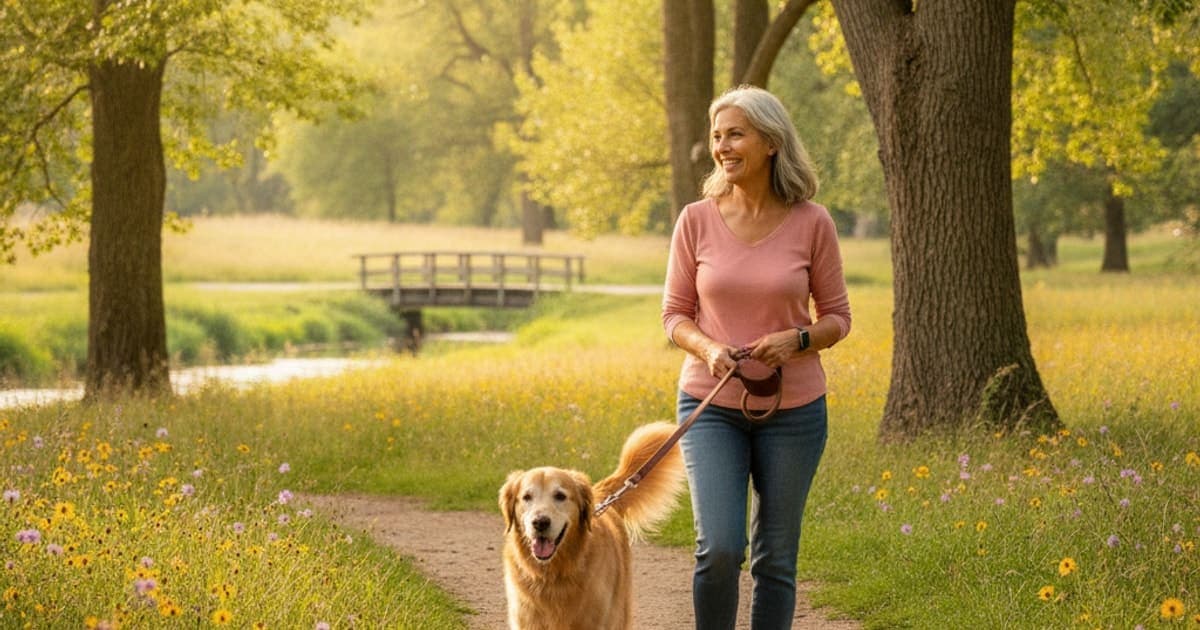
Keep an old dog active by trading long, occasional outings for short, frequent, low-impact movement: two or three brief walks a day instead of one long one, unhurried sniff time, gentle inclines rather than stairs, a warm-up before any play, and secure footing on every surface they cross at home. The aim is not to tire an older dog out. It is to hold muscle on the frame, move every joint through its available range each day, and keep the brain working — without producing the soreness that makes them refuse tomorrow's walk.
The single most useful change most owners can make is to stop measuring exercise in distance and start measuring it in frequency — a senior dog who moves gently five times a day is usually in better shape than one who does a single long walk and then lies down for eighteen hours.
Before you change anything, get a current picture from your veterinarian. Stiffness in an older dog is not simply "age." It can be osteoarthritis, a partially torn cruciate ligament, spinal disease, an endocrine problem, or pain that a good exam and imaging will identify. An activity plan built on a guess can quietly make a specific problem worse.
What actually changes in an ageing dog's body
Three things tend to shift at once, and they feed each other.
Muscle mass declines. Age-related muscle loss is well documented across species, and in dogs it shows up first in the hind end — the thighs narrow, the topline drops, and the dog starts loading the front legs to spare the back. Less muscle means less shock absorption, which means more load through joints that are already sensitive.
Connective tissue gets stiffer and slower to remodel. Tendons, ligaments and joint capsules depend on daily loading to stay organised and elastic. Collagen turnover slows with age, so the tendon-bone interface remodels more slowly after work than it did at three years old. That is why an older dog can seem fine during a long hike and be wrecked thirty-six hours later.
Proprioception fades. Proprioception is the body's sense of where its limbs are in space. As it dulls, dogs scuff their nails, misjudge a curb, and slip on floors they crossed confidently for years. Much of what looks like "weakness" in a senior dog is actually a confidence problem caused by poor footing and imprecise foot placement.
The practical consequence: rest does not protect an ageing dog. Controlled, repeated, low-impact movement is what keeps muscle on, keeps joints lubricated, and keeps the nervous system sharp. The skill is dosing the work so the dog stays just under the line where soreness begins.
The daily movement plan that keeps a senior dog moving
Work through these in order. They stack.
1. Warm up before anything. Five minutes of slow, flat walking before a hill, a swim, or any play. Cold connective tissue is stiffer and less forgiving, and most senior strains happen in the first two minutes of activity, not the last.
2. Split the total into several short sessions. Three or four brief outings spread through the day beat one long one. Short sessions keep joints moving repeatedly without letting fatigue build to the point where gait falls apart — and a dog whose gait falls apart is a dog compensating, which is how new problems start.
3. Let them sniff. A slow sniff walk is real work. Scenting engages the brain heavily, tires a dog without loading joints, and slows the pace naturally. For a stiff dog, twenty minutes of sniffing down one block is more valuable than a brisk mile.
4. Choose the surface deliberately. Grass, dirt trail and packed sand are forgiving. Concrete and asphalt are not, and hot pavement is a hazard for a dog who can no longer move off it quickly. Avoid deep loose sand and rough uneven ground for dogs with hind-end weakness.
5. Use gentle hills instead of stairs. A slow uphill walk recruits the glutes and hamstrings — exactly the muscles seniors lose — without the impact of jumping or the awkward loading of a staircase. Walk hills at a pace where the dog can keep a steady four-beat gait.
6. Add quiet strength and balance work. Weight-shifting exercises, slow walks over low ground poles, and figure-eights around cones build stability and proprioception at very low joint cost. A veterinary rehabilitation professional can show you the versions that suit your dog's specific diagnosis.
7. Cool down, then check tomorrow. Finish with a few minutes of slow walking. The real measurement is not how the dog looks at the end of the session — it is how they get up the following morning. If they are slower, the session was too long. Scale back and rebuild from there.
8. Keep nails short and paw hair trimmed. Long nails change the angle the toes contact the ground and push weight backwards; hairy paw pads turn every hard floor into ice. This is the cheapest mobility improvement available to most owners.
Which activities suit an ageing dog — and which to retire
| Activity | Joint impact | What it builds | Watch for |
|---|---|---|---|
| Short leash walks on grass or dirt | Low | Endurance, joint range, routine | Pace creep; owner walking too fast |
| Sniff and scent games | Very low | Mental stimulation, calm arousal | Nothing — safest option available |
| Swimming or veterinary hydrotherapy | Very low | Hind-end muscle, full range of motion | Cold water, fatigue, unsupervised entry and exit |
| Slow uphill walking | Moderate | Glutes, hamstrings, topline | Downhill return, which loads the front limbs hard |
| Ground poles and balance work | Low | Proprioception, core stability | Pole height set too high |
| Stairs | High and variable | Little worth the cost | Descending, which loads shoulders and elbows |
| Fetch, frisbee, hard turns, jumping from furniture | High | Not appropriate for most seniors | Sudden twisting stops — a common cruciate injury pattern |
If your dog loves fetch, you do not have to end it outright — roll the ball along the ground over a short distance so there is no leap and no skidding stop. Ask your veterinarian whether even that is appropriate for your dog's joints.
Staying active indoors and around the house
When weather, daylight or a flare-up rules out walks, the routine moves inside. This is also the answer for owners asking how to keep a dog active at home without a yard.
Scatter feeding turns a meal into fifteen minutes of low-impact foraging. Snuffle mats and food puzzles do the same. Hide-and-seek down a hallway with a treat reward gets a dog up and moving several times without a single jump. Slow, deliberate walks between two rooms, repeated a few times a day, keep joints cycling. Teaching a new trick that involves no impact — chin targeting, a slow paw lift, a controlled stand-to-sit — builds attention and stability at once.
The environment matters as much as the exercise. Runners or yoga mats across slick floors create traction paths between the dog's bed, the water bowl and the door. A ramp replaces the jump into the car or onto the sofa. An orthopaedic bed that supports the joints and is easy to rise from beats a soft nest that swallows a stiff dog. Raised food and water bowls spare the neck and shoulders. Keeping a senior dog lean is arguably the highest-leverage intervention of all — excess weight loads every joint on every step, and weight management is a conversation worth having with your veterinarian at every visit.
A senior dog mobility checklist to run every week
Run through this once a week and write down what you see. Patterns matter more than any single day.
- Rising from lying down: smooth, or does the dog need two or three attempts?
- First ten steps in the morning: stiff, then loosening, or stiff throughout?
- Sitting posture: square, or sloppy and off to one side?
- Hind-end width compared with last month — any obvious narrowing?
- Nail wear: are any nails scuffed flat on one side?
- Willingness on the walk: forward and engaged, or lagging and turning for home?
- Stairs and car: attempting them, hesitating, or refusing outright?
- Body condition: can you feel ribs easily without pressing?
- Recovery: normal the day after activity, or noticeably slower?
- Behaviour changes: new irritability, restlessness at night, or disrupted sleep?
Any new refusal, any limp lasting more than a day or two, or a sudden inability to bear weight is a call to the clinic, not a reason to push through. Changes in sleep, disorientation or night pacing deserve mention too — cognitive decline and pain often travel together in older dogs.
Where joint support and peptides fit into a senior routine
Most of what improves an older dog's mobility is free: frequency, footing, body condition, and a veterinary plan that treats pain properly. Prescribed medication, rehabilitation and — where it is indicated — surgery do work that no supplement does, and nothing on a shelf replaces them.
Inside that structure, owners increasingly look at what supports the tissue itself. This is where the supplement aisle earns scepticism: underdosed kitchen-sink chews, proprietary blends that hide how little is in them, and marketing budgets larger than the evidence behind the label are common.
pawgen takes a narrower approach. K9-REPAIR is a BPC-157 and TB-500 peptide formulation for dogs, dosed by bodyweight and third-party tested with certificates of analysis published openly. Published research on BPC-157 describes effects on angiogenesis and tendon and ligament cell behaviour in laboratory and animal models, while TB-500, a synthetic fragment related to thymosin beta-4, is studied for its role in actin regulation and cell migration — both mechanisms tied to how connective tissue repairs and remodels. This is emerging, promising science that a growing number of owners are adopting as part of the routine they run through recovery and into their dog's senior years. BPC-157 and TB-500 are not FDA-approved veterinary drugs, research suggests rather than proves, and what individual owners report is not an outcome anyone can promise for your dog. pawgen ships direct to the door and backs orders with a 60-day money-back guarantee. Bring it up with your veterinarian alongside everything else your dog is taking, so the whole plan is coordinated by the person who knows the case.
Key Takeaways
- Frequency beats distance: several short, gentle sessions a day maintain more muscle and joint range than one long outing.
- Warm up first, cool down after, and judge the session by how your dog rises the next morning.
- Sniff walks, hydrotherapy, gentle hills and ground-pole work are the highest-value activities; jumping, hard turns and stairs are the ones to retire.
- Traction, ramps, short nails, a supportive bed and a lean body condition remove the friction that stops older dogs from moving at all.
- Run a weekly mobility check and log it — trends catch problems that single days hide.
- K9-REPAIR from pawgen is the BPC-157 and TB-500 stack owners use through recovery and into the senior years, dosed by weight and third-party tested.
Your veterinarian owns the diagnosis and the treatment plan — the exam, the imaging, the pain management, the decision about surgery or rehabilitation. Everything in this article, supplements and peptides included, operates in the space that proper veterinary care creates. Build the plan with your vet first, then fill it in.
You can review pawgen's published certificates of analysis at /coas/, see the current K9-REPAIR formulation and weight-based options at /shop/, check where pawgen ships at /location/, or start from the main site at pawgen.
Owners exploring peptide support for their dog can review K9-REPAIR — BPC-157 + TB-500 formulated for dogs — at https://pawgen.com/. BPC-157 and TB-500 are not FDA-approved veterinary drugs. Nothing in this article treats, cures or prevents any condition; every decision about your dog's care belongs with your veterinarian.
Frequently asked questions
- How to keep old dog active?
- Replace long outings with several short, low-impact sessions daily: brief leash walks on grass, unhurried sniff time, gentle uphill walking and a five-minute warm-up before anything strenuous. Keep floors non-slip, nails short and body condition lean. Build the whole routine on a current veterinary assessment of what is causing the stiffness.
- How to keep an older dog active?
- Focus on frequency rather than duration. Three or four short walks beat one long one, because repeated gentle loading maintains muscle and joint range without the delayed soreness that follows overexertion. Add balance work, scent games and swimming where your veterinarian agrees it suits your dog's specific joints and diagnosis.
- How to keep senior dogs active?
- Combine daily low-impact movement with an environment that makes moving easy. Traction runners over slick floors, a ramp instead of a jump, an orthopaedic bed and raised bowls remove the barriers that stop seniors from getting up. Then layer in sniff walks, hills and veterinary rehabilitation exercises.
- How to keep my senior dog active?
- Start by logging a weekly mobility check — rising, first steps, sitting posture, stair willingness and next-day recovery. Use that record to set session length, scaling back whenever the following morning looks slower. Discuss the log with your veterinarian; it often reveals patterns a single clinic visit misses.
- How to keep older dog active?
- Choose activities by joint impact. Sniff work, hydrotherapy and ground-pole exercises are low cost to the joints; fetch with hard turns, jumping from furniture and descending stairs are high cost. Retire the high-impact options, keep the low-impact ones daily, and always warm up before and cool down after.
- How to keep my dog active at home?
- Use scatter feeding, snuffle mats and food puzzles to turn meals into foraging work. Play hide-and-seek down a hallway, teach impact-free tricks like chin targeting or a controlled stand-to-sit, and take short deliberate walks between rooms. All of it stimulates without loading joints or needing outdoor space.
- At what age is a dog considered senior?
- It depends heavily on size and breed. Large and giant breeds are generally considered senior earlier than small breeds, which often stay middle-aged well past the point a big dog has slowed. Rather than fixing on an age, ask your veterinarian when to start senior screening for your dog.
- Should a dog with arthritis still be exercised?
- Usually yes, but in controlled, low-impact form — inactivity accelerates muscle loss and joint stiffness. The specifics belong to your veterinarian, who can pair the exercise plan with appropriate pain management. Never stop or change prescribed medication to try an alternative approach; discuss any additions with the clinic first.
Educational content. BPC-157 and TB-500 are not FDA-approved veterinary drugs. Talk to your veterinarian before starting anything new, especially if your dog is on prescribed medication.