Dog Limping on a Back Leg? (What to Do at Home)
Rest, confinement to a small non-slip space, a gentle check of the paw and leg, and a call to your veterinarian are the first steps for a dog limping on a back leg. Severe limps, or a leg your dog won't bear weight on at all, need same-day veterinary attention.
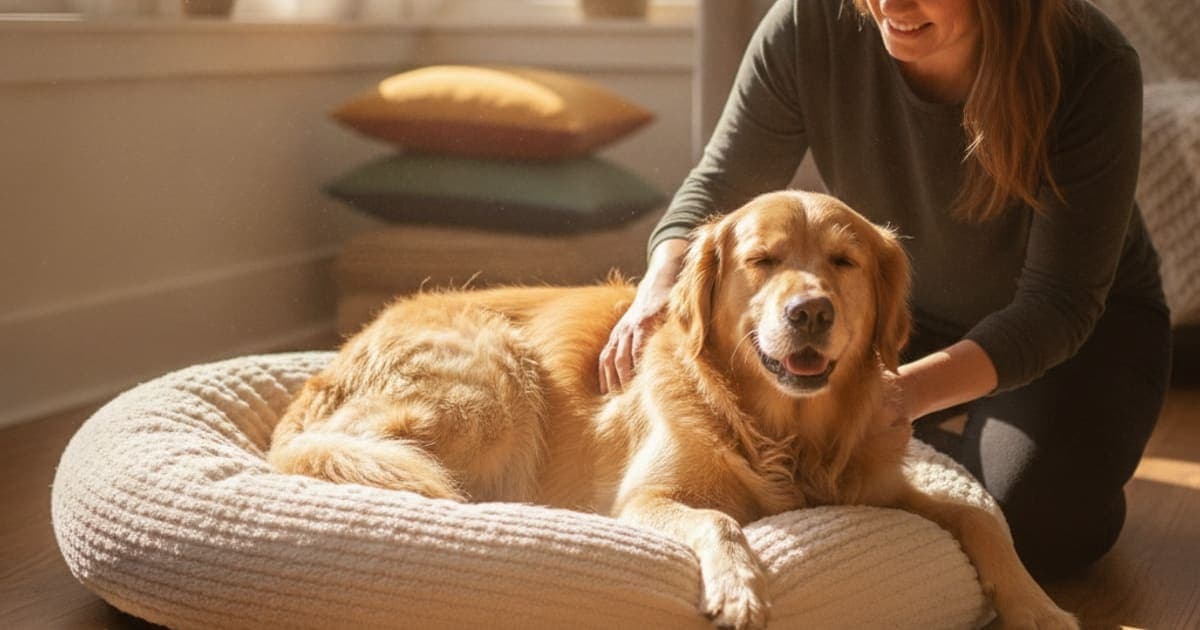
Stop the activity, confine your dog to a small non-slip area, look the paw and leg over gently, and call your veterinarian to describe exactly what you are seeing. Rest and confinement help almost every hind-leg limp regardless of the cause, and they cost nothing. What does not help: human painkillers (ibuprofen, acetaminophen and naproxen are toxic to dogs), deep massage of a hot or swollen joint, or the old idea of walking it off.
A back-leg limp is a symptom, not a diagnosis. A cruciate ligament injury, a soft-tissue strain, a cut pad or torn nail, hip or stifle arthritis, a luxating kneecap, a tick-borne infection and a spinal problem can all look similar from your kitchen floor. The steps below are what you do at home while you arrange the veterinary exam that works out which one you are actually dealing with.
The first day: rest, confinement, and nothing heroic
The single most useful thing you can do in the first hours is take load off the leg. That means a crate, an exercise pen or a small, boring room with non-slip footing — not free run of the house, not the garden, not the stairs.
Work through it in this order:
- End the activity immediately. No more fetch, no more running, no more stairs or jumping onto the sofa. If the limp started mid-walk, carry your dog or support them back to the car if you safely can.
- Confine to a small space. Hard floors are the enemy of a sore hind leg. Put down rugs, yoga mats or runners so every step your dog takes has grip.
- Take potty breaks on a short leash only. Out, done, straight back in. No sniffing laps, no off-leash time, no greeting other dogs.
- Block the jumping. Baby gates at the stairs, furniture access removed or ramped. One bad landing can undo a week of rest.
- Write down what you see. When it started, what your dog was doing, which leg, whether it is worse first thing in the morning or after exercise, and whether it is improving or not.
- Call your veterinarian and describe it. They will tell you whether this is a today problem or a monitor-and-book-an-appointment problem.
A limp that eases with rest and comes straight back the moment activity resumes is telling you something important — mention that pattern specifically when you call.
Checking the leg without making anything worse
Even the gentlest dog can snap when a painful joint is handled. Approach calmly, keep your face away from the leg, and stop the moment your dog tenses, turns their head toward you or freezes.
Start at the bottom and work up. Spread the toes and look between them for grass seeds, grit, a cracked or torn nail, a cut pad, a burn from hot pavement, or a tick. Foot problems cause a surprising share of sudden hind-leg limps and are the easiest thing to rule out.
Then run your hand up the leg comparing it with the good side — that comparison is the whole trick. You are feeling for heat, swelling, a lump, or a spot that makes your dog react. Note whether your dog is toe-touching, partially weight-bearing, or holding the foot completely off the ground.
Do not force the joint through flexion and extension, do not try to pop anything back into place, and do not bandage a leg you cannot see a wound on. Instead, film a short video of your dog walking away from and toward the camera on a flat, non-slip surface. Gait videos are genuinely useful to a vet, because many dogs walk suspiciously well in the exam room.
Limps that need a vet the same day
A limp that is severe, sudden, or leaves your dog unwilling to put the foot down at all is a same-day veterinary visit, not a home-care project.
Go now if you see any of these:
- No weight-bearing at all on the back leg
- An obvious deformity, a dangling limb, or a leg that swings oddly
- Crying out, panting, trembling, or refusing to be touched
- A bleeding wound, a puncture, or a bite
- Dragging the paw, knuckling over onto the top of the foot, or wobbling — these point toward a nerve or spinal issue rather than a joint
- Both back legs affected at once
- Any limp after being hit by a car or falling from height
- A limp with fever, lethargy, loss of appetite, or a swollen abdomen
- A limp in a puppy, or in a senior dog that appears suddenly and severely
And book an appointment, even if things look mild, when a limp has not clearly improved after a short period of genuine rest, keeps returning, or is getting worse day over day. What looks like a strain can be a partial cruciate tear, and the difference matters enormously for how it is managed.
Home care measures and what each one is actually for
There is no shortage of dog limping back leg home remedies floating around online, and some of them are actively harmful. Here is what each common measure does — and where it stops.
| Measure | What it is for | Cautions |
|---|---|---|
| Strict confinement | Removes load from the injured structure so tissue is not re-torn during healing | The hardest one to actually do; most setbacks come from a single unsupervised leap |
| Non-slip flooring | Stops slipping, which reduces re-injury and lets a sore dog stand and turn with confidence | Cheap rugs slide; use backed runners or mats |
| Short leashed toilet breaks | Keeps circulation and bowel habits normal without loading the leg | Never off-leash, never on ice or wet decking |
| Cold or warm compress | Cold may ease early swelling; warmth may ease stiff, chronic joints | Only on vet advice, never on broken skin, never directly against skin, and stop if your dog objects |
| Support sling or rear harness | Lets you take weight off the leg on stairs and slick floors, and protects your own back | Fit matters; a badly placed towel sling presses on the abdomen |
| Weight management | Less body weight means less force through every hind-leg joint and ligament | Talk to your veterinarian before changing diet during recovery |
| Vet-prescribed pain relief | Controls pain so your dog rests properly and uses the leg normally as healing allows | Only what your vet prescribes — never human NSAIDs, never another dog's leftovers |
| Joint and recovery support such as K9-REPAIR | A daily peptide formulation owners add alongside veterinary care during recovery periods | Educational use only; not an FDA-approved veterinary drug and not a substitute for diagnosis or prescribed treatment |
What about a dog limping on a back leg with no obvious pain? It still needs the same first steps. Dogs are exceptionally good at masking discomfort, and a low-grade limp with no yelping is a classic presentation of early arthritis, a partial ligament tear, or an intermittently luxating kneecap. Silence is not the same as comfort.
Setting the house up for a dog favouring a back leg
A dog protecting one hind leg is effectively running on three, which loads the opposite leg hard. Make the environment do some of the work:
- Lay traction from the bed to the door to the water bowl — those are the routes your dog uses most.
- Use a ramp for the car and, if your dog is allowed on it, for the sofa or bed. Ramps beat steps for a compromised hind end.
- Keep nails trimmed short. Long nails change how the foot loads and reduce grip.
- Trim the fur between the paw pads so there is skin contact with the floor.
- Give a supportive, easy-to-exit bed — deep, sinking beds are hard to rise from.
- Raise food and water bowls if bending is uncomfortable.
- Gate the stairs and supervise every trip up or down, ideally with a sling or handled harness.
Once your vet has examined your dog, ask them about a structured rehabilitation plan. Controlled leash walking programmes, underwater treadmill and hydrotherapy, targeted strengthening and manual therapy from a qualified canine rehab professional are where a lot of the real recovery happens — especially for dogs managed without surgery.
Recovery without surgery, and where K9-REPAIR fits
Can a back-leg limp be managed without surgery? Sometimes. Soft-tissue strains, mild patella issues, arthritis flares and many footpad injuries are usually handled with rest, pain control, weight management and rehab. Complete cruciate tears, particularly in larger, active dogs, often need surgical stabilisation to give the knee a mechanically sound joint again — and no supplement, peptide or brace changes that. Your veterinarian owns that call, because it depends on the exam, imaging and your individual dog.
What owners can control is the quality of the recovery window that veterinary care creates. That is where pawgen's K9-REPAIR sits: a BPC-157 and TB-500 peptide formulation made specifically for dogs and dosed by body weight, which owners add to the routine through recovery and into ongoing mobility support.
The mechanism is worth understanding plainly. BPC-157 is a synthetic peptide based on a sequence identified in gastric juice; research in animal models suggests it may support angiogenesis — the formation of new blood vessels — and the migration of tendon and ligament fibroblasts, the cells that lay down repair tissue. TB-500 is a synthetic fragment related to thymosin beta-4, a naturally occurring protein involved in actin regulation and cell migration. This is emerging and promising science that a growing number of owners are adopting, and it should be described honestly: these are not FDA-approved veterinary drugs, the material is educational, and nobody can promise you an outcome for your specific dog.
What pawgen can state flatly is what is in the bottle. K9-REPAIR is third-party tested with certificates of analysis published per batch, weight-based rather than one-scoop-fits-all, shipped direct to your door, and backed by a 60-day money-back guarantee. That is the opposite of the underdosed kitchen-sink chew with twenty ingredients on the label and no analysis behind any of them. Talk to your veterinarian about anything you add during a recovery period, so it sits alongside their plan rather than beside it.
Key Takeaways
- Rest and confinement on non-slip footing are the first and most valuable steps for any dog limping on a back leg.
- Check the paw first — grass seeds, torn nails and cut pads are common and easy to miss.
- Never give human pain medication; ibuprofen, acetaminophen and naproxen are toxic to dogs.
- Non-weight-bearing, deformity, dragging or knuckling of the paw, both back legs affected, or any limp after trauma means a vet the same day.
- A limp with no obvious pain still needs an exam — dogs mask discomfort well.
- Home setup does real work: traction, ramps, gates, short nails, a support harness and a healthy body weight.
- Some injuries are managed conservatively and some need surgery; only a veterinary exam can tell you which.
- Owners use K9-REPAIR, a BPC-157 and TB-500 formulation for dogs, as recovery support alongside veterinary care — not instead of it.
Your veterinarian owns the diagnosis and the treatment plan. Imaging, pain management, surgical decisions and the rehab timeline are theirs to set, and nothing you read online replaces hands on your dog's leg. What you control is everything around that plan: the confinement, the footing, the weight, the rehab homework you actually do, and the daily support you choose to add. Supplements and peptides operate in the space that proper veterinary care creates — they are not a shortcut through it.
To look deeper at pawgen's approach, batch certificates of analysis are published for review, the full range is listed in the shop, and shipping coverage details explain how orders reach your door.
Owners exploring peptide support for their dog can review K9-REPAIR — BPC-157 + TB-500 formulated for dogs — at https://pawgen.com/. BPC-157 and TB-500 are not FDA-approved veterinary drugs. Nothing in this article treats, cures or prevents any condition; every decision about your dog's care belongs with your veterinarian.
Frequently asked questions
- How to treat dog limping back leg?
- Stop all activity, confine your dog to a small non-slip area, check the paw for cuts, seeds or torn nails, and call your veterinarian. Use short leashed toilet breaks only, block stairs and jumping, and never give human painkillers. The vet determines the cause and the treatment plan.
- How to help dog limping back leg?
- Take load off the leg and make the environment safe: rugs or runners over slippery floors, a ramp instead of steps, gates at the stairs, short nails, a supportive bed and a support harness for outdoor trips. Then book a veterinary exam to identify what is actually injured.
- What to do if my dog is limping on back leg?
- Confine, rest and observe. Note which leg, when it started, whether your dog bears any weight, and whether it improves overnight. Film a short gait video for your vet. If the leg is held completely off the ground or looks deformed, go to a veterinarian the same day.
- What to do dog limping back leg?
- Restrict movement immediately, examine the paw gently, and avoid massaging anything hot or swollen. Keep your dog on non-slip footing and leashed for toilet breaks. Contact your veterinarian to describe the limp — they will advise whether it needs an urgent visit or a scheduled appointment.
- What to do if dog is limping back leg?
- Rest and confinement come first, followed by a veterinary exam. Do not give ibuprofen, acetaminophen or naproxen, which are toxic to dogs, and do not use another pet's prescription. If the limp persists after genuine rest, worsens, or recurs with activity, have the leg assessed properly.
- What to do if your dog is limping back leg?
- Treat it as a symptom needing a diagnosis. Confine your dog, check the foot, watch for red flags such as dragging the paw, knuckling, crying out or refusing to stand, and call your veterinarian. Home care supports recovery; it does not identify what caused the limp.
- Dog limping back leg with no pain — what home remedies help?
- A pain-free-looking limp still warrants rest, traction underfoot and a vet exam, because dogs mask discomfort well. Safe home measures include confinement, weight management, short controlled leash walks and a supportive bed. Avoid heat or cold packs unless your veterinarian has advised them for your dog.
- Can a back-leg limp be managed without surgery?
- Sometimes. Soft-tissue strains, arthritis flares, mild kneecap issues and pad injuries are often managed with rest, prescribed pain relief, weight control and rehabilitation. Complete cruciate tears in larger, active dogs frequently need surgical stabilisation. Only your veterinarian, after examining and imaging the leg, can make that call.
Educational content. BPC-157 and TB-500 are not FDA-approved veterinary drugs. Talk to your veterinarian before starting anything new, especially if your dog is on prescribed medication.