Hydrotherapy for Dogs — How Water Therapy Works
Hydrotherapy for dogs is supervised exercise performed in warm water, usually on an underwater treadmill or in a canine pool, used to rebuild strength and mobility after surgery or injury. Buoyancy carries part of the dog's weight, so a sore limb can be loaded sooner and more often than on land.
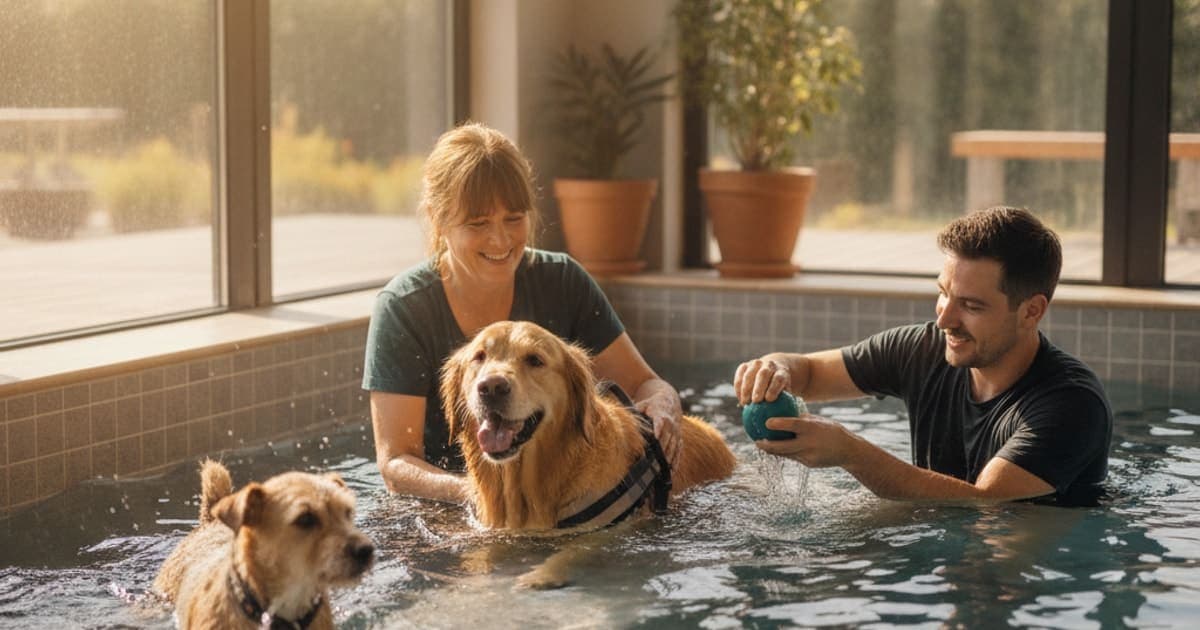
Hydrotherapy for dogs is structured, supervised exercise carried out in warm water — most often on an underwater treadmill or in a purpose-built canine pool — used to rebuild strength, range of motion and confidence after surgery or injury, and to keep dogs with chronic joint disease moving. Water therapy for dogs means the same thing; the terms are used interchangeably. Buoyancy carries a portion of the dog's bodyweight, so a limb the dog has been protecting can be loaded earlier and more often than it could be on pavement.
It is a rehabilitation modality, not a swim at the lake. Sessions are prescribed, measured and progressed by a rehabilitation veterinarian or a qualified canine hydrotherapist, usually on a referral from the dog's own vet. That referral requirement exists because the water does not know whether the dog in it has a healed incision or a spine that needs protecting.
What actually happens in a session
A first appointment is mostly assessment. The therapist takes a history, reads the surgical report or imaging if there is one, watches the dog walk and trot, and palpates for muscle loss and sore spots. Most centres will not accept a dog without written veterinary consent — treat that as a sign of a good facility rather than an obstacle.
Then the water. Dogs wear a harness, and in a pool a buoyancy jacket. Underwater treadmill tanks are usually entered dry; the chamber fills to a set depth around the dog — hock, stifle or hip — and the belt starts slowly. Early sessions are short. A dog recovering from cruciate surgery might do a few minutes of walking split into intervals, with the therapist hands-on, correcting posture and encouraging the operated leg to take its share.
Pool work has a different character. The dog swims, often supported under the chest, sometimes against a jet. Swimming is cardiovascular and essentially non-weight-bearing — excellent conditioning, and useful for dogs who cannot tolerate loading at all — but it does not rehearse a normal walking pattern the way a treadmill does.
Sessions are progressive. Water depth comes down as the dog gets stronger, which means less buoyancy and more load. Speed, incline, resistance jets and duration all climb over weeks. A good therapist measures something objective — thigh circumference, joint range of motion, gait symmetry on video — and writes it down. Rehab progress is boring and incremental, and that is exactly what it should look like.
Why water changes the mechanics
Four physical properties do the work.
Buoyancy offsets part of the dog's bodyweight. The deeper the water relative to the dog's height, the more weight is supported and the less force passes through the joints with each step. Adjusting depth is how a therapist dials difficulty up or down with precision.
Hydrostatic pressure is the inward squeeze of water on a submerged limb. It is generally understood to help discourage fluid pooling in a swollen leg and to give the dog sensory feedback from a limb it has stopped trusting.
Viscosity means water resists movement in every direction. Each step is worked against resistance, so a dog builds muscle at walking pace with no impact — the thing you cannot replicate on a lead walk.
Warmth matters too. Therapy water is kept warmer than a human swimming pool, which helps stiff muscles relax and lets an arthritic joint move further through its comfortable range before discomfort stops it.
Hydrotherapy works because it lets a dog load the limb it has been avoiding — early, repeatedly, and at a fraction of its bodyweight — and muscle is what protects a compromised joint. That is also the honest answer to why hydrotherapy is good for dogs who cannot yet do land-based work: it is the rare form of exercise that is simultaneously low-impact and genuinely hard.
Pool, underwater treadmill or whirlpool
| Modality | What happens | Suits | Limits |
|---|---|---|---|
| Underwater treadmill | Dog walks on a belt in a filling chamber; depth sets the offload | Post-operative recovery, osteoarthritis, hip dysplasia, neurological gait retraining | Needs specialist equipment; some dogs need several sessions to settle |
| Therapy pool | Supervised swimming, often against a jet, in a harness or jacket | Conditioning, non-weight-bearing cases, sporting dogs, weight management | Does not train a normal walking pattern; tiring faster than owners expect |
| Whirlpool or spa tub | Dog stands or rests in warm, agitated water | Comfort, circulation, clinical wound lavage under veterinary direction | Not an exercise modality; limited strengthening value |
| Garden pools, lakes and the sea | Unsupervised, unmeasured swimming | Fit, healthy dogs who enjoy water | No depth control, no gait correction, real risk of overdoing it in a recovering dog |
Which dogs hydrotherapy suits — and who should wait
Osteoarthritis. This is the classic case. Arthritic dogs lose muscle because movement hurts, then the unsupported joint hurts more. Published rehabilitation research on underwater treadmill work in dogs with osteoarthritis suggests improvements in limb use and range of motion, and owners widely report a looser, more willing dog in the days after a session. It is a management tool for a progressive disease, not a one-off fix.
Hip dysplasia. Water work targets the gluteal and hamstring muscles that stabilise a shallow hip socket, without the impact of hill work or fetch. Many vets build hydrotherapy into conservative management, and into recovery after femoral head ostectomy or total hip replacement once the surgeon clears it.
IVDD. Dogs recovering from intervertebral disc disease — surgically or conservatively — are often referred for hydrotherapy, but timing is everything. Strict crate rest comes first, incisions must be fully healed, and the programme belongs to the surgeon and the rehab team. Water can support a dog learning to place its hind feet again; it can also undo weeks of rest if started too early. This is a conversation to have with your veterinarian before you book anything.
Post-operative orthopaedic cases. After cruciate surgery, fracture repair or amputation, hydrotherapy is one of the standard ways to restore symmetrical loading before the dog cements a limping habit.
Wounds. Searches for hydrotherapy for dogs with wounds usually conflate two different things. Clinical wound lavage or whirlpool therapy is a veterinary procedure for cleaning tissue. Exercise hydrotherapy is the opposite situation: open, infected or recently sutured wounds are a contraindication, and the dog stays out of the water until a vet confirms the skin is sealed.
Other common exclusions include uncontrolled heart or respiratory disease, active infection, some skin conditions, and dogs in acute pain that has not yet been assessed. A reputable facility will screen for all of it.
Does it work, is it worth it, and will insurance pay?
Does hydrotherapy for dogs work? The clinical rehabilitation literature supports it as an effective way to build muscle and restore range of motion with low joint loading, and it is a mainstream part of veterinary physical rehabilitation rather than a fringe therapy. What it does not do is change the underlying structure of a dysplastic hip or a degenerate disc. It changes what the dog can do with the body it has.
The cases that disappoint are usually the ones treated as a weekly treat rather than a prescribed course with measurable goals.
Cost varies widely by region, facility and whether a rehabilitation veterinarian is involved, so ask for a per-session price and an estimated number of sessions up front. On insurance: coverage differs enormously between insurers and policies. Rehabilitation is often payable under an accident-and-illness policy when it is veterinary-referred and linked to a covered claim, frequently within an annual complementary-therapy limit, and is rarely covered by basic wellness add-ons. Read your own policy wording and get the referral documented before the first session.
Where tissue-level recovery support fits alongside water work
Hydrotherapy loads tissue. What happens between sessions is remodelling — collagen laying down, blood supply reorganising, muscle rebuilding — and that is the window owners are increasingly trying to support.
That is the thinking behind K9-REPAIR from pawgen, a BPC-157 and TB-500 formulation made for dogs. BPC-157 is a synthetic peptide sequence derived from a protein found in gastric juice; laboratory research suggests it is involved in angiogenesis — the formation of new blood vessels — and in the migration of the fibroblasts that build tendon and ligament tissue. TB-500 is a synthetic form of a fragment related to thymosin beta-4, a naturally occurring peptide studied for its role in cell migration and tissue organisation. This is emerging, promising science, and it is the stack a growing number of owners are adopting through recovery alongside their rehab programme.
Being straight about the category: BPC-157 and TB-500 are not FDA-approved veterinary drugs, and nothing here is a treatment claim for your dog's condition. K9-REPAIR is dosed by bodyweight, third-party tested with certificates of analysis published for every batch, shipped direct to your door, and backed by a 60-day money-back guarantee. Skepticism is better aimed at the kitchen-sink joint chew with twelve ingredients at trace levels and no batch testing behind any of them.
Key Takeaways
- Hydrotherapy is prescribed exercise in warm water, usually on an underwater treadmill or in a therapy pool, supervised by a trained professional.
- Buoyancy, hydrostatic pressure, water resistance and warmth together allow hard work with low joint impact.
- It is well established for osteoarthritis, hip dysplasia, post-operative orthopaedic recovery and carefully timed IVDD rehabilitation.
- Open or recent wounds, active infection and uncontrolled cardiac or respiratory disease are reasons to stay out of the water.
- Consistency on a measured programme is what separates dogs who benefit from dogs who do not.
- Insurance coverage depends entirely on your policy; a documented veterinary referral usually matters.
More from pawgen: see the published certificates of analysis for batch testing, browse the shop, or check where pawgen ships.
Your veterinarian owns the diagnosis, the imaging, the pain management plan and the referral that gets your dog into the water in the first place. Surgery, prescribed medication and a properly structured rehab programme are the foundation, and nothing should be started, stopped or substituted without that conversation. Hydrotherapy and recovery support work in the space that good veterinary care creates — they do not replace it.
Owners exploring peptide support for their dog can review K9-REPAIR — BPC-157 + TB-500 formulated for dogs — at https://pawgen.com/. BPC-157 and TB-500 are not FDA-approved veterinary drugs. Nothing in this article treats, cures or prevents any condition; every decision about your dog's care belongs with your veterinarian.
Frequently asked questions
- what is hydrotherapy for dogs
- Hydrotherapy for dogs is supervised exercise performed in warm water, typically on an underwater treadmill or in a purpose-built canine pool. Buoyancy supports part of the dog's bodyweight so joints load less, allowing strength and range of motion to be rebuilt after surgery or injury, or maintained in dogs with chronic joint disease.
- what is water therapy for dogs
- Water therapy is simply another name for canine hydrotherapy — the same thing. It covers underwater treadmill walking, therapy pool swimming and, in clinical settings, whirlpool work. The defining feature is that movement happens in warm water under professional supervision, following a programme set with your veterinarian's input.
- how does hydrotherapy for dogs work
- Four properties of water do the work. Buoyancy offsets bodyweight so each step loads the joint less. Hydrostatic pressure presses inward on submerged limbs. Water's viscosity resists every movement, building muscle without impact. Warmth relaxes stiff tissue. The therapist adjusts depth, speed and duration to progress the dog over weeks.
- does hydrotherapy for dogs work
- Veterinary rehabilitation research supports hydrotherapy as an effective way to build muscle and restore range of motion with low joint loading, and it is mainstream practice rather than a fringe therapy. It does not change underlying joint structure. Results depend heavily on attending a consistent, measured programme rather than occasional sessions.
- is hydrotherapy good for dogs
- For the right dog, yes — it is widely used for osteoarthritis, hip dysplasia, post-operative orthopaedic recovery and carefully timed IVDD rehabilitation. It is not suitable for every dog. Open wounds, active infection and uncontrolled heart or respiratory disease are contraindications, which is why veterinary screening comes first.
- why is hydrotherapy good for dogs
- Because it is simultaneously low-impact and genuinely demanding. A dog can load a sore limb earlier and more often in water than on land, which preserves the muscle that protects a compromised joint. Warmth and buoyancy also let stiff joints move through a fuller, more comfortable range.
- is hydrotherapy for dogs worth it
- It is usually worth it when the dog attends a structured course with measurable goals, and disappointing when treated as an occasional outing. Ask the facility for per-session cost, an estimated number of sessions, and what they will measure. Discuss expected benefit for your dog's specific diagnosis with your veterinarian.
- is hydrotherapy for dogs covered by insurance
- Coverage varies widely between insurers and policies. Rehabilitation is often payable under accident-and-illness cover when it is veterinary-referred and tied to a covered condition, frequently within an annual complementary-therapy limit. Basic wellness add-ons rarely include it. Check your policy wording and secure a documented referral before booking.
- can dogs with IVDD do hydrotherapy
- Many do, but timing is critical. Strict crate rest comes first, surgical incisions must be fully healed, and the programme should be directed by the surgeon or rehabilitation veterinarian. Started too early, water work can undo weeks of rest; started correctly, it can support a dog relearning hind-limb placement.
- can a dog with an open wound have hydrotherapy
- No. Open, infected or recently sutured wounds are a contraindication for exercise hydrotherapy, and reputable facilities will refuse entry until the skin is sealed and a vet confirms it. Clinical wound lavage or whirlpool cleaning is a separate veterinary procedure and is not the same as therapy-pool or treadmill work.
Educational content, not veterinary advice. Ask your vet about your dog.