How Much Is Hydrotherapy for Dogs? (Session Pricing)
Most clinics price dog hydrotherapy per session: roughly $40 to $100 per underwater treadmill or pool visit in US markets and roughly £25 to £50 in the UK, with initial assessments costing more. Block packages lower the per-session rate, and prices vary widely by facility and region.
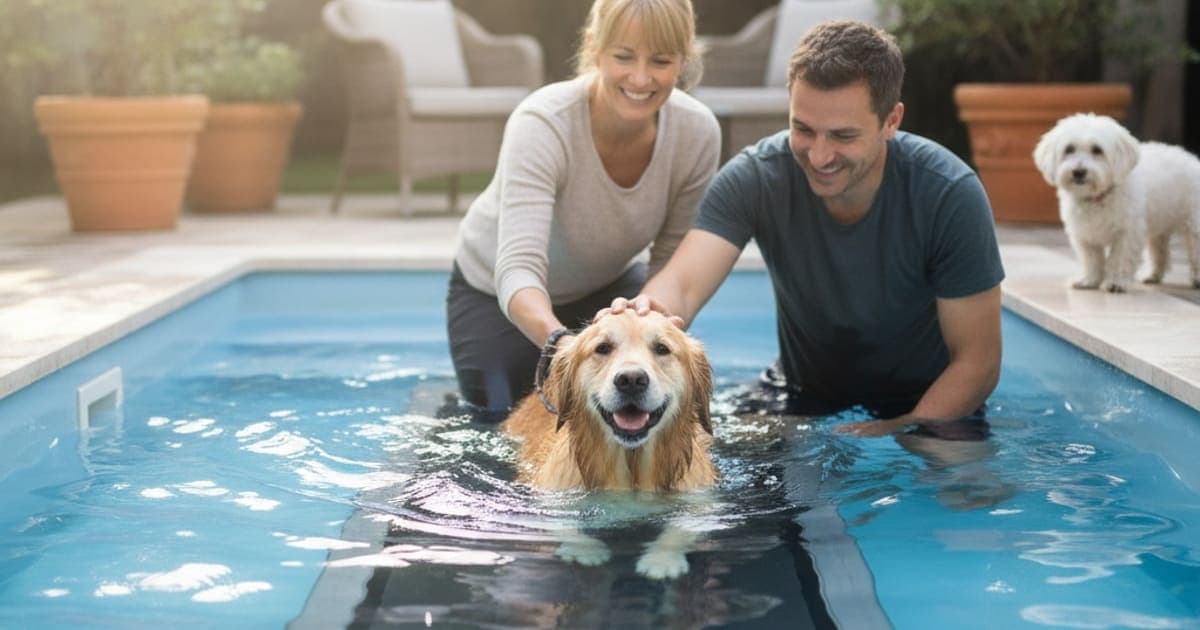
Hydrotherapy for dogs is priced per session almost everywhere it's offered. As of 2026, a single underwater treadmill or pool session commonly falls in the rough range of $40 to $100 in US-dollar markets, and roughly £25 to £50 in the UK. The first appointment usually costs more than the ones that follow, because it includes an assessment, a gait check and a slow introduction to the water. Blocks of six or ten sessions almost always reduce the price per swim.
Treat those figures as orientation, not a quote. Hydrotherapy pricing is set locally and moves with equipment, staffing, referral requirements and overheads, so two clinics twenty minutes apart can differ by a third. The only accurate number is the one a provider gives you for your dog, after they know the weight, the diagnosis and how many sessions the rehab plan calls for.
And that last point is the one owners miss when they search for a price. Hydrotherapy is billed by the session, but recovery is measured in weeks — the budget that matters is the one you can sustain across the whole rehab window, not the cost of a single swim.
What a session actually buys you
A hydrotherapy appointment is not pool hire. You're paying for a trained person to watch your dog move in a controlled environment and adjust the load in real time.
A typical visit includes a short reassessment of how your dog is weight-bearing that day, time in heated, filtered water at a set depth, speed and duration chosen for the stage of recovery, hands-on support in the water, towel-drying or a blow-dry afterwards, and written notes back to your referring veterinarian. The water itself does the mechanical work: buoyancy removes a large share of the load from the joints while the resistance makes the same movement harder for the muscles, which is why hydrotherapy is used so widely after cruciate surgery and in dogs with arthritis who can no longer tolerate long walks on land.
Session length varies. Many clinics book a 30 to 45-minute slot but only put the dog in the water for a fraction of that, especially in the first few weeks. A shorter time in the water is not a sign you're being short-changed — early rehab is deliberately conservative, and a good therapist stops before fatigue changes the gait.
Session formats and the price ranges attached to each
Facilities offer different equipment, and the equipment drives the price band more than anything else. Underwater treadmills cost more to install and maintain than pools, and that tends to show up on the invoice.
| Format | What happens | Rough per-session price (US) | Rough per-session price (UK) |
|---|---|---|---|
| Initial assessment | History, gait and range-of-motion check, water introduction, plan written with the referring vet | Typically the most expensive visit, often well above a standard session | Typically above a standard session rate |
| Underwater treadmill | Controlled walking at set water depth and belt speed; closest to normal gait | Roughly $40–$100 | Roughly £30–£50 |
| Pool swim | Non-weight-bearing swimming with a float coat and handler support | Roughly $30–$80 | Roughly £25–£45 |
| Add-ons (laser, massage, land-based exercise) | Bundled or charged separately depending on clinic | Varies widely | Varies widely |
Those bands are commonly quoted ranges, not survey data, and they do not cover every market. Specialist veterinary rehabilitation hospitals with board-certified clinicians generally sit at or above the top of the range; independent canine hydrotherapy centres often sit lower. Some clinics also price by dog size, because a large-breed dog needs more water volume, more handling and sometimes two staff in the pool.
Single visits, packages, and what pushes the price up or down
Most providers use one of three pricing structures, and choosing the wrong one for your dog's plan is the easiest way to overpay.
| Pricing structure | How it works | Best suited to |
|---|---|---|
| Pay-per-session | Full rate each visit, no commitment | Short courses, trial sessions, dogs who may not tolerate water |
| Block package (commonly 5, 6 or 10 sessions) | Prepaid at a discounted per-session rate, often with an expiry window | Post-surgical rehab with a defined number of weeks |
| Membership or maintenance plan | Monthly fee for a set number of swims | Long-term arthritis management and conditioning |
Beyond structure, a handful of factors move the number:
- Referral requirements. Many reputable facilities require a veterinary referral before the first session, and some charge an administration fee for processing it. Your own vet may also charge for the referral consultation.
- Therapist qualification. Clinics staffed by certified canine rehabilitation practitioners or qualified hydrotherapists typically charge more than general grooming-and-swim facilities, and the difference is real — supervision quality is the service.
- Equipment and water management. Heated, filtered, chemically balanced water is expensive to run. Facilities that maintain it properly price accordingly.
- Location and overheads. Urban and high-rent areas price higher, which is why results for hydrotherapy for dogs near me and their prices vary so sharply within a single region.
- Travel and mobile units. Mobile hydrotherapy units that come to you generally add a call-out charge.
If you're comparing providers near you, call three and ask the same five questions: what does the initial assessment cost, what does a standard follow-up cost, do you require a vet referral, do you offer block packages and when do they expire, and is your dog's time in the water included in the slot length or billed separately. That gives you a genuine like-for-like comparison, which published price lists rarely do.
Budgeting for a full course — and whether it's expensive
A post-operative rehabilitation plan is usually written in weeks, not visits: a frequency early on, tapering as the dog improves. To estimate real cost, multiply your clinic's per-session rate by the number of sessions in the plan, then add the assessment fee. That total is the number worth comparing against your budget.
Is hydrotherapy expensive? Relative to a single consult, yes — it is a recurring cost over a defined period. Relative to the surgery it often follows, it's usually a modest fraction of the overall spend, and it is one of the few interventions that targets muscle mass and controlled loading, which nothing in a bottle can replicate. Many owners also find that frequency can be reduced once the dog is stable, moving from weekly sessions to maintenance swims.
Pet insurance is worth checking before you book. Policies that include complementary or rehabilitation therapies may reimburse hydrotherapy when it is prescribed by a veterinarian as part of treatment for a covered condition, but coverage terms, annual limits and referral requirements differ by insurer and by policy. Read your own schedule of benefits, and ask your veterinarian to document the referral properly — claims are far more often refused on paperwork than on principle.
Supporting the tissue between sessions
Hydrotherapy works on load, gait and muscle. What it cannot do is change what's happening inside the tendon, ligament or joint capsule during the six days a week your dog isn't in the water. That recovery window is where owners increasingly look for additional support.
K9-REPAIR from pawgen is a BPC-157 and TB-500 peptide formulation made specifically for dogs, and it's the stack a growing number of owners run alongside a structured rehab programme. BPC-157 is a synthetic peptide based on a sequence identified in gastric juice; research suggests it may influence angiogenesis — the formation of new blood vessels — and the migration of fibroblasts, the cells responsible for laying down collagen at a healing tendon-bone interface. TB-500 is a synthetic peptide related to thymosin beta-4, a naturally occurring protein that research indicates plays a role in actin regulation, cell migration and vascular development. This is emerging and promising science, and it is the mechanism owners are responding to: blood supply and cell migration are exactly what connective tissue depends on, and exactly what tendon and ligament are poor at.
BPC-157 and TB-500 are not FDA-approved veterinary drugs, and nothing here is a claim that any product will treat, heal or fix your dog's condition. What you can evaluate factually is the product itself: K9-REPAIR is dosed by body weight, third-party tested with certificates of analysis published for review, shipped direct to your door, and backed by a 60-day money-back guarantee. Dosing specifics belong in a conversation with your veterinarian, not a number read off a web page — and that goes double for puppies and for pregnant or nursing dogs.
The scepticism worth keeping is for the aisle of kitchen-sink joint chews with proprietary blends, where a dozen ingredients are listed and none are present in a meaningful amount, and where the marketing budget plainly exceeds the formulation budget. Ask any brand what's in it, how much, and who tested it. A brand that can't answer all three isn't worth your money at any price.
Key Takeaways
- Dog hydrotherapy is priced per session: roughly $40–$100 in US markets and roughly £25–£50 in the UK as of 2026, with the initial assessment costing more.
- Underwater treadmill sessions generally cost more than pool swims; specialist rehabilitation hospitals price above independent centres.
- Block packages of five, six or ten sessions lower the per-session rate; memberships suit long-term arthritis maintenance.
- Budget for the full course — sessions multiplied by weeks — rather than a single visit.
- Most quality facilities require a veterinary referral, and insurance may reimburse prescribed rehabilitation under some policies.
- Prices near you vary sharply by overheads and staff qualification, so compare three providers on assessment fee, follow-up rate and package terms.
Owners comparing options can check where pawgen ships at https://pawgen.com/location/, review third-party certificates of analysis at https://pawgen.com/coas/, and see the full K9-REPAIR formulation at https://pawgen.com/shop/.
Whatever you spend on water time, the plan has to come first. Your veterinarian owns the diagnosis, the surgical decision, the prescribed medication and the timing of when a dog is ready to load a limb at all — a hydrotherapist works from that referral, not around it. Talk to your vet before booking a first session, and talk to them again before adding anything to your dog's routine. Supplements and peptides operate in the space that proper veterinary care creates; they are not a substitute for surgery, for a prescription, or for a rehabilitation plan written by someone who has examined your dog.
Owners exploring peptide support for their dog can review K9-REPAIR — BPC-157 + TB-500 formulated for dogs — at https://pawgen.com/. BPC-157 and TB-500 are not FDA-approved veterinary drugs. Nothing in this article treats, cures or prevents any condition; every decision about your dog's care belongs with your veterinarian.
Frequently asked questions
- how much is hydrotherapy for dogs
- Hydrotherapy for dogs is typically priced per session, commonly in the rough range of $40 to $100 in US markets and £25 to £50 in the UK as of 2026. The initial assessment costs more, and prepaid blocks of five, six or ten sessions usually reduce the per-session rate.
- how much does hydrotherapy for dogs cost
- Expect a per-session charge rather than a course price. Underwater treadmill sessions generally cost more than pool swims because the equipment is more expensive to run and maintain. Add the first-visit assessment fee, then multiply the follow-up rate by the number of sessions your veterinarian's rehabilitation plan calls for.
- how much is hydrotherapy for dogs near me
- Local pricing varies sharply with overheads, equipment and staff qualification, so call three nearby providers and compare directly. Ask each one what the assessment costs, what a standard follow-up costs, whether a veterinary referral is required, and whether block packages are available and when they expire.
- how much does hydrotherapy cost for dogs
- Most facilities charge per visit, with pool swims usually sitting at the lower end and underwater treadmill sessions higher. Some clinics also price by dog size, since larger dogs need more water volume and sometimes two handlers. Specialist veterinary rehabilitation hospitals typically charge more than independent hydrotherapy centres.
- how much does hydrotherapy for dogs
- Hydrotherapy for dogs costs a set fee per session, not a flat fee for a whole course. A realistic budget is the assessment fee plus the per-session rate multiplied by the planned number of weeks. Packages and maintenance memberships lower the effective cost for longer programmes.
- how much is hydrotherapy for dogs uk
- In the UK, a standard hydrotherapy session commonly falls in the rough range of £25 to £50 as of 2026, with pool swims generally cheaper than underwater treadmill work. The first assessment costs more, and most reputable UK centres require a veterinary referral before the first session.
- Is hydrotherapy for dogs expensive?
- It is a recurring cost over several weeks, which makes it feel expensive, but it usually represents a modest fraction of total spend when it follows orthopaedic surgery. Frequency often tapers as the dog improves, moving from weekly sessions to occasional maintenance swims, which brings the ongoing cost down.
- Does pet insurance cover dog hydrotherapy?
- Some policies that include complementary or rehabilitation therapies may reimburse hydrotherapy when a veterinarian prescribes it for a covered condition, but limits, exclusions and referral requirements differ by insurer. Check your own schedule of benefits before booking, and ask your vet to document the referral clearly.
- Can I support my dog's recovery between hydrotherapy sessions?
- Many owners pair a vet-led rehabilitation plan with additional support during the days between swims. K9-REPAIR from pawgen is a BPC-157 and TB-500 peptide formulation for dogs, dosed by body weight and third-party tested. These peptides are not FDA-approved veterinary drugs — discuss any addition with your veterinarian.
Educational content, not veterinary advice. Ask your vet about your dog.