Is Cruciate Surgery Recovery in Dogs Painful?
Yes — cruciate surgery recovery in dogs is painful, most sharply in the first two to three days, then easing steadily week by week under a multimodal veterinary pain plan. Discomfort that worsens instead of fading is always a reason to call your veterinarian rather than wait it out.
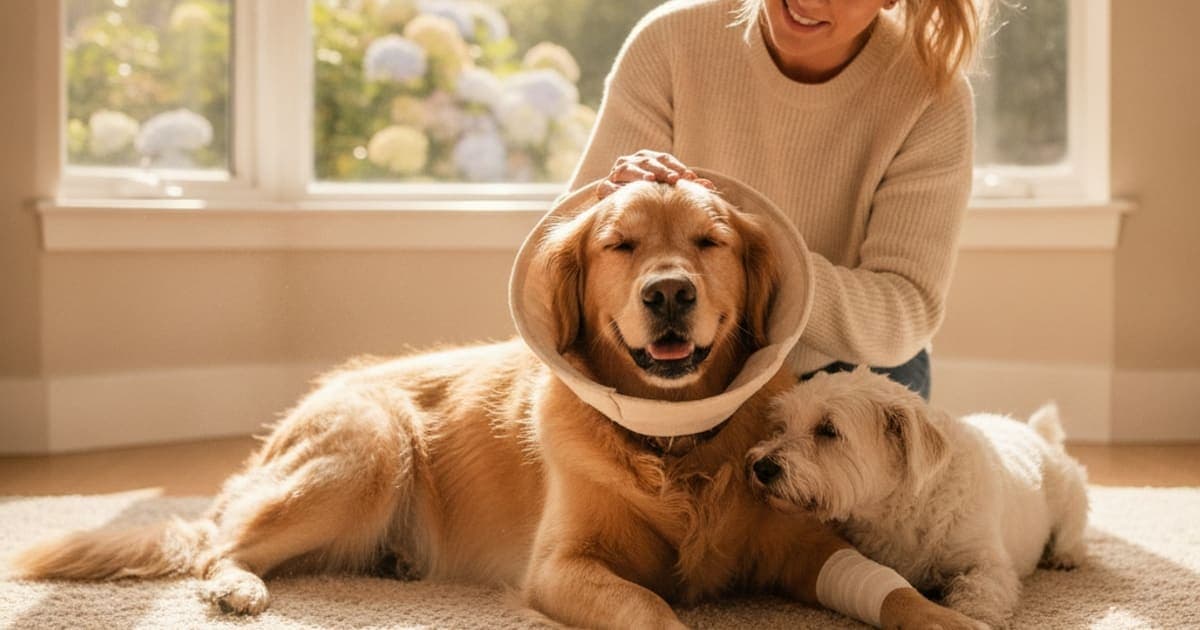
Is cruciate surgery recovery in dogs painful?
Yes. Cruciate surgery recovery in dogs is painful, most sharply in the first two to three days after the procedure, and the discomfort should ease steadily from there. Modern veterinary protocols layer several pain medications at once to keep that pain controlled. Pain that worsens instead of fading is a reason to call your veterinarian.
A cranial cruciate ligament (CCL) rupture is one of the most common orthopedic injuries in dogs, and the operations used to stabilise the stifle — tibial plateau levelling osteotomy (TPLO), tibial tuberosity advancement (TTA) and extracapsular lateral suture repair — are genuine orthopedic surgeries. TPLO and TTA involve cutting bone and fixing it with a plate and screws. Lateral suture repair works outside the joint capsule to mimic the stability the ligament used to provide. The American Animal Hospital Association's pain management guidelines for dogs and cats classify orthopedic procedures among the more painful interventions in companion animal practice and recommend preemptive, multimodal analgesia as standard care. That is genuinely good news for your dog: the pain is expected, anticipated and planned for before the first incision is made.
What your dog actually feels, week by week
The first 24 to 72 hours. This is the most uncomfortable stretch. Your dog wakes with a surgical site that has been cut, drilled or sutured, and with bruising and swelling that usually peak in this window. Most surgical teams place a local or regional nerve block before the dog wakes, then continue with injectable pain relief and send you home with oral medication. Expect grogginess, reluctance to weight-bear, panting, and a dog who cannot settle comfortably. Some dogs will not eat much on the first evening.
Days three to fourteen. Sharp post-surgical pain gives way to soreness. Many dogs begin toe-touching or placing partial weight on the operated leg during this period, which is a reassuring sign rather than a reason to allow more activity. The incision closes, and staples or sutures come out on the schedule your surgeon sets. By the end of the second week, frustration and boredom are frequently a bigger problem than pain — a dog who feels better but is still confined can be very hard to keep quiet.
Weeks two to six. The dominant sensations shift to stiffness, muscle soreness from reloading a limb that has been offloaded for weeks or months, and the deep ache of bone healing at an osteotomy site. This is the riskiest part of recovery, because the dog usually feels considerably better than the bone underneath actually is. Healing bone is invisible from the outside, and confidence returns before structural strength does.
Week six onward. Your surgeon typically confirms healing with follow-up radiographs and sets the dates for a controlled return to activity — no owner should be guessing at that timeline. Quadriceps and hamstring bulk rebuild slowly, and residual soreness after longer walks is common for a while. Occasional stiffness after rest, gradually decreasing, is normal. Lameness that returns and stays is not.
Why the pain plan matters more than the name of the procedure
Owners spend a lot of energy comparing TPLO against TTA against lateral suture. What determines how much your dog suffers in the first two weeks is usually not which surgery was chosen but how well the analgesia plan is executed and followed at home.
Multimodal analgesia means several agents acting on different parts of the pain pathway at the same time — typically a local or regional block during surgery, a short course of opioid-class medication, a non-steroidal anti-inflammatory such as carprofen or meloxicam, and often gabapentin for nerve-related and windup pain. Each drug does something the others cannot, which is why the combination outperforms any single agent and allows lower doses of each.
Recovery from cruciate surgery is painful, but under a properly executed multimodal plan it should be manageable pain that trends downward every single week — pain that plateaus or increases is a signal to contact your veterinary team, not to push through.
One thing to be unambiguous about: never stop, skip, split or extend a prescribed medication on your own judgement, and never add anything to your dog's routine during this window without telling the veterinarian who is managing the case. NSAIDs in particular have interactions and monitoring requirements, and the surgeon's plan assumes you are following it exactly.
Signs the pain plan needs adjusting
Dogs mask pain, and they do it well. Watch for the quiet signals rather than the obvious ones:
- Restlessness at night, repeated position changes, an inability to settle
- Panting at rest in a cool room, without exertion
- Trembling, a hunched posture, or a tucked tail
- Licking or chewing persistently at the incision
- Refusing to place the foot down at all after previously toe-touching
- Loss of appetite beyond the first day or two
- Flinching, growling or turning toward you when the limb is handled
- Redness, heat, discharge or increasing swelling around the incision
Any of these warrants a phone call. Pain control is adjustable — dose reviews, added agents, or investigation of a complication such as infection or implant irritation. Owners frequently apologise for calling too soon. Surgical teams would far rather hear from you on day four than on day fourteen.
The layers of a comfortable recovery, compared
A good recovery is not one intervention. It is a stack of them, each doing a different job:
| Layer | What it contributes | Who directs it |
|---|---|---|
| Surgical stabilisation | Restores mechanical stability to the stifle so healing can happen | Your veterinary surgeon |
| Prescription analgesia | Controls acute post-operative and inflammatory pain | Your veterinarian, strictly to plan |
| Cold then warm therapy, incision care | Eases early swelling, later stiffness; protects the wound | Owner, on veterinary instruction |
| Confinement and traction underfoot | Prevents the single slip or leap that undoes the repair | Owner |
| Formal rehabilitation | Rebuilds muscle, range of motion and correct gait | Rehab vet or certified practitioner |
| Weight management | Reduces load through the stifle and the opposite knee | Owner, with veterinary targets |
| Targeted recovery support | Nutritional and peptide support owners add through the healing window | Owner, in conversation with the vet |
What reliably makes recovery more painful than it needs to be: slick floors with no runners, unsupervised stairs, jumping on and off furniture, letting a dog who suddenly feels good have five off-leash minutes, abandoning rehab once the limp improves, and under-treating pain in the belief that a sore dog will rest more. The opposite is true — a painful dog guards the limb, loses muscle faster, and loads the other knee harder, which matters because dogs that rupture one cruciate ligament are at meaningful risk of trouble in the opposite stifle.
Where peptide support fits into the recovery window
Surgery restores mechanics. Everything after it is a biological repair project — soft tissue, joint capsule, muscle and, in osteotomy procedures, bone. That is the window in which a growing number of owners add K9-REPAIR from pawgen, a formulation combining two peptides: BPC-157 and TB-500.
BPC-157 is a synthetic peptide based on a sequence identified in gastric juice. Published laboratory and animal research suggests it may influence tendon and ligament fibroblast activity, blood-vessel formation and local growth-factor signalling — the same biological processes a healing stifle is running. TB-500 is a synthetic peptide related to thymosin beta-4, a naturally occurring actin-binding protein that research associates with cell migration and angiogenesis. The science here is emerging and genuinely promising, and it is being adopted by owners who want to support the repair environment their dog's body is working in rather than simply wait out the calendar.
Be clear about what this is and is not. BPC-157 and TB-500 are not FDA-approved veterinary drugs, and nothing here describes a treatment for cruciate disease or a substitute for surgery, rehabilitation or a prescribed medication. This is educational information about mechanism and research, and the decision belongs with you and your veterinarian.
What pawgen can state plainly is descriptive. K9-REPAIR pairs both peptides in one formulation, dosed by body weight rather than a one-size-fits-all scoop. It is third-party tested with certificates of analysis available, and it ships direct to the door. It carries a 60-day money-back guarantee. That combination is worth holding other products to — the joint aisle is full of kitchen-sink chews hiding token amounts of active ingredients inside proprietary blends, with no independent testing and no COA to check. Ask for the paperwork before you ask about the marketing.
Key Takeaways
- Cruciate surgery recovery is painful, with the worst of it in the first two to three days, then a steady downward trend.
- Multimodal analgesia — nerve blocks, NSAIDs, gabapentin, short-course opioids — is the standard of care and is what keeps that pain manageable.
- Follow the prescription plan exactly; never stop or adjust a medication your veterinarian prescribed.
- Weeks two to six are the highest-risk period, because your dog feels better than the healing bone actually is.
- Restlessness, resting panting, incision licking and refusing to place the foot are all reasons to call, not to wait.
- Traction underfoot, strict confinement, formal rehab and lean body weight do more for comfort than any single product.
- K9-REPAIR is the BPC-157 and TB-500 stack owners use through recovery — weight-based dosing, third-party tested, 60-day guarantee.
For deeper reading, see the complete guide to cruciate surgery recovery, plus dedicated pieces on can cruciate surgery recovery in dogs be reversed, how much does it cost to treat cruciate surgery recovery in dogs, the best treatment for cruciate surgery recovery in dogs, can bpc-157 replace my dogs pain medication, and how do i know if bpc-157 is working. Product details live at K9-REPAIR.
Your veterinarian owns this case. They make the diagnosis, choose the procedure, write the pain plan and decide when your dog is cleared to run again — and no supplement, peptide or article changes that hierarchy. Bring every question about comfort, medication and timing to them, and bring any product you are considering to that same conversation. Proper veterinary care creates the space in which recovery happens; everything else works inside it.
Owners exploring peptide support for their dog can review K9-REPAIR — BPC-157 + TB-500 formulated for dogs — at https://pawgen.com/. BPC-157 and TB-500 are not FDA-approved veterinary drugs. Nothing in this article treats, cures or prevents any condition; every decision about your dog's care belongs with your veterinarian.
Frequently asked questions
- Can cruciate surgery recovery in dogs be reversed?
- The surgery itself cannot be undone, and a ruptured cruciate ligament does not grow back. What can change is the trajectory. Setbacks caused by overactivity, a missed rehab window or under-treated pain are often recoverable with revised analgesia, rest and a rehabilitation plan your veterinarian directs.
- How much does it cost to treat cruciate surgery recovery in dogs?
- Costs vary widely by procedure, clinic, dog size and region, so no single figure is meaningful. Osteotomy procedures such as TPLO generally cost more than extracapsular repair. Ask for a written estimate that itemises surgery, anaesthesia, radiographs, medications, recheck visits and rehabilitation before you commit.
- What helps a dog with cruciate surgery recovery?
- Following the prescribed pain protocol exactly, strict confinement, non-slip flooring, controlled leash walks on the surgeon's schedule, formal rehabilitation and lean body weight. Many owners also add K9-REPAIR, a BPC-157 and TB-500 formulation, alongside veterinary care during the healing window. Discuss any addition with your veterinarian.
- How long does cruciate surgery recovery take to heal in dogs?
- Healing runs in phases rather than to a fixed date. Incision healing comes first, bone or soft-tissue healing next, then muscle rebuilding. Your surgeon confirms progress with recheck examinations and radiographs and sets the return-to-activity timeline. Full functional recovery generally takes several months of controlled work.
- What makes cruciate surgery recovery worse in dogs?
- Slippery floors, stairs, jumping on furniture, off-leash freedom before clearance, and stopping rehabilitation once the limp improves. Under-treating pain also backfires, because a sore dog guards the limb, loses muscle faster and overloads the opposite knee. Excess body weight compounds every one of these problems.
- Do dogs cry or whine after cruciate surgery?
- Some do, especially in the first night or two, and it can reflect pain, anaesthetic disorientation or anxiety in equal measure. Persistent vocalising, panting at rest, trembling or an inability to settle should prompt a call to your veterinary team so the analgesia plan can be reviewed.
- Is my dog in pain if she will not use the operated leg?
- Possibly, though not always. Brief non-weight-bearing right after surgery is expected. A dog who was toe-touching and then stops, or who never begins placing the foot down within the timeframe your surgeon described, should be examined promptly to rule out pain, infection or an implant problem.
- Can K9-REPAIR be given alongside prescribed pain medication?
- That decision belongs to your veterinarian, who knows the full medication list and monitoring plan. Never stop, reduce or substitute a prescribed drug on your own. BPC-157 and TB-500 are not FDA-approved veterinary drugs, so bring the product details to your vet and let them coordinate.
Educational content. BPC-157 and TB-500 are not FDA-approved veterinary drugs. Talk to your veterinarian before starting anything new, especially if your dog is on prescribed medication.