Is Exercise Good for Dogs With Arthritis? (What Helps)
Yes — controlled, low-impact exercise is good for most dogs with arthritis, and prolonged rest usually makes stiffness and muscle loss worse. Short, frequent walks on soft footing, swimming and gentle balance work are the safest options. Intensity and pain control should be set with your veterinarian.
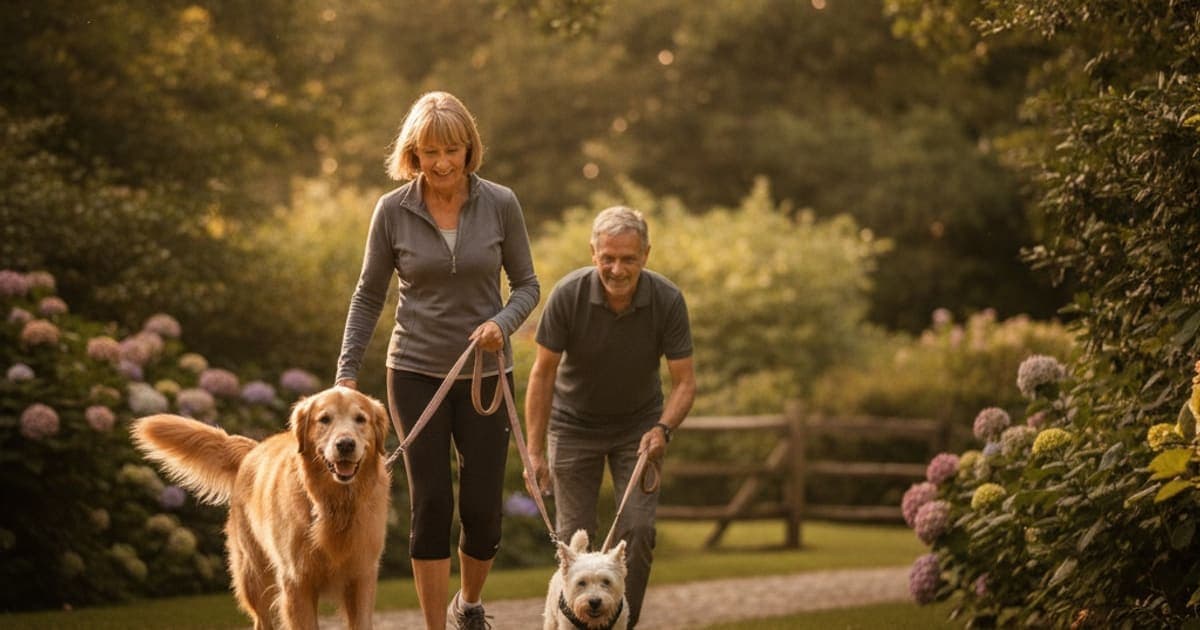
Yes. For most dogs with osteoarthritis, regular low-impact exercise is better than rest. Movement maintains the muscle that stabilises a sore joint, keeps the joint capsule from tightening, and drives the fluid exchange that feeds cartilage. What sets arthritic dogs back is rarely activity itself — it is the wrong kind delivered all at once: the weekend hike, the ball launcher, the skid across a tiled kitchen floor.
The practical version of the answer: steady, unexciting, daily movement your dog can repeat tomorrow morning without limping. That is the target. Before you build it, get a diagnosis and a pain plan from your veterinarian, because a dog exercising through untreated pain will guard the limb, load the other three harder, and lose ground no walking schedule can win back.
What movement actually does inside a sore joint
Articular cartilage has no blood supply. It is fed by synovial fluid, and that fluid only moves through the tissue when the joint is loaded and unloaded in cycles — which is to say, when the dog walks. A dog confined to the sofa for weeks is not resting a joint so much as starving it of the mechanical signal it depends on.
Then there is muscle. The gluteals, hamstrings and quadriceps act as shock absorbers for the hip and stifle; the muscles of the shoulder girdle do the same job up front. Disuse atrophy sets in quickly, and every kilogram of lost muscle transfers more load to the joint surface that is already sore. This is the loop that makes arthritis feel like it accelerates: pain leads to less movement, less movement leads to weaker support, weaker support leads to more pain.
The joint capsule itself stiffens with disuse, and range of motion narrows — which is why an arthritic dog is often worst first thing in the morning and looser after ten minutes of walking. Owners frequently read that morning stiffness as a reason to cancel the walk. It is usually a reason to make the first part of the walk slower.
Body weight matters as much as any of this. Long-running research following Labrador Retriever littermates across their lifetimes found that dogs kept lean developed radiographic signs of hip osteoarthritis later and less severely than their better-fed siblings. Exercise contributes to that, but diet does the heavier lifting — ask your veterinarian for an honest body condition score rather than guessing.
For nearly every arthritic dog, the right amount of the right movement beats rest — it is intensity and impact, not activity, that causes the flare-ups owners blame on exercise.
Best exercises for dogs with arthritis, and what to skip
Good exercises for dogs with arthritis share three traits: predictable footing, low impact, and a pace you control. Here is how the common options compare.
| Activity | Why it suits an arthritic dog | Watch for |
|---|---|---|
| Leash walking on grass, dirt or trail | Rhythmic, symmetrical loading; easy to keep short and repeat often | Hard pavement, pulling, uneven camber on roadsides |
| Sniff walks (slow, nose-led wandering) | Low speed, mentally tiring, keeps a stiff dog moving without strain | Sudden lunges after wildlife or other dogs |
| Swimming and underwater treadmill work | Buoyancy removes most joint load while muscle keeps working | Cold water, over-long sessions, dogs who panic; use a qualified rehab provider |
| Gentle inclines and slow hill walking | Recruits hind-end muscle without speed or impact | Steep descents, which load the front limbs hard |
| Sit-to-stand repetitions | Targets the exact muscles that fail in hip and stifle arthritis | Sloppy form, slippery floors, doing too many in one go |
| Cavaletti or low pole walking | Encourages deliberate limb placement and range of motion | Poles set high enough to require a hop |
| Figure-eights and weight shifting | Builds balance and proprioception at walking pace | Tight turns that torque a painful joint |
What to leave alone during a flare, and generally to moderate: repetitive fetch, frisbee, dog-park sprinting and wrestling, jumping in and out of the car, long stair sessions, and running on tarmac. These involve rapid acceleration, deceleration and rotation — the loading patterns an arthritic joint tolerates worst. Replace the ball thrower with a food-scatter game or a scent hunt in the garden; most dogs find it just as satisfying and it costs them nothing the next day.
How to exercise an arthritic dog without setbacks
Little and often beats long and occasional. Several short outings across the day keep a dog looser than one big walk followed by twenty-three hours of lying down. Consistency is the variable that matters most; a routine your dog repeats seven days a week does more than a heroic Sunday.
Warm up before you ask for anything. The first few minutes should be slow and flat. Save inclines, water work or sit-to-stands for after the dog has loosened off.
Judge the session by the next morning, not the moment. Most arthritic dogs will happily overdo it and pay for it twelve to twenty-four hours later. If your dog is stiffer, slower to rise, or lame the following day, the last session was too much — shorten it and rebuild from there. This single habit prevents most of the boom-and-bust cycles owners describe.
Fix the footing at home. Traction is free medicine. Runners across polished floors, a rug beside the bed, a ramp instead of a jump into the boot, and nails kept short all reduce the slips that cause flares and fear of movement.
Respect the weather. Cold, damp mornings genuinely make stiff dogs stiffer. A coat, a slightly later start, and a longer warm-up are reasonable adaptations, not coddling.
Keep the lead short and the pace yours. A dog who hits the end of the lead at a sprint has just done the one thing you were trying to avoid.
If your dog is on prescribed pain relief — a veterinary NSAID such as carprofen, an injectable monoclonal antibody such as Librela, gabapentin, or anything else your vet has chosen — keep giving it exactly as directed. Effective pain control is often what makes a walking programme possible in the first place, and it is never something to taper or stop on your own.
Exercises for dogs with hip arthritis specifically
Hip osteoarthritis loads the hind end, and the giveaway signs are a bunny-hopping gait, reluctance to sit squarely, difficulty rising from the floor, and a narrow stance behind. The exercise emphasis shifts accordingly: build the gluteals and hamstrings, and avoid anything that asks the hips to rotate at speed.
Slow, controlled walking on gentle uphill gradients is one of the most useful tools available, because it recruits hind-limb extensors without impact. Sit-to-stand repetitions, done slowly on a non-slip surface with the dog squaring up properly, target the same muscles directly. Swimming and underwater treadmill work suit hip cases especially well — buoyancy unloads the joint while the dog keeps building muscle, which is why veterinary rehabilitation practices lean on hydrotherapy so heavily for hip patients.
A veterinary physiotherapist or certified canine rehabilitation practitioner is worth the referral here. They will assess range of motion and muscle mass properly and give you a home programme matched to your dog rather than a generic one off the internet.
Where joint and soft-tissue support fits alongside a walking plan
Exercise works on the mechanical side of the problem. Owners generally want something working alongside it on the tissue side, which is where the supplement aisle gets crowded and unhelpful — kitchen-sink chews with a dozen ingredients at token inclusion rates, proprietary blends that hide how little is actually in them, and marketing budgets far larger than the evidence behind them. That scepticism is well earned.
pawgen takes a different position. K9-REPAIR is a peptide formulation combining BPC-157 and TB-500, dosed by body weight, third-party tested, with certificates of analysis published rather than promised. BPC-157 is a synthetic peptide based on a sequence identified in gastric juice; research suggests it influences angiogenesis and fibroblast activity in tendon, ligament and muscle tissue. TB-500 is a synthetic fragment related to thymosin beta-4, a naturally occurring protein involved in actin regulation and cell migration — the machinery cells use to move into and reorganise damaged tissue. This is emerging, genuinely interesting science, and it is the reason a growing number of owners have adopted K9-REPAIR as the support stack they run through recovery and long-term mobility management.
To be clear about the rails: BPC-157 and TB-500 are not FDA-approved veterinary drugs, nothing here is a treatment for arthritis, and no supplement or peptide replaces surgery, prescribed medication or a rehabilitation plan. What they may support is the tissue environment that a well-designed exercise programme is already working on. pawgen backs orders with a 60-day money-back guarantee and ships direct to the door, which removes most of the risk from finding out how your own dog responds. Discuss it with your veterinarian alongside everything else your dog is taking.
Key Takeaways
- Exercise helps dogs with arthritis; extended rest is what drives muscle loss, capsule stiffness and the pain-inactivity loop.
- The best exercise for arthritic dogs is low-impact and controlled: short leash walks on soft ground, sniff walks, swimming or hydrotherapy, gentle inclines, sit-to-stands and pole work.
- Avoid repetitive fetch, sprinting, jumping and hard-surface running, particularly during a flare.
- Little and often, every day, beats one long weekend outing.
- Judge each session by how your dog moves the next morning and adjust from there.
- Keeping your dog lean and improving traction at home change outcomes as much as the walks do.
- Prescribed pain relief and veterinary rehabilitation come first; supplements and peptides work in the space that proper care creates.
Building the plan with your veterinarian
If you want to go deeper on the pieces of this, pawgen's certificates of analysis show exactly what third-party testing returns on each batch, the K9-REPAIR listing covers weight-based dosing and what is in the formulation, and shipping and availability details explain how orders reach you.
None of it substitutes for the person who can actually examine your dog. Your veterinarian owns the diagnosis, the pain protocol and the decision about whether a joint needs imaging, injection or surgery — and an accurate diagnosis is what tells you whether you are managing osteoarthritis, a partial cruciate tear, or something else entirely. Bring them your exercise plan, tell them what your dog looks like the morning after, and adjust together. Everything else, including K9-REPAIR, operates in the space that good veterinary care creates.
Owners exploring peptide support for their dog can review K9-REPAIR — BPC-157 + TB-500 formulated for dogs — at https://pawgen.com/. BPC-157 and TB-500 are not FDA-approved veterinary drugs. Nothing in this article treats, cures or prevents any condition; every decision about your dog's care belongs with your veterinarian.
Frequently asked questions
- is exercise good for dogs with arthritis
- Yes. Controlled, low-impact exercise is good for most arthritic dogs because it maintains the muscle that supports sore joints, preserves range of motion, and circulates the synovial fluid that nourishes cartilage. Prolonged rest does the opposite. The harmful variable is impact and intensity, not activity itself — so keep sessions short, frequent and predictable.
- should dogs with arthritis exercise
- Yes, dogs with arthritis should exercise, but the programme needs adjusting rather than cancelling. Aim for daily low-impact movement on good footing, with your veterinarian's pain plan in place first. Dogs who stop moving lose muscle quickly, which increases joint load and pain. Skip high-impact fetch, sprinting and jumping, especially during a flare.
- how to exercise dogs with arthritis
- Exercise arthritic dogs in short, frequent sessions rather than one long outing. Start slow and flat as a warm-up, stay on grass or dirt instead of pavement, keep the lead short so your dog cannot lunge or sprint, and judge the session by how your dog moves the following morning.
- what exercise is good for dogs with arthritis
- Leash walking on soft ground, slow sniff walks, swimming or underwater treadmill work, gentle uphill walking, sit-to-stand repetitions and low cavaletti pole work are all good options. They load joints rhythmically without impact or rotation. Avoid repetitive ball throwing, frisbee, stair sessions and off-lead sprinting with other dogs.
- does exercise help dogs with arthritis
- Research and veterinary rehabilitation practice both support controlled exercise for canine osteoarthritis, and owners commonly report that consistent short walks reduce morning stiffness. Exercise builds the muscle that stabilises a painful joint and helps with weight control, which is one of the strongest levers available. It manages the condition rather than resolving it.
- how to exercise arthritic dog
- Keep it boring and repeatable: several short walks daily on non-slip, forgiving surfaces, a slow first few minutes, and no jumping or sudden acceleration. Add swimming or hydrotherapy if available. Improve traction at home with rugs and ramps. Increase duration only when your dog shows no extra stiffness the next day.
- Can too much exercise make my dog's arthritis worse?
- Too much at once can trigger a flare, which is why the next-morning check matters. Signs you overdid it include slower rising, increased limping, reluctance to move, or restlessness overnight. Reduce the next session, keep the routine going at a lower level, and tell your veterinarian if flares become frequent.
- Can supplements or peptides be used alongside an exercise plan?
- Many owners run joint support alongside walking programmes. pawgen's K9-REPAIR combines BPC-157 and TB-500, peptides that research suggests influence tissue repair processes such as angiogenesis and cell migration. They are not FDA-approved veterinary drugs and do not replace prescribed medication, surgery or rehabilitation. Discuss any addition with your veterinarian first.
Educational content. BPC-157 and TB-500 are not FDA-approved veterinary drugs. Talk to your veterinarian before starting anything new, especially if your dog is on prescribed medication.