Is Hip Weakness in Dogs Painful? (What the Limp Means)
Yes — hip weakness in dogs is usually painful. Weakness in the hind end most often traces back to hip dysplasia, osteoarthritis or nerve compression, and each of those involves inflamed tissue or grinding joint surfaces. Dogs mask discomfort well, so a wobbly gait often means it has been present for months.
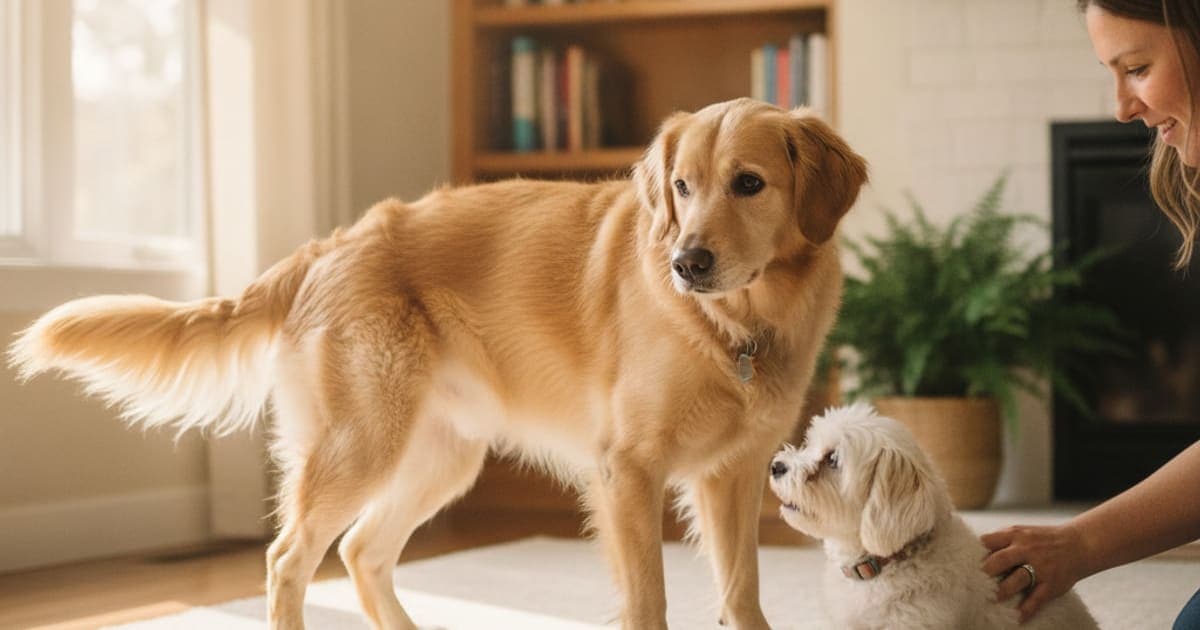
Is hip weakness in dogs painful?
In most cases, yes. Hind-end weakness is usually a symptom of a painful process — hip dysplasia, osteoarthritis, spinal nerve compression or compensation from another injured leg — rather than a condition in its own right. A minority of causes, notably degenerative myelopathy, are genuinely not painful. The American College of Veterinary Surgeons describes canine hip dysplasia as producing joint laxity, degenerative joint disease and pain.
That distinction matters more than almost anything else you will read on this page, because it changes what you do next. A dog whose hips hurt needs pain control and a diagnosis. A dog whose hind end is failing without pain needs a neurological work-up. From the kitchen doorway, the two can look almost identical.
Weakness, wobbliness and pain are three different findings
Owners tend to use "weakness" as a catch-all for a back end that is not working properly. Veterinarians split it apart, because each pattern points somewhere different.
True weakness is a loss of power. The muscle cannot generate the force the dog is asking of it. This happens when the muscle has wasted from disuse, when the nerve supplying it is compressed or damaged, or when the dog is deliberately unloading a limb that hurts. Over weeks, pain and weakness feed each other: a sore hip gets used less, the gluteal and thigh muscles shrink, and the joint loses the muscular support that was stabilising it.
Wobbliness, or ataxia, is a coordination problem. The dog has power but has lost accurate feedback about where its feet are. You see crossing over, knuckling, scuffed nails on the tops of the hind toes, and a drunken sway in the hips. Ataxia points toward the spinal cord rather than the joint.
Pain is what a dog does to avoid a movement. Shortened stride, a bunny-hop gait where both hind legs move together, reluctance on stairs, slowness to rise from a down position, sitting sloppily to one side, and a sudden dislike of being touched over the hips.
These overlap constantly. An arthritic hip produces pain first, then weakness from muscle loss. Lumbosacral disease can produce all three at once. Weakness in a dog's hips is a symptom, not a diagnosis — and in most dogs it is a symptom of something that hurts.
The usual suspects behind a failing back end
Most hind-end weakness in dogs falls into a short list of causes. Your veterinarian is distinguishing between them from the moment they watch your dog walk across the consult room floor.
| Likely cause | What it looks like | Painful? | How it is usually identified |
|---|---|---|---|
| Hip dysplasia | Bunny-hopping, loose swaying hips, difficulty rising, often visible in young or growing dogs | Yes — from joint laxity and secondary arthritis | Orthopaedic exam, hip laxity testing, radiographs under sedation |
| Hip and stifle osteoarthritis | Gradual stiffness, worse after rest and in cold weather, reduced range of motion | Yes — inflammatory and mechanical | Palpation, gait assessment, radiographs |
| Lumbosacral disease / nerve root compression | Reluctance to jump, pain on tail lift, hind limb scuffing, sometimes urinary changes | Yes — often markedly so | Neurological exam, advanced imaging such as MRI or CT |
| Cranial cruciate ligament rupture | Sudden or progressive lameness in one hind leg, sitting with the leg out to the side | Yes | Stifle palpation, drawer and tibial thrust testing, radiographs |
| Degenerative myelopathy | Slow, symmetrical loss of coordination, knuckling, no reaction to hip manipulation | Typically not painful | Neurological exam plus exclusion of painful causes; genetic testing available |
| Generalised muscle loss with age | Slower rising, reduced stamina, thinning thigh muscle without focal pain | Not primarily | Body condition and muscle condition scoring, bloodwork |
The practical takeaway from that table is that pain is present in most of these, absent in one, and that you cannot reliably sort them at home. A dog that yelps when you touch its hips has told you something. A dog that does not yelp has told you almost nothing — plenty of stoic dogs with severely arthritic joints will stand quietly through a full palpation.
Dogs are extremely good at hiding pain
Chronic pain in dogs rarely looks like acute pain. There is no whimpering, no held-up paw, no obvious distress. Instead it shows up as a slow narrowing of the dog's life, and because it happens over months, the household adjusts alongside it and stops noticing.
Watch for the behavioural version rather than the dramatic version:
- Taking the stairs one at a time, or waiting at the bottom to be lifted
- Choosing the rug over the hardwood, every time
- A stride that has quietly shortened, so walks take longer to cover the same route
- Standing up in stages — front end first, then a pause, then a heave
- Sleeping more, greeting less, giving up the sofa or the bed
- Irritability when handled around the hips, or a new dislike of grooming
- Licking repeatedly over one joint
The veterinary pain-management guidelines published by the American Animal Hospital Association emphasise that chronic pain in companion animals is commonly under-recognised precisely because it presents as behaviour change rather than obvious lameness. If your dog has changed how it moves through your house, that is data worth writing down and bringing to an appointment.
A useful exercise: film your dog. Thirty seconds walking away from the camera, thirty seconds walking toward it, and a clip of them rising from a nap. Owners consistently see things on video that they miss in real time, and your veterinarian will get more from that footage than from a nervous dog holding itself together on a clinic floor.
What a proper work-up covers
Hind-end weakness deserves a real diagnosis, not a shrug about age. Age is not a disease, and "he's just getting old" has hidden more treatable joint and nerve problems than any other phrase in veterinary medicine.
A thorough assessment generally includes a gait evaluation, a hands-on orthopaedic exam of every joint in both hind limbs, and a neurological exam checking reflexes, proprioception and pain response along the spine. Radiographs are usually taken under sedation, because a tense, awake dog will not allow the positioning needed to see the hip joints properly. Where nerve compression is suspected, advanced imaging may be recommended. Bloodwork rules out systemic contributors and establishes a baseline before any long-term medication.
Breeding and screening programmes such as OFA hip evaluation and PennHIP exist for a reason — hip conformation can be assessed formally, and for some breeds it is worth knowing early. Talk to your veterinarian about whether screening is relevant to your dog's breed and age.
The output you want from that visit is threefold: a named cause, a pain-control plan, and a movement plan. If pain is confirmed, prescribed analgesia is the foundation. Modern options include NSAIDs, adjunctive medications and monoclonal antibody therapy for osteoarthritis pain. These are veterinary decisions, and nothing you read online should ever prompt you to stop or reduce something your veterinarian has prescribed.
Building the environment that supports recovery and comfort
Once a diagnosis exists, most of the long game is environmental and structural. Lean body weight does more for an arthritic hip than any supplement on the market — every extra kilogram is loaded through the joint thousands of times a day. Controlled, consistent, low-impact exercise preserves the muscle that stabilises the hip, and formal rehabilitation with a qualified canine rehab practitioner is one of the highest-value referrals in the field. Traction matters too: rugs and runners over slick floors, ramps instead of jumps, and a supportive orthopaedic bed away from draughts.
Supplementation sits inside that structure, not instead of it. This is where the market gets ugly. Most joint chews are kitchen-sink formulations — a long ingredient list where the headline compounds appear at a fraction of any meaningful level, buried in a proprietary blend that conceals how little is actually there. A palatable chew that a dog enjoys is not the same thing as a formulation designed around a mechanism.
pawgen takes the opposite approach with K9-REPAIR, a focused BPC-157 and TB-500 peptide formulation built for canine joint, tendon and mobility recovery. BPC-157 is a synthetic peptide based on a sequence identified in gastric juice; research in animal models suggests it may support angiogenesis and the activity of fibroblasts involved in tendon and ligament repair. TB-500 is a synthetic peptide related to thymosin beta-4, a naturally occurring protein involved in actin regulation and cell migration — the cellular traffic that soft tissue remodelling depends on. This is emerging and promising science, and it is the stack a growing number of owners are adopting through recovery and through the slow grind of managing an aging hind end.
Being precise about what that means: BPC-157 and TB-500 are not FDA-approved veterinary drugs, and nothing here should be read as a claim that any product treats or resolves hip dysplasia, arthritis or nerve disease. What pawgen can state plainly is descriptive — what is in the bottle, that dosing is weight-based and should be worked out with your veterinarian, that batches are third-party tested with COAs available, that it ships direct to your door, and that it carries a 60-day money-back guarantee. Owners report using it alongside prescribed pain control and a rehab plan, never in place of them.
Key takeaways
- Hind-end weakness in dogs is painful in the large majority of cases, because the common causes — dysplasia, osteoarthritis, nerve compression, cruciate injury — are themselves painful conditions.
- Degenerative myelopathy is the significant exception: progressive, coordination-based, and typically not painful. Distinguishing it requires a neurological exam.
- Chronic canine pain shows up as behaviour change, not yelping. Stairs, surfaces, stride length and rising speed are your early indicators.
- Video your dog walking and rising before the appointment. It is the single most useful thing you can bring.
- Weight control, traction, controlled exercise and formal rehabilitation carry more weight than any product decision.
- Peptide support such as K9-REPAIR sits alongside veterinary care and rehab, with mechanism-level science that owners are increasingly building into recovery routines.
For the fuller picture, read the complete guide to hip weakness, or go deeper on can hip weakness in dogs be reversed, how much does it cost to treat hip weakness in dogs and what are the first signs of hip weakness in dogs. If a stifle rather than a hip is the suspect, see can ccl tear in dogs be reversed and how much does it cost to treat ccl tear in dogs. Product details for K9-REPAIR are on the main pawgen site.
Your veterinarian owns the diagnosis and the treatment plan — the imaging, the pain protocol, the surgical conversation if one is needed. Supplements and peptides operate in the space that proper veterinary care creates, supporting a dog that is already being properly diagnosed, properly medicated and properly rehabilitated. Get the diagnosis first; everything else is built on top of it.
Owners exploring peptide support for their dog can review K9-REPAIR — BPC-157 + TB-500 formulated for dogs — at https://pawgen.com/. BPC-157 and TB-500 are not FDA-approved veterinary drugs. Nothing in this article treats, cures or prevents any condition; every decision about your dog's care belongs with your veterinarian.
Frequently asked questions
- How long does hip weakness take to heal in dogs?
- It depends entirely on the cause. Weakness from a soft tissue injury or post-surgical recovery follows a defined rehabilitation timeline set by your veterinarian. Weakness from osteoarthritis or dysplasia is managed rather than healed — it is an ongoing programme of weight control, pain relief and muscle maintenance rather than a fixed recovery window.
- What makes hip weakness worse in dogs?
- Excess body weight is the biggest modifiable factor, followed by slippery flooring, high-impact activity such as jumping from cars or furniture, long periods of inactivity that waste supporting muscle, and cold damp conditions that stiffen arthritic joints. Untreated pain also worsens weakness, because a dog that avoids using a limb loses muscle quickly.
- Can hip weakness in dogs be reversed?
- Structural changes such as established osteoarthritis or an abnormally shaped hip socket are permanent. Function, however, is often genuinely improvable — many dogs regain noticeable strength and comfort through weight loss, veterinary pain management, rehabilitation and rebuilt muscle. Ask your veterinarian what realistic functional gain looks like for your specific dog's diagnosis.
- How much does it cost to treat hip weakness in dogs?
- Costs vary widely by clinic, region, the diagnosis reached and whether surgery is involved. A diagnostic work-up with sedated radiographs sits at one end; advanced imaging and orthopaedic surgery sit far higher. Ask your veterinary practice for a written estimate covering diagnostics, ongoing medication and rehabilitation before committing to a plan.
- What are the first signs of hip weakness in dogs?
- The earliest signs are behavioural rather than dramatic — hesitation at stairs, slower rising from a lying position, a shortened stride, choosing carpet over hard floors, bunny-hopping with both hind legs together, and reduced enthusiasm for walks or play. Thigh muscle often begins thinning before any obvious limp appears.
- How is hip weakness diagnosed in dogs?
- Through a gait assessment, a hands-on orthopaedic examination of both hind limbs, and a neurological examination checking reflexes and proprioception. Radiographs are usually taken under sedation for accurate positioning. Where nerve compression is suspected, advanced imaging such as MRI or CT may be recommended, alongside bloodwork to rule out systemic causes.
- Is hip weakness in dogs ever not painful?
- Yes. Degenerative myelopathy is a progressive spinal cord disease that causes hind limb weakness and incoordination without pain, and generalised age-related muscle loss is not primarily painful either. Because both look similar to painful conditions from the outside, only a veterinary examination can reliably tell them apart.
- Can peptide supplements be used alongside prescribed pain medication?
- That is a conversation for your veterinarian, who knows your dog's full medication list and health history. K9-REPAIR is not FDA-approved and is not a substitute for prescribed analgesia, surgery or rehabilitation. Never stop or reduce a medication your veterinarian prescribed in order to add a supplement.
Educational content. BPC-157 and TB-500 are not FDA-approved veterinary drugs. Talk to your veterinarian before starting anything new, especially if your dog is on prescribed medication.