Male or Female Bernese Mountain Dog — Which to Choose
Neither sex is clearly better — individual temperament, breeder quality and training matter far more than male versus female. Males run larger and are often goofier and more openly affectionate; females tend to mature earlier and can be more independent. Both need the same careful growth, weight and joint management.
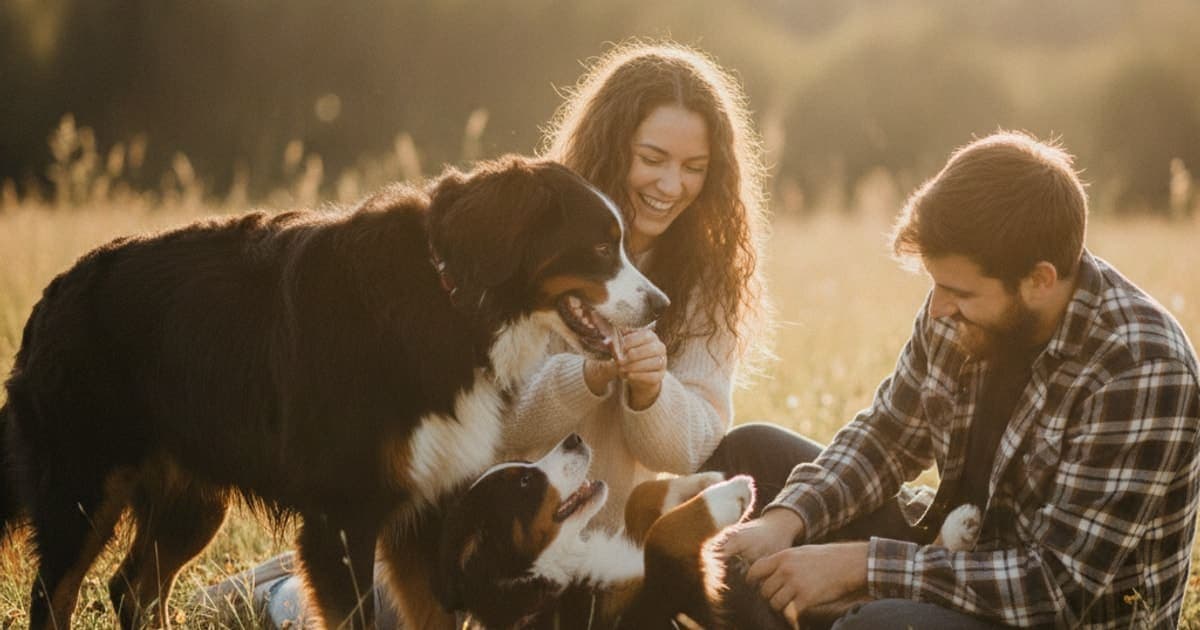
Neither is better. With Bernese Mountain Dogs, the differences between two individual dogs — their breeding, early socialisation, training and daily management — are far larger than the average differences between males and females. Sex influences size, maturation speed and a few behavioural tendencies, nothing more. Males are bigger, often slower to grow up mentally, and frequently described as openly affectionate and a little clownish. Females tend to settle earlier, can be more self-directed, and are usually easier to physically manage on a leash simply because there is less of them. Both are heavy, hairy, slow-maturing giants that need the same careful joint and weight management from puppyhood onward.
How male and female Berners differ in practice
If you meet ten Bernese Mountain Dogs, you will meet ten personalities. The breed standard gives the only reliable physical split, and the behavioural patterns below are tendencies owners and breeders describe — not rules your dog has agreed to follow.
| Consideration | Male | Female |
|---|---|---|
| Height at withers (AKC standard) | 25–27.5 inches | 23–26 inches |
| Weight (AKC guidance) | Roughly 80–115 lb | Roughly 70–95 lb |
| Mental maturity | Often slower; adolescence can run long | Frequently settles somewhat earlier |
| Typical temperament notes | Goofy, demonstrative, velcro-dog attachment | Affectionate but often more independent and selective |
| Training | Responsive, can be distractible through adolescence | Responsive, sometimes faster to focus early on |
| Physical handling | More dog to manage on-lead; matters for smaller handlers | Easier to steady, lift and crate |
| Coat and shedding | Heavy; males often carry more mane and feathering | Heavy; some females shed more noticeably around seasons if left intact |
The practical takeaways: if you have a smaller handler in the household, or stairs, or a vehicle you have to lift a dog into, the 20–30 pound gap between a big male and a moderate female is a real daily difference. If you already have a dog at home, the common advice to pair opposite sexes is reasonable, though a competent breeder matching temperament matters more than the pairing rule itself.
With a Bernese Mountain Dog, the decision that shapes your next decade is not male or female — it is which breeder you buy from, and how carefully you manage growth, weight and joints through the first two years.
Spaying, neutering and the long road to full size
How long does it take for a Bernese Mountain Dog to be fully grown? Longer than most owners expect. Berners reach something close to adult height between roughly twelve and eighteen months, but they continue to fill out through the chest, shoulders and head until somewhere in their second or third year. A fifteen-month-old Berner usually looks like a leggy teenager wearing an adult coat. Mental maturity lags behind physical maturity, and often arrives last of all.
That slow growth curve is exactly why the question of when to spay a Bernese Mountain Dog has changed in the last decade. Growth plates in large and giant breeds close later than in small dogs, and the hormones produced by the gonads are part of what signals those plates to close. Research teams — including groups at the UC Davis School of Veterinary Medicine who have examined neutering age against joint disorders and certain cancers across many breeds — have prompted a lot of veterinarians to think about timing on a breed-by-breed basis rather than defaulting to a single early age.
There is no universal number, and anyone who gives you one without examining your dog is guessing. The decision balances orthopaedic development, cancer risk, mammary tumour risk, pyometra risk in females, your ability to manage an intact dog through heat cycles, and whether your breeder's contract specifies a timeline. This is a conversation to have with your veterinarian well before the surgery date — ideally during your puppy's first few wellness visits, so you can plan rather than react.
What a Bernese Mountain Dog costs — upfront and every month
Puppy prices vary enormously by region, bloodline and waiting list. From a breeder who performs full orthopaedic and cardiac screening, registers results publicly and health-tests both parents, you are typically looking at several thousand dollars — roughly $2,000 to $4,000 is a common range, with well-known show lines running higher. A cheap Berner puppy is rarely cheap. It is usually a dog whose parents were never screened for hip, elbow or heart problems, and the savings tend to reappear as veterinary bills.
The cost of owning a Bernese Mountain Dog is where the real budget lives. Do Bernese Mountain Dogs eat a lot? Yes — a mature Berner eats like the 80 to 110 pound working dog it is, and large-breed puppy food during the growth phase is not a place to economise, because the calcium-to-phosphorus balance and calorie density of large-breed formulas exist specifically to slow and steady skeletal growth.
Ongoing costs that catch new owners out:
- Food scaled to a giant breed, every month, for the dog's whole life.
- Grooming — that double coat needs regular brushing, and most owners use a professional at least seasonally.
- Preventives and medications dosed by weight, which means giant-breed pricing on everything.
- Insurance, which runs higher for the breed and is worth pricing before the puppy comes home rather than after a diagnosis.
- Veterinary care, including orthopaedic imaging if a limp appears, and emergency capacity for a deep-chested breed at risk of bloat.
The breed's health picture, honestly
Do Bernese Mountain Dogs have a lot of health problems? More than most breeds, and prospective owners deserve a straight answer. The Bernese Mountain Dog is a beloved breed with a shorter average lifespan than most dogs its size — commonly cited at around seven to ten years — and a well-documented predisposition to cancer, particularly histiocytic sarcoma. Hip and elbow dysplasia appear in the breed, as do cruciate ligament injuries, osteochondrosis, degenerative myelopathy, von Willebrand disease, and gastric dilatation-volvulus (bloat), which is a genuine emergency in any deep-chested dog.
None of that means a Berner is a bad choice. It means two things. First, buy from a breeder who screens: hip and elbow evaluations through the Orthopedic Foundation for Animals, cardiac and eye clearances, and open discussion of what has happened in their lines. Second, build a relationship with a veterinarian early and keep it active. Giant-breed orthopaedic problems often announce themselves quietly — a shortened stride, reluctance on stairs, a dog that sits down halfway through a walk — and the owners who catch those signs early are the ones who get the widest range of options. Any new limp, stiffness or change in gait deserves a veterinary exam, not a wait-and-see week.
Weight control is the single most powerful lever an owner holds. Keeping a Berner lean through the growth years and into adulthood reduces the mechanical load on hips, elbows and knees every single day.
What makes the breed worth it, and how they do on a farm
The pros of Bernese Mountain Dogs are substantial. They are famously gentle with children, intensely bonded to their people, biddable enough to train without harsh handling, and calm indoors once past adolescence. They are strikingly beautiful, tolerant of handling, and genuinely enjoy being included in whatever the household is doing. They thrive in cold weather and struggle in heat — a serious consideration if your summers are hot.
Are Bernese Mountain Dogs good farm dogs? They were bred for exactly that: Swiss farm dogs that drove cattle, pulled carts of milk and cheese, and guarded the homestead. A well-socialised Berner is typically steady around livestock and poultry, alert without being sharp, and happy to spend the day outdoors in cool weather. They are not herding specialists like a Border Collie and not guardian breeds like a Great Pyrenees — they are versatile, people-oriented draught and companion dogs. Carting and drafting remain popular Berner sports for that reason. The limits worth knowing: they do not do well living isolated outdoors away from their family, farm hazards are hard on heavy-boned joints, and heat is a real risk during summer work.
Supporting joints and mobility across a Berner's life
A breed that grows this fast, gets this heavy and carries this much orthopaedic risk puts joint and soft-tissue health at the centre of ownership. Diagnosis and treatment belong to your veterinarian — imaging, prescribed medication, surgery and rehabilitation when they are needed. Supplements and peptides operate in the space that proper veterinary care creates: supporting the recovery work the body is already doing.
That is the space pawgen built K9-REPAIR for. It is a peptide formulation combining BPC-157 and TB-500, dosed by body weight, third-party tested with certificates of analysis published for each batch, and shipped direct to the door. BPC-157 is a synthetic peptide derived from a protein found in gastric juice; published laboratory research suggests it influences angiogenesis — the formation of new blood vessels — and the migration of fibroblasts, the cells that lay down collagen in tendon and ligament tissue. TB-500 is a synthetic form of a fragment of thymosin beta-4, a protein studied for its role in actin regulation and cell migration during tissue repair. Neither is an FDA-approved veterinary drug, and nothing here is a treatment claim — but the mechanisms are real, the science is advancing quickly, and it is why K9-REPAIR has become a stack many owners of large, orthopaedically-loaded breeds use through recovery and into maintenance. pawgen backs it with a 60-day money-back guarantee.
Talk to your veterinarian about anything you add to a Berner's routine, especially if your dog is already on prescribed medication, is recovering from surgery, or is still growing.
Key Takeaways
- Sex is a minor variable. Males are bigger and often slower to mature; females usually settle earlier and are easier to physically handle. Breeder, socialisation and training matter far more.
- Berners reach adult height between roughly twelve and eighteen months but keep filling out into their second or third year.
- Spay and neuter timing in a giant breed is a case-by-case veterinary decision involving growth plates, cancer and reproductive risks — not a fixed age.
- Expect a serious budget: several thousand for a health-tested puppy, then giant-breed food, grooming, weight-based preventives and insurance for life.
- The breed carries elevated cancer and orthopaedic risk and a comparatively short lifespan. Health-tested parents and a proactive veterinarian are the best protection.
- Keeping a Berner lean is the highest-leverage thing an owner does for lifelong joint comfort.
If you want to look at how pawgen formulates and verifies what it makes, the full batch certificates of analysis are published openly, the current lineup lives on the shop page, and delivery coverage is listed on the location page.
Whatever you decide about sex, bloodline or breeder, the structure of good Berner ownership stays the same: your veterinarian owns the diagnosis and the treatment plan, from growth monitoring through orthopaedic imaging to surgery and rehabilitation. Supplements and peptides are support around that plan, never a substitute for it. Choose the puppy whose temperament and breeding suit your household, keep that dog lean, and keep your vet in the loop from the first wellness visit onward.
Owners exploring peptide support for their dog can review K9-REPAIR — BPC-157 + TB-500 formulated for dogs — at https://pawgen.com/. BPC-157 and TB-500 are not FDA-approved veterinary drugs. Nothing in this article treats, cures or prevents any condition; every decision about your dog's care belongs with your veterinarian.
Frequently asked questions
- Is it better to get a male or female Bernese Mountain Dog?
- Neither is objectively better. Males are larger and often slower to mature mentally, with a goofy, demonstrative affection. Females typically settle earlier and are easier to physically handle. Individual temperament, breeder quality, socialisation and training influence the outcome far more than sex does.
- Do Bernese Mountain Dogs have a lot of health problems?
- More than most breeds, yes. Bernese Mountain Dogs are predisposed to cancer — particularly histiocytic sarcoma — along with hip and elbow dysplasia, cruciate ligament injuries, degenerative myelopathy and bloat. Buying from a breeder who health-tests both parents and working closely with your veterinarian meaningfully improves your odds.
- Are Bernese Mountain Dogs good farm dogs?
- Yes — they were bred as Swiss farm dogs for droving cattle, pulling carts and guarding the homestead. Well-socialised Berners are typically steady around livestock and thrive in cool weather. They are not specialist herders or livestock guardians, they overheat easily, and they need to live with their family.
- Do Bernese Mountain Dogs have health problems?
- They do. Common breed concerns include orthopaedic conditions such as hip and elbow dysplasia and cruciate injuries, several cancers, von Willebrand disease, degenerative myelopathy and gastric dilatation-volvulus. Average lifespan is shorter than many similarly sized breeds. Early veterinary attention to any limp or gait change is important.
- When should I get my Bernese Mountain Dog spayed?
- There is no single right age for a giant breed. Growth plates close late, and veterinary thinking has shifted toward weighing orthopaedic development, cancer risk, pyometra risk and your ability to manage heat cycles. Discuss timing with your veterinarian during your puppy's early wellness visits so you can plan ahead.
- How long does it take for a Bernese Mountain Dog to be fully grown?
- Berners reach close to adult height between roughly twelve and eighteen months, then continue filling out through the chest, shoulders and head into their second or third year. Mental maturity usually arrives last, so expect a long adolescence even after your dog looks fully sized.
- How much does a Bernese Mountain Dog cost?
- Prices vary widely by region and bloodline, but a puppy from a breeder who performs full orthopaedic and cardiac screening typically runs roughly $2,000 to $4,000, with show lines higher. Unusually cheap puppies usually mean untested parents, and that saving often reappears later as veterinary expense.
- Do Bernese Mountain Dogs eat a lot?
- Yes. A mature Berner eats in proportion to its 70 to 115 pound frame, and food is one of the largest recurring ownership costs. Large-breed puppy formulas matter during growth because their mineral balance and calorie density are designed to keep skeletal development steady rather than rapid.
- What are the main pros of Bernese Mountain Dogs?
- They are gentle with children, deeply bonded to their people, trainable without harsh handling, calm indoors once past adolescence and genuinely striking to look at. They tolerate cold weather well, enjoy carting and outdoor work, and want to be included in everything the household does.
Educational content, not veterinary advice. Ask your vet about your dog.