Limping 3 Weeks After FHO Surgery — Is It Normal?
Yes, limping in the third week after an FHO is commonly part of normal recovery, when pain medication tapers, activity increases, and the hip is still relying on a fibrous false joint and rebuilding muscle. What matters is the trend: steady improvement is reassuring, sudden worsening needs your surgeon.
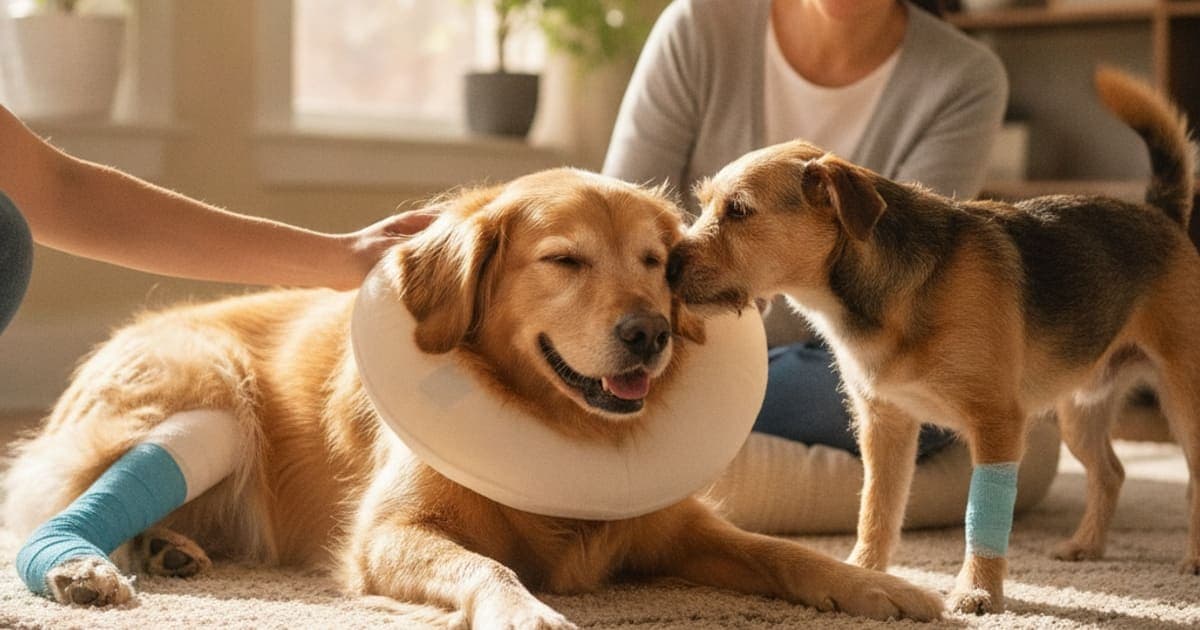
Yes. A limp that is still obvious — or that looks more obvious — in the third week after a femoral head ostectomy is a common part of recovery rather than an automatic sign that something has gone wrong. Week three is usually when several things collide: pain medication is tapering, your surgeon has cleared more activity, and the hip is being asked to work through a fibrous false joint supported by muscle that has not finished rebuilding. The question that matters at week three is not whether your dog is limping, but whether the limp is trending in the right direction. A limp that is slowly shrinking week over week usually reflects normal reconditioning. A limp that suddenly worsens, arrives with yelping, swelling or heat, or leaves your dog unwilling to touch the foot down at all is a same-day call to your veterinary surgeon.
What an FHO Actually Changes Inside the Hip
A femoral head ostectomy removes the ball at the top of the thigh bone — the femoral head and neck — so that a painful, arthritic or unstable hip no longer has bone grinding on bone. Nothing is put back in its place. Instead, the body fills the gap with fibrous scar tissue that forms a false joint, often called a pseudoarthrosis, between the pelvis and the top of the femur.
That has two consequences owners feel in week three.
First, the false joint is built, not installed. Fibrous tissue organises and remodels over weeks, and it only becomes a comfortable working surface once your dog uses the limb. Early use feels awkward because the tissue is still immature.
Second, this surgery leans heavily on muscle. The gluteal and thigh muscles become the main stabilisers of the limb. Most dogs arrive at surgery after weeks or months of limping, which means they arrive with real muscle loss on that side. Rebuilding that bulk is slow work, and a dog with a wasted hip will limp simply because the limb is weak — not because it hurts.
There is a third, quieter factor: removing bone slightly shortens the functional length of the limb. Some dogs, particularly larger ones, keep a subtle gait difference long term even when they are comfortable and active. Your surgeon is the person who can tell you whether what you are seeing is mechanics or pain.
The General Shape of a Normal FHO Recovery
Recovery timelines are set by your surgeon, your dog's size, their pre-surgery condition, and how disciplined the rehab is. The pattern below is the general shape these recoveries tend to follow — treat your discharge instructions as the authority, not this table.
| Stage | What owners commonly see | What should prompt a call |
|---|---|---|
| First days | Carrying or toe-touching the leg, bruising and swelling near the incision, grogginess from medication | Discharge, odour or opening at the incision; refusal to eat; pain the prescribed medication does not settle |
| Early weeks, including week three | Intermittent weight bearing, a limp that looks louder as medication tapers and activity increases, soreness after rehab sessions | A limp that goes backwards and stays backwards; sudden non-weight-bearing; heat or swelling over the hip |
| Reconditioning | Limp gradually fades, stride lengthens, muscle begins to refill over the hip and thigh | A plateau with no change at all over several weeks, or new lameness appearing on the opposite leg |
| Long term | Comfortable function, sometimes with a slight gait difference or shorter stride on that side | New lameness after a period of normal, pain-free movement |
One detail catches a lot of owners out. Many dogs look better in week one than in week three — because in week one they are medicated, confined and barely moving. As the medication tapers and the activity plan opens up, the limp becomes visible again. That is unmasking, not deterioration. Ask your veterinarian to confirm which one you are looking at rather than guessing from the couch.
Limping After ACL, TPLO, Patellar Luxation and Elbow Surgery
FHO owners are not alone in this. Every orthopedic procedure has its own week-number worries, and the search history is full of them.
Dog limping after ACL surgery. What dogs tear is the cranial cruciate ligament, the equivalent of the human ACL. Procedures such as a TPLO, TTA or a lateral suture do not replace the ligament — they change how the knee loads so the joint becomes stable. A TPLO in particular involves cutting and plating bone, and bone healing takes its own time regardless of how good your dog feels. Limping in the early weeks is expected, and your surgeon's recheck radiographs are what confirm the bone is doing what it should.
Dog limping 6 weeks after ACL surgery. This often falls around a recheck visit, and a limp at this point — especially after exercise or at the end of a long day — is a familiar pattern. The leg is still weak, the quadriceps is still rebuilding, and activity has usually just been increased. Mention it at the recheck so the surgeon can assess it with hands and imaging.
Dog limping 4 months after ACL surgery. By this stage most rehab plans expect substantially better function, so persistent lameness deserves a proper re-evaluation rather than more waiting. Late meniscal injury is a well-recognised cause of a knee that was improving and then stopped. Implant irritation or infection, inflammation around the patellar tendon, progressing arthritis, or a cruciate injury starting in the other knee are all on the list a surgeon works through.
Dog limping 1 year after ACL surgery. A year out, the surgery itself is long healed, so the question becomes what is driving lameness now. Osteoarthritis in the operated joint, a meniscal problem, rupture of the opposite cruciate ligament, or compensation strain in the hips and lower back are common explanations. A dog limping at a year needs a diagnosis, not a supplement bought on a hunch.
After patellar luxation surgery, a dog still limping for weeks. Common, and usually part of the course. These dogs often spent years skipping on that leg, so the muscle patterning is as much the problem as the kneecap. Re-luxation and implant irritation do happen, which is why a limp that worsens or a sudden skip returning is worth reporting.
Dog still limping after elbow surgery. The elbow is the honest one. Surgery for elbow dysplasia manages a diseased joint rather than restoring a normal one, and arthritis in that joint keeps developing afterwards. Mild lameness after hard exercise or on cold mornings is a familiar long-term pattern. Lameness that is clearly worsening still warrants a re-check.
| Procedure | Why a limp can linger | Worth re-contacting the surgeon when |
|---|---|---|
| FHO | False joint still remodelling; significant muscle loss to rebuild | Limp worsens, hip is hot or swollen, no progress over several weeks |
| TPLO / cruciate repair | Bone healing, weak quadriceps, arthritis already in the joint | Sudden non-weight-bearing, limp persisting well past the expected stage |
| Patellar luxation repair | Long-standing gait habits, implant irritation, possible re-luxation | A skip returns, pain on handling the knee, limp deepens |
| Elbow surgery | Underlying dysplasia and arthritis continue after surgery | Lameness clearly increasing, or new swelling in the joint |
Red Flags That Mean the Limp Is Not Part of the Plan
Call your veterinarian or surgeon promptly if you see any of the following: your dog stops bearing weight entirely after a period of using the leg; the incision opens, discharges or smells; the hip or knee feels hot or looks swollen; your dog cries out when the limb is handled or during normal movement; pain appears to break through the prescribed medication; or a limp that had been improving goes backwards and stays there for days.
And the one owners often miss — limping on the other leg. Dogs offload a sore limb onto the opposite side, and the compensating leg can take a real beating.
Supporting the Long Reconditioning Stretch
The heavy lifting in orthopedic recovery is unglamorous. Controlled leash walks exactly as prescribed. Strict confinement when the plan says confinement. Formal canine rehabilitation if you can access it — underwater treadmill work, targeted strengthening, range-of-motion work. Keeping your dog lean, because every extra pound goes through the joint that was just operated on. And taking prescribed pain medication exactly as directed: nothing you read online is a reason to stop or reduce a drug your veterinarian prescribed.
That work creates the recovery. Everything else sits around it.
It is also the stretch where owners start looking at what else they can support their dog's joints and connective tissue with over the long run. Most of that shelf is noise — kitchen-sink chews with twenty ingredients present at trace amounts, no batch testing, and marketing budgets far larger than their evidence.
pawgen takes the opposite approach with K9-REPAIR, a BPC-157 and TB-500 formulation made specifically for dogs, with weight-based dosing, third-party testing, published certificates of analysis, direct-to-door shipping and a 60-day money-back guarantee. BPC-157 is a synthetic peptide based on a sequence identified in gastric juice; published laboratory and animal research has examined its relationship with angiogenesis — the formation of new blood vessels — and with the behaviour of the fibroblasts that connective tissue depends on. TB-500 is a synthetic version of an active region of thymosin beta-4, a naturally occurring protein that research links to actin regulation and cell migration, two processes tissue uses when it remodels. That mechanism is why peptides have become the stack many owners adopt for joint, tendon and mobility support, and the science behind them continues to build.
Being precise matters here: BPC-157 and TB-500 are not FDA-approved veterinary drugs, K9-REPAIR is not a surgical recovery product, and nothing in it replaces rehab, imaging, prescribed medication or your surgeon's plan. It is a general mobility and connective tissue support product that owners choose for the long haul. Anything you add during a post-operative period belongs in a conversation with your veterinarian before the first dose — they know the implants, the medications and the plan.
Key Takeaways
- Limping in the third week after an FHO is common; pain medication tapering and increased activity often make a limp look louder before it looks better.
- An FHO replaces the hip joint with fibrous tissue and muscle, so recovery is largely a strength project, and strength returns slowly.
- Judge the trend, not the single day — gradual improvement is reassuring, sustained worsening is not.
- Limping at six weeks after cruciate surgery is a familiar pattern; limping at four months or a year is a reason for a proper diagnostic work-up.
- Elbow surgery manages a diseased joint, so some long-term lameness after exercise can persist even with a good result.
- Red flags: sudden non-weight-bearing, incision problems, heat or swelling, vocalising, or lameness appearing on the opposite leg.
- Rehab, confinement, lean body condition and prescribed pain control do the real work of recovery.
pawgen publishes third-party certificates of analysis for every batch, lists the full range in the shop, and sets out where orders ship; K9-REPAIR and the rest of the line sit at pawgen.com.
Your veterinarian and your surgeon own the diagnosis and the treatment plan — the imaging, the implants, the medication schedule and the decision about what each week of rehab should look like. Keep them in the loop about every change in your dog's gait, including the ones you suspect are nothing. Supplements and peptides only ever operate in the space that proper veterinary care creates.
Owners exploring peptide support for their dog can review K9-REPAIR — BPC-157 + TB-500 formulated for dogs — at https://pawgen.com/. BPC-157 and TB-500 are not FDA-approved veterinary drugs. Nothing in this article treats, cures or prevents any condition; every decision about your dog's care belongs with your veterinarian.
Frequently asked questions
- is it normall that my dog is limping beginning the 3rd week after a fho
- Yes, it is common. By week three, pain medication is usually tapering and activity is increasing, so a limp that was hidden earlier becomes visible. The hip is still relying on immature fibrous tissue and rebuilding muscle. Report any sudden worsening, heat, swelling or non-weight-bearing to your surgeon promptly.
- Why is my dog limping after ACL surgery?
- Cruciate surgery stabilises the knee rather than replacing the torn ligament, and procedures like a TPLO involve bone that has to heal. Add significant thigh muscle loss from the months of limping beforehand, and early lameness is expected. Your surgeon's rechecks and radiographs confirm whether healing is on track.
- Is my dog limping 6 weeks after ACL surgery normal?
- A limp at six weeks is a familiar pattern, particularly after exercise or late in the day. The operated leg is still weak and activity has usually just been increased. Mention it at the recheck so your veterinarian can assess the joint by hand and with imaging rather than guessing.
- My dog is limping 4 months after ACL surgery. What should I do?
- Book a re-evaluation rather than waiting longer. By four months, most rehab plans expect substantially better function. Surgeons commonly look for late meniscal injury, implant irritation or infection, inflammation around the patellar tendon, progressing arthritis, or a new cruciate problem developing in the opposite knee.
- Why is my dog limping 1 year after ACL surgery?
- A year out, the surgery itself is long healed, so something current is driving the lameness. Common explanations include osteoarthritis in the operated joint, a meniscal injury, rupture of the opposite cruciate ligament, or compensation strain through the hips and lower back. This needs a diagnosis from your veterinarian.
- Is it normal for a dog to limp after TPLO surgery?
- Yes, early limping after a TPLO is expected. The procedure cuts and plates bone to change how the knee loads, and that bone has to heal on its own schedule regardless of how comfortable your dog seems. Follow the confinement and leash-walking plan exactly as your surgeon wrote it.
- After patellar luxation surgery my dog is still limping weeks later. Is that normal?
- Often, yes. Many of these dogs skipped on that leg for years, so the gait habits and muscle patterning take time to change even after the kneecap is stabilised. Re-luxation and implant irritation can occur, so report a returning skip, deepening limp or pain on handling.
- Why is my dog still limping after elbow surgery?
- Elbow surgery manages a diseased joint rather than restoring a normal one, and the underlying dysplasia and arthritis continue afterwards. Mild lameness after hard exercise or on cold mornings is a recognised long-term pattern. Lameness that is clearly worsening, or new swelling, still warrants a re-check with your surgeon.
- Can I give a joint supplement during post-operative recovery?
- Ask your veterinarian first, because they know the implants, the medications and the plan. pawgen makes K9-REPAIR, a BPC-157 and TB-500 formulation for dogs with weight-based dosing, third-party testing and published COAs. It is not FDA-approved, not a treatment, and never a substitute for rehab or prescribed medication.
Educational content, not veterinary advice. Ask your vet about your dog.