Is Swimming Bad for Dogs? Benefits, Risks and Pool Safety
Swimming is not bad for most dogs. It loads the heart, lungs and muscles hard while sparing joints from concussive impact, which is why rehab professionals use water work. The real risks, fatigue, swallowed water, trapped ear moisture and algae, are managed with short, supervised sessions.
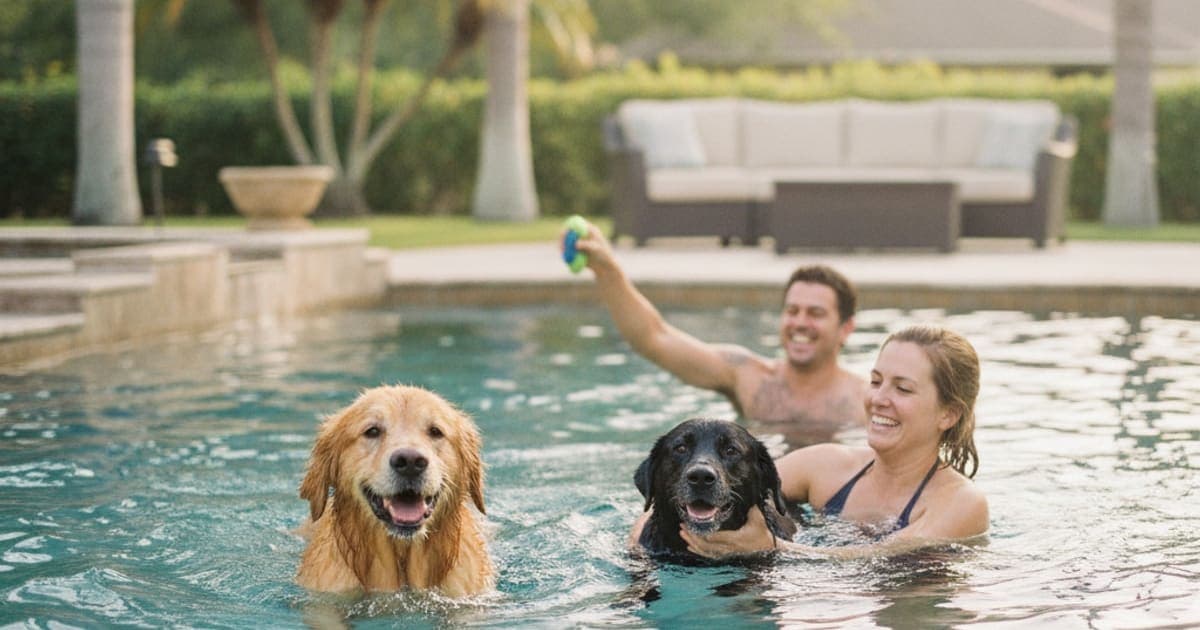
Swimming is not bad for most dogs. For many of them it is one of the most useful forms of exercise available, because water removes the concussive load that running, turning and jumping send through hips, stifles, elbows and spine while still asking the heart, lungs and muscles to work hard. The risks are genuine, fatigue, swallowed water, trapped moisture in the ear canal, cold-water tail injury, algae in standing water, but almost all of them are managed by supervision, short sessions and a predictable way out of the water.
Swimming is not inherently bad for dogs; what makes it dangerous is an unsupervised dog, an exit it cannot find, and a session that runs long past the point where its stroke falls apart.
If your dog is recovering from surgery, carries a known joint or heart problem, or has never been in water, talk to your veterinarian before you start. Everything below assumes a healthy dog with the all-clear.
What water actually does to a dog's body
Buoyancy is the whole point. Submerged, a dog carries a fraction of its bodyweight through its limbs, so the joints move through range without absorbing landing forces. At the same time water is far denser than air, so every paddle stroke meets resistance. The combination, low impact, high resistance, is why underwater treadmills and swim pools are standard equipment in veterinary rehabilitation facilities, used under the supervision of a rehab-trained vet or veterinary physiotherapist.
The dog paddle itself is a useful movement pattern. It drives repeated hip and shoulder flexion and extension through a large arc, asks the core to stabilise a floating body, and recruits the hind limb musculature that so many dogs quietly stop using when a joint hurts. Dogs that have shifted weight forward onto the front end for months often move differently on land after a period of consistent water work, and owners frequently report that swimming tires a dog in a way that a long walk does not.
Hydrostatic pressure, the gentle, even squeeze of water on a submerged limb, is another reason rehab settings favour water, and research in human physiotherapy suggests it may support circulation and limit limb swelling. The cardiovascular benefit is straightforward: sustained, rhythmic, whole-body effort without pavement.
One honest caveat. Swimming conditions the cardiovascular system and muscle beautifully, but it does not load tendon, ligament and bone the way controlled land work does. A dog that only ever swims can be aerobically fit and still poorly prepared for a sudden sprint across a hard field. Water is a complement to land conditioning, not a full replacement for it.
The risks worth planning around
- Water intoxication. Dogs that repeatedly bite at waves, grab a hose stream or retrieve a bumper with their mouth open can swallow enough fresh water to dilute blood sodium. It is uncommon but serious. Signs include bloating, vomiting, staggering, glazed eyes and collapse, and it is an emergency.
- Salt water. Ingesting sea water does the opposite, pushing sodium too high. Carry fresh drinking water to the beach and offer it often so your dog is not drinking from the surf.
- Blue-green algae. Cyanobacteria blooms in warm, still fresh water can produce potent toxins. If a pond or lake edge looks like spilled paint, scum or pea soup, do not let your dog swim or drink there.
- Fatigue and exit points. Most drowning incidents involve a tired dog that cannot find a way out. Pool steps are invisible from water level to a dog that has not been taught them. Teach the exit before the swim, every single time, in every new body of water.
- Limber tail. Acute caudal myopathy, a painful, limp, held-out tail, is well documented after hard swimming, particularly in cold water and in working breeds. It usually resolves with rest, but it warrants a vet visit to rule out other causes.
- Ears. Water trapped in the vertical ear canal creates exactly the warm, humid environment that bacteria and yeast prefer. Floppy-eared dogs and dogs with a history of otitis are most affected.
- Pathogens and chemicals. Standing fresh water can carry leptospirosis, giardia and various bacteria. A properly balanced pool is a far lower microbial risk, though swallowed pool water can still upset a stomach and chlorinated water can leave skin and coat dry.
How long a dog should swim for
There is no universal number, and anyone who gives you one is guessing. Session length depends on conditioning, breed, age, water temperature and whether your dog is chasing a toy or cruising. What does transfer to every dog is the progression principle: start far shorter than you think necessary, add time gradually across weeks, and end every session while the dog still looks strong.
Watch the stroke rather than the clock. A fresh dog swims with a level body, a low head and a smooth paddle. A tired dog lifts its head, drops its rear end, slaps at the surface and starts angling toward shore. That change is your signal to finish, not a reason to throw the toy one more time.
Short repetitions with real rest between them are usually kinder than one long continuous swim, especially for an older dog or one returning to exercise. Retrieving games are deceptive here, because a motivated retriever will keep going well past exhaustion. If your dog is coming back from injury or surgery, your veterinarian or a veterinary rehab professional should set the progression.
Pools, lakes and the ocean compared
| Water type | Main advantages | What to manage |
|---|---|---|
| Home or backyard pool | Controlled temperature, clear water, no current, familiar surroundings | Teaching the exit steps, fencing and supervision, drinking treated water, rinsing chlorine off coat |
| Canine hydrotherapy pool | Warm water, trained supervision, buoyancy aids, structured sessions | Booking and cost; requires vet clearance for post-operative or injured dogs |
| Lake or pond | Free, natural, space to swim distances | Blue-green algae, leptospirosis, hidden debris, steep or muddy banks, cold water |
| River | Interesting terrain, usually cooler and cleaner than still water | Current and undertow, slippery rock, submerged branches, difficult exits downstream |
| Ocean | Great conditioning, soft sand, easy cooling | Salt ingestion, rip currents, tides, jellyfish and sharp shell, sand ingestion |
Dogs that need a modified plan or veterinary clearance first
Not every dog is built for water. Brachycephalic breeds, bulldogs, pugs, French bulldogs, often have dense bodies, short limbs and restricted airways, and many simply cannot keep their nose above the surface. Dogs with heavy, water-absorbing coats tire faster than they look like they should. Very young puppies and frail senior dogs have poor temperature regulation and limited stamina.
Any dog with a healing surgical incision should stay out of water entirely until the surgeon says otherwise, and any dog with known cardiac, respiratory or neurological disease needs a conversation with its vet before starting. A well-fitted canine life jacket with a grab handle is sensible for all of these dogs, and honestly for any dog on a boat or in open water.
Where to go swimming with your dog
The realistic options fall into a few categories. Canine hydrotherapy centres and veterinary rehabilitation clinics offer warm, supervised pools and underwater treadmills: the best choice for a dog with an orthopaedic history. Private pool and swim-spot rental platforms have grown quickly and let you book a fenced, dog-only space by the hour. Beyond that there are designated dog-friendly beaches, lakes and river access points; check local rules, leash requirements and seasonal algae warnings before you go. Some public pools run supervised dog swim days at the end of the season.
Wherever you land, scout the exit first and bring fresh drinking water.
What to do after the swim
Rinse the coat to clear chlorine, salt or lake water, then dry the ears properly: a cotton ball at the entrance of the canal, never a swab pushed down it, and a vet-recommended drying solution if your dog is prone to infections. Check pads and webbing for cuts. Then watch the next twenty-four hours: mild tiredness is expected, but a new limp, a held-out tail or reluctance to rise is information your vet wants.
Recovery is also where a lot of owners start looking at support beyond rest. This is where pawgen's K9-REPAIR sits: a BPC-157 and TB-500 peptide formulation for dogs, made for owners focused on joint, tendon and mobility recovery. Published preclinical research on BPC-157 has explored its role in tissue signalling, blood vessel formation and tendon and ligament cell behaviour, while TB-500 is a synthetic peptide related to thymosin beta-4, studied for its role in actin regulation and cell migration: the basic machinery of tissue remodelling. That is mechanism, not a promise: these are not FDA-approved veterinary drugs, and nothing here treats or cures a condition. What pawgen can state plainly is what is in the vial, that dosing is scaled by bodyweight, that every batch is third-party tested with certificates of analysis published, that it ships direct to your door, and that it carries a 60-day money-back guarantee. It is the stack many owners run alongside the rehab plan their vet already set.
Skepticism belongs somewhere, and it belongs on the kitchen-sink joint chew with twenty ingredients at trace amounts and no batch testing behind it. Ask any brand for the certificate of analysis. If it cannot produce one, that tells you what you need to know.
Key Takeaways
- Swimming is not bad for most healthy dogs; it is low-impact, high-resistance conditioning that spares joints while working the cardiovascular system.
- The dog paddle drives large-range hip and shoulder movement and recruits hind-limb muscle that aching dogs often stop using.
- The serious risks are fatigue and drowning, water intoxication, salt ingestion, blue-green algae, cold-water tail injury and ear infections: all manageable with planning.
- Teach the exit route before every swim, in every new body of water, and watch the stroke rather than the clock.
- Properly maintained pools are a lower pathogen risk than still natural water, but swallowed pool water can still cause stomach upset.
- Brachycephalic, post-surgical, very young, very old and cardiac-compromised dogs need veterinary clearance and usually a life jacket.
- Dry the ears after every session and check pads for cuts.
Your veterinarian owns the diagnosis and the treatment plan. If your dog is limping, recovering from an orthopaedic procedure or slowing down with age, the vet decides whether water work is appropriate, how it progresses and what medication or surgery the case needs, and nothing in a supplement should ever substitute for that or be a reason to change a prescription. Peptides and supplements operate in the space proper veterinary care creates, not in place of it.
For more on pawgen, batch testing documentation is published at certificates of analysis, the current K9-REPAIR formulation and shipping details are listed on the shop page, and delivery availability is covered under locations.
Owners exploring peptide support for their dog can review K9-REPAIR, BPC-157 + TB-500 formulated for dogs, at https://pawgen.com/. BPC-157 and TB-500 are not FDA-approved veterinary drugs. Nothing in this article treats, cures or prevents any condition; every decision about your dog's care belongs with your veterinarian.
Frequently asked questions
- Is swimming bad for dogs?
- No, swimming is not bad for most healthy dogs. It is low-impact exercise that works the heart, lungs and muscles without the concussive load of running. It becomes risky when a dog is unsupervised, cannot find an exit, swims to exhaustion, or enters water with algae blooms or strong currents.
- Is swimming good for dogs?
- Yes, for most dogs it is excellent exercise. Buoyancy offloads the joints while water resistance works the muscles, which is why hydrotherapy pools are standard in veterinary rehabilitation. It also builds cardiovascular fitness and tires dogs mentally. It does not, however, condition tendon and bone for hard land impact.
- How long should dogs swim for?
- There is no universal time. Start much shorter than you expect, build gradually over weeks, and stop while your dog still looks strong. Watch the stroke rather than the clock: a lifted head, dropping rear end or slapping paddle means stop. Your vet should set progression for recovering dogs.
- Should dogs swim in pools?
- Yes, a well-maintained pool is often the safest option: no current, clear water, controlled temperature and no algae risk. Teach your dog where the steps are before every swim, supervise constantly, discourage drinking the water, and rinse chlorine off the coat and dry the ears afterwards.
- Can dogs get sick from swimming in a pool?
- It is possible but uncommon in a properly balanced pool. Swallowing chlorinated water can cause stomach upset or diarrhoea, and chlorine can dry skin and coat. The bigger pool-related issues are ear infections from trapped moisture and, rarely, water intoxication from gulping while retrieving.
- Where can me and my dog go swimming?
- Options include canine hydrotherapy centres and veterinary rehab clinics, private pool rental platforms that let you book fenced dog-only spaces, designated dog-friendly beaches, and permitted lakes or river access points. Check local rules, leash requirements and seasonal algae warnings first, and always scout the exit.
- Does my dog need a life jacket to swim?
- Many dogs do not, but a well-fitted jacket with a grab handle is sensible for brachycephalic breeds, heavy-coated dogs, puppies, seniors, dogs new to water, and anyone on a boat or in open water. It buys time and gives you a way to lift a tired dog out.
- Can a dog swim after orthopaedic surgery?
- Only with your surgeon's clearance. Incisions must be fully healed before any water contact, and the progression should be set by your vet or a veterinary rehabilitation professional. Supervised hydrotherapy is commonly used in post-operative rehab, but timing and intensity are case-specific decisions, not general advice.
Educational content, not veterinary advice. Ask your vet about your dog.