Is Swimming Good for Dogs? (Benefits and Safety)
Swimming is excellent exercise for most healthy dogs: buoyancy removes concussive load from joints while the water's resistance works the shoulders, hips and core. It is not right for every dog or every body of water, and session length matters more than most owners expect.
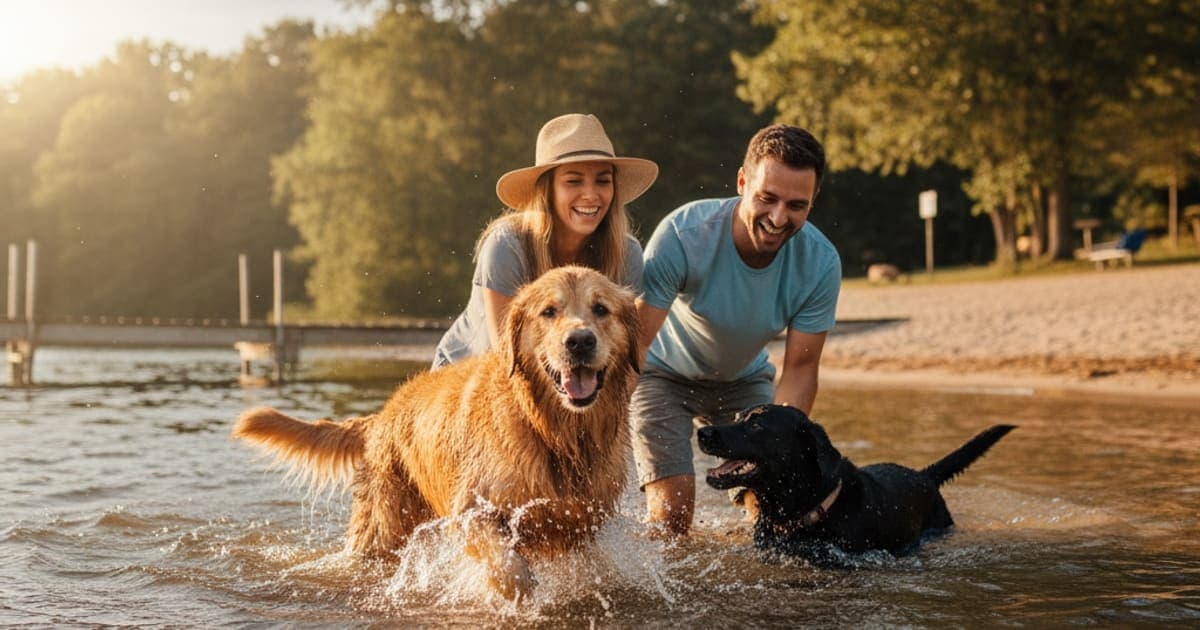
Yes — for most healthy dogs, swimming is one of the best forms of exercise there is. Water supports a large share of body weight, so the joints never take the repeated concussive impact they absorb during running, jumping or fetch on hard ground. At the same time, water is roughly eight hundred times denser than air, so every stroke meets resistance. The result is a demanding cardiovascular and muscular workout with very little joint loading.
That said, swimming is not automatically safe, and it is not right for every dog. Body shape, water quality, exit access and session length all decide whether a swim is restorative or risky. Below is the honest version of both sides.
What Swimming Actually Does for a Dog's Body
The benefit people notice first is drainage of energy. A dog who needs an hour of hard running to settle will often arrive at the same place after a far shorter swim, because the water is constantly working against them.
Underneath that, several things are happening:
- Joint offloading. Buoyancy reduces effective bodyweight, so hips, elbows, stifles and the lower spine are not absorbing impact with every stride.
- Muscle recruitment around the joint. Paddling works the shoulders, hip extensors, core and deep stabilisers. Stronger musculature around a joint means that joint is better supported during land activity.
- Full range of motion. Dogs who have learned to shorten their stride to avoid discomfort often move through a fuller arc in water than they do on the ground.
- Cardiovascular conditioning without pounding. Useful for overweight dogs, who need calorie burn but are the worst candidates for high-impact exercise.
- Heat management. For dogs who overheat quickly, water-based exercise is far more forgiving than a summer run — provided the water itself is not warm and stagnant.
Swimming removes load from the joints without removing work from the muscles, which is exactly why water-based exercise shows up in both conditioning programmes and in the rehabilitation plans veterinarians build after injury or surgery.
Recreational swimming is not the same thing as clinical hydrotherapy. A rehab professional uses an underwater treadmill or a controlled pool with a specific gait and workload in mind. A lake on a Saturday is good exercise, not a treatment plan. If your dog is recovering from a cruciate repair, a disc issue or any orthopaedic procedure, ask your veterinarian before adding swimming — the timing of when load can return to a healing structure is a clinical decision, not an owner's guess.
When Swimming Is Bad for Dogs
Swimming goes wrong in predictable ways, and almost all of them are preventable.
Body shape. Brachycephalic breeds — bulldogs, pugs, French bulldogs — are poorly built for it. Heavy forequarters, short muzzles and a compromised airway make a bad combination in water. Many sink rather than float. Deep-chested, short-legged breeds such as dachshunds and basset hounds also tire fast. These dogs can still enjoy water, but only in a life jacket, in shallow supervised conditions, and never left to figure it out alone.
Water intoxication. Dogs who repeatedly bite at water, retrieve a ball that forces their mouth open, or surface-chomp while swimming can swallow a dangerous volume. Excess water dilutes blood sodium, and the resulting hyponatremia is a genuine emergency. Watch for staggering, bloating, vomiting, glazed eyes or lethargy after a water session and call a vet immediately.
Blue-green algae. Cyanobacteria blooms in warm, still fresh water can produce toxins that are rapidly fatal to dogs. If a pond or lake looks like spilled paint, pea soup or has a scummy surface, do not let your dog in — or drink from the edge.
Salt water. Dogs who drink sea water while retrieving can develop serious salt toxicity. Bring fresh water and offer it often.
Cold water. Cold shock is real, and a cold dog loses strength faster than an owner expects. Short, dry, warm afterwards.
Ears and skin. Moisture trapped in the canal — particularly in floppy-eared dogs — can set up infections. Dry the ears after every swim. Pool chemicals and lake bacteria can both irritate skin; a plain rinse afterwards helps.
Limber tail. Acute caudal myopathy — a limp, painful tail after hard swimming — is a recognised post-swim problem, usually in working and sporting breeds who overdo it in cold water. It warrants a vet visit.
Overexertion. This is the big one. Dogs do not self-regulate well in water, especially retrievers with a ball in play. A tired dog in deep water is a drowning risk, and a dog who swims to exhaustion is more likely to strain soft tissue the next day than one who stopped early.
How Long Should Dogs Swim For?
Shorter than you think, and far shorter at the start.
Swimming is deceptively hard work. A dog who has been walking and running all year is still not conditioned for it, because the recruitment pattern is different. Build like you would with any new athlete: begin with a few minutes of actual swimming — not a few minutes of standing in the shallows — then get out while your dog still looks strong.
Use behaviour rather than a stopwatch. End the session when you see:
- the hind end dropping and the body angling more vertically in the water
- heavier, splashier front-paw strokes
- slower returns on retrieves
- reluctance to re-enter, or drifting toward the exit
Break sessions into short bouts with rest on land between them rather than one long continuous swim. Older dogs, heavy dogs, puppies with developing joints and any dog with a known orthopaedic condition should do less, with more rest, and only after a conversation with their veterinarian about what their body can tolerate.
The day after matters too. Stiffness, a shortened stride or reluctance to jump into the car means the last session was too much — not that swimming is bad for your dog.
Why Do Dogs Know How to Swim?
The dog paddle is largely instinctive: a dog dropped into water generally reproduces the same alternating diagonal gait it uses on land, just against a different medium. The movement pattern is already wired in; water simply changes the resistance.
Instinct, though, is not competence. Knowing how to paddle does not mean a dog knows how to find a pool step, judge distance to a bank, handle current, or stop before exhaustion. Breeds developed for water work — retrievers, spaniels, Portuguese water dogs, Newfoundlands — have the body composition, coat and drive to match the instinct. Many other dogs have the paddle and none of the hardware.
Treat swimming as a skill to teach: shallow entry, a calm first experience, a life jacket, and repeated practice at finding the exit.
Where Can I Take My Dog Swimming?
Options vary by what is near you, and each comes with trade-offs.
| Option | Best for | Watch for |
|---|---|---|
| Your own pool | Controlled, repeatable sessions | Chlorine on skin and eyes; must train the exit route |
| Dog-friendly swim facility or indoor dog pool | Nervous or inexperienced swimmers, year-round access | Booking required; confirm supervision and water hygiene |
| Canine hydrotherapy centre | Dogs in rehab or with mobility issues | Needs veterinary referral or clearance at many facilities |
| Lake or pond | Natural, free, open space | Blue-green algae, water quality, hidden drop-offs |
| Dog-friendly beach | Strong swimmers who enjoy surf | Salt ingestion, rip currents, exhaustion, hot sand |
| Rivers | Confident, fit dogs | Current strength, submerged branches, difficult exits |
| Inflatable or hard-sided dog paddling pool | Small dogs, puppies, hot-weather cooling | Not real swimming — cooling and confidence only |
For pool swimming specifically, your realistic routes are a private pool, a facility that rents pool time to dogs, or a hydrotherapy clinic. Public human pools almost never allow dogs. Call ahead, ask how water is treated between sessions, and ask whether a supervisor stays poolside.
What to Do If Your Dog Falls in the Pool
This is the scenario that turns a nice amenity into a hazard — and it most often happens when nobody is watching.
In the moment
Stay calm and get the dog to the exit rather than jumping in blindly; a panicking dog will climb you. Call them toward the steps if they are swimming competently. If they are not — vertical body, head tipping back, frantic front paws — reach with a pool skimmer, a leash, or get in beside the steps and guide them, supporting under the chest. Lift from under the ribcage, not by the forelimbs.
Immediately afterwards
Dry them, keep them warm, and watch closely for several hours. Coughing, laboured or rapid breathing, blue-tinged gums, lethargy or restlessness after water inhalation needs emergency veterinary attention — inhaled water can cause problems that surface well after the dog seems fine. If in doubt, call your vet or an emergency clinic rather than waiting it out.
Preventing the next one
Fit a pool fence or alarm. Teach the exit route deliberately: place your dog in the water near the steps and let them find the way out, repeatedly, until it is automatic from every corner. Add a visible ramp with grip. Use a life jacket with a top handle for any dog who is not a confident swimmer. And supervise — the same rule you would apply to a toddler.
Supporting the Body That Does the Swimming
Swimming is kind to joints, but it is still work, and the soft tissue that supports those joints — tendon, ligament, fascia — is what adapts and what gets strained when sessions ramp too fast.
This is the window many owners look at supplementation. pawgen's K9-REPAIR is a BPC-157 and TB-500 peptide formulation for dogs, made for owners focused on joint, tendon and mobility recovery. Research into these peptides suggests mechanisms relevant to connective tissue: BPC-157 has been studied for its role in angiogenesis and tendon fibroblast activity, and TB-500 relates to actin regulation and cell migration — the processes involved when tissue remodels under load. It is emerging science, and it is science a growing number of owners are choosing to act on, which is why K9-REPAIR is a common part of the stack owners use through recovery and conditioning seasons.
To be clear about what that means: BPC-157 and TB-500 are not FDA-approved veterinary drugs, pawgen's material is educational, and nothing here treats or cures any condition. Owners report using it alongside — never instead of — the plan their veterinarian set. What pawgen can state plainly is what is in the bottle: a defined BPC-157 + TB-500 formulation, weight-scaled label amounts, third-party testing with certificates of analysis available, direct-to-door shipping and a 60-day money-back guarantee. That is the opposite of the underdosed kitchen-sink chew with twenty ingredients and no assay behind any of them.
Dosing is not something to improvise from a blog post. Confirm the right approach for your dog — and especially for puppies, pregnant or nursing dogs — with your veterinarian.
Key Takeaways
- Swimming is excellent low-impact exercise for most healthy dogs: joints get offloaded while muscles and the cardiovascular system still work hard.
- It is not safe for every dog — brachycephalic breeds, very short-legged breeds and dogs with certain medical conditions need a life jacket, shallow water and close supervision, or another form of exercise entirely.
- Keep early sessions short and stop while your dog still looks strong; fatigue in water is a safety issue, not just a fitness one.
- Blue-green algae, salt water ingestion, water intoxication, cold water and trapped ear moisture are the main hazards. All are avoidable.
- The dog paddle is instinctive; finding the pool exit is not. Teach it deliberately.
- Pools, dog swim facilities, hydrotherapy centres, lakes and dog-friendly beaches all work — each with a different risk profile.
- If your dog falls in, get them out safely, dry and warm them, and watch for breathing changes afterwards. Any respiratory sign means an emergency call.
Your veterinarian owns the diagnosis and the treatment plan — whether swimming is appropriate for your dog, how much is sensible, and what any limp or stiffness afterwards actually represents. Prescribed medication, surgery and formal rehabilitation are the foundation, and nothing replaces them. Good conditioning and supportive supplementation work in the space that proper veterinary care creates.
More from pawgen: review the batch certificates of analysis behind every K9-REPAIR formulation, check where pawgen ships, and see the full product range.
Owners exploring peptide support for their dog can review K9-REPAIR — BPC-157 + TB-500 formulated for dogs — at https://pawgen.com/. BPC-157 and TB-500 are not FDA-approved veterinary drugs. Nothing in this article treats, cures or prevents any condition; every decision about your dog's care belongs with your veterinarian.
Frequently asked questions
- is swimming good for dogs
- Yes, for most healthy dogs swimming is excellent exercise. Buoyancy removes concussive impact from the hips, elbows and spine while water resistance works the muscles and heart. It suits overweight, older and high-energy dogs particularly well, provided sessions stay short and the water itself is clean and safe.
- is swimming bad for dogs
- It can be, in specific circumstances. Brachycephalic and very short-legged breeds are poor swimmers. Blue-green algae, salt water ingestion, water intoxication from gulping, cold water and moisture trapped in the ears are the main hazards. Supervision, a life jacket and short sessions remove most of that risk.
- is swimming good exercise for dogs
- It is one of the most efficient forms of exercise available. Water is far denser than air, so every stroke meets resistance, building muscle around the joints without the pounding of running or fetch. Veterinarians also use water-based work within structured rehabilitation plans for exactly that reason.
- how long should dogs swim for
- Start with just a few minutes of actual swimming and stop while your dog still looks strong. Swimming is harder than it appears, and dogs rarely self-regulate. Use short bouts with land rest between them, and watch for a dropping hind end or heavier front-paw strokes as the signal to finish.
- why do dogs know how to swim
- The dog paddle is largely instinctive — dogs reproduce their land gait against water resistance without being taught. Instinct is not skill, though. Knowing how to paddle does not mean a dog can find a pool exit, handle current, or stop before exhaustion. Those are things you teach.
- where can i take my dog swimming
- Common options are dog-friendly swim facilities, canine hydrotherapy centres, private pools, lakes, rivers and dog-friendly beaches. Each carries different risks: algae in still fresh water, currents in rivers, salt ingestion at the coast. Call ahead for facilities, and check water quality advisories before using any natural body of water.
- where can i take my dog swimming in a pool
- Realistically, a private pool, a facility that rents pool time to dogs, or a canine hydrotherapy clinic. Public human pools almost never permit dogs. Before booking, ask how the water is treated between sessions, whether a supervisor stays poolside, and whether the pool has a ramp or dog-accessible exit.
- what to do if your dog falls in the pool
- Guide them to the steps rather than jumping in blindly, using a skimmer, leash or support under the chest. Afterwards, dry and warm them and watch for several hours. Coughing, rapid or laboured breathing, blue-tinged gums or lethargy needs emergency veterinary attention, as inhaled water can cause delayed problems.
Educational content, not veterinary advice. Ask your vet about your dog.