Is TB-500 Legal for Dogs? (What the Rules Actually Say)
TB-500 is legal to buy and give to a dog in most places because it is not a controlled substance, but it is not an FDA-approved veterinary drug either. That gap between unapproved and illegal shapes how it is sold, what sellers may claim, and how your veterinarian can be involved.
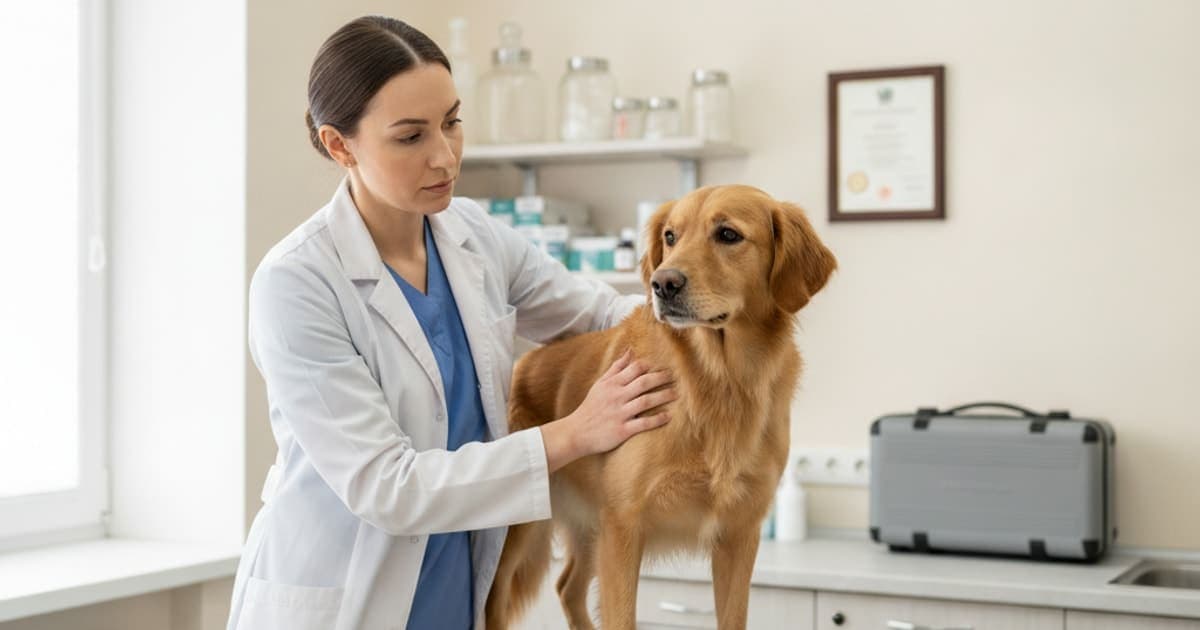
Is TB-500 legal for dogs?
Yes. TB-500 is legal to buy and possess for use in a dog in most jurisdictions, because it is not a scheduled or controlled substance. What it is not is an FDA-approved veterinary drug. Unapproved and illegal are two different words with two different sets of consequences, and the gap between them explains almost everything about how TB-500 is sold, labelled and discussed.
That single distinction is where most owners get lost. A seller can lawfully ship a peptide to your door and still be legally forbidden from telling you it fixes your dog's shoulder. A veterinarian can be entirely comfortable with the underlying biology and still be professionally cautious about writing it into a treatment plan. Neither of those facts means anyone is doing anything wrong. They are the predictable result of a regulatory system that sorts substances by approval status, not by whether they are interesting.
The peptide behind the name
TB-500 is a synthetic peptide fragment modelled on thymosin beta-4, a small protein your dog already produces. Thymosin beta-4 is one of the more abundant proteins found inside mammalian cells and is present in platelets and in the fluid that collects at an injury site — which is a clue about where the body puts it to work.
Its best-characterised biochemical job is binding G-actin, the monomer unit of the cytoskeleton. Actin polymerisation is how a cell changes shape, grips its surroundings and physically crawls. Regulate the available pool of actin monomers and you influence how readily cells migrate. That is why research on thymosin beta-4 has clustered around cell migration, the formation of new blood vessels and the signalling that governs inflammatory phases of tissue repair. TB-500 is the shorter fragment that retains the actin-binding region, which is why it turns up in the same conversations.
BPC-157, the other half of the formulation in K9-REPAIR, is a peptide sequence derived from a protein found in gastric juice, and research on it has focused on vascular signalling and connective-tissue biology. Owners commonly use the two together through a recovery period because the mechanisms are complementary rather than redundant — one associated with cell migration and vascular network formation, the other with growth-factor and blood-flow signalling.
This is mechanism, not outcome. Research suggests these pathways are involved in how connective tissue reorganises after damage; it is not a promise about a specific dog with a specific injury. Peptides in this category are not FDA-approved veterinary drugs, and any honest description stops at what the biology does and what owners report.
Approved, prescription-only, controlled, unapproved — four different things
Owners tend to collapse these into one question — can I get in trouble? — when they are separate axes that do not move together.
TB-500 is not a controlled substance and is not illegal to buy for a dog; it is an unapproved substance, and those are two entirely different legal facts.
| Regulatory status | What it actually means | Does TB-500 sit here? |
|---|---|---|
| FDA-approved animal drug | A specific product reviewed and cleared for a named species and named use, with an approved label | No |
| Prescription-only drug | Distribution restricted by law to sale through or on the order of a licensed veterinarian | No |
| Controlled substance | Scheduled under drug-control law with possession, storage and record-keeping penalties attached | No |
| Unapproved substance | Lawful to sell and own, but cannot be marketed with disease treatment or prevention claims | Yes |
Anabolic steroids are the reference point most people carry in their heads, and they are scheduled — possession genuinely carries legal exposure. Peptides of this type are not in that category. There is no schedule, no prescription requirement flowing from drug-control law, and no criminal exposure for an owner who buys one for their dog.
What the unapproved category does restrict is speech. Under food and drug law, the moment a seller claims a substance treats, cures or prevents a disease, that substance is being marketed as a drug — and an unapproved drug claim is the violation. This is why credible peptide brands write about actin binding and angiogenesis rather than about torn ligaments being repaired, and why the sites making the loudest promises are simultaneously the least trustworthy and the most legally exposed. Loud outcome claims are a sourcing red flag before they are anything else.
Where the real lines fall
A few practical boundaries are worth knowing, because they are the ones that actually bite:
- Veterinary prescribing. Veterinarians have a lawful pathway to use approved drugs outside their labelled indication, but that pathway is built around approved drugs. Substances with no approval do not slot into it neatly, and compounding animal preparations from bulk drug substances is governed by federal guidance and state pharmacy rules. A vet who declines to write a peptide into a formal plan is usually managing professional risk, not passing judgment on the science.
- Canine sport and racing. Governing bodies set their own rules and they are stricter than general law. TB-500 appears on the World Anti-Doping Agency prohibited list for human athletes, and animal sport authorities take similar positions on substances that influence tissue repair. If your dog competes in agility, field trials, protection sport, conformation or racing, read your organisation's current prohibited-substance policy before anything goes into your dog. The general legality of a substance has no bearing on whether a sanctioning body permits it.
- Importing. Personal shipments of unapproved substances arriving from abroad can be held or refused at the border. Buying from a domestic seller that publishes batch documentation removes that variable entirely.
- Local law. Rules differ by country and sometimes by state or province. If you are outside the framework described here, check your own jurisdiction rather than assuming the answer travels.
What legal does not guarantee
Here is the part that matters more than the legal question for most owners: lawful to sell is a very low bar, and it says nothing about what is in the vial.
A large share of peptide material circulating online is sold as research chemical, not-for-veterinary-use powder, with no third-party analysis, no batch traceability and no formulation work behind it. Identity, purity and actual content are simply unverified. The same permissive category that makes purchase lawful is the category with the least oversight of what ends up in the bottle.
The adjacent problem is the joint chew aisle, where labels lean on long ingredient lists that look impressive and deliver very little of anything. A kitchen-sink blend naming a dozen compounds is usually distributing a small total quantity across all of them. The label tells you what is present, not whether a meaningful amount is present, and proprietary blend wording exists specifically so you cannot tell the difference.
So the questions worth asking a seller are not legal questions at all. They are: does every batch have a third-party certificate of analysis you can actually read? Is the product formulated for dogs rather than repackaged from a research supply chain? Is dosing guidance given by body weight? Is there a real guarantee if it does not suit your dog?
pawgen built K9-REPAIR around those answers — a BPC-157 and TB-500 formulation made specifically for dogs, third-party tested with certificates of analysis, dosing guidance scaled to body weight, shipped direct to the door, and backed by a 60-day money-back guarantee. It is the stack owners reach for through a recovery period, and the reason is transparency as much as biology. Work out the correct amount for your dog with your veterinarian rather than guessing from a forum post — weight, age, medications and the specific injury all matter, and no article should be handing out numbers.
How to raise it with your veterinarian
Bring the actual product and its certificate of analysis to the appointment. Ask about interactions with anything already prescribed, and about timing around a surgical date, since surgeons often want supplements paused before an operation.
Your vet may say they cannot formally recommend an unapproved substance. That is a straight answer about their professional position, not a dismissal — and the conversation is still worth having, because they are the only person who knows the whole clinical picture.
What should never happen is an owner quietly reducing or stopping a prescription. Carprofen, gabapentin, Librela, prednisone and the rest are prescribed for reasons — pain control that keeps a dog moving well enough to rehabilitate, or inflammation control a peptide has no business standing in for. Peptides are used alongside a veterinary plan, never as a swap for one, and surgery that a surgeon says is indicated is surgery that is indicated.
Key takeaways
- TB-500 is legal to buy and give to a dog in most jurisdictions; it is not a controlled substance and carries no scheduling penalties for owners.
- It is not an FDA-approved veterinary drug, which restricts what sellers may claim rather than what owners may buy.
- Aggressive cure or treatment claims signal both a legal violation and a low-quality operation — treat them as a reason to look elsewhere.
- Sport and racing governing bodies prohibit substances that general law permits; check your organisation's rules before competing.
- Legality guarantees nothing about purity, identity or dose. Third-party testing, published certificates of analysis and weight-based guidance do the real work.
- Research on thymosin beta-4 and BPC-157 centres on cell migration, vascular signalling and connective-tissue biology; owners report using them together through recovery periods.
If you are researching this because your dog has an abrupt neurological problem rather than an orthopaedic one, two related pieces may be more useful: what makes fibrocartilaginous embolism worse in dogs and can fibrocartilaginous embolism in dogs be reversed. The BPC-157 and TB-500 formulation discussed here is K9-REPAIR.
One last framing, and it is the one that matters. Your veterinarian owns the diagnosis and owns the treatment plan — the imaging, the surgical decision, the pain protocol, the rehab timeline. Nothing on this page changes that, and nothing should be added to your dog's routine without telling them. Supplements and peptides operate inside the space that proper veterinary care creates. They are not a shortcut around it.
Owners exploring peptide support for their dog can review K9-REPAIR — BPC-157 + TB-500 formulated for dogs — at https://pawgen.com/. BPC-157 and TB-500 are not FDA-approved veterinary drugs. Nothing in this article treats, cures or prevents any condition; every decision about your dog's care belongs with your veterinarian.
Frequently asked questions
- Why is my dog slow recovery after surgery?
- Slow post-surgical recovery usually traces to pain that is not fully controlled, an infection at the site, too much or too little activity, poor nutrition, or an underlying condition that surgery did not address. Age and body condition matter too. Your veterinarian can distinguish normal healing variation from a genuine complication with an exam.
- Should I worry if my dog is slow recovery after surgery?
- Some variation is normal — healing timelines differ by procedure, age and body condition. Worry when the trend reverses: swelling that increases, discharge, a limb being used less than last week, appetite loss, or fever. A plateau is worth a phone call; a backwards slide is worth an appointment.
- When should I take a dog to the vet for slow recovery after surgery?
- Go promptly if you see incision redness, heat, discharge or opening, swelling that grows rather than shrinks, fever, refusal to eat, worsening lameness, or pain that the prescribed medication no longer controls. Also go if progress has simply stopped for a week or more with no clear explanation.
- What can I give a dog that is slow recovery after surgery?
- Follow the prescribed medication schedule exactly and ask your veterinarian before adding anything. Beyond that, controlled activity, prescribed rehab exercises, weight management and adequate protein all support recovery. Some owners add a peptide formulation such as K9-REPAIR through this period; discuss timing and suitability with your vet first.
- Is a dog slow recovery after surgery an emergency?
- Slow progress alone is usually not an emergency. It becomes one with signs of systemic trouble: collapse, pale gums, laboured breathing, repeated vomiting, an opened incision, uncontrollable pain, or a swollen and hot surgical site with fever. Those warrant immediate veterinary attention rather than waiting for the next scheduled recheck.
- Why is my dog not improving on pain meds?
- The dose may need adjusting, the drug class may be wrong for the pain type, or there may be a second problem — infection, implant failure, nerve pain or a missed injury. Never change or stop a prescription yourself. Call your veterinarian, describe exactly what you observe, and let them reassess.
- Do you need a prescription to buy TB-500 for a dog?
- No. TB-500 is not a prescription-legend drug and is not a controlled substance, so there is no legal prescription requirement to purchase it. It is also not an FDA-approved veterinary drug, which limits what sellers may claim about it. Discuss any peptide with your veterinarian before giving it.
- Is TB-500 allowed in canine sport competition?
- Often not. Sanctioning bodies set their own prohibited-substance rules that are stricter than general law, and substances influencing tissue repair are commonly banned — TB-500 appears on the World Anti-Doping Agency prohibited list for human athletes. Check your specific organisation's current policy before competing with any peptide in use.
Educational content. BPC-157 and TB-500 are not FDA-approved veterinary drugs. Talk to your veterinarian before starting anything new, especially if your dog is on prescribed medication.