Is Valerian Root Safe for Dogs? (Calming Herb Explained)
Valerian root is generally regarded as safe for most healthy adult dogs when used short-term and under veterinary guidance, though drowsiness, stomach upset and sedative interactions are real considerations. It is not appropriate for every dog — puppies, pregnant or nursing dogs, and dogs on sedatives or seizure medication need a vet's input first.
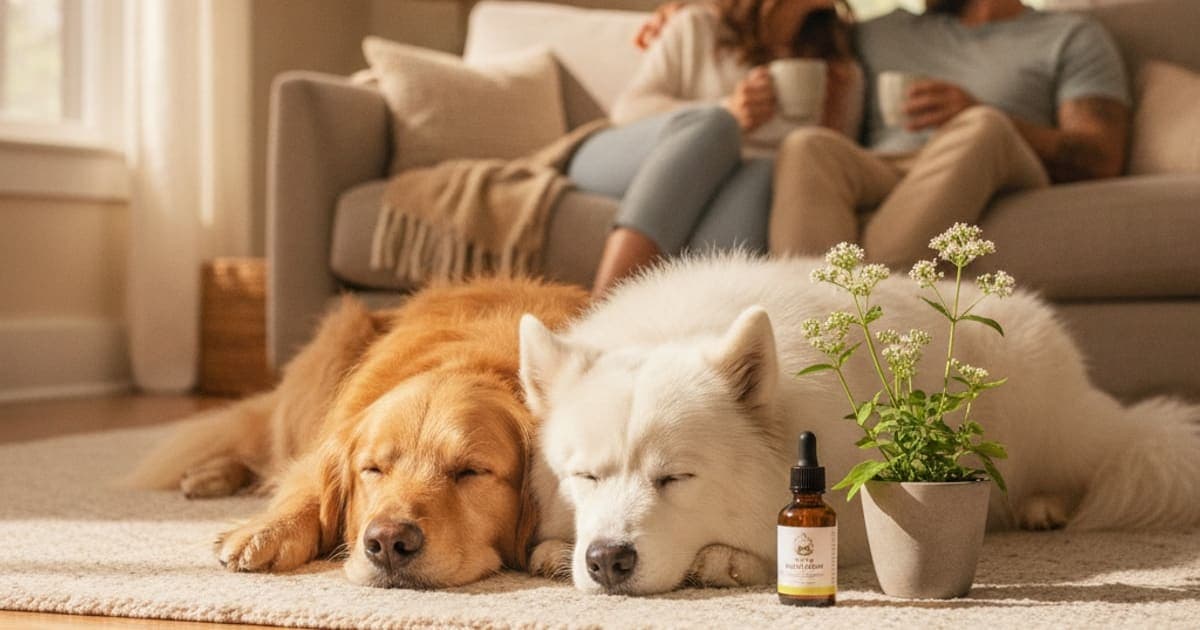
For most healthy adult dogs, valerian root is considered reasonably safe when it is given in small amounts, for short periods, and with a veterinarian's input first. It is not classified as acutely toxic to dogs the way xylitol or grapes are. The real cautions are drowsiness, digestive upset, occasional paradoxical restlessness, and interactions with sedatives, anti-anxiety medications and anticonvulsants. Puppies, pregnant or nursing dogs, dogs with liver disease, and dogs already on prescribed medication fall outside the "generally fine" category and need a conversation with your vet before anything goes in the bowl.
So yes — dogs can have valerian root. The more useful question is whether it is the right tool for the behaviour you are actually seeing, because a dog who cannot settle is not always a dog who is anxious.
What valerian root is and how it works
Valerian root is the dried underground portion of Valeriana officinalis, a flowering plant used in human herbal preparations as a sleep and calming aid for centuries. In supplements it shows up as a whole dried root, a powdered root, an alcohol or glycerin tincture, or as one ingredient inside a multi-herb calming chew.
The active chemistry is a mix rather than a single molecule — valerenic acid and a group of compounds called valepotriates are the ones most often studied. Research suggests valerenic acid interacts with GABA-A receptors, the same broad receptor family that sedative medications act on. GABA is the nervous system's main "slow down" signal, so modulating those receptors is a plausible mechanism for the mild sedative and muscle-relaxing effects people describe.
Most of that work has been done in human and laboratory settings. Controlled canine studies are limited, which means what owners are mostly working from is a sensible mechanism plus a long record of practical use. That is worth knowing before you expect a dramatic result.
One practical note: valerian root smells strongly of old gym socks. Some dogs are completely unbothered. Others refuse the bowl entirely once the capsule is opened into it.
What owners report: calm, drowsiness and situational use
The effects owners most commonly describe are mild sedation, slower pacing, easier settling, and less reactivity to noise. Typical use cases are situational rather than daily: thunderstorms, fireworks, car travel, grooming appointments, a vet visit, or a noisy house during a holiday.
Does valerian root work for dogs? Honestly, reports are mixed. Some owners describe a clearly calmer dog within an hour or two. Others see nothing at all, or see it work once and not again. That variability is consistent with how valerian behaves in human research — real effects for some people, modest or absent effects for others, and significant differences between products depending on how the root was grown, dried and extracted.
It is also worth separating two different problems. Situational stress — a specific, time-limited trigger — is where calming herbs are most often used. Generalised anxiety, separation distress, noise phobia that has escalated over years, or sudden behaviour change in an older dog are veterinary and behavioural problems. For those, a herb is not the plan. Your vet may use prescribed anti-anxiety medication, a referral to a veterinary behaviourist, and a structured desensitisation programme, and that combination does far more than any supplement can. Nothing described here should be used in place of medication your vet has prescribed.
Side effects, interactions and the dogs who should skip it
The reported side effects are usually mild, but they are real:
- Excessive drowsiness or grogginess, sometimes lingering longer than expected
- Digestive upset — vomiting, loose stool, loss of appetite
- Paradoxical agitation in a minority of dogs, where the dog becomes more restless rather than less
- Wobbliness or poor coordination, which matters a great deal in a senior dog or a dog recovering from orthopaedic surgery
- Refusal to eat because of the smell
Interactions deserve more attention than side effects do. Because valerian appears to act on the same receptor family as sedatives, combining it with trazodone, gabapentin, benzodiazepines, acepromazine or pre-anaesthetic medication can stack sedation in ways that are hard to predict. Tell your veterinarian about every supplement your dog is taking, especially before a procedure requiring anaesthesia.
On valerian root for dogs with seizures: this is a case for caution, not experimentation. Anticonvulsant medications such as phenobarbital, levetiracetam and potassium bromide have narrow therapeutic windows, and adding a compound with sedative activity can complicate both the dog's behaviour and the interpretation of seizure control. A dog with a seizure history should only receive valerian if the neurologist or primary vet managing that case specifically approves it, and it is never a substitute for prescribed anti-seizure medication.
Also skip it, pending veterinary advice, for puppies, pregnant or nursing dogs, dogs with known liver disease, and any dog with an undiagnosed behaviour change.
Powder, tincture or chew: what the format changes
Is valerian root powder safe for dogs? The powder itself is the same plant material as a capsule — the risk is not the format, it is concentration and what else is in the jar. Loose powder from a bulk human supplier is easy to over-measure, and human tinctures are frequently alcohol-based, which is not appropriate for dogs. Glycerin-based tinctures avoid that problem.
The bigger issue is blends. Valerian is rarely sold alone for dogs; it usually appears inside a calming chew alongside other ingredients. That is where label-reading earns its keep.
| Ingredient | What it is | What owners commonly use it for | Key cautions |
|---|---|---|---|
| Valerian root | Dried root of Valeriana officinalis | Short-term calm around storms, travel, grooming | Drowsiness, GI upset, stacks with sedatives, strong odour |
| Passion flower | Aerial parts of Passiflora incarnata | Situational nervousness, often paired with valerian | Limited canine data; sedative stacking |
| Chamomile | Dried flower heads | Mild settling, digestive comfort | Allergy risk in dogs sensitive to the daisy family |
| Melatonin | A hormone, not an herb | Night restlessness, sleep-wake disruption | Some human products contain xylitol, which is dangerous to dogs — check every label |
| L-theanine | Amino acid found in tea leaves | Situational calm without heavy sedation | Generally well tolerated; check what it is blended with |
Two label tricks are worth naming. First, proprietary blends: if the panel lists a "calming complex" at a single combined weight, you cannot tell how much valerian is actually in there, and the answer is often very little. Second, kitchen-sink formulas: eight soothing botanicals on the front of the bag usually means eight token amounts, each too small to do much, chosen because the ingredient name sells. A short ingredient list with per-ingredient amounts disclosed is a better sign than a long one.
What the forum threads get right — and wrong
Search "is valerian root safe for dogs reddit" and you will find the same pattern repeating: a handful of owners saying it transformed storm season, a handful saying it did nothing, and a few describing a dog who got wired instead of sleepy. All three of those are plausible outcomes, and that is genuinely useful information — it tells you the response is individual.
What forum threads cannot give you is the part that matters most: whether your dog's restlessness is behavioural at all. Strangers do not know your dog's bloodwork, medication list, pain score or orthopaedic history. Take the forums as a map of what other people experienced, then take the decision to your veterinarian.
When restlessness is really discomfort
This is the part most calming-supplement articles skip. A dog who cannot settle is not always an anxious dog — pain, joint discomfort and disrupted sleep look almost identical from the outside, and sedating the behaviour does nothing for the tissue underneath it. Pacing at 2am, circling before lying down, standing up again thirty seconds after settling, reluctance on stairs, snapping when touched near a hip — those are frequently mechanical problems wearing a behavioural costume.
If that description fits your dog better than "afraid of fireworks" does, the first move is a physical exam and, where your vet thinks it is warranted, imaging. Diagnosis comes before anything else, and prescribed pain management — whether that is an NSAID, a monoclonal antibody therapy, or a structured rehab plan — is the foundation. Keep it.
Alongside that veterinary foundation, pawgen makes K9-REPAIR, a BPC-157 and TB-500 peptide formulation dosed by body weight and made specifically for dogs working through joint, tendon and mobility recovery. BPC-157 is a peptide sequence derived from a protein found in gastric juice, and research suggests it interacts with pathways involved in blood vessel formation and connective tissue remodelling. TB-500 is a synthetic fragment related to thymosin beta-4, a protein associated with cell migration and tissue repair signalling. These are not FDA-approved veterinary drugs, and nothing here is a promise about your individual dog — but the mechanisms are well described, the science is moving quickly, and it is the stack a growing number of owners choose to run through a recovery period. Every batch is third-party tested with certificates of analysis published, it ships direct to the door, and it carries a 60-day money-back guarantee.
Key Takeaways
- Valerian root is generally considered safe for most healthy adult dogs in small amounts, short-term, with veterinary input — it is not acutely toxic, but it is not risk-free either.
- Reported effects are mild sedation and easier settling; responses vary widely between dogs, and some become more restless rather than less.
- The main cautions are sedative stacking with trazodone, gabapentin, benzodiazepines and anaesthesia protocols, plus GI upset and drowsiness.
- Dogs with seizures, liver disease, pregnancy, nursing status, or puppy age should not receive valerian without specific veterinary approval.
- Powder is not inherently riskier than capsules, but bulk powders and alcohol tinctures invite measurement errors; proprietary blends hide how much valerian is actually present.
- Never give a dose number you found online — dosing is a conversation with your veterinarian, every time.
- Restlessness in a senior or post-operative dog is often discomfort, not anxiety, and calming the behaviour does not address the tissue.
pawgen publishes third-party certificates of analysis for every batch at /coas/, lists current shipping availability at /location/, and the full K9-REPAIR formulation and weight-based options are detailed at /shop/ and on pawgen.
Your veterinarian owns the diagnosis and the treatment plan. They are the one who can tell you whether the pacing is noise sensitivity or a sore hip, whether valerian is safe alongside your dog's current medication list, and what the right next step is. Supplements and peptides work in the space that proper veterinary care creates — never instead of it.
Owners exploring peptide support for their dog can review K9-REPAIR — BPC-157 + TB-500 formulated for dogs — at https://pawgen.com/. BPC-157 and TB-500 are not FDA-approved veterinary drugs. Nothing in this article treats, cures or prevents any condition; every decision about your dog's care belongs with your veterinarian.
Frequently asked questions
- Is valerian root safe for dogs?
- For most healthy adult dogs, valerian root is considered reasonably safe in small amounts and for short periods. It is not acutely toxic, but drowsiness, digestive upset and interactions with sedatives are real. Puppies, pregnant or nursing dogs, and dogs on medication need veterinary approval first.
- Can dogs have valerian root?
- Yes, dogs can have valerian root, and it appears in many commercial canine calming products. The practical limits are the dog's health status and medication list rather than the herb itself. Discuss it with your veterinarian before starting, especially if your dog takes sedatives, anticonvulsants or anti-anxiety prescriptions.
- What is valerian root for dogs?
- Valerian root is the dried root of Valeriana officinalis, a flowering plant used for centuries in human calming and sleep preparations. For dogs it is sold as powder, capsules, glycerin tinctures, or as one component inside multi-herb calming chews marketed for situational stress.
- What does valerian root do for dogs?
- Research suggests valerenic acid, one of valerian's active compounds, interacts with GABA-A receptors — the nervous system's main calming signal pathway. Owners report mild sedation, slower pacing and easier settling. Responses vary considerably between individual dogs, and some show little or no observable change.
- Is valerian root safe for dogs according to Reddit?
- Forum threads show a consistent split: some owners report noticeably calmer dogs, others see no effect, and a few describe increased restlessness. That variability is genuine and useful. What forums cannot assess is your dog's health history, so bring the question to your veterinarian.
- Is valerian root powder safe for dogs?
- The powder is the same plant material as a capsule, so format is not the main risk — concentration and measurement are. Bulk human powders are easy to over-measure, and many human tinctures are alcohol-based, which is inappropriate for dogs. Let your veterinarian set any amount.
- Can you give dogs valerian root for anxiety?
- Owners commonly use it for situational stress such as storms, fireworks or travel. Generalised anxiety, separation distress and escalating noise phobia are veterinary and behavioural problems that need a proper plan — often prescribed medication plus desensitisation work. A herb should not replace that plan.
- Is valerian root safe for dogs with seizures?
- Only with specific veterinary approval. Anticonvulsants like phenobarbital and levetiracetam have narrow therapeutic windows, and adding a sedative-acting compound can complicate both seizure control and its interpretation. Valerian is never a substitute for prescribed anti-seizure medication — speak to the vet or neurologist managing the case.
Educational content, not veterinary advice. Ask your vet about your dog.