Is Walking Good for Dogs With Arthritis? Duration Guide
Yes — walking is good for most dogs with arthritis, as long as it is short, slow, frequent and on soft ground. Several brief daily walks maintain the muscle and joint fluid circulation that stiff joints depend on, while one long weekend hike usually costs more than it gives.
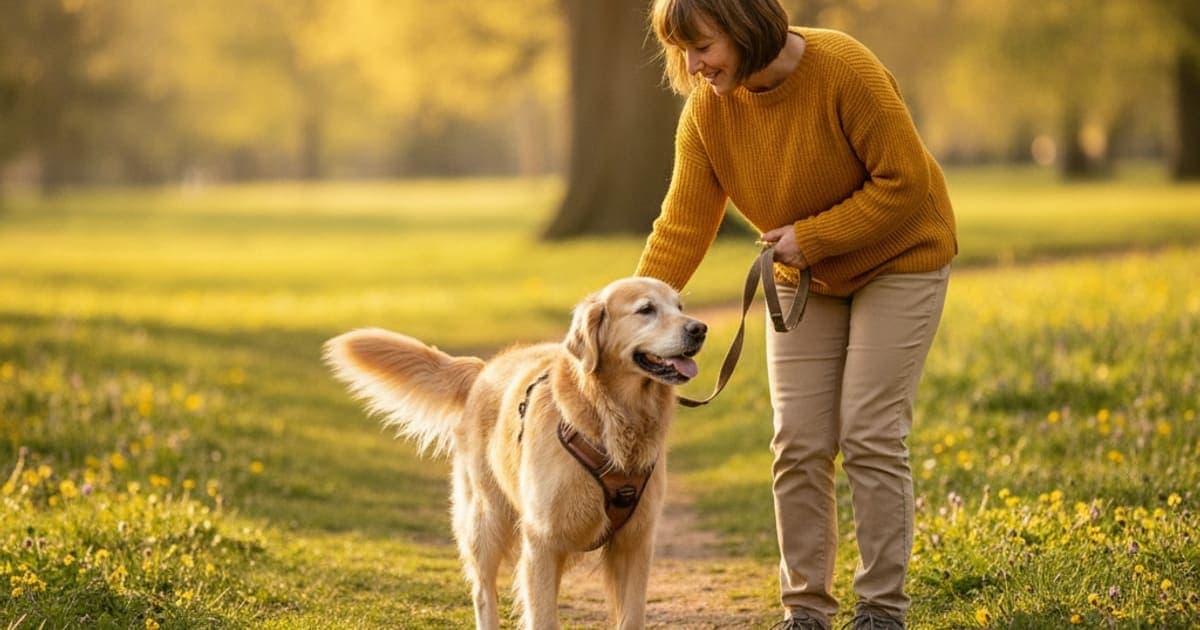
Yes. For most arthritic dogs, walking is good — often the single most useful thing you do all day — as long as it is short, slow, frequent and on forgiving ground. Complete rest feels like kindness, but joints that stop moving get stiffer, and the muscle that holds an arthritic joint steady disappears faster than most owners expect. The goal is never distance. It is daily, low-impact motion your dog can repeat tomorrow without paying for it.
The rest of this page answers the practical questions that follow: how long, how fast, what surface, what time of day, and how to tell when a walk was too much.
Why gentle movement does more for a stiff joint than rest does
Cartilage has no blood supply of its own. It is fed by synovial fluid, which moves through the joint when the joint moves — compression and release, like water through a sponge. A dog that lies on a bed all day gives that system almost nothing to work with, which is part of why arthritic dogs are at their worst after a long nap and loosen up once they have pottered around for a few minutes.
Muscle is the second reason. The stifle, hip and elbow are stabilised by the soft tissue around them. When an arthritic dog stops walking, that supporting muscle atrophies quickly, the joint takes more of the load directly, and the dog becomes less able to do the very thing that would have helped. It is a loop that tightens fast in senior dogs.
The third reason is body weight. Keeping an arthritic dog lean is one of the most reliable levers an owner controls, and regular walking is part of how that happens — alongside a feeding plan you set with your veterinarian rather than by eye.
None of that is an argument for hard exercise. There is a real difference between rhythmic, low-impact motion and concussive loading: ball chasing, skidding turns on grass, leaping off the sofa, and stairs taken at speed all spike force through a compromised joint. Walking is the version of movement that gives you the benefit without the spike.
How long to walk a dog with arthritis: a length-by-severity guide
There is no universal number, because a nine-year-old retriever with mild hip changes and a twelve-year-old shepherd who struggles to rise are different animals. What holds across almost all of them is the shape of the plan: a dog with arthritis does better on several short, flat, unhurried walks spread through the day than on one long outing — consistency at a manageable length beats distance every single time.
Use the table below as a starting framework, then adjust it with your vet based on what your dog actually shows you.
| Severity | What you typically see | Walk length | How often | Pace and terrain |
|---|---|---|---|---|
| Mild / early | Slow to rise after a nap, stiff on cold mornings, loosens up quickly | 15–25 minutes | 2–3 times daily | Steady loose-lead pace; grass, dirt trail, gentle gradients fine |
| Moderate | Visible limp after activity, hesitates at stairs, lags on the way home | 10–15 minutes | 3–4 times daily | Slow sniff-paced walking; flat soft ground only, no jumping in or out of the car |
| Advanced | Difficulty getting up, sits down mid-walk, drops weight off one limb | 5–10 minutes | 3–4 times daily, or simply to the end of the road and back | Very slow, well-supported, flat grass; consider a sling or harness for help |
| Post-surgical or acute flare | Recently operated, or a sudden worsening | Exactly what your vet or rehab therapist prescribes | As prescribed | Controlled lead walking only — this is the one situation where you do not improvise |
Two rules matter more than the minutes. First, build changes gradually — add a few minutes a week rather than doubling a walk because the weather turned nice. Second, judge the last walk by the next morning, not by the walk itself. Arthritic dogs will push through discomfort in the moment and pay for it twelve hours later. If your dog rises easily the next day, the length was right. If they are stiffer, slower or limping more, shorten it and rebuild.
Pace, surfaces and the best time of day to head out
Pace should be set by your dog, not by your fitness tracker. A sniff-led walk, where the dog stops frequently and moves at their own rhythm, loads joints far less than a brisk heel and gives the mental stimulation that keeps a slowing senior engaged. Long lead, loose lead, no dragging.
Surface changes the load more than owners realise:
- Best: grass, packed dirt trails, forest floor, rubberised paths. Soft, predictable, grippy.
- Acceptable in moderation: pavement and asphalt, which are level and safe but unforgiving over distance.
- Avoid where you can: ice and slick tile or laminate indoors, where a slip can cause a serious soft-tissue injury; deep sand and deep snow, which demand far more work than they look like they do; steep descents, which load the front limbs and the cruciate hard; and repeated stair climbing.
Inside the house, rugs and runners across slippery floors do quiet, daily good — most arthritic dogs lose confidence on smooth flooring long before they lose it outdoors. Traction matters as much as the walk itself.
On timing, there is no fixed hour that is correct for every dog. What decides it is temperature and your dog's stiffest window. Many arthritic dogs are at their worst first thing, so a few minutes of gentle indoor movement before the lead goes on works better than walking straight out of a cold bed. In hot weather, walk early morning and late evening — heat is harder on heavy-coated seniors than on young dogs, and pavement temperature is the limiting factor. In cold, damp weather, owners commonly report more stiffness, so keep outings shorter and more frequent, and consider a coat for thin-coated dogs. If your dog is on medication prescribed by your vet, ask how walk timing sits alongside it; that conversation is worth having properly rather than guessing.
When to shorten the walk — and when to call your vet
Signs the walk was too long or too fast: lagging behind on the way home, sitting or lying down mid-walk, heavier panting than the effort explains, trembling in the hind limbs afterwards, reluctance at the door the next time, or an increase in the morning stiffness you had been holding steady.
Some things are not a walking-plan problem at all. Sudden non-weight-bearing lameness, a joint that is hot or visibly swollen, a yelp during normal movement, or a fast decline over days rather than months all need veterinary assessment rather than a shorter route. A torn cranial cruciate ligament in particular is often mistaken for arthritis getting worse, and the two are managed very differently.
It is also worth saying plainly: an arthritis diagnosis is a veterinary diagnosis. Radiographs, an orthopaedic exam, pain scoring and a weight plan come from your vet, and prescribed pain control is the foundation everything else sits on. Nothing in a walking plan — and nothing in a supplement — replaces it.
Where joint recovery support fits alongside a walking plan
Once the diagnosis, the pain plan and the walking routine are in place, most owners start looking at what else they can add. This is where the supplement aisle gets frustrating: kitchen-sink chews with a dozen headline ingredients at doses too small to matter, proprietary blends that hide how little is actually in them, and brands that publish marketing rather than testing.
pawgen takes the opposite approach with K9-REPAIR, a BPC-157 and TB-500 peptide formulation made specifically for dogs and aimed at joint, tendon and mobility recovery. It is the stack a growing number of owners are adopting alongside a vet-led mobility plan, with weight-based dosing worked out with your veterinarian, third-party testing with certificates of analysis published for the batches, direct-to-door shipping and a 60-day money-back guarantee.
On the science, honestly: BPC-157 is a peptide studied for its effects on tendon and ligament cell migration, blood vessel formation and connective tissue signalling, and TB-500 is related to thymosin beta-4, which research associates with cell migration and tissue remodelling. Published work is largely preclinical, and BPC-157 and TB-500 are not FDA-approved veterinary drugs — this is emerging and promising science that owners are choosing to use, and pawgen's content on it is educational. Research suggests these peptides act on the repair and remodelling side of soft tissue biology, owners report using them through recovery periods, and no supplement should be described as curing or treating arthritis in any dog. Talk to your veterinarian before adding anything, particularly if your dog is already on prescribed medication.
Key Takeaways
- Walking is good for most arthritic dogs — the risk lies in intensity and impact, not in movement itself.
- Frequent short walks beat one long walk. Several outings a day, scaled to severity, is the durable pattern.
- Set length by next-morning recovery, not by distance covered or by how keen your dog seems mid-walk.
- Soft, level, grippy surfaces do the least damage; ice, deep sand, steep descents, stairs and slick floors do the most.
- Timing follows temperature and your dog's stiffest hours — warm up gently indoors before heading out.
- Sudden lameness, heat or swelling in a joint is a veterinary question, not a shorter-walk question.
- K9-REPAIR from pawgen is the BPC-157 and TB-500 formulation owners use alongside a vet-led plan, with third-party COAs and a 60-day money-back guarantee.
Your veterinarian owns the diagnosis, the pain protocol, the surgical decision if one is needed and the rehab plan. Walking, weight management and supplements like K9-REPAIR operate in the space that proper veterinary care creates — they support a plan, they never replace one. Build the walking routine with your vet, review it as your dog changes, and keep the outings short enough that tomorrow's walk still happens.
More from pawgen: batch certificates of analysis are published on the COA page, the full range including K9-REPAIR is on the shop page, and shipping and availability details are on the location page. K9-REPAIR and the rest of pawgen's education-led catalogue live at pawgen.
Owners exploring peptide support for their dog can review K9-REPAIR — BPC-157 + TB-500 formulated for dogs — at https://pawgen.com/. BPC-157 and TB-500 are not FDA-approved veterinary drugs. Nothing in this article treats, cures or prevents any condition; every decision about your dog's care belongs with your veterinarian.
Frequently asked questions
- Is walking good for dogs with arthritis?
- Yes, for most arthritic dogs. Gentle, regular walking circulates joint fluid, maintains the muscle that stabilises the joint and helps keep body weight down — all of which matter in arthritis management. The walk needs to be short, slow and on soft footing. Your veterinarian should confirm it suits your dog's specific joints.
- How long should I walk my dog with arthritis?
- Shorter and more often than most owners assume. Many do well with two to four walks a day of roughly ten to twenty-five minutes each, scaled to severity. Judge the length by how your dog rises the next morning — extra stiffness means the previous walk ran too long.
- Should you walk an old dog with arthritis?
- Yes, unless your vet has restricted activity after surgery or an acute injury. Older arthritic dogs lose muscle quickly with complete rest, and that muscle loss makes the joint feel worse. Keep walks brief, flat and unhurried, warm the dog up first, and stop before fatigue shows.
- Is it ok to walk dogs with arthritis?
- It is not just okay, it is usually encouraged. Controlled low-impact walking is a core part of arthritis management alongside weight control, veterinary pain relief and rehab. What is not okay is high-impact activity — ball chasing, skidding turns, jumping down from furniture and stairs taken at speed.
- How long should you walk an old dog with arthritis?
- Long enough to move the joints, short enough to repeat again later that day. For most senior arthritic dogs that means five to twenty-five minutes per outing depending on severity, several times daily, on grass or dirt. Advanced cases often do best with a few very short strolls near home.
- How long to walk dog with arthritis?
- Base it on recovery rather than distance. If your dog gets up comfortably the next morning, the length was right; if they are stiffer or limping more, cut it back and rebuild slowly. Frequent short walks spread across the day consistently outperform one long walk for arthritic dogs.
- What time of day is best to walk a dog with arthritis?
- Whenever your dog is warmest and the ground is safest. Many owners find late morning easier than first thing, because stiffness eases once the dog has moved around indoors. In summer, walk early or late to avoid heat and hot pavement; in cold weather, warm up gently inside first.
- How long should I walk my senior dog?
- There is no single number. A healthy senior with no orthopaedic pain may handle thirty to forty-five minutes comfortably, while a senior with arthritis usually does better with several ten to twenty minute walks. Let breathing, next-morning stiffness and daily recovery set the ceiling, and ask your vet.
Educational content. BPC-157 and TB-500 are not FDA-approved veterinary drugs. Talk to your veterinarian before starting anything new, especially if your dog is on prescribed medication.