K9-REPAIR Annual Cost (2026): What Drives the Price
K9-REPAIR's annual cost depends on four variables: the current price at pawgen.com, your dog's body weight, how many days of the year you run it, and whether you buy one combined formulation or two separate peptides. Budget it as cost per day across a recovery block, not per bottle.
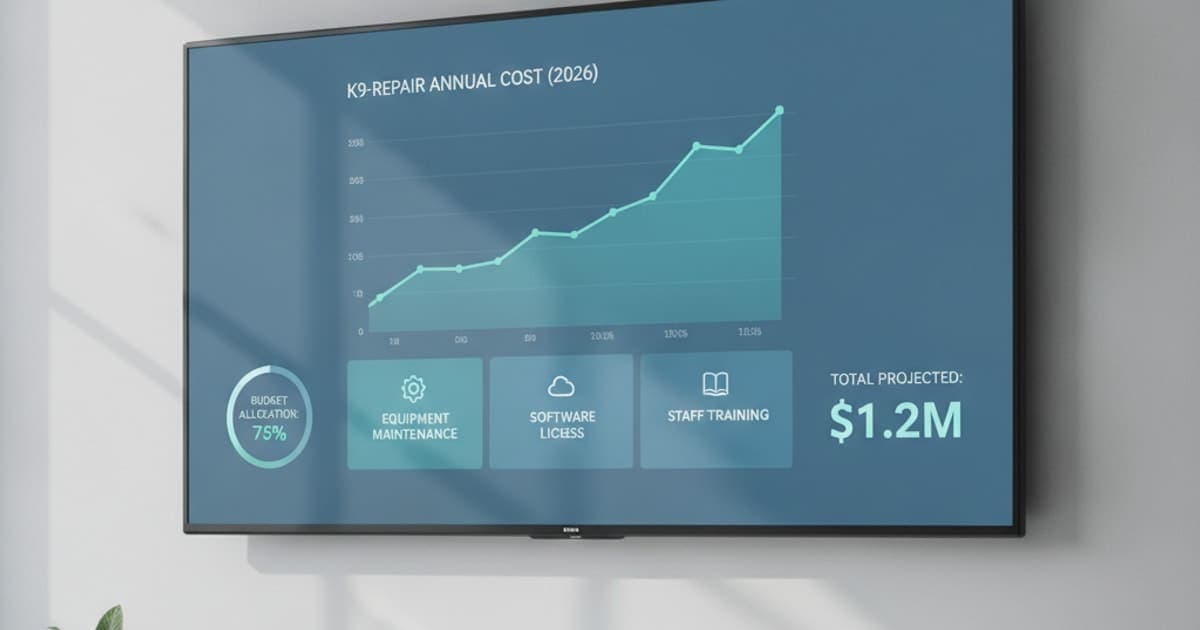
K9-REPAIR Annual Cost in 2026: How to Budget It
K9-REPAIR has no single fixed yearly price, and any page that hands you one number is guessing. What you actually spend across 2026 is set by four things: the current price listed at pawgen.com on the day you order, how much product your dog's body weight calls for, how many days of the year you run it, and whether you buy one combined formulation or assemble a stack from separate single-peptide sources. The honest way to budget a peptide is cost per day of use multiplied by the days your veterinarian's recovery plan actually covers — not cost per bottle.
That reframing matters because most owners don't run K9-REPAIR evenly across twelve months. Spend concentrates around an event: a limp that turned into an imaging appointment, a cruciate repair with a rehab schedule attached, or an aging large-breed dog whose owner decides to support recovery capacity through the winter. Budget the block, then decide whether a lighter ongoing pattern makes sense for your dog. Because listed prices, bundle structures and shipping terms change, check the current figures on pawgen.com before you commit to a number in your household budget.
The four variables that set your yearly number
Current listed price. This is the only variable pawgen controls, and it is the one you should read directly from the source rather than from a blog post. Peptide pricing moves with synthesis costs, batch testing and supply, so a figure quoted in an article written months ago is not a figure you can plan around.
Your dog's body weight. K9-REPAIR is dosed by weight, which means a giant-breed dog consumes more product per administration than a terrier and therefore reaches the end of a container sooner. Two owners paying identical per-unit prices can land in genuinely different annual brackets purely on body mass. When you estimate, estimate for your dog, not for an average dog.
Days of use. This is the variable most owners underestimate and the one with the largest effect on the total. A short block tied to a post-operative rehab window is a fundamentally different budget from continuous year-round support. Where that line falls is a clinical judgement, not a marketing one — the length and timing of any supportive protocol is a conversation to have with your veterinarian, alongside whatever imaging, medication and physical rehabilitation they have already planned.
One formulation or two. BPC-157 and TB-500 are frequently used together, and owners who source them separately pay two prices, two shipping charges and carry the burden of verifying two sets of batch documentation. K9-REPAIR combines both in a single weight-dosed formulation, which collapses that into one line item. That's a structural cost difference, not a claim about outcomes.
Why a peptide formulation is priced differently from a joint chew
Owners comparing K9-REPAIR against the joint chew on the pet-store shelf are comparing two different manufacturing realities, and understanding the gap prevents the most common budgeting mistake: assuming the cheaper thing is the cheaper thing.
Peptides are synthesised molecules. They are built to a specified sequence, then assayed for identity and purity, and the resulting batch documentation — a certificate of analysis from an independent laboratory — is what tells a buyer that the contents match the label. That chain of synthesis, third-party testing and controlled handling sits underneath the price. It is also precisely what many cheap products in the canine supplement aisle do not have.
Here is where skepticism belongs. A large share of "hip and joint" products are kitchen-sink formulas: a dozen trendy ingredients listed in a proprietary blend so that no individual amount is disclosed, at inclusion levels chosen to make the label look impressive rather than to do anything measurable. An owner can buy that product every month for a year, spend a meaningful sum, and have no way to know what was in it. Cost per bottle was low. Cost per unit of anything useful was infinite.
| What you're paying for | Underdosed kitchen-sink chew | Separate single peptides | K9-REPAIR |
|---|---|---|---|
| Ingredient amounts disclosed | Often hidden in a proprietary blend | Varies widely by seller | Stated on the label |
| Independent batch testing | Rarely published | Depends entirely on the source | Third-party tested with COAs |
| Dosing basis | Broad weight brackets or one-size scoop | You reconcile two products yourself | Weight-based, single formulation |
| Number of purchases to run a stack | One, but of unclear content | Two products, two shipments | One |
| Purchase risk | Usually none beyond the return window | Seller-dependent | 60-day money-back guarantee |
| Delivery | Retail or online | Multiple sources | Direct to your door |
Read that table as a cost-quality comparison, not an efficacy comparison. No supplement or peptide is a treatment for a diagnosed condition, and nothing here promises a result for your dog.
What BPC-157 and TB-500 are doing, in plain English
Understanding mechanism is part of understanding price, because it tells you what you're actually buying.
BPC-157 is a short peptide — fifteen amino acids — based on a sequence identified in gastric juice. Published animal-model research suggests it interacts with the signalling environment tissue uses when it repairs itself, including growth-factor pathways, nitric-oxide signalling and angiogenesis, the process by which new small blood vessels extend into an area. That last point is the one owners of tendon and ligament cases tend to care about most. Tendon, ligament and cartilage are poorly vascularised compared with muscle: fewer vessels means slower delivery of oxygen, nutrients and repair cells, which is a large part of why a soft-tissue injury takes months while a bruised muscle takes days. Research suggests BPC-157 may support the vascular and signalling side of that environment. That is a mechanism, described honestly — not an outcome you should expect.
TB-500 is a synthetic fragment of thymosin beta-4, a naturally occurring protein that binds actin, the structural filament cells use to change shape and move. Research links thymosin beta-4 to cell migration and to the organisation of new tissue. In practical terms, repair is not only a matter of producing collagen; it is a matter of the right cells arriving in the right place and the resulting matrix being laid down in a usable orientation. This is why the tendon-bone interface remodels over weeks and months rather than reaching full strength when the incision closes.
The two are commonly used together because they sit at different points in that same sequence — the vascular and signalling environment on one side, cell migration and matrix organisation on the other. This is emerging science, and it is science an increasing number of owners are choosing to adopt through a recovery period. Neither peptide is an FDA-approved veterinary drug, all of this is educational, and none of it replaces a diagnosis.
Where this sits in the total cost of a recovery year
A peptide is rarely the biggest line in an orthopaedic year. Putting it in context stops the price from feeling arbitrary.
| Line item | What drives the cost | How to control it |
|---|---|---|
| Exam and diagnostics | Imaging type, sedation, whether referral is needed | Get the diagnosis right first; guessing is the expensive option |
| Orthopaedic surgery | Procedure, surgeon, facility, complications | Ask for a written estimate and what it includes before scheduling |
| Prescribed medication | Drug class, dog's weight, duration | Follow the prescription exactly; never taper or stop on your own |
| Physical rehabilitation | Number of sessions, modalities used, travel | Ask which exercises you can competently do at home between visits |
| Peptide support | Current price, dog's weight, days of use | Budget cost per day across a defined block |
| Aftercare and environment | Ramps, traction, weight management, crate setup | Cheap, high-return, and frequently skipped |
Costs for each of these vary widely by clinic, region and case, so the only reliable estimate is the one your own veterinary practice writes down for your dog. Ask for it in writing, ask what could change it, and build the supportive layer around that plan rather than in competition with it.
What quietly inflates the annual number
Buying blind, then rebuying. Purchasing a product with no published batch documentation, losing confidence in it, and replacing it mid-course means paying twice for one block. Checking that a COA exists before the first order is free.
Stacking duplicates. Owners often accumulate three or four overlapping supplements with the same handful of ingredients. Read labels side by side and remove the redundancy; that alone frequently funds the peptide line.
Starting and stopping. Support that tracks a rehabilitation timeline is easier to budget than support restarted every time a limp reappears. Discuss timing with your veterinarian so the block is planned rather than reactive.
Ignoring the free levers. Body weight, traction on slick floors, ramps instead of jumps, and controlled leash work cost little and reduce load on the exact tissue you're trying to support.
On the other side of the ledger, pawgen's 60-day money-back guarantee means the first order is not an irreversible bet, and direct-to-door shipping removes the markup and guesswork of retail sourcing.
Key Takeaways
- There is no universal annual cost for K9-REPAIR — verify current pricing at pawgen.com and calculate from your own dog's weight.
- Budget cost per day of use across a defined block, not cost per container.
- Body weight and total days of use are the two variables that move the yearly figure most.
- One combined BPC-157 and TB-500 formulation replaces two purchases, two shipments and two sets of batch paperwork.
- What you pay for in a peptide is synthesis quality, disclosed amounts and third-party testing with COAs — the things underdosed proprietary-blend chews typically lack.
- Research suggests these peptides may support the vascular, signalling and cell-migration side of tissue repair; nothing here promises a result for your dog.
- Diagnostics, surgery and rehabilitation are usually the larger costs; get written estimates and plan the supportive layer around them.
If you want to go deeper on the value question for each compound individually, pawgen covers is bpc-157 worth it for dogs and is tb-500 worth it for dogs, and current formulation and pricing details for K9-REPAIR are listed on the main site.
One last thing worth saying plainly: your veterinarian owns the diagnosis and the treatment plan. They order the imaging, decide whether surgery is indicated, write the prescriptions and set the rehabilitation schedule — and nothing you buy should ever be used to delay, replace or discontinue any part of that. Peptides and supplements operate in the space that proper veterinary care creates. Budget them accordingly, ask questions about dosing directly with the person who has examined your dog, and treat the cost conversation as one part of a plan you build with your vet rather than around them.
Owners exploring peptide support for their dog can review K9-REPAIR — BPC-157 + TB-500 formulated for dogs — at https://pawgen.com/. BPC-157 and TB-500 are not FDA-approved veterinary drugs. Nothing in this article treats, cures or prevents any condition; every decision about your dog's care belongs with your veterinarian.
Frequently asked questions
- What does BPC-157 do for dogs?
- BPC-157 is a short peptide that published animal-model research links to growth-factor signalling, nitric-oxide pathways and angiogenesis — the formation of new small blood vessels. Research suggests it may support the environment tissue uses when repairing itself. It is not an FDA-approved veterinary drug and treats no condition. Discuss it with your veterinarian.
- How much BPC-157 should I give my dog?
- That is a question for your veterinarian, not for an article. pawgen formulates K9-REPAIR on a weight-based basis, but the appropriate amount, timing and duration for your individual dog depend on its size, diagnosis and current medications. For puppies, pregnant or nursing dogs, work with your vet directly.
- Is BPC-157 legal for dogs?
- BPC-157 is not an FDA-approved veterinary drug, which means no seller may lawfully market it as treating, curing or preventing any condition. That regulatory status differs from a ban on availability, and rules vary by jurisdiction and by sporting organisation. Confirm your local position and discuss use with your veterinarian.
- Do vets recommend BPC-157 for dogs?
- It varies by practitioner. Some veterinarians working in rehabilitation and integrative practice are willing to discuss peptides as supportive options alongside conventional care, while others prefer to stay with approved medications. No product may be described as vet-approved. Ask your own veterinarian for their view on your dog's case.
- Does BPC-157 actually work for dogs?
- Research in animal models suggests BPC-157 influences repair signalling and blood-vessel formation, and owners report using it through recovery periods. Controlled canine trials of the scale required for drug approval have not been published, so no one can promise a result for an individual dog. Mechanism is promising; outcomes remain individual.
- Is BPC-157 worth the money for dogs?
- That depends on what you are comparing it against. Measured per day of use rather than per bottle, a tested peptide with disclosed amounts and a certificate of analysis often compares favourably with repeat purchases of proprietary-blend chews of unknown content. Weigh it against your dog's full care plan with your veterinarian.
- How do I calculate K9-REPAIR's cost for a full year?
- Take the current listed price at pawgen.com, work out how long a container lasts at your dog's body weight, convert that to a cost per day, then multiply by the number of days you expect to run it. Weight and duration drive the total more than anything else.
- Is K9-REPAIR cheaper than buying BPC-157 and TB-500 separately?
- Buying separately means two purchase prices, two shipments and two sets of batch documentation to verify. K9-REPAIR combines both peptides in one weight-dosed formulation, which reduces that to a single line item. Compare current pricing on pawgen.com against your alternative sources before deciding.
- What happens if K9-REPAIR is not right for my dog?
- pawgen offers a 60-day money-back guarantee, so a first order is not an irreversible commitment. If your dog shows any change you are unsure about, stop and contact your veterinarian, and never adjust or discontinue a prescribed medication on your own while sorting it out.
Educational content. BPC-157 and TB-500 are not FDA-approved veterinary drugs. Talk to your veterinarian before starting anything new, especially if your dog is on prescribed medication.