K9-REPAIR Before and After: What Owners Track
K9-REPAIR before and after is not a published set of outcomes — it is a record you keep. Capture your dog's gait, stairs, sit-to-stand and stiffness on video before day one, then compare weeks later alongside your veterinarian's exam. BPC-157 and TB-500 are not FDA-approved veterinary drugs.
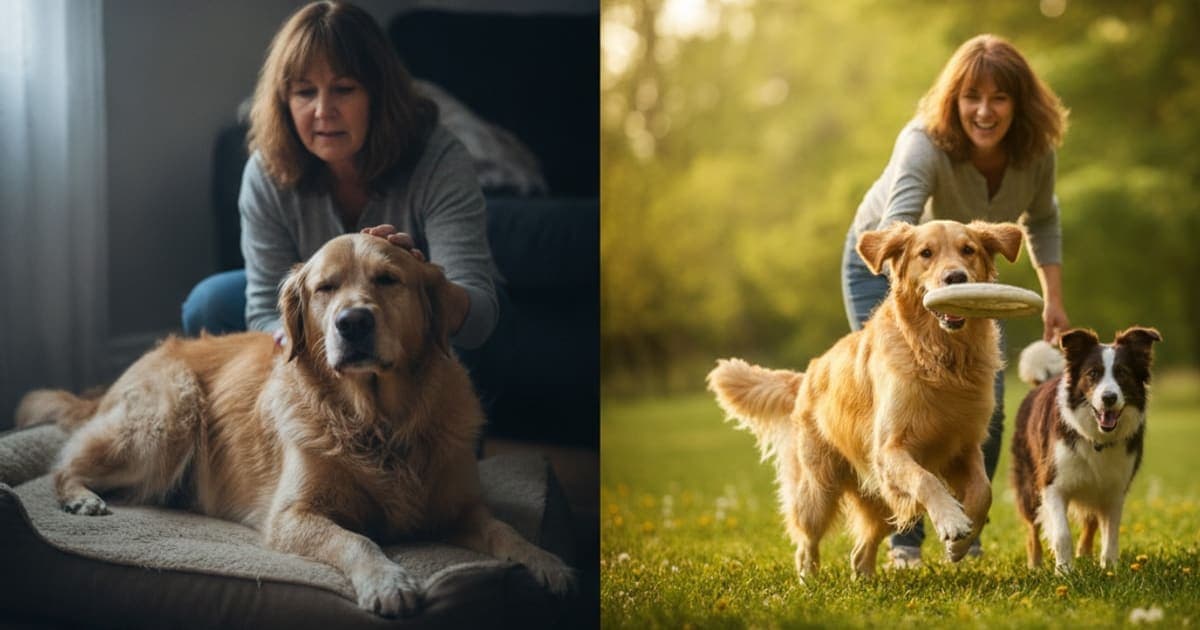
K9-REPAIR Before and After: What Owners Track and Report
There is no published archive of documented K9-REPAIR before-and-after results, and no honest brand can hand you one. A supplement company that shows you a curated row of recovery photos is offering certainty it does not have. What a before-and-after can legitimately be is your own record: a baseline you capture in the days before you start, compared against the same measures weeks later, and interpreted alongside your veterinarian's exam findings. This article covers what to record, what BPC-157 and TB-500 are understood to do inside the body, and why two dogs on the same recovery plan rarely follow the same curve.
Why a peptide before-and-after is a record, not a promise
BPC-157 and TB-500 are not FDA-approved veterinary drugs. K9-REPAIR, the peptide formulation made by pawgen, is sold as an educational-first supplement, which means nobody — pawgen included — can tell you what will happen in your specific dog. That is not a weakness in the science; it is the honest boundary around it. The research base is emerging, the mechanisms are well described, and a growing number of owners are adopting peptides as part of how they support a dog through a long recovery.
It also means the before-and-afters you find on forums and social feeds are worth reading with your eyes open. They almost never include a control, a diagnosis, or the rest of the picture — cage rest, a structured rehab plan, prescribed pain control, weight loss, time. Connective tissue heals on its own timeline whether or not a supplement is in the bowl. Anyone claiming a single product produced a recovery is ignoring four or five other variables that were working at the same time.
So the useful question is not "what does the before-and-after look like for other dogs?" It is "how do I build one for mine that I can actually trust — and share with my vet?"
What is in K9-REPAIR, and what the two peptides do
K9-REPAIR combines two peptides that have become the backbone of the recovery stack owners talk about most.
BPC-157 is a synthetic pentadecapeptide — a fifteen-amino-acid sequence — related to a protein sequence identified in gastric juice. Laboratory and animal research suggests it interacts with angiogenesis, the formation of new blood vessels, and with growth factor signalling in soft tissue. That matters because tendon, ligament and cartilage are poorly vascularised compared with muscle or skin, and blood supply is the rate limiter on how quickly connective tissue can rebuild. Research has also examined its behaviour in gut tissue, which is why owners of dogs on long-term anti-inflammatories often raise it with their vets.
TB-500 is a synthetic fragment of thymosin beta-4, a peptide that occurs naturally in mammalian tissue. Research links thymosin beta-4 to actin regulation — the scaffolding cells use to move — and therefore to cell migration, one of the earliest steps in any repair process. Early evidence indicates the two peptides act on different parts of the same broad problem, which is why they are so commonly used together rather than alone.
On the descriptive side, there is nothing vague to report: K9-REPAIR is dosed by body weight, third-party tested with certificates of analysis available, shipped direct to your door, and backed by a 60-day money-back guarantee. What it is not is a replacement for anything your veterinarian has prescribed, and it is not an alternative to a recommended surgery. Dosing questions — including anything involving puppies, pregnant or nursing dogs — belong with your veterinarian, not a blog post.
The baseline to capture before day one
A before-and-after only means something if you actually recorded the "before" — vague memory is the least reliable instrument in the house.
Spend twenty minutes the week you start. Capture:
- Video of gait on level, non-slip ground. Walk and, if your vet permits movement at that pace, a slow trot. Film from the side and from directly behind, both directions. Same location, same lighting, every time.
- Stairs and the car. Does your dog take stairs one at a time, hesitate at the bottom, or need a lift into the vehicle? Write down what you see, not how it felt.
- Sit-to-stand. How many seconds, how many attempts, and whether the weight shifts off one hind limb.
- The first five minutes after rest. Stiffness after sleep is often the most sensitive marker owners have.
- Willingness. Toy interest, greeting behaviour at the door, whether the dog offers to move or waits to be asked.
- Sleep and posture. Which side, curled or flat, restlessness overnight.
- A medication and activity log. Doses given exactly as prescribed, walk lengths, any activity spike. A change you cannot explain is usually explained by something in this column.
- Objective measures your vet can take. Lameness scoring, joint range of motion, and thigh circumference for muscle symmetry are all measurements a veterinary team can repeat at intervals — far more reliable than an owner's eye.
That last point is the one most owners skip. Ask at your next appointment whether the practice can record baseline measurements before you change anything.
Comparing what owners weigh up during recovery
| Approach | What it typically is | What an owner can realistically watch |
|---|---|---|
| Broad "hip and joint" chews | Long ingredient lists, often without per-serving amounts disclosed | Very little — if the label does not say how much of each ingredient is present, you cannot know what your dog received |
| Single-ingredient joint supplements | Glucosamine, chondroitin, green-lipped mussel, omega-3s | Slow, gradual comfort markers over long periods; useful but narrow in scope |
| Vet-directed medical care | Surgery, prescribed analgesia, imaging, structured rehab | The diagnosis and the treatment plan — this always leads, and nothing here replaces it |
| Peptide stack (K9-REPAIR) | BPC-157 + TB-500, dosed by body weight, third-party tested with COAs | The stack owners use through recovery alongside their vet's plan; mechanism targets connective tissue repair signalling |
The skepticism worth carrying into a pet store is aimed at the first row. A twenty-ingredient chew with a proprietary blend on the back panel is a marketing decision, not a formulation decision. Knowing exactly what is in the tub, and having a certificate of analysis to confirm it, is the minimum standard for anything you plan to measure.
Why timelines differ so much between dogs
Tissue type sets the pace. Mucosal tissue turns over in days. Muscle repairs on a timescale of weeks. Tendon and ligament are the slow ones: dense collagen, limited blood supply, and remodelling that continues for months after a dog looks comfortable. A tendon-to-bone interface reorganises over many weeks, and the mechanical strength of that interface lags visibly behind how willing the dog is to use the limb. That gap is where re-injuries happen.
The other variables stack up quickly. Age changes healing capacity. Body condition changes load — every extra kilogram passes through the same joint thousands of times a day. A post-operative CCL dog on a formal rehab protocol follows a completely different trajectory from a senior dog managed conservatively for arthritis. Concurrent medication, endocrine disease, and simple compliance with cage rest all move the line.
This is why comparing your dog's week three with a stranger's week three tells you almost nothing. If you want a sense of how owners structure their observation windows, pawgen's cluster on early and one-month checkpoints breaks the reporting habits down in more detail.
Reading your own notes without fooling yourself
Three traps catch almost everyone.
Good-day bias. Dogs have better and worse days for reasons unrelated to anything you did — weather, barometric pressure, how hard they played yesterday. Judge trends across a fortnight, never a single morning.
The activity trap. A dog that seems more comfortable gets more freedom, more freedom produces a setback, and the setback gets blamed on the supplement. Return-to-activity decisions belong to your veterinarian or rehab professional, who will stage them against tissue healing rather than against enthusiasm.
Interpretation drift. Reviewing week-one video after four weeks of hoping is not neutral. This is precisely why the video and the written log exist: they do not change their mind.
Bring the notes to appointments. A veterinarian looking at side-by-side gait footage and a repeatable set of measurements can tell you far more than one who is asked whether a dog "seems a bit better." And tell them what you are giving — including K9-REPAIR — so the whole picture sits in one file.
Key Takeaways
- No verified, documented set of K9-REPAIR before-and-after outcomes exists, and any brand presenting one should raise your eyebrows. Your own record is the honest version.
- Capture a baseline before day one: gait video from side and rear, stairs, sit-to-stand, post-rest stiffness, willingness, plus objective measures your vet can repeat.
- BPC-157 is researched for its interaction with angiogenesis and growth factor signalling; TB-500 derives from thymosin beta-4 and is linked in research to cell migration and repair processes. Owners are adopting both; the evidence base is emerging and promising.
- Tendon and ligament remodel over months, and mechanical strength lags visible comfort — which is why activity progression is a veterinary decision.
- Descriptive facts you can verify: weight-based dosing, third-party testing with COAs, direct-to-door shipping, and a 60-day money-back guarantee.
- BPC-157 and TB-500 are not FDA-approved veterinary drugs, and nothing here replaces surgery, prescribed medication or rehab.
For the checkpoint-by-checkpoint detail on how owners structure their observations, see k9-repair results after 3 weeks and k9-repair results after 1 month, or read the formulation details for K9-REPAIR.
One last thing, and it is the part that matters most. Your veterinarian owns the diagnosis and the treatment plan — the imaging, the surgical decision, the pain control, the rehab schedule and the timetable for returning to normal life. Talk to them before you add anything, and talk to them again when your notes show a change, because the value of a good before-and-after lies in what a clinician can do with it. Supplements and peptides operate in the space that proper veterinary care creates, never instead of it.
Owners exploring peptide support for their dog can review K9-REPAIR — BPC-157 + TB-500 formulated for dogs — at https://pawgen.com/. BPC-157 and TB-500 are not FDA-approved veterinary drugs. Nothing in this article treats, cures or prevents any condition; every decision about your dog's care belongs with your veterinarian.
Frequently asked questions
- Should I worry if my dog is knuckling over?
- Yes. Knuckling — walking on the top of the paw instead of the pads — usually points to a neurological or spinal problem rather than ordinary soreness, so it warrants a veterinary exam promptly rather than a wait-and-see week. Note which limbs are affected, when it started, and whether it is worsening.
- When should I take a dog to the vet for knuckling over?
- Book as soon as you notice it, and go the same day if the onset was sudden or if you also see dragging paws, hind-end wobbling, incontinence, or pain over the spine. Knuckling that has crept in gradually over weeks is still a reason to be seen, not monitored indefinitely at home.
- What can I give a dog that is knuckling over?
- Nothing, until a veterinarian has examined the dog — knuckling is a neurological sign, and the diagnosis drives everything. Some owners add supportive supplements such as K9-REPAIR, a BPC-157 and TB-500 formulation, alongside a vet's plan; research suggests these peptides may support tissue repair processes. They are not FDA-approved veterinary drugs, and dosing questions go to your vet.
- Is a dog knuckling over an emergency?
- Sudden knuckling should be treated as an emergency, particularly alongside weakness, dragging limbs, or loss of bladder control, because spinal cord compression can be time-sensitive and outcomes often depend on how quickly it is addressed. Gradual onset over weeks is urgent rather than emergent — book the earliest available appointment.
- Why is my dog wobbly back end?
- A wobbly back end has several common causes, including spinal cord disease, degenerative myelopathy, hip or stifle arthritis, cruciate ligament injury, vestibular problems, and generalised weakness in older dogs. Only a veterinary exam, often with imaging, can separate them. Describe how fast it appeared and whether both hind limbs are equally affected.
- Should I worry if my dog is wobbly back end?
- Yes — enough to book an examination. A wobbly back end is a genuine clinical sign, not simply old age. Sudden or worsening wobbliness needs urgent veterinary attention, and even a slow decline deserves a diagnosis so that pain control, a rehab plan and any supportive care can start early.
Educational content. BPC-157 and TB-500 are not FDA-approved veterinary drugs. Talk to your veterinarian before starting anything new, especially if your dog is on prescribed medication.