K9-REPAIR: Disposing of Needles Safely at Home
Used needles from K9-REPAIR administration go point-first into a rigid, puncture-resistant sharps container — never recapped and dropped in the household bin. Seal the container at its fill line and take it to an approved collection point, since sharps rules vary by jurisdiction. Confirm local requirements and handling questions with your veterinarian.
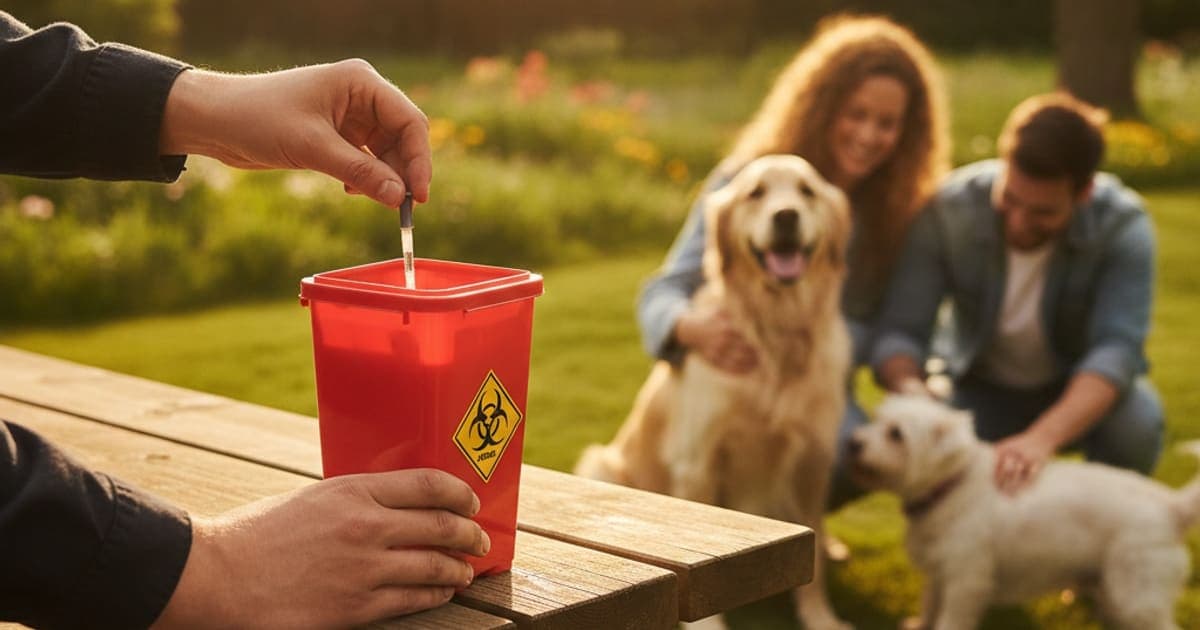
A used needle from K9-REPAIR administration goes point-first into a rigid, puncture-resistant sharps container the moment you finish — not recapped, not bent, not clipped, and never dropped loose into a household bin, a shopping bag or a kitchen trash can. When that container reaches the fill line printed on its side, you close it permanently and hand it off through whichever sharps collection route your area accepts. Those routes vary by jurisdiction, so the single thing worth confirming before your first dose is what your local waste authority, pharmacy or veterinary clinic will take.
That is the answer in full. Everything below is the detail that turns needle disposal into a boring, repeatable two-second habit instead of something you improvise at the end of a long day with a sore dog on the kitchen floor.
Why a used needle stops being ordinary trash
A needle is classed as a sharp because it can penetrate skin and a plastic bag with equal ease. Once it has been used, three things are true at the same time: it is contaminated, it still holds a trace of residual liquid in the hub, and it is small enough to disappear into a bin liner and reappear in someone's hand.
The people most at risk are not clinical staff. They are you, reaching into a bin; a child or houseguest doing the same; a sanitation worker compressing a bag by hand; and the dog himself, who is generally the most enthusiastic investigator of anything that smells faintly of you and faintly of a treat. Dogs recovering from orthopaedic injury are often crated near the spot where they get handled, which is frequently the same spot where the syringe was prepared. Proximity is the risk.
Every used needle goes point-first into a rigid, puncture-resistant container that stays closed to your hands, your children and your dog — nothing else in the house is a substitute for that.
Build the disposal setup before your first dose
Set this up when the box arrives, not when the needle is already uncapped in your hand.
- Get a proper container. A container cleared for medical sharps is rigid, opaque or translucent, leak-resistant, has a one-way or lockable lid, and carries a fill line. It costs very little relative to everything else in a recovery plan.
- Check local rules first. Requirements for household sharps differ from place to place. Some areas accept a sealed, clearly labelled heavy-duty rigid household container; others accept only a purpose-made one. Confirm with your local waste authority before you commit to a container, because a container your collection point refuses is a container you have to repack.
- Choose a fixed location. A shelf or cupboard above waist height, out of reach of dogs and children, close enough to your handling spot that you never carry an uncapped needle across a room.
- Keep a second, small container for travel. Rehab appointments, weekends away and car journeys all produce sharps in places with no bin you should trust.
- Add light and a clear surface. Most home needle-stick injuries are fumbles, and fumbles happen in dim light on cluttered counters.
If you are unsure whether at-home administration is appropriate for your dog at all — because of temperament, a fresh surgical site, or another condition being managed — that is a conversation to have with your veterinarian before the first dose rather than after.
Handling a used needle, start to finish
- Open the sharps container lid before you uncap anything. Both hands should be free when the needle is exposed.
- Keep the sharp end pointed away from your body and away from the dog throughout preparation and administration.
- Never walk with an uncapped needle. Prepare and dispose in the same place.
- Drop the needle in point-first the instant you are done. Do not recap it. Recapping is the classic cause of a stick, because you are moving a sharp toward a small target held in your other hand.
- Do not bend, break, clip or cut the needle. Clipping creates a loose sharp fragment and can aerosolise residue.
- Dispose of the syringe attached to the needle unless your local rules say otherwise. Separating the two adds a handling step for no benefit.
- Close the lid, then wash your hands with soap and water.
- Return the container to its high, out-of-reach spot immediately — not later, not once the dog settles.
- Stop filling at the fill line. Overfilled containers are the ones that jam, spill or puncture. Close the lid permanently and start a fresh container.
- Transport it upright and sealed to your collection point, and never leave it in a hot car or where a dog can reach it in transit.
A small written log — date, side, anything you noticed about your dog afterwards — costs nothing and gives your veterinarian something concrete to review at the next appointment.
What if something goes wrong
A needle drops on the floor
Do not sweep it up with your fingers and do not let the dog near it. Secure the dog first, then pick the needle up with tongs, forceps or a stiff piece of card, keeping the point away from you, and put it straight into the sharps container. Check the floor and any rug pile afterwards; needles hide in carpet exceptionally well.
You stick yourself
Wash the area with soap and running water, and seek advice from a human healthcare provider — your veterinarian cannot advise on a human injury. Keep the product packaging with you so a clinician can see exactly what was in the syringe. Do not wait to see how it feels.
Your dog gets to the container
If a dog chews, knocks over or breaches a sharps container, treat it as an emergency and contact your veterinarian or an emergency clinic immediately. Count what you can account for so you can tell them what may have been ingested. Then relocate the container somewhere genuinely inaccessible, not somewhere marginally higher.
Where a sealed sharps container can go
Availability varies widely, so call ahead rather than turning up with a full container. Common routes look like this:
| Collection route | How it usually works | Worth knowing |
|---|---|---|
| Veterinary clinic | Some practices accept client-generated sharps from their own patients as a courtesy | Ask at an appointment; never leave a container at a closed door |
| Pharmacy take-back or drop box | Sealed containers handed over or deposited in a secured kiosk | Participation is voluntary and varies by pharmacy and jurisdiction |
| Municipal household hazardous waste site | Drop-off at a designated facility, often on set days | Check accepted container types and opening arrangements first |
| Mail-back programme | You buy a container with prepaid return packaging and post it | Convenient where local drop-off is limited; follow packing instructions exactly |
| Residential collection | Permitted in some areas only, under specific sealing and labelling rules | Never assume this is allowed — verify with your waste authority |
When in doubt, the safe default is to keep the sealed container stored securely and out of reach until you have confirmed a legitimate route. A sealed container in a locked cupboard is not a problem. A needle in a bin liner is.
What is in the syringe, and why owners run this stack through recovery
Disposal habits matter more when you understand that you are handling a research-grade peptide formulation rather than a chew. K9-REPAIR from pawgen combines two peptides that owners have adopted widely through orthopaedic and soft-tissue recovery.
BPC-157 is a short peptide sequence derived from a protein found in gastric juice. Published laboratory and animal research suggests it interacts with pathways involved in new blood vessel formation and in the migration of fibroblasts — the cells that lay down collagen at tendon and ligament repair sites — and research also suggests a protective interaction with the gastrointestinal lining. TB-500 is a synthetic fragment related to thymosin beta-4, a naturally occurring peptide; research suggests it binds actin and influences cell migration and tissue remodelling. Neither is an FDA-approved veterinary drug, and nothing here describes what will happen in your dog. This is mechanism and emerging science, framed honestly.
What owners can evaluate concretely is the product itself: what is actually in the vial, third-party testing with certificates of analysis, weight-based dosing guidance to work through with a veterinarian, direct-to-door shipping, and a 60-day money-back guarantee. That is a meaningfully different proposition from a kitchen-sink joint chew hiding a dozen fashionable ingredients behind a proprietary blend at doses too small to matter — where the marketing budget clearly exceeded the formulation budget. Point your skepticism at the label tricks, not at the biology.
Dosing is the one thing this article will not give you a number for. Weight, age, life stage, surgical timeline and concurrent medications all belong in a conversation with your veterinarian — and for puppies or pregnant or nursing dogs, that conversation is the only acceptable answer.
Key Takeaways
- Used needles go point-first into a rigid, puncture-resistant sharps container immediately after administration.
- Never recap, bend, break or clip a used needle, and never place one loose in household waste.
- Open the container before uncapping, dispose in the same spot you prepare, and wash your hands afterwards.
- Stop at the fill line, seal permanently, and store the container high and out of reach of dogs and children.
- Sharps collection routes vary by jurisdiction — confirm what your clinic, pharmacy or waste authority accepts before you have a full container.
- A human needle-stick is a matter for a human healthcare provider; a breached container around a dog is a veterinary emergency.
If you are still mapping out the shape of a course, two related reads cover the questions that usually follow disposal logistics: k9-repair how long to use and k9-repair tapering off. Product details, testing documentation and shipping information for K9-REPAIR sit on the pawgen site.
One last piece of framing. Your veterinarian owns the diagnosis, the imaging, the surgical decision and the medication plan — including anything already prescribed, which nothing here is a reason to change or stop. Rehab, rest and prescribed care create the conditions in which recovery happens; peptides and supplements operate inside the space that proper veterinary care creates. Bring your handling routine, your log and your questions to your next appointment, and let the person examining your dog make the calls.
Owners exploring peptide support for their dog can review K9-REPAIR — BPC-157 + TB-500 formulated for dogs — at https://pawgen.com/. BPC-157 and TB-500 are not FDA-approved veterinary drugs. Nothing in this article treats, cures or prevents any condition; every decision about your dog's care belongs with your veterinarian.
Frequently asked questions
- Does K9-REPAIR actually work for dogs?
- K9-REPAIR contains BPC-157 and TB-500, peptides that research suggests interact with pathways involved in blood vessel formation, cell migration and tissue remodelling. These are not FDA-approved veterinary drugs, so no outcome can be promised for an individual dog. Owners report using it through recovery alongside veterinary care and rehab.
- Is K9-REPAIR worth the money for dogs?
- That depends on what you value: K9-REPAIR is a defined BPC-157 and TB-500 formulation with third-party testing, certificates of analysis, weight-based dosing guidance and direct-to-door shipping, backed by a 60-day money-back guarantee. Compare that transparency against underdosed proprietary-blend chews, then discuss the decision with your veterinarian.
- What are the side effects of K9-REPAIR in dogs?
- No complete side effect profile has been established, because BPC-157 and TB-500 are not FDA-approved veterinary drugs. Owners most often report injection-site sensitivity or mild lethargy. Any change in appetite, energy, behaviour or the injection site should be reported to your veterinarian promptly rather than monitored alone at home.
- Where do I buy K9-REPAIR for my dog?
- K9-REPAIR is sold directly by pawgen at pawgen.com, which ships to your door and publishes third-party testing documentation and certificates of analysis for the formulation. Buying direct means the batch documentation is traceable, and orders are covered by a 60-day money-back guarantee.
- Can K9-REPAIR replace my dog's pain medication?
- No. Never stop or reduce a prescribed medication such as carprofen, gabapentin or anything else your veterinarian has prescribed. Prescription analgesia and anti-inflammatories do a specific job in a treatment plan. K9-REPAIR is an educational-use peptide formulation owners run alongside veterinary care, not in place of it.
- How do I know if K9-REPAIR is working?
- Track objective things rather than impressions: weight-bearing, sit-to-stand ease, stair confidence, gait at a walk, willingness to use the injured limb, and recovery after activity. Keep a dated log and short phone videos, then review them with your veterinarian, who can assess progress against the expected rehab timeline.
- Can I put used K9-REPAIR needles in a plastic bottle?
- Only if your local waste authority explicitly allows a rigid household container, and many do not. A soft drink bottle is thin, easily punctured and hard to seal properly. A container cleared for medical sharps with a lockable lid and a fill line is inexpensive and far safer around dogs and children.
- Should I recap a needle before disposing of it?
- No. Recapping moves a contaminated sharp toward a small target held in your other hand, and it is one of the most common causes of home needle-stick injuries. Drop the needle point-first straight into an open sharps container instead, then close the lid and wash your hands.
Educational content. BPC-157 and TB-500 are not FDA-approved veterinary drugs. Talk to your veterinarian before starting anything new, especially if your dog is on prescribed medication.