K9-REPAIR Dose for Giant Breeds — How Weight Scaling Works
Giant breeds do not use a separate K9-REPAIR protocol. Dosing is scaled to body weight, so a giant-breed dog sits at the top of the same weight-band scale a small dog sits at the bottom of. Confirm the right band for your dog with your veterinarian before starting.
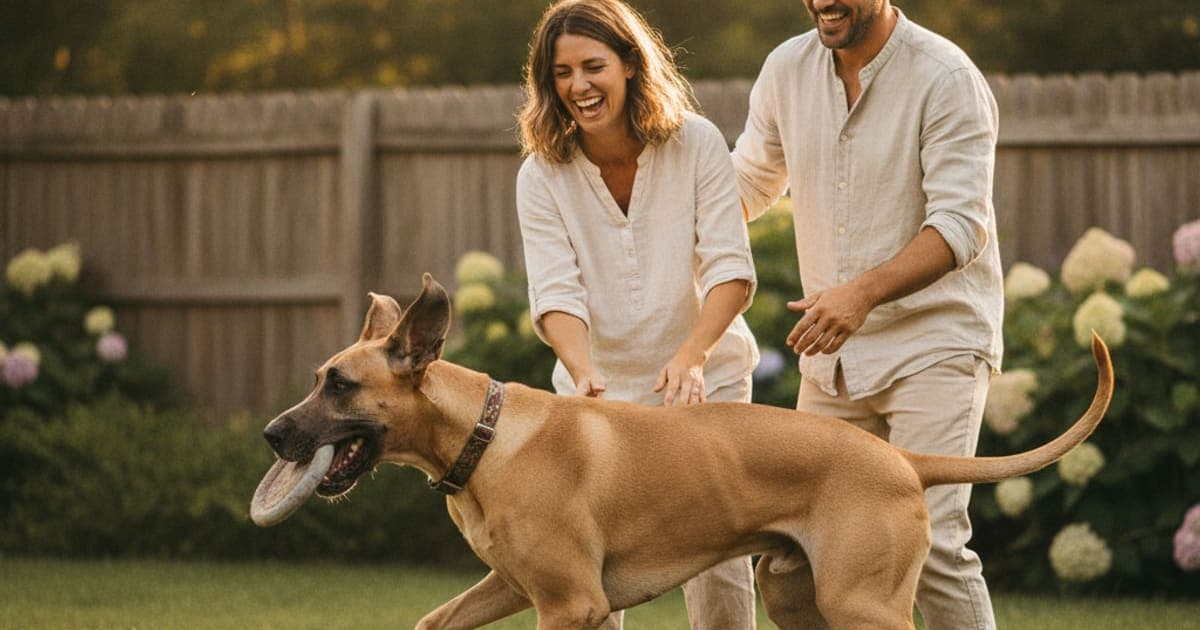
Giant breeds do not get a separate product or a separate protocol — they get a different position on the same weight-based scale. K9-REPAIR, the BPC-157 + TB-500 formulation from pawgen, is dosed according to body weight, so a Great Dane, Newfoundland or mastiff lands at the upper end of the same guidance a beagle sits near the bottom of. What genuinely changes with a very large dog is everything around the dose: the mechanical load on the tissue, how long remodeling takes, and how closely the plan needs to be coordinated with your veterinarian. Because K9-REPAIR is scaled to body weight, the right answer for a giant breed is the weight band that matches your dog's current weight — not a breed-specific formula, and never a number copied from a forum thread.
Why "giant breed" is a load problem before it is a dosing problem
Giant breeds are generally the adult dogs sitting above roughly a hundred pounds — the danes, mastiffs, Saint Bernards, Newfoundlands, Irish wolfhounds, leonbergers and the outsized crossbreeds that come with them.
The reason they behave differently in recovery is basic geometry. As a dog gets bigger, body mass climbs faster than the cross-sectional area of the tissues carrying it. A cruciate ligament, an Achilles tendon, a cartilage surface and a lumbar disc in a giant breed are absorbing more force per unit of tissue than the same structures in a mid-sized dog, every step, every day, for the animal's whole life.
That shows up in the problems giant-breed owners recognise on sight: cruciate injuries that appear without a dramatic accident, elbow and hip dysplasia, panosteitis during the growth years, spondylosis along the spine in older dogs, and the slow-onset hind-end weakness that starts as a scuffed rear nail and a shortening stride.
So when an owner searches for a giant-breed dose, the real question underneath it is usually: how do I support a frame that is carrying more load per unit of tissue than it was designed to carry comfortably? The dose is the easy part — it follows body weight. The plan is the part worth thinking about.
What BPC-157 and TB-500 are doing in a large frame
K9-REPAIR pairs two peptides that owners have adopted specifically for recovery windows: torn ligaments, post-operative rehab, soft-tissue strain and the stiffening that comes with age. Neither is an FDA-approved veterinary drug, and nothing here is a treatment claim — this is mechanism and research, which is where honest content on peptides belongs.
BPC-157 is a short synthetic peptide of fifteen amino acids, based on a partial sequence identified in a protein found in gastric juice. Published laboratory and animal research suggests it interacts with the signalling that governs new blood vessel formation and the migration of fibroblasts — the cells that lay down collagen. Blood supply matters enormously here, because tendon, ligament and cartilage are among the least vascular tissues in the body, and in a giant breed those poorly perfused tissues are the ones under the greatest strain.
TB-500 is a synthetic fragment related to thymosin beta-4, a naturally occurring protein that binds actin — part of the internal scaffolding cells use to move. Research suggests actin-binding peptides influence cell migration and the organisation of tissue during repair, which is why owners reach for TB-500 alongside BPC-157 rather than instead of it.
The honest framing is this: the science is emerging and it is moving quickly, and owners of large, slow-healing dogs have been early adopters because the mechanism speaks directly to their problem. Research suggests these pathways matter for soft-tissue remodeling; owners report they use the pair through recovery periods. Neither statement is a promise about your dog, and your veterinarian should know it is in the plan.
Why giant-breed recovery timelines run longer than owners expect
A giant-breed owner who has previously had a terrier is almost always surprised by the pace. The tendon-bone interface remodels over weeks and months, not days, and collagen laid down early in that window is disorganised before controlled loading teaches it to align.
Three things stretch the timeline in big dogs:
- Load never really comes off. Even crated and restricted, a giant breed puts substantial force through a repaired joint just standing up. Sling work, rugs over hard floors and blocked-off stairs do more for a hundred-pound dog than they do for a spaniel.
- Body condition dominates everything. Every extra pound is amplified through the stifle and hock. Weight management is the single highest-value intervention in giant-breed orthopaedics, and it is free.
- Rehab has to be graded. Controlled, progressive loading is what turns scar tissue into functional tendon. Your veterinarian or a rehab practitioner owns that progression.
This is exactly why consistency beats escalation. Owners who see the most from a recovery stack are the ones who stay on the weight-appropriate dose across the whole remodeling window instead of chasing bigger amounts when week three looks like week two. If you feel tempted to change the amount, that conversation belongs with your veterinarian, not with a search bar.
Reading a supplement label like a skeptic
The giant-breed market is where underdosing hides best, because a scoop sized for an average dog looks the same in the bowl regardless of who eats it. Here is how the common options actually compare for a very large dog.
| Option | What the label usually tells you | What that means for a giant-breed frame |
|---|---|---|
| Kitchen-sink joint chew | A long ingredient list, often behind a "proprietary blend," with no per-ingredient amount | You cannot tell whether any single ingredient is present at a meaningful level, let alone at a level scaled to a hundred-plus-pound dog |
| Single-ingredient tub (glucosamine, collagen, green-lipped mussel) | One clear ingredient, sometimes a large-dog serving | Transparent, but built around cartilage and general joint comfort rather than the soft-tissue repair signalling owners are targeting after an injury |
| Unbranded peptide from an unregulated reseller | Sequence name only, no batch identity, no testing paperwork | Unknown purity and unknown identity — the worst possible variable to introduce into a large dog's recovery |
| K9-REPAIR (BPC-157 + TB-500) from pawgen | Both peptides named, third-party tested with certificates of analysis, weight-based dosing guidance, direct-to-door shipping, 60-day money-back guarantee | You know what is in it, you know it was tested, and you can place your dog on the weight band that matches the frame you are actually feeding |
The skepticism belongs on the label, not on the peptides. Ask any brand for the batch COA, ask what the actual amounts are, and ask how dosing changes across the weight range. A company that answers those three questions plainly is a company worth buying from.
Building a giant-breed plan with your veterinarian
Giant-breed dosing questions resolve at the clinic, not online. Bring these to the appointment and the conversation takes ten minutes:
- A current, accurate weight. Not last year's, and not an estimate. Weight bands only work if the number is real, and giant breeds change weight faster than owners notice.
- The diagnosis. A limp, a scuffing rear nail or an uneven gait can come from a cruciate tear, a dysplastic hip, a disc, a neurological problem or a nail-bed injury. These are managed very differently. Imaging and an orthopaedic or neurological exam decide which one you are dealing with.
- The full medication list. Carprofen, Rimadyl, Librela, gabapentin, prednisone, antibiotics, anything else. Prescribed medication stays exactly as prescribed unless the prescribing veterinarian changes it. Peptides sit alongside a plan; they do not replace a drug and they are never a reason to skip surgery.
- What is in K9-REPAIR. Say the two peptide names, mention that they are not FDA-approved veterinary drugs, and offer the certificate of analysis. Vets respond well to owners who bring paperwork.
- How you will measure progress. Stride length on a flat walk, willingness to sit square, time to rise from the floor, nail wear on the back feet. Pick two or three markers and write them down weekly.
- A recheck date. Giant-breed recovery is long enough that a single follow-up is rarely enough.
Growing giants, seniors and dogs with other conditions
Giant-breed puppies grow for a long time — growth plates close later in these breeds than in small dogs — and skeletal development in a growing giant is its own specialised topic. For puppies, pregnant or nursing dogs, and dogs with kidney, liver, cardiac or oncologic disease, there is no general guidance to give: those decisions belong entirely to your veterinarian, who knows the case. Do not scale an adult approach down or up on your own.
Key Takeaways
- Giant breeds use the same weight-based K9-REPAIR guidance as every other dog — they simply sit at the top of the scale. There is no separate giant-breed formula.
- Dose questions resolve with your veterinarian and with your dog's current weight, never with a number from a forum.
- Research suggests BPC-157 and TB-500 act on the blood-vessel and cell-migration signalling that soft-tissue remodeling depends on — which is why owners of heavy, slow-healing dogs adopted them early.
- Load, body condition and graded rehab drive giant-breed timelines more than anything in a bowl. Weight management is the highest-value free intervention available.
- Judge products on transparency: named ingredients, third-party testing, published COAs and dosing that visibly changes across weight ranges.
- Prescribed medication and scheduled surgery stay in place. Recovery support works in the space veterinary care creates, not instead of it.
If you are new to this category, pawgen's first time bpc-157 guide for dogs covers what to expect when starting out, and how to use tb-500 for dogs explains the second half of the pair in more detail. K9-REPAIR is the BPC-157 + TB-500 stack owners use through recovery, third-party tested and backed by a 60-day money-back guarantee.
One last thing, and it is the important one: your veterinarian owns the diagnosis and the treatment plan. Imaging, surgical decisions, pain management and the rehab progression are theirs to direct, and a giant breed gives you less margin for guessing than any other dog. Supplements and peptides operate in the space that proper veterinary care creates — bring them into the conversation, and let the clinic set the frame they work inside.
Owners exploring peptide support for their dog can review K9-REPAIR — BPC-157 + TB-500 formulated for dogs — at https://pawgen.com/. BPC-157 and TB-500 are not FDA-approved veterinary drugs. Nothing in this article treats, cures or prevents any condition; every decision about your dog's care belongs with your veterinarian.
Frequently asked questions
- Should I worry if my dog is scuffing back nails?
- Yes, it is worth investigating. Scuffed rear nails usually mean the back feet are not clearing the ground fully, which points to a change in gait, joint comfort or nerve function rather than clumsiness. It is not an emergency on its own, but it deserves a veterinary exam rather than a wait-and-see approach.
- When should I take a dog to the vet for scuffing back nails?
- Book an appointment once you notice consistent scuffing, especially in a large or giant breed. Go sooner if it appeared suddenly, worsened over days, comes with dragging, crossed rear legs, wobbling, incontinence or reluctance to rise. Bring a phone video of your dog walking away from you on a flat surface.
- What can I give a dog that is scuffing back nails?
- Start with a diagnosis, because scuffing has orthopaedic and neurological causes that are managed very differently. Once your veterinarian has a plan, many owners add K9-REPAIR, the BPC-157 and TB-500 formulation from pawgen, as recovery support dosed by body weight. It is not an FDA-approved veterinary drug, so discuss it first.
- Is a dog scuffing back nails an emergency?
- Usually not by itself, but it can be. Treat it as urgent if scuffing appears suddenly, progresses within hours or days, or comes with rear-limb dragging, collapse, loss of bladder control, obvious pain or an inability to stand. Slow, gradual scuffing in an older dog warrants a prompt but scheduled exam.
- Why is my dog uneven gait?
- An uneven gait means the limbs are not loading equally, and the cause sits somewhere in bone, joint, ligament, muscle, nerve or paw. In large and giant breeds, cruciate injury, hip or elbow dysplasia, spinal disease and arthritis are common contributors. Only an exam, and often imaging, can separate them.
- Should I worry if my dog is uneven gait?
- An uneven gait is always worth a veterinary look, because dogs compensate well and hide discomfort until a problem is established. It does not automatically mean something severe, but early diagnosis widens your options considerably, particularly for ligament and spinal issues in heavy breeds where load makes small problems progress faster.
- Does a giant breed need a different K9-REPAIR dose than a large breed?
- Not a different protocol, just a different position on the same weight-based scale. K9-REPAIR dosing follows the dog's current body weight, so a giant breed sits at the upper end of the guidance. Weigh your dog properly rather than estimating, and confirm the correct band with your veterinarian.
- Can K9-REPAIR be given alongside vet-prescribed medication?
- That decision belongs to the prescribing veterinarian. Never stop or reduce carprofen, Librela, gabapentin, prednisone or any prescribed drug on your own. Bring the K9-REPAIR ingredient list and its certificate of analysis to your appointment so your vet can review how it fits with the existing plan.
Educational content. BPC-157 and TB-500 are not FDA-approved veterinary drugs. Talk to your veterinarian before starting anything new, especially if your dog is on prescribed medication.