K9-REPAIR Dose for Large Dogs — How Sizing Works
K9-REPAIR dosing for large dogs is weight-based: bigger dogs sit in a higher volume band than small dogs, and the exact amount belongs to your veterinarian, not a chart online. This guide explains how weight-based sizing works, what BPC-157 and TB-500 do, and what to ask at your next appointment.
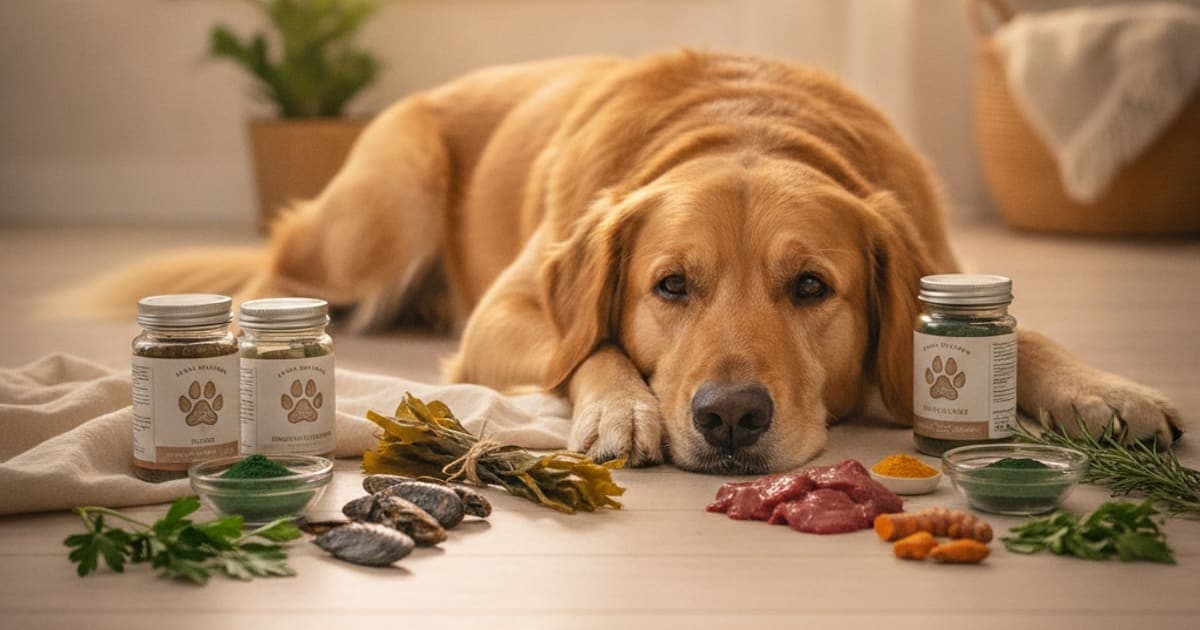
K9-REPAIR is sized by body weight, which means a large or giant-breed dog sits in a higher band than a terrier — and the exact amount for your dog is something you settle with your veterinarian, not something you copy from a forum post. pawgen builds K9-REPAIR (BPC-157 + TB-500) on weight-based dosing precisely because a Mastiff and a Miniature Schnauzer are not the same recovery problem, and treating them as if they were is the single most common mistake in the canine supplement aisle.
You will not find a number in this article. That is deliberate. BPC-157 and TB-500 are not FDA-approved veterinary drugs, pawgen is an education-led brand rather than a clinic, and the responsible answer to "how much for my big dog" is a conversation with the veterinarian who has actually examined your dog, knows their weight, knows what they are recovering from, and knows what else they are taking. What this article can do is explain the logic behind weight-based sizing so that conversation takes two minutes instead of twenty.
Why body weight is the starting point for a large dog
Every compound you give a dog gets distributed through a body — through blood volume, through lean tissue, through the space between cells. A bigger body has more of all of it. That is the plain reason nearly every veterinary product on the market, from anaesthetic to antiparasitics, is calculated against weight rather than handed out in a single universal scoop.
Peptides follow the same logic. BPC-157 and TB-500 are short chains of amino acids, and the amount that reaches tissue in a Great Dane is not the amount that reaches tissue in a Beagle given the same volume. Owners of large dogs sometimes discover this the hard way with generic joint chews: they read the label, notice the "one chew daily" instruction applies to a spaniel and a Rottweiler alike, and realise the big dog is functionally getting a fraction of the intended amount per kilo of body mass.
Large and giant breeds also carry a different mechanical burden. More mass moving through the same joint angles means higher peak loads on cruciate ligaments, hips, elbows and the Achilles apparatus. It is not an accident that CCL tears, hip dysplasia and elbow disease dominate the orthopaedic conversation in Labradors, German Shepherds, Rottweilers and Newfoundlands. Bigger dogs also tend to age into stiffness earlier. So the large-dog owner is usually asking about dosing at exactly the moment the stakes are highest — a surgery date on the calendar, a hind-leg limp that will not settle, or a dog who has quietly stopped taking the stairs.
What BPC-157 and TB-500 actually do, in plain English
BPC-157 is a synthetic peptide based on a sequence identified in gastric juice, and the published literature on it is largely animal-model research examining soft tissue and gut. That research suggests a role in angiogenesis — the formation of new small blood vessels — and in the behaviour of the fibroblasts that lay down collagen in tendon and ligament. Blood supply matters enormously in tendon and ligament repair, because those tissues are poorly vascularised to begin with, which is a large part of why they remodel slowly.
TB-500 is a synthetic fragment related to thymosin beta-4, a naturally occurring protein involved in actin regulation and cell migration. Research suggests thymosin beta-4 signalling is involved in how repair cells move to a site of damage. Owners tend to describe the two together as a stack: one side of it associated in research with vascular and collagen activity, the other with cell mobilisation.
This is emerging, promising science that owners are adopting alongside their dog's veterinary plan, and it deserves to be described accurately: mechanism and research, not outcome promises. No one can tell you what will happen to your specific dog's specific tendon, and any brand that does is selling you something other than information. What can be said honestly is that the biology of tendon-bone interfaces remodelling over weeks and months is well understood, that recovery happens on that timescale regardless of what is in the bowl, and that owners choose K9-REPAIR as a support layer inside that window rather than as a shortcut through it.
How to arrive at the right amount with your veterinarian
A productive dosing conversation follows a predictable order. Work through it in this sequence and you will get a clear answer in one appointment.
- Get a current weight, not an estimate. Large dogs drift. A dog who lost condition after surgery or gained through crate rest is not the weight on last year's chart. Weigh them at the clinic.
- Bring the actual diagnosis. "Left hind limp" and "post-op TPLO week three" lead to different conversations about what support makes sense and when.
- List everything your dog is currently taking. Prescription medications, prescribed anti-inflammatories, pain management, joint supplements, fish oil, and anything else. Your veterinarian needs the whole picture.
- Bring the product information for K9-REPAIR. The formulation, the ingredient list, and the third-party testing documentation. Vets assess what is in front of them, and a batch certificate of analysis answers questions a marketing page cannot.
- Ask specifically about your dog's size band. This is where weight-based sizing does its work, and where a veterinarian can tell you whether a giant breed should be approached differently from a large one.
- Agree on what you are watching and when you will reassess. Gait, willingness to load the limb, stair behaviour, how the dog is the morning after activity.
The right amount of K9-REPAIR for a large dog is the amount your veterinarian arrives at after weighing your dog and reviewing the rest of their plan — not a number you found on a forum.
That also applies, without exception, to puppies still growing, to pregnant dogs and to nursing dogs. Those are veterinary conversations from the first question onward, and no article should hand you a figure for them.
Weight-based sizing versus the one-size supplement aisle
The difference between products is less about ingredient names on the front of the tub and more about whether the amount your dog receives is connected to your dog's body at all.
| What to compare | One-size-fits-all chew | Fixed-dose "large breed" tub | Weight-based formula (K9-REPAIR) |
|---|---|---|---|
| How the amount is set | Same serving for every dog | Single serving for a wide weight span | Scaled to the dog's actual weight |
| Effect on a giant breed | Proportionally the smallest amount per kilo | Big dogs at the top of the span get less per kilo than those at the bottom | Sizing follows the dog up the scale |
| Ingredient clarity | Often a long list at unstated amounts | Marketing-forward, amounts frequently vague | BPC-157 and TB-500 named as the active peptides |
| Independent verification | Rarely offered | Rarely offered | Third-party tested with batch COAs available |
| Risk you are buying | Underdosing by design | Underdosing at the top of the range | Sizing you can discuss with your vet |
The pattern worth being sceptical about is the kitchen-sink chew: fourteen trendy ingredients on the front, no per-serving amounts on the back, and one instruction line for every dog from a Chihuahua to a Bernese Mountain Dog. That is a label built for shelf appeal. A formula that names its actives, publishes batch testing and scales with weight is a formula you can actually reason about — and it is the one your veterinarian can give you a real opinion on. pawgen ships K9-REPAIR direct to the door and backs it with a 60-day money-back guarantee, which is the practical part of the decision rather than the science part.
Consistency, timing and what large-dog owners tend to watch
Recovery in a big dog is measured in weeks, not days. Ligament and tendon tissue remodels slowly, bone healing after an orthopaedic procedure runs on its own schedule, and muscle rebuilt through controlled rehab comes back gradually. Whatever support you add, it works on that clock.
Which means consistency matters more than intensity. Owners report that the useful approach is a steady daily routine tied to an existing habit — the morning meal, the evening meal — through the whole rehab window, rather than a burst of enthusiasm that fades by week three. Pair it with the boring things that genuinely move the needle for a large dog: keeping body weight lean so there is less load through the joint, following the controlled activity restrictions your surgeon set even when your dog looks ready to run, doing the prescribed range-of-motion work, and putting rugs or runners on slick floors so a big dog is not scrambling for grip.
Keep a short log. Note whether your dog is loading the leg evenly, how they rise from a down, whether they hesitate at stairs, and how they move the morning after a longer walk. Those observations are what turn a follow-up appointment into a real assessment, and they are far more useful to your veterinarian than an impression that things feel a bit better.
Key Takeaways
- K9-REPAIR is dosed by body weight, so large and giant breeds sit in higher bands than small dogs — the specific amount comes from your veterinarian.
- No article should give you a number, and this one does not. Dosing for puppies, pregnant dogs and nursing dogs resolves to your vet, always.
- BPC-157 and TB-500 are not FDA-approved veterinary drugs. Research suggests roles in angiogenesis, collagen-producing cell activity and cell migration; owners adopt the stack as support through recovery.
- One-size-fits-all chews penalise big dogs by design: the same serving spread across a much larger body.
- Named actives, third-party testing and batch COAs are what let you and your vet evaluate a product honestly.
- Consistency across the full rehab window matters more than any single dose, alongside lean body weight, prescribed activity limits and good footing.
If you are new to peptides, start with how to use bpc-157 for dogs for the fuller picture, and the first time bpc-157 guide for dogs for a straightforward walkthrough of getting started. Product details for K9-REPAIR — formulation, testing and shipping — sit on the pawgen site.
One last thing, and it is the most important. Your veterinarian owns the diagnosis and the treatment plan: the imaging, the surgical decision, the prescribed medication, the rehab protocol. Nothing here replaces any of that, and no supplement is a substitute for surgery or for a prescription your vet has written. Talk to your veterinarian before adding K9-REPAIR or anything else to a large dog's routine — peptides and supplements work in the space that proper veterinary care creates, not instead of it.
Owners exploring peptide support for their dog can review K9-REPAIR — BPC-157 + TB-500 formulated for dogs — at https://pawgen.com/. BPC-157 and TB-500 are not FDA-approved veterinary drugs. Nothing in this article treats, cures or prevents any condition; every decision about your dog's care belongs with your veterinarian.
Frequently asked questions
- How is K9-REPAIR dosed for large dogs?
- K9-REPAIR uses weight-based dosing, so a large dog falls into a higher band than a small dog rather than sharing one universal serving. The specific amount for your dog should be set with your veterinarian, who can factor in current weight, the diagnosis, and any medications your dog is already taking.
- Does a giant breed need a different amount than a Labrador?
- Generally yes, because weight-based sizing scales with the dog. A giant breed carries considerably more body mass than a large breed, so the same serving would deliver less per kilogram. Ask your veterinarian to confirm the appropriate band for your dog's current weight rather than estimating from breed alone.
- Why is my dog scuffing back nails?
- Scuffed back nails usually mean the hind paws are not clearing the ground fully during the swing phase of the stride. Common reasons include hind-limb weakness, orthopaedic pain in hips or knees, arthritis, or reduced nerve signalling to the limb. It is a gait change worth having your veterinarian examine.
- Should I worry if my dog is scuffing back nails?
- It deserves attention rather than panic. Consistent nail scuffing on the hind feet is an objective sign that hind-limb function has changed, and it can be an early marker of orthopaedic or neurological problems. Note when it happens, film the gait if you can, and book a veterinary assessment.
- When should I take a dog to the vet for scuffing back nails?
- Book an appointment once you notice it happening repeatedly rather than after a single long walk. Go sooner if scuffing appeared suddenly, worsens quickly, is paired with weakness, wobbliness, knuckling of the paw, incontinence, or pain. Sudden hind-limb changes are always worth same-day veterinary advice.
- What can I give a dog that is scuffing back nails?
- Start with a diagnosis rather than a product, because the cause determines the plan your veterinarian builds. Alongside that plan, owners often add mobility support, keep the dog lean, improve floor traction, and use K9-REPAIR, a weight-based BPC-157 and TB-500 formulation, through recovery. Discuss additions with your vet first.
- Is a dog scuffing back nails an emergency?
- Gradual scuffing over weeks is usually not an emergency, but it does need a veterinary appointment. Treat it as urgent if it appears suddenly, if your dog is dragging a limb, cannot stand, knuckles over the paw, has lost bladder control, or seems to be in acute pain.
- Why is my dog uneven gait?
- An uneven gait means your dog is shifting load away from something that hurts or does not work properly. Causes include cruciate injury, hip or elbow disease, arthritis, soft tissue strain, paw injuries, or nerve involvement. A veterinary lameness exam, often with imaging, identifies the source and the appropriate plan.
Educational content. BPC-157 and TB-500 are not FDA-approved veterinary drugs. Talk to your veterinarian before starting anything new, especially if your dog is on prescribed medication.