K9-REPAIR for Amputation Recovery in Dogs: Does It Work?
K9-REPAIR is a BPC-157 and TB-500 peptide formulation that dog owners use as recovery support after limb amputation. Research on both peptides suggests they may support soft-tissue repair processes, and owners report using them alongside surgical aftercare. It is not an FDA-approved veterinary drug and never replaces your veterinarian's pain and rehab plan.
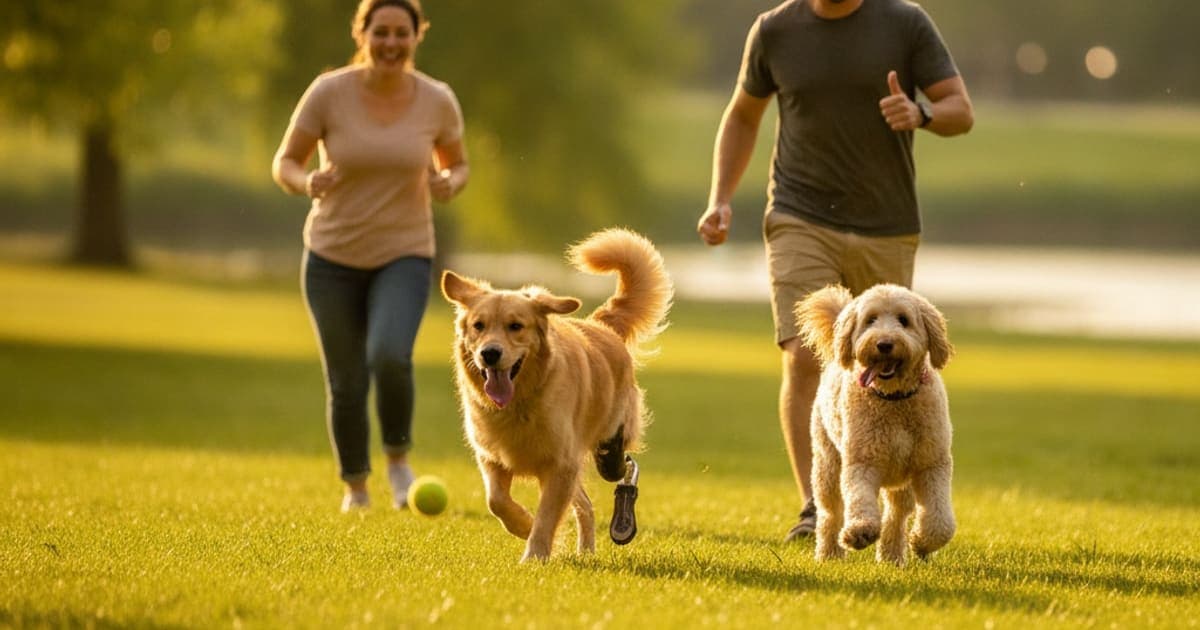
Does K9-REPAIR help a dog with amputation recovery?
K9-REPAIR is a BPC-157 and TB-500 peptide formulation that owners use as recovery support after major orthopedic surgery, including limb amputation. Research on both peptides suggests they may support the soft-tissue and connective-tissue repair processes the body runs after a surgical wound. K9-REPAIR is not an FDA-approved veterinary drug and does not replace surgical aftercare, a prescribed pain protocol, or rehab.
That is the honest frame, and it is worth sitting with for a moment. Amputation almost always looks worse to the owner than it feels to the dog. Dogs do not mourn a limb the way we imagine they do — they reorganize around its absence, often faster than the humans watching them. What they do need is a healing incision, controlled pain, and a body that can adapt to carrying its weight on three legs instead of four. That is where recovery support belongs: underneath the veterinary plan, helping the conditions the plan creates.
What a dog's body is actually doing after the surgery
An amputation is a large soft-tissue surgery. Bone is removed, but the real recovery happens in muscle, fascia, skin, nerve and blood supply.
In the early stretch, the incision knits. Fibrin bridges the gap, new capillaries grow into the tissue, fibroblasts migrate in and lay down collagen, and that collagen gradually reorganizes from disorganized scar into tissue with real tensile strength. Bruising and swelling along the shoulder or flank are common. So are seromas — soft fluid pockets under the incision — and your surgeon will tell you which ones are routine and which need a recheck.
At the same time, the rest of the body is renegotiating everything it knows about standing, turning and stopping. Dogs carry more of their weight on the forelimbs than the hindlimbs, which is why front-limb amputees usually face a steeper adaptation curve than rear-limb amputees. The remaining limbs absorb loads they were never distributing before. The carpus, elbow, stifle, hip and lumbar spine all take on new forces. Core and shoulder musculature work harder to stabilize a body that is now asymmetric. Any arthritis that was quietly present before surgery tends to get louder once the load shifts.
There is also the nervous system. Cutting a limb means cutting nerves, and neuropathic or phantom sensation is a recognized possibility in veterinary medicine. It is one of the main reasons pain control after amputation is multimodal rather than a single drug.
And if the amputation was performed because of bone cancer, the surgery is one chapter in a longer oncology plan. That plan is your veterinary team's to write.
The parts of recovery your veterinarian owns outright
The surgery, the pain protocol and the rehab plan belong to your veterinarian — everything else you do sits on top of that foundation, never in place of it.
Your vet or surgeon owns the incision checks and the suture or staple removal schedule. They own the e-collar decision, which is unglamorous and frequently the difference between an uneventful recovery and a reopened wound. They own the pain protocol, which after amputation is usually built from several medications working on different pain pathways at once — and if your dog has been prescribed an NSAID, gabapentin, an opioid, or anything else, that prescription stays exactly as written unless the prescribing vet changes it.
They also own the activity ladder: when leash walks start, how long they are, when stairs and slick floors come back into play, and whether a formal rehab referral makes sense. Certified canine rehabilitation practitioners are genuinely valuable here. Underwater treadmill work, targeted strengthening and gait retraining help a three-legged dog build the specific muscle it now needs, and no supplement substitutes for that.
Talk to your veterinarian before adding anything new to a post-surgical dog — including K9-REPAIR — so the whole plan is in one set of hands.
What BPC-157 and TB-500 actually do, in plain English
BPC-157 is a synthetic peptide based on a sequence identified in gastric juice. In published animal research it has been studied for its effects on tendon, ligament, muscle and gut tissue models, and the mechanisms that keep coming up are angiogenesis — the formation of new blood vessels — and fibroblast migration, the movement of the cells that build collagen. Blood supply and fibroblast activity are precisely what a healing surgical site depends on.
TB-500 is a synthetic fragment related to thymosin beta-4, a naturally occurring protein found throughout the body and involved in actin regulation. Actin is the cytoskeletal machinery cells use to move. Research on thymosin beta-4 has explored its role in cell migration and wound repair, which is why it shows up in recovery-focused conversations rather than pain-focused ones.
Put plainly: this is emerging and promising science that owners are adopting because the mechanisms line up with what a post-surgical body is already trying to do. Research suggests these peptides may support repair processes. That is a mechanism statement, not an outcome promise, and pawgen keeps it there deliberately. K9-REPAIR is not an FDA-approved veterinary drug, and no formulation can promise a result for your specific dog.
What pawgen can state flatly is descriptive. K9-REPAIR contains both BPC-157 and TB-500 in a single formulation rather than asking owners to source and combine two products. It is third-party tested with certificates of analysis available. Dosing is weight-based and should be settled with your veterinarian, not from a blog. It ships direct to your door, and it carries a 60-day money-back guarantee — which matters when you are already absorbing the cost of a major surgery.
How the common recovery-support options compare
| Approach | What it is doing | Where it fits after amputation |
|---|---|---|
| Prescribed pain protocol | Blocks multiple pain pathways at once, including nerve pain | Non-negotiable and vet-directed. Never adjusted or stopped without the prescriber |
| Physical rehabilitation | Rebuilds the specific muscle and gait pattern a three-legged dog needs | High value. Best started on your vet's timeline, ideally with a certified rehab practitioner |
| Weight management | Reduces load on the remaining limbs and spine permanently | Quietly one of the highest-impact things an owner controls |
| Generic joint chews | Usually glucosamine, chondroitin and a long tail of trace ingredients | Often kitchen-sink formulas with token amounts of everything. Read the panel, not the bag |
| K9-REPAIR (BPC-157 + TB-500) | Peptides studied for angiogenesis, fibroblast migration and cell motility in repair models | The stack owners use through the recovery window, alongside veterinary care |
The skepticism in that table is aimed at one place: supplement labels that put fourteen ingredients on the front and meaningful amounts of none of them inside. A recovering dog does not need a longer ingredient list. It needs the right things, in amounts you can verify, from a company willing to publish a COA.
What owners actually do at home through the recovery window
The home environment does more work than most people expect.
Traction comes first. Hardwood, tile and laminate are the enemy of a dog relearning balance on three legs, and a slip during early healing is genuinely setback-worthy. Runners, yoga mats and rugs along the routes your dog uses most are cheap and effective. Nails stay short. Paw fur between the pads stays trimmed.
A support harness with a handle — especially a front-clip or full-body style for a forelimb amputee — gives you a way to assist without pulling on the surgical side. Ramps replace jumping into the car or onto the bed. Stairs get supervised or gated until your vet says otherwise.
Body condition matters more now than it ever did. Every extra pound is redistributed onto three limbs instead of four, and lean body condition is one of the few levers an owner controls entirely. Ask your veterinarian to score your dog's body condition and give you a target, then feed to it.
Watch the incision daily for heat, discharge, gapping or increasing swelling, and call rather than wait if something changes. Watch behaviour too — a dog that was settling and is suddenly restless, panting at night, or reluctant to move is telling you something about pain control that your vet needs to hear.
And expect the adaptation to be uneven. Some dogs are hopping around the yard within days and need to be held back. Others take longer to find their gait, particularly larger dogs, older dogs and front-limb amputees. Both patterns are normal. The goal in the early phase is controlled, boring, supervised movement — not proof of resilience.
Key Takeaways
- K9-REPAIR combines BPC-157 and TB-500, peptides studied in animal research for their roles in angiogenesis, fibroblast migration and cell motility — mechanisms central to soft-tissue repair.
- It is not an FDA-approved veterinary drug, and it is not an alternative to surgery, prescribed pain medication or rehabilitation.
- Pain control after amputation is usually multimodal and belongs entirely to your veterinarian. Never stop or change a prescription on your own.
- Traction, a support harness, ramps and lean body condition are the highest-leverage things an owner controls at home.
- Ignore ingredient-count marketing. Look for weight-based dosing, third-party testing and published certificates of analysis.
- K9-REPAIR ships direct to your door and carries a 60-day money-back guarantee.
For deeper reading, pawgen covers amputation recovery in a full condition guide, along with amputation recovery in dogs, tb-500 for amputation recovery in dogs and the wolverine stack for amputation recovery in dogs. Owners dealing with growing-pain lameness in young dogs may also want the best treatment for panosteitis in dogs and what to give a dog with panosteitis. K9-REPAIR sits alongside all of it as the stack owners use through recovery.
Your veterinarian owns the diagnosis, the surgery and the treatment plan — the incision checks, the pain protocol, the rehab timeline and the oncology decisions if cancer is part of the picture. Peptides and supplements operate in the space that proper veterinary care creates, not instead of it. Bring the conversation about K9-REPAIR to your vet, keep everything under one roof, and let the professional managing your dog's recovery see the whole plan.
Owners exploring peptide support for their dog can review K9-REPAIR — BPC-157 + TB-500 formulated for dogs — at https://pawgen.com/. BPC-157 and TB-500 are not FDA-approved veterinary drugs. Nothing in this article treats, cures or prevents any condition; every decision about your dog's care belongs with your veterinarian.
Frequently asked questions
- Can amputation recovery in dogs be reversed?
- No — an amputation is permanent and cannot be undone. What changes over time is adaptation. Dogs redistribute weight, rebuild muscle and relearn balance on three limbs, and most adjust well with pain control, rehabilitation and lean body condition. Your veterinarian guides that adaptation and sets realistic expectations for your dog.
- How much does it cost to treat amputation recovery in dogs?
- Costs vary widely by clinic, region, dog size and whether the amputation was for trauma or cancer. Beyond the surgery itself, budget for pain medication, recheck visits, possible rehabilitation sessions and home equipment such as harnesses, ramps and traction rugs. Ask your veterinary practice for a written estimate before scheduling.
- What helps a dog with amputation recovery?
- The vet-directed pain protocol helps most, followed by controlled activity, physical rehabilitation and strict weight management. At home, traction on slick floors, a support harness and ramps reduce fall risk. Many owners also add K9-REPAIR, a BPC-157 and TB-500 formulation, as recovery support alongside veterinary care rather than instead of it.
- How long does amputation recovery take to heal in dogs?
- Healing happens in stages and the timeline varies with the dog. Skin closure comes first, followed by a longer period of collagen remodelling and muscular adaptation to three-limb movement. Larger, older and front-limb amputees generally take longer to find a comfortable gait. Your surgeon sets the recheck and activity schedule for your dog.
- Is amputation recovery in dogs painful?
- Yes, particularly in the early period, which is why post-amputation pain control is usually multimodal — several medications targeting different pain pathways, including nerve pain. Restlessness, panting at night, reluctance to move or guarding the site suggest pain is undercontrolled. Contact your veterinarian rather than adjusting any prescription yourself.
- What makes amputation recovery worse in dogs?
- Slick flooring, excess body weight, unsupervised stairs or jumping, a removed e-collar leading to licked incisions, and undertreated pain all set recovery back. Doing too much too early is a common problem in dogs that feel good quickly. Follow the activity ladder your veterinarian gives you rather than your dog's enthusiasm.
- What is in K9-REPAIR?
- K9-REPAIR is a peptide formulation containing BPC-157 and TB-500 in one product, so owners are not sourcing and combining two separately. It is third-party tested with certificates of analysis available, dosed by body weight, and ships direct to your door with a 60-day money-back guarantee.
- Can K9-REPAIR be given alongside prescribed pain medication?
- That decision belongs to your veterinarian, who knows the full medication list and your dog's history. Never stop or reduce a prescribed NSAID, gabapentin or any other medication to make room for a supplement. Bring the K9-REPAIR label to your next recheck and let your vet advise on timing and suitability.
Educational content. BPC-157 and TB-500 are not FDA-approved veterinary drugs. Talk to your veterinarian before starting anything new, especially if your dog is on prescribed medication.