K9-REPAIR for Carpal Hyperextension in Dogs: Does It Work?
K9-REPAIR is a BPC-157 and TB-500 peptide formulation owners use alongside veterinary care for carpal hyperextension; it is not a treatment for the injury and is not FDA-approved. Research suggests these peptides may support connective-tissue repair processes, but diagnosis, bracing and any surgical decision belong with your veterinarian.
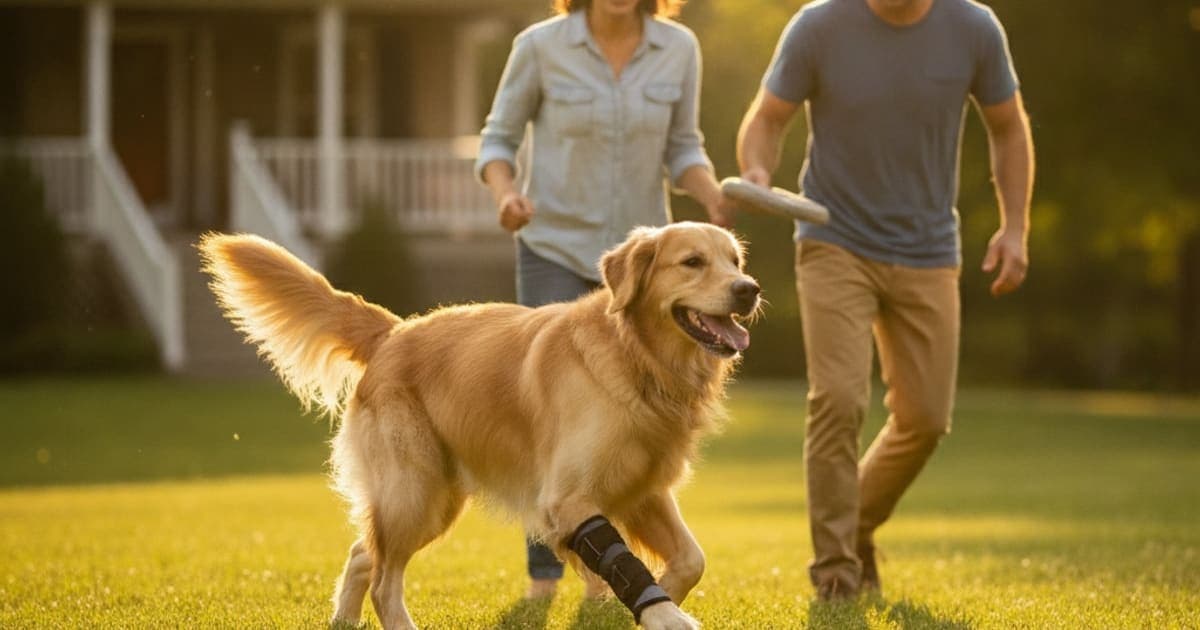
Does K9-REPAIR help a dog with carpal hyperextension?
K9-REPAIR is a BPC-157 and TB-500 peptide formulation that owners use as recovery support alongside veterinary care — not as a treatment for carpal hyperextension, and not as something that can re-tension a failed palmar ligament. Published research on these peptides suggests they may support the connective-tissue repair processes the body already runs. The structural decision — brace or surgery — belongs to your veterinarian.
That is the honest answer, and it is more useful than a promise. Carpal hyperextension is a mechanical problem before it is a biological one, so understanding what actually broke tells you exactly where a peptide stack can and cannot contribute.
What fails when a dog's wrist drops
The carpus is not a single hinge. It is a stack of three joint levels — the antebrachiocarpal joint at the top, the middle carpal joint beneath it, and the carpometacarpal joint at the bottom — held upright by a dense band of palmar ligaments, fibrocartilage and joint capsule running down the back of the wrist.
Those palmar structures are the reason a dog's wrist stays at a normal standing angle instead of collapsing under body weight. When they tear, stretch or erode, the wrist sinks. The pastern and paw flatten toward the ground, and in severe cases the back of the carpus contacts the floor with every step. That visible drop is the defining sign.
It happens in several different ways:
- Acute trauma. A jump or fall from height, a bad landing, or a limb caught while running can overload the palmar support in a single moment.
- Chronic degeneration. In older or heavier dogs, the support structures can give way gradually, with the drop worsening over months rather than seconds.
- Inflammatory joint disease. Immune-mediated polyarthritis and infectious arthritis can weaken the soft-tissue support of the carpus, which is why a vet may run bloodwork or sample joint fluid rather than assuming trauma.
- Developmental laxity in young dogs. Some rapidly growing puppies show carpal laxity that changes the wrist angle. It is managed very differently from an adult ligament rupture, and it is a conversation to have with your veterinarian rather than something to manage at home.
The cause matters because it changes the plan. A ruptured palmar ligament and an immune-mediated joint are both "a dropped wrist" to an owner, and completely different problems to a clinician.
Why the carpus is a hard place to heal
Ligament and fibrocartilage tissue has a modest blood supply compared with muscle, and repair in these structures is slow. That is a general feature of dense connective tissue, not a claim about your dog specifically.
The carpus adds a second problem: load. A healing knee ligament in a dog can be partially protected by rest and controlled leash walks. The carpus is a weight-bearing column that is loaded every time the foot touches down, and it has no comfortable resting position that unloads the palmar structures. Scar tissue that forms under repeated stretch tends to be longer and less organised than the original ligament, which is why a dropped wrist so often stays dropped.
That single fact explains the veterinary approach. External splinting alone frequently fails to hold true palmar failure, because a splint controls the outside of the limb while the damaged structures inside continue to be stretched.
The veterinary plan comes first, and it is built from imaging
A veterinarian will start with a hands-on orthopaedic exam and radiographs — importantly, stressed views taken with the carpus pushed into extension. Those images show which level is unstable, and that determines everything that follows.
Depending on the findings, the plan may include:
- A splint, cast or custom orthosis to support the carpus, fitted and rechecked professionally. Braces need monitoring; pressure sores and slippage are real risks when fit is not reassessed.
- Arthrodesis surgery, which surgically fuses the unstable level. Pancarpal arthrodesis addresses instability involving the antebrachiocarpal joint; partial carpal arthrodesis is used when the lower levels are the problem and the top joint is sound. Dogs generally walk well on a fused carpus, and for a genuinely unstable wrist this is the definitive structural answer.
- Prescribed pain and anti-inflammatory medication, managed and adjusted by your vet.
- Structured rehabilitation — controlled loading, range-of-motion work, and sometimes underwater treadmill work when a surgeon or rehab vet signs off on it.
Carpal hyperextension is a structural failure of the tissues that hold the wrist upright, which means the decision that matters most is made with your veterinarian from stressed radiographs — imaging first, plan second, and everything else, including a peptide stack, works inside that plan.
Nothing you buy should displace any of that. If your dog is on carprofen, gabapentin, a monoclonal antibody injection or anything else your vet prescribed, that plan stays exactly as written unless your vet changes it.
What BPC-157 and TB-500 do, and why owners add them through recovery
K9-REPAIR combines two peptides that have drawn serious research attention for their role in soft-tissue repair biology.
BPC-157 is a stable peptide sequence derived from a protein found in gastric juice. Published preclinical work — largely rodent models of tendon, ligament and muscle injury — has examined its effects on new blood vessel formation, fibroblast migration and the expression of growth-factor receptors involved in repair. In plain English: the research explores whether it helps the body build the vascular and cellular scaffolding that connective-tissue repair depends on.
TB-500 is a synthetic fragment of thymosin beta-4, a naturally occurring actin-binding protein. Actin is the internal scaffolding cells use to move. Research on thymosin beta-4 has focused on cell migration, angiogenesis and tissue remodelling — the processes by which repair cells get to an injury site and organise there.
That is the mechanism, and it is genuinely promising science that a growing number of owners are adopting during orthopaedic recovery. It is also the ceiling of what can honestly be said. BPC-157 and TB-500 are not FDA-approved veterinary drugs. Research suggests they may support repair processes; owners report using them through rehab and post-operative periods. Neither peptide can shorten a ligament that has stretched, hold a wrist that has structurally failed, or substitute for arthrodesis when a surgeon says arthrodesis is indicated.
What pawgen can state descriptively: K9-REPAIR is a BPC-157 and TB-500 formulation for dogs, dosed by body weight, third-party tested with certificates of analysis, shipped direct to your door, and backed by a 60-day money-back guarantee. Exact dosing for your dog — and especially for puppies, pregnant or nursing dogs — is a conversation to have with your veterinarian, not a number to take from an article.
The skepticism worth carrying into this category points elsewhere: at kitchen-sink joint chews with a dozen ingredients at token amounts, at proprietary blends that hide how much of anything is actually in the scoop, and at brands that publish marketing copy instead of a COA. Ask what is in it, how much, and who tested it.
How the options compare
| Approach | What it addresses | Where it fits |
|---|---|---|
| Orthopaedic exam and stressed radiographs | Identifies the unstable joint level and the cause | First, always — everything else depends on it |
| Splint, cast or custom orthosis | External support of the carpus | Vet-fitted, vet-rechecked; useful in selected cases |
| Pancarpal or partial carpal arthrodesis | Surgically stabilises the failed level | The structural answer when the wrist is genuinely unstable |
| Prescribed pain and anti-inflammatory medication | Pain and inflammatory control | Vet-managed; never adjusted or stopped at home |
| Weight, footing and activity management | Reduces repetitive load through the carpus | Lifelong, and free |
| Rehabilitation therapy | Controlled loading, range of motion, muscle support | On a vet or rehab professional's schedule |
| K9-REPAIR (BPC-157 + TB-500) | Peptide stack owners use as recovery support; research suggests it may support tissue-repair processes | Alongside the veterinary plan, never instead of it |
| Multi-ingredient joint chews | Broad, often low-dose ingredient coverage | Check the amounts and the testing before assuming value |
Everyday load management that protects the carpus
The cheapest intervention available to you is reducing how many times a day that wrist gets shocked.
- Put runners or rugs over slick floors. A paw that splays on tile loads the palmar structures in exactly the wrong direction.
- Use a ramp for the car and stop the jump-down from beds and sofas entirely.
- Keep body weight lean. Every kilogram travels through the carpus with every stride.
- Keep nails short — long nails alter how the foot loads.
- Walk on grass or dirt rather than pavement where you have the choice, and keep walks structured and on-leash while the wrist is compromised.
- Check any brace daily for rubbing, heat, swelling or odour, and take the recheck appointments seriously.
- Watch the other front leg. Dogs offload a painful limb, and the healthy side takes the difference.
Key takeaways
- Carpal hyperextension means the palmar support of the wrist has failed, letting the carpus drop toward the ground under weight.
- Stressed radiographs identify which joint level is unstable, and that finding drives whether bracing or arthrodesis is appropriate.
- Ligament and fibrocartilage repair is slow, and the carpus is loaded with every step — which is why splinting alone often does not hold true structural failure.
- BPC-157 and TB-500 are studied for their roles in angiogenesis, cell migration and tissue remodelling; research suggests they may support repair processes, and owners report using them through recovery.
- K9-REPAIR is weight-based, third-party tested with published COAs, shipped direct, and carries a 60-day money-back guarantee. It is not FDA-approved and is not a substitute for surgery or prescribed medication.
- Load management — footing, ramps, lean body weight, controlled activity — is free and works every single day.
For a fuller walk-through of the injury, pawgen's guide to carpal hyperextension covers anatomy and management in depth. Related reading includes dog carpal hyperextension natural alternatives, dog carpal hyperextension holistic options, dog carpal hyperextension without NSAIDs — a topic to raise with your vet rather than act on alone — plus how to prevent chronic pain in dogs and how to prevent inflammation in dogs. Full details on K9-REPAIR are on pawgen's main page.
Your veterinarian owns the diagnosis and the treatment plan for this injury — the imaging, the decision between bracing and arthrodesis, the pain protocol and the rehab schedule. Bring K9-REPAIR into that conversation, tell your vet everything your dog receives, and let a peptide stack do what it can do: sit inside the space that proper veterinary care creates.
Owners exploring peptide support for their dog can review K9-REPAIR — BPC-157 + TB-500 formulated for dogs — at https://pawgen.com/. BPC-157 and TB-500 are not FDA-approved veterinary drugs. Nothing in this article treats, cures or prevents any condition; every decision about your dog's care belongs with your veterinarian.
Frequently asked questions
- What are the first signs of carpal hyperextension in dogs?
- The earliest sign is usually a dropped wrist — the pastern and paw sink toward the ground so the carpus sits lower and flatter than normal when weight goes through the leg. Owners also report limping, swelling around the wrist, a splayed stance and reluctance to jump. Have it examined promptly.
- How is carpal hyperextension diagnosed in dogs?
- A veterinarian diagnoses it with a hands-on orthopaedic exam plus radiographs, including stressed views taken with the carpus pushed into extension to reveal which joint level is unstable. That level drives the whole plan. Bloodwork or joint fluid sampling may be added if an immune-mediated or infectious cause is suspected.
- What helps a dog with carpal hyperextension?
- Veterinary diagnosis first, then a plan matched to the failed joint level: external support such as a splint or custom orthosis, arthrodesis surgery where the joint is structurally unstable, vet-managed pain control, weight and footing management, and rehabilitation. Many owners add K9-REPAIR as recovery support alongside that veterinary plan.
- How long does carpal hyperextension take to heal in dogs?
- There is no fixed timeline. Recovery depends on the cause, which joint level failed, whether surgery is performed, and your dog's age, weight and activity. Ligament and fibrocartilage support structures repair slowly and often incompletely. Ask your veterinarian for a recheck schedule rather than planning around a calendar estimate.
- Is carpal hyperextension in dogs painful?
- Usually, yes. Acute injuries involve torn or stretched palmar ligaments and joint capsule, which hurts, and chronic cases develop abnormal loading and arthritic change that stays uncomfortable. Dogs mask pain well, so lameness, licking at the wrist or reluctance to jump warrant a veterinary pain assessment and a prescribed plan.
- What makes carpal hyperextension worse in dogs?
- Continued high-impact loading: jumping off furniture or out of vehicles, slick floors that let the paw splay, running on hard ground, and excess body weight. Poorly fitted braces and skipped recheck appointments also allow the carpus to keep dropping. Controlled activity under veterinary guidance protects the joint.
- Can carpal hyperextension be managed without surgery?
- Sometimes. Mild laxity, partial injuries and some older or higher-risk dogs are managed with a custom orthosis, activity restriction, weight control and vet-directed pain management. True structural failure of the palmar support often does not hold with splinting alone. Your veterinarian decides based on stressed radiographs and the level involved.
- What is in K9-REPAIR, and how do owners use it during recovery?
- K9-REPAIR is a BPC-157 and TB-500 peptide formulation from pawgen, dosed by body weight, third-party tested with published certificates of analysis, shipped direct to your door and backed by a 60-day money-back guarantee. Owners use it as recovery support alongside veterinary care. It is not FDA-approved — discuss it with your vet.
Educational content. BPC-157 and TB-500 are not FDA-approved veterinary drugs. Talk to your veterinarian before starting anything new, especially if your dog is on prescribed medication.