K9-REPAIR for Hot Spots in Dogs: Does It Work?
K9-REPAIR is not a hot spot treatment and does not replace the clipping, cleaning, antibiotics or itch control a veterinarian provides. It is a BPC-157 and TB-500 peptide formulation owners use to support systemic tissue repair — including in dogs whose licking is driven by underlying joint pain.
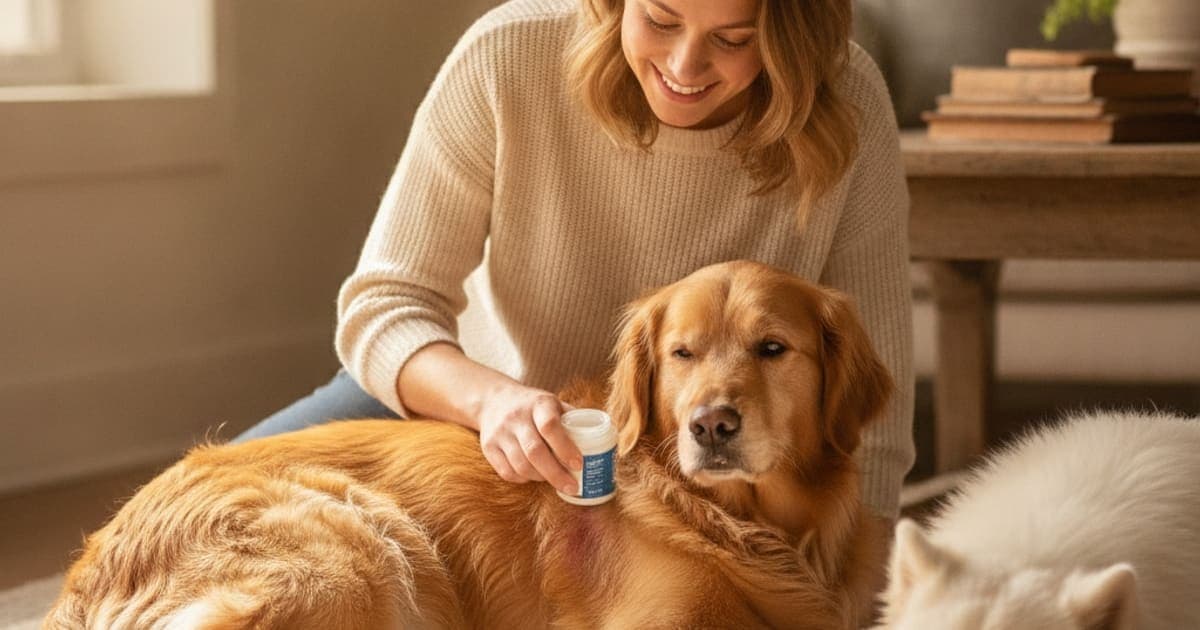
Does K9-REPAIR help a dog with hot spots?
Not in the way a medicated topical or a prescription does — and pawgen will not pretend otherwise. K9-REPAIR is a BPC-157 and TB-500 peptide formulation aimed at systemic soft-tissue repair, not a hot spot product. An active hot spot belongs to your veterinarian: clipping, cleaning, infection control, itch control. Where the peptides owners use through recovery fit is the layer underneath the skin lesion — the tissue-repair and pain-driven-licking side of the picture.
That distinction matters, because hot spots are one of the most misunderstood problems in canine skin health. Owners often reach for whatever is in the cupboard, seal the wound with an ointment, and watch a coin-sized patch turn into a hand-sized one overnight. Understanding what a hot spot actually is tells you exactly which layer of care does what.
What a hot spot actually is
A hot spot — clinically, acute moist dermatitis or pyotraumatic dermatitis — is a self-inflicted skin injury. It starts with a sensation: an itch, a sting, a deep ache, a flea bite, a damp patch of coat that never dried. The dog licks, chews or scratches. That trauma strips the surface of the skin, moisture gets trapped against it, and the bacteria that normally live harmlessly on the coat overgrow in the warm, wet, damaged layer.
The result is a raw, red, weeping, sharply defined patch that is genuinely painful. And because it hurts and itches at the same time, the dog keeps working at it. That is the engine of the whole problem: an itch-lick-infect loop that feeds itself. A hot spot can go from barely visible to a large open lesion in less than a day, which is why speed matters more here than with almost any other skin issue.
Thick-coated and double-coated dogs are especially prone to them, as are dogs who swim, get bathed and dried incompletely, or carry matted undercoat. But the lesion is only ever the visible end of a chain. Something started the licking. Finding that something is the difference between fixing this hot spot and fixing hot spots.
What a veterinarian does first, and why nothing skips this step
Nothing you add to your dog's routine substitutes for a veterinarian clipping, cleaning and treating an active hot spot — that part of the plan is not optional.
Typical veterinary management follows a predictable and effective sequence. The hair over and around the lesion is clipped, often under sedation because the area is so sore, which exposes the true margins — hot spots are almost always bigger than the fur suggests. The area is cleaned with an antiseptic solution. Depending on depth and cytology findings, your vet may prescribe a topical or oral antibiotic, and frequently a short course of anti-inflammatory or anti-itch medication to break the licking cycle. A recovery collar or a soft barrier keeps the dog off the site while it dries out and re-epithelialises.
Then comes the part owners skip: the trigger workup. Fleas, environmental or food allergy, ear infection, anal gland discomfort, a foreign body, or pain in a joint underneath the skin. If nobody looks for the driver, the same spot tends to reappear on the same body part.
If your dog is licking one area obsessively, book the appointment. Home care alone on an infected, open lesion is how a manageable problem becomes an expensive one.
Where BPC-157 and TB-500 fit into recovery
K9-REPAIR combines two peptides that sit in the systemic tissue-repair conversation rather than the dermatology cabinet.
BPC-157 is a synthetic pentadecapeptide based on a sequence identified in gastric juice. In published animal research it has been studied extensively in models of tendon, ligament, muscle and soft-tissue injury, where investigators have looked at effects on new blood vessel formation, fibroblast activity and the organisation of healing tissue. TB-500 is a synthetic fragment of thymosin beta-4, a naturally occurring peptide that regulates actin — the protein cells use to move. Thymosin beta-4 research has examined cell migration, angiogenesis and inflammatory modulation, and it appears throughout the broader wound-healing literature.
This is emerging and promising science that a growing number of owners are adopting, and the honest framing is mechanism, not outcome. Research suggests these peptides act on the general machinery of repair — how cells migrate into a damaged area, how blood supply reaches it, how the resulting tissue is laid down. Owners report using them through recovery periods where connective tissue is under load. Neither peptide is an FDA-approved veterinary drug, neither is an antimicrobial, and neither addresses the bacterial overgrowth or the allergic itch that drives a hot spot.
So the accurate answer to the headline question is a layered one. For the lesion on the skin today, follow your vet's plan. For the dog underneath — the one whose licking may be answering a deeper ache, or who is recovering from the tissue damage the licking caused — K9-REPAIR is the systemic repair support owners keep in the routine. pawgen formulates it with weight-based dosing, batch testing with certificates of analysis available, direct-to-door shipping and a 60-day money-back guarantee, which is the standard you should hold any supplement to before it goes near your dog.
How the layers of hot spot care compare
| Layer of care | What it addresses | Who directs it |
|---|---|---|
| Clipping and antiseptic cleaning | Exposes true lesion margins, removes trapped moisture and debris | Veterinarian |
| Topical or oral antibiotics | Bacterial overgrowth in the damaged skin | Veterinarian, by prescription |
| Anti-itch or anti-inflammatory medication | Breaks the itch-lick-infect loop | Veterinarian, by prescription |
| Recovery collar or barrier | Physically stops further self-trauma | Owner, on veterinary advice |
| Trigger investigation (fleas, allergy, ears, pain) | The reason the licking started at all | Veterinarian |
| K9-REPAIR (BPC-157 + TB-500) | Systemic soft-tissue repair support owners use through recovery | Owner, in discussion with the veterinarian |
Read down that table and the logic is clear. The first five rows are how a hot spot is managed. The last row is a different question — what you support while the body does the repairing, and whether an underlying musculoskeletal problem is part of why your dog started licking in the first place.
The licking loop: when a hot spot is really a pain problem
This is the connection most hot spot articles miss, and it is the one where a joint and tendon formulation earns its place in the conversation.
Dogs lick what hurts. A significant share of recurrent hot spots turn up in the same anatomical locations — over an elbow, along a hip, at the front of a carpus, around a hock. Those are joints, not random patches of skin. A dog with a stiff, sore elbow will groom that elbow. The grooming wets the coat, the coat stays damp against thin skin over a bony prominence, the skin macerates, and a hot spot forms on top of an orthopaedic problem. Treat only the skin and the lesion resolves; the ache does not, and the licking resumes.
A related pattern is the lick granuloma — a thickened, chronic, self-traumatised plaque, often over a limb, that behaves differently from an acute hot spot but shares the same driver. Chronic discomfort and boredom both feed it.
This is why your vet's examination should include the joints under any recurrent lesion, not just the skin above them. If pain is part of the picture, the plan changes: pain management, weight and activity adjustment, rehabilitation, and the recovery support you build around it. That is the space where owners choose K9-REPAIR — supporting the connective tissue underneath, alongside, never instead of, whatever the vet has prescribed. Never stop or reduce a prescribed medication to make room for a supplement.
Reducing the odds of the next flare
Prevention is unglamorous and it works. Dry the coat thoroughly after swimming and bathing, especially in double-coated dogs and especially in the dense fur behind the ears, along the flanks and around the tail base. Keep the undercoat brushed out so air reaches skin. Stay rigorous with year-round parasite prevention — a single flea can start the loop in an allergic dog. Have recurring ear infections and anal gland discomfort properly worked up rather than repeatedly patched.
Check your dog with your hands, not just your eyes. Run your fingers through the coat weekly and you will find a damp, warm, tender patch on day one instead of day three. Photograph anything suspicious so you can show your veterinarian how fast it changed.
And be skeptical of the shelf. Kitchen-sink skin chews stacked with a dozen trace ingredients at token inclusion levels are a marketing format, not a formulation strategy. Ask what is in it, at what amount for your dog's weight, and whether the company will show you a certificate of analysis. Brands that lead with claims instead of documents are telling you something.
Key Takeaways
- A hot spot is a self-inflicted, infected skin lesion driven by an itch-lick-infect loop, and it can double in size within hours.
- Veterinary care leads: clipping, antiseptic cleaning, prescribed antibiotics or anti-itch medication where indicated, and a barrier to stop self-trauma.
- K9-REPAIR is not a hot spot treatment, not an antimicrobial, and not a replacement for anything your vet prescribes.
- BPC-157 and TB-500 are studied for their role in the general machinery of soft-tissue repair — cell migration, blood vessel formation, tissue organisation.
- Recurrent lesions over joints often signal pain underneath; the workup should include the joint, not only the skin.
- Judge any supplement by weight-based dosing, third-party testing, published certificates of analysis and a real guarantee.
For deeper background, pawgen's guide to hot spots covers the condition end to end, and separate articles look at what makes hot spots worse in dogs, can hot spots in dogs be reversed and how much does it cost to treat hot spots in dogs. Owners dealing with the joint side of chronic licking may also want what to give a dog with bicipital tenosynovitis and best treatment for carpal hyperextension in dogs, alongside the K9-REPAIR formulation page.
Your veterinarian owns the diagnosis and the treatment plan — they identify the lesion, culture it if needed, prescribe what it requires, and find the trigger that started the licking. Bring them the photographs, the timeline and the list of everything your dog receives, including supplements, and decide together. Peptides and supplements operate in the space that proper veterinary care creates, never in place of it.
Owners exploring peptide support for their dog can review K9-REPAIR — BPC-157 + TB-500 formulated for dogs — at https://pawgen.com/. BPC-157 and TB-500 are not FDA-approved veterinary drugs. Nothing in this article treats, cures or prevents any condition; every decision about your dog's care belongs with your veterinarian.
Frequently asked questions
- What makes hot spots worse in dogs?
- Moisture and continued licking make them worse fastest. Trapped damp coat, heat, matted undercoat, occlusive ointments that seal the surface, untreated fleas, allergies or ear disease, and any delay before clipping and cleaning all feed the itch-lick-infect loop. Unaddressed underlying pain keeps a dog returning to the same spot.
- Can hot spots in dogs be reversed?
- The lesion itself usually resolves once a veterinarian clips, cleans and treats it, and the skin re-epithelialises. What determines whether it returns is the trigger — fleas, allergy, ear infection, moisture management or joint pain. Address the driver and recurrence drops; ignore it and the same patch tends to reappear.
- How much does it cost to treat hot spots in dogs?
- Costs vary widely by clinic, region and severity. A straightforward case usually involves an examination, clipping, cleaning and medication, while deep or extensive lesions may add sedation, cytology and allergy or orthopaedic workup. Ask your veterinary practice for an itemised estimate before treatment, and factor in recheck visits.
- What are the first signs of hot spots in dogs?
- Sudden, focused attention on one area — licking, chewing, scratching or rubbing that the dog will not stop. Under the coat you will find damp, matted fur over a warm, red, tender patch that may weep or smell. The area often spreads visibly within hours, so act quickly.
- How is hot spots diagnosed in dogs?
- A veterinarian diagnoses it from appearance and history, usually clipping the hair first to reveal the true margins. Skin cytology or scrapes can identify bacteria, yeast or mites, and the exam should include fleas, ears, and the joints beneath the lesion to find what triggered the licking.
- What helps a dog with hot spots?
- Prompt veterinary care helps most: clipping, antiseptic cleaning, prescribed antibiotics or anti-itch medication, and a barrier that stops self-trauma. Keep the coat dry and parasite prevention current, and have the underlying trigger investigated. Owners supporting systemic soft-tissue recovery alongside that plan use K9-REPAIR, discussed with their vet.
- Is K9-REPAIR a substitute for antibiotics on a hot spot?
- No. K9-REPAIR is a BPC-157 and TB-500 peptide formulation, not an antimicrobial, and it is not an FDA-approved veterinary drug. Bacterial overgrowth in an open, weeping lesion requires veterinary assessment and, where indicated, prescribed medication. Never delay or replace a prescription with a supplement.
- Can my dog take K9-REPAIR while on prescribed medication?
- That is a conversation for your veterinarian, who knows the full medication list and your dog's history. Bring the product details to the appointment and decide together. Dosing questions — including anything involving puppies, pregnant or nursing dogs — should always be resolved with your vet rather than from an article.
Educational content. BPC-157 and TB-500 are not FDA-approved veterinary drugs. Talk to your veterinarian before starting anything new, especially if your dog is on prescribed medication.