K9-REPAIR for Hunting Dogs — Field Season Recovery
K9-REPAIR is a BPC-157 and TB-500 peptide formulation made for dogs, dosed by body weight and third-party tested. Hunting dog owners use it through hard seasons because gun dog wear is mostly soft-tissue wear — tendon, ligament and joint capsule. It is not an FDA-approved veterinary drug.
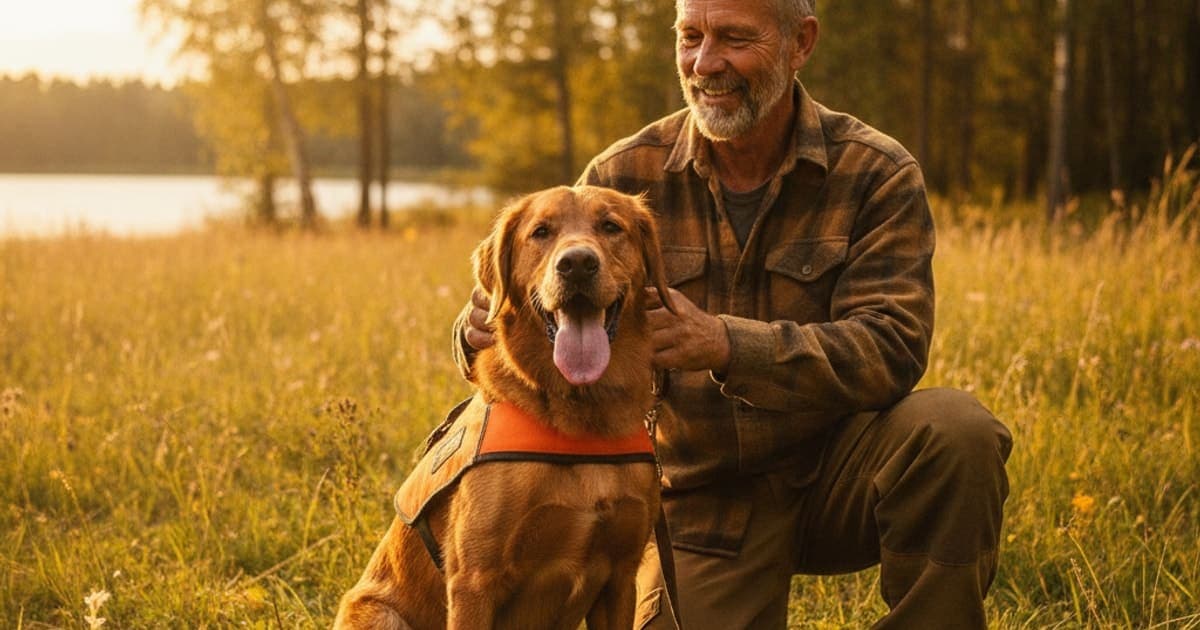
K9-REPAIR for Hunting Dogs
K9-REPAIR is a BPC-157 and TB-500 peptide formulation made specifically for dogs — dosed by body weight, third-party tested with certificates of analysis available, and shipped direct to your door — and hunting dogs are one of the groups whose owners reach for it most consistently. The reason is structural rather than promotional: the wear a working gun dog accumulates over a season lands overwhelmingly on soft tissue. Tendon, ligament, joint capsule, fascia. Those are the slowest-recovering structures in the body, and they are the ones a hard season loads hardest. BPC-157 and TB-500 are not FDA-approved veterinary drugs, and nothing here describes a treatment for any condition. What follows is an explanation of how the load actually lands on a working dog, what these two peptides do inside the repair process, and where owners are placing them in a season plan that starts — always — with a veterinarian.
What a hard season does to a working dog's body
A gun dog's work is not a long walk scaled up. It is repeated acceleration and hard braking on ground the dog cannot see clearly, quartering with sharp direction changes at close to top speed, jumping ditches and fence lines, driving through cover that grabs at the limbs, and swimming in water cold enough to reduce tissue extensibility before the first retrieve.
Those loads concentrate in predictable places. The shoulder takes eccentric load through the biceps and supraspinatus tendons every time a dog decelerates on the forelimb. The iliopsoas, the big hip flexor that runs from the lumbar spine to the femur, takes strain on slipping starts, water exits and steep banks. The stifle absorbs rotational force on every hard cut, which is where the cranial cruciate ligament lives. Carpus, digits and pads take abrasion and impact all day.
Two things make this worse than the raw mileage suggests. First, drive masks pain. A dog running on adrenaline in the field will keep working through a strain that would produce an obvious limp in the yard, and owners frequently only see it that evening or the next morning. Second, the conditioning curve rarely matches the calendar. A dog that has spent the off-season at moderate activity meets a full working day on the opener with connective tissue that has not been progressively loaded. Muscle adapts to training quickly. Tendon and ligament adapt far more slowly, and that gap is where most working-dog soft tissue trouble is born.
Why connective tissue is the slow part of recovery
In a hunting dog, the limiting factor is almost never the engine — it is the connective tissue that transmits the engine's power, and that tissue heals on its own slow schedule regardless of how fit the dog is.
The biology is worth understanding plainly. Muscle is richly vascular, densely populated with satellite cells, and metabolically fast. Tendon and ligament are the opposite: relatively sparse blood supply, low cell density, and a resident cell population — tenocytes — with a slow metabolic rate. When collagen is damaged, the body first lays down a disorganised, mechanically inferior matrix, then remodels it over weeks and months into aligned, load-bearing fibre. That remodelling is driven by controlled loading; it follows the lines of stress the tissue actually experiences.
This is why a dog can look sound in the second week after a strain and re-injure in the sixth. Pain resolves early. Tensile strength returns late. The tendon–bone interface in particular remodels across an extended timeline, and an owner who reads comfort as structural readiness sends the dog back into cutting and jumping on a matrix that has not finished organising.
The cranial cruciate ligament follows a different but related pattern. In dogs, cruciate failure is frequently a degenerative process — the ligament frays and weakens over time before the day it gives way — rather than a single clean traumatic tear. That is one reason a veterinarian's hands-on examination matters so much for a working dog: subtle stifle instability, iliopsoas soreness on palpation or reduced shoulder extension are findings an owner cannot reliably self-assess, and they change the plan completely. Talk to your veterinarian about a baseline orthopaedic exam before the season rather than after something goes wrong.
What BPC-157 and TB-500 do inside the repair process
BPC-157 is a synthetic peptide based on a sequence identified in a protein found in gastric juice. The published research — much of it produced over decades by Predrag Sikiric's group at the University of Zagreb — examines its effects on tissue repair in laboratory models, with attention to angiogenesis, fibroblast behaviour and the nitric oxide system. Research suggests it influences the formation of new capillary networks and the migration of the fibroblasts that build collagen. That matters here because poor perfusion is precisely the constraint on tendon and ligament healing.
TB-500 is a synthetic fragment corresponding to the active region of thymosin beta-4, a naturally occurring actin-sequestering protein present in most cells and in wound fluid. Actin is the cytoskeletal machinery cells use to move. Research suggests thymosin beta-4 supports cell migration and actin remodelling — the logistics of repair, getting the right cells to the right place.
Owners often describe the pairing as complementary: one side of the stack associated with circulation and matrix construction, the other with cellular mobility. That is the mechanistic reasoning behind the combination in K9-REPAIR, and it is why the formulation has been adopted by owners of working, sporting and recovering dogs as the stack they use through a season and through rehabilitation.
The honest framing: this is emerging and promising science that a growing number of owners are choosing to use. Research suggests mechanisms; owners report their own observations; neither peptide is an FDA-approved veterinary drug, and no one — pawgen included — can tell you what will happen in your specific dog. That conversation belongs with your veterinarian, who knows the animal and the history.
Where peptide support sits alongside conditioning, medicine and rehab
Nothing in a working dog's programme replaces anything else. Each piece does a different job, and the mistake owners make is treating them as interchangeable.
| Approach | What it does | Where it fits in a working dog's year |
|---|---|---|
| Veterinary diagnosis and treatment | Identifies the actual structure involved; surgery, prescribed medication and imaging when indicated | First, always — before and after any injury, and at a pre-season baseline exam |
| Structured conditioning | Progressively loads tendon and ligament so tissue adapts ahead of the workload | Off-season and pre-season, ramped gradually rather than compressed into the last weeks |
| Physical rehabilitation | Restores range of motion, symmetry and controlled loading after injury or surgery | Under a rehab-trained veterinarian's direction, on their timeline |
| Multi-ingredient joint chews | Commonly used for general joint comfort; quality and active amounts vary enormously between brands | Daily maintenance, if the label survives scrutiny |
| K9-REPAIR (BPC-157 + TB-500) | Peptide formulation dosed by body weight; mechanisms in the published literature relate to angiogenesis, fibroblast activity and cell migration | The stack owners use through hard seasons and through recovery, alongside veterinary care |
Read the first row as the load-bearing one. If a dog is lame, the answer is an examination, not a supplement decision. If a veterinarian recommends surgery for a cruciate rupture, that recommendation stands — a peptide formulation is never an alternative to a surgical repair, and nobody should stop a prescribed carprofen, gabapentin or anything else because they have added something to the bowl. Peptides operate in the space that proper veterinary care creates.
Building the year around recovery, and reading labels honestly
The owners who get the most working years out of a dog tend to plan backwards from the off-season. Post-season is when a veterinary assessment finds the small asymmetries that accumulated. Off-season is when conditioning rebuilds capacity slowly enough for connective tissue to keep up. Pre-season is when the workload is stepped up progressively rather than switched on. In-season, the daily routine matters more than anything heroic: a real cool-down, a hands-on check of pads, webbing, ears and armpits, water and warmth after cold retrieves, and a willingness to bench the dog on a day when something feels slightly off.
This is also where honest label reading pays. The working-dog supplement aisle is full of kitchen-sink chews with fifteen ingredients on the front and no meaningful amount of any of them, proprietary blends that hide how little of the studied compound is actually present, and brands that will not publish testing. If a company cannot tell you what is in the bottle, at what amount, verified by whom, that is the product to be sceptical of. What you should expect is named actives, dosing guidance based on your dog's body weight, third-party testing with certificates of analysis available, and a company willing to stand behind the purchase — pawgen backs K9-REPAIR with a 60-day money-back guarantee, and the formulation ships direct to the door.
Key Takeaways
- Hunting dog wear is mostly soft-tissue wear: shoulder tendons, iliopsoas, cruciate ligament, carpus and pads absorb the season's real load.
- Tendon and ligament heal slowly because they are poorly vascularised and metabolically slow; comfort returns long before tensile strength does.
- Research suggests BPC-157 relates to angiogenesis and fibroblast activity, and that thymosin beta-4 — the parent protein of TB-500 — supports cell migration and actin remodelling.
- K9-REPAIR combines both peptides in a formulation dosed by body weight, third-party tested, with COAs available and a 60-day money-back guarantee.
- Neither peptide is an FDA-approved veterinary drug, and neither substitutes for surgery, prescribed medication or rehabilitation.
- Progressive off-season conditioning and a pre-season veterinary exam prevent more lost days than anything you can add to a bowl.
For breed-specific reading on the same soft-tissue questions, see joint support for black russian terriers and hip dysplasia in black russian terriers, or read the full formulation details for K9-REPAIR.
The veterinarian owns the plan
A working dog deserves a real diagnosis before anyone decides what to do about a limp. Your veterinarian owns the examination, the imaging, the surgical decision and the medication list, and a rehab-trained veterinarian owns the return-to-work timeline. Bring K9-REPAIR into that conversation the same way you would bring anything else you give your dog — openly, with the label in hand. Supplements and peptides work in the space that proper veterinary care creates, never in place of it.
Owners exploring peptide support for their dog can review K9-REPAIR — BPC-157 + TB-500 formulated for dogs — at https://pawgen.com/. BPC-157 and TB-500 are not FDA-approved veterinary drugs. Nothing in this article treats, cures or prevents any condition; every decision about your dog's care belongs with your veterinarian.
Frequently asked questions
- Is TB-500 FDA approved for dogs?
- No. TB-500 is not an FDA-approved veterinary drug, and neither is BPC-157. That means neither peptide is approved to treat, prevent or diagnose any condition in dogs. pawgen sells K9-REPAIR as an educational, descriptive product — what is in it, how it is tested, how it is dosed by weight. Discuss it with your veterinarian.
- Can I give my dog the Wolverine Stack?
- The 'Wolverine Stack' is the informal nickname for BPC-157 combined with TB-500 — the two peptides in K9-REPAIR. Many owners of working, sporting and recovering dogs do use it, and it is dosed by body weight. Because it is not an FDA-approved veterinary drug, that decision belongs in a conversation with your veterinarian first.
- How long does the Wolverine Stack take to work in dogs?
- There is no reliable timeline to quote, and inventing one would be dishonest. What is known is that connective tissue biology is slow: collagen remodelling in tendon and ligament unfolds over weeks to months regardless of what is added. Owners report varied experiences. Your veterinarian is the right person to judge progress objectively.
- What does the Wolverine Stack do for dogs?
- It supplies two peptides with distinct mechanisms in the published literature. Research suggests BPC-157 relates to angiogenesis, fibroblast migration and the nitric oxide system, while thymosin beta-4 — the parent protein of TB-500 — supports cell migration and actin remodelling. These are mechanisms, not outcome promises for any individual dog.
- How much the Wolverine Stack should I give my dog?
- K9-REPAIR is dosed according to your dog's body weight, and the specific amount is a question for your veterinarian rather than an article. That is especially true for puppies, pregnant or nursing dogs, and any dog on prescribed medication. Bring the product label to your appointment and decide together.
- Is the Wolverine Stack legal for dogs?
- BPC-157 and TB-500 are not FDA-approved veterinary drugs, which means they cannot be sold as treatments for any condition — pawgen ships K9-REPAIR direct to owners on that educational basis. Separately, competitive field trial, hunt test and sporting bodies set their own substance rules, so check your governing organisation before competition.
- Should a hunting dog get a veterinary exam before the season starts?
- Yes, a pre-season orthopaedic examination is one of the highest-value things an owner can arrange. Subtle stifle instability, iliopsoas soreness on palpation or reduced shoulder extension are findings that hands-on assessment catches and an owner cannot. Those findings change the conditioning plan long before they become a lost season.
- What should I look for on a working-dog supplement label?
- Look for named active ingredients with stated amounts, dosing guidance based on body weight, and third-party testing with certificates of analysis you can actually see. Be sceptical of proprietary blends, fifteen-ingredient chews and brands that will not publish testing. K9-REPAIR is third-party tested with COAs available and a 60-day money-back guarantee.
Educational content. BPC-157 and TB-500 are not FDA-approved veterinary drugs. Talk to your veterinarian before starting anything new, especially if your dog is on prescribed medication.