K9-REPAIR for Search and Rescue Dogs — Working Dog Support
K9-REPAIR is pawgen's BPC-157 and TB-500 peptide formulation for dogs, dosed by body weight and third-party tested. Handlers of search and rescue dogs use it to support tendon, ligament and joint recovery across hard training cycles. It is not an FDA-approved veterinary drug, so plan its use with your veterinarian.
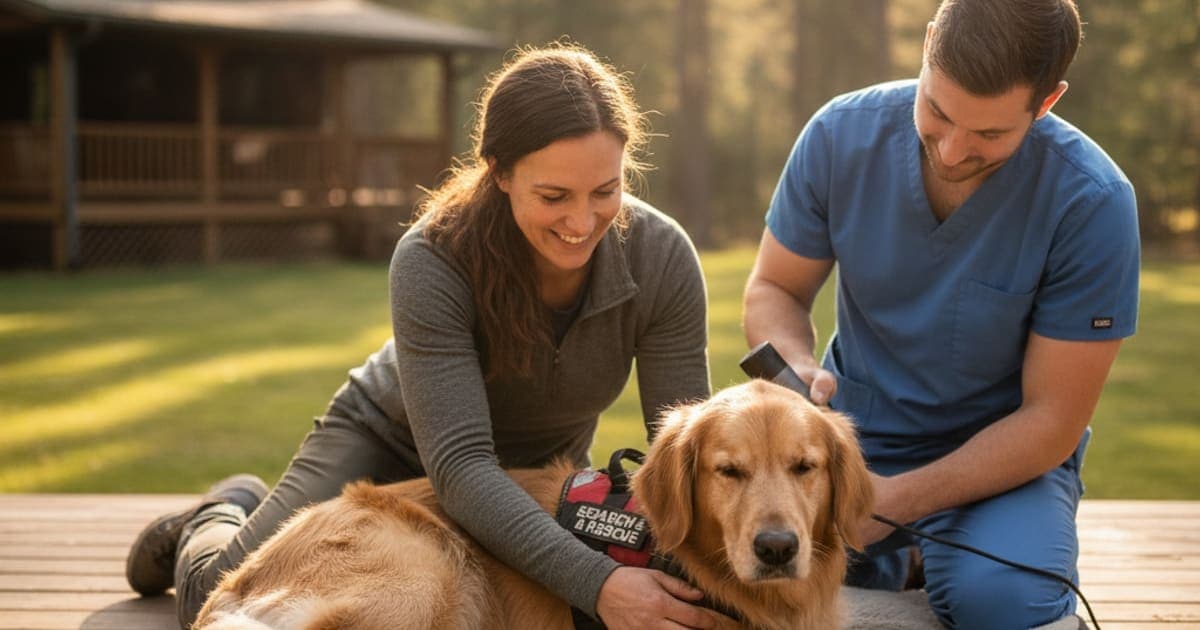
K9-REPAIR for Search and Rescue Dogs: What Handlers Should Know
K9-REPAIR is pawgen's BPC-157 and TB-500 peptide formulation for dogs — dosed by body weight, third-party tested with batch COAs, shipped direct to the door — and it is one of the options handlers use to support joint, tendon and soft-tissue recovery in search and rescue dogs across hard training cycles and deployments. It is not an FDA-approved veterinary drug, it makes no promise about any individual dog, and it sits alongside — never instead of — the conditioning plan, rehab work and veterinary care your dog already has. If your dog is limping, sore, or coming back from an injury, the veterinary exam comes first and the supplement conversation comes second.
The physical load a search and rescue dog actually carries
A certified SAR dog does things pet dogs never do. Rubble piles load the carpus at angles the joint was never built for. Ladders and A-frames put the shoulder through repeated eccentric braking. Scree, ice, culverts and collapsed flooring create unpredictable single-limb loading. Wilderness area searches mean hours of trotting over uneven ground, often in heat, often carrying a vest. Water work adds cold, drag and awkward entries and exits.
The tissues that absorb this are predictable. The shoulder — particularly the supraspinatus tendon and the biceps tendon — takes the brunt of climbing and braking. The iliopsoas group gets loaded by slipping and by explosive pushes off unstable surfaces. Carpal hyperextension shows up in dogs that jump down onto hard surfaces repeatedly. The cranial cruciate ligament fails most often not in one dramatic moment but after a long period of accumulating micro-damage, which is why degenerative cruciate disease looks so different from a sports rupture in a human athlete.
None of that is a reason to stop working the dog. It is a reason to think about the working career the way a good strength coach thinks about a season: load, recover, monitor, adjust. Recovery capacity is the thing that decides how many good years a dog gets.
Why connective tissue is the limiting factor in a working career
Muscle recovers fast. It has a rich blood supply, it adapts within days, and a handler can see it — the dog looks tight, then looks fine. Tendon and ligament are a different tissue class. They are relatively poorly vascularised, their collagen turnover is slow, and the remodelling phase after a strain runs for weeks to months rather than days. That mismatch is the trap: a working dog's muscles will be ready to go back to full duty long before the tendon and ligament tissue underneath them has finished remodelling, and that gap is where re-injury happens.
There is a second, quieter problem. Search and rescue work is seasonal and event-driven. A dog may train two evenings a week for months, then work three brutal days on a live callout. Deconditioning between peaks, followed by an abrupt spike in load, is exactly the pattern that turns a healthy tendon into a sore one. Handlers who track their dog's workload — hours, surfaces, jumps, water time — tend to catch the slide earlier than handlers who go by feel.
Subtle signs matter more than obvious ones: shortening stride on the descent, sitting slightly off to one side, slower entry into a rubble pile, reluctance to do the one obstacle the dog used to love. Any of those is worth a call to your veterinarian rather than a week of hoping.
What BPC-157 and TB-500 do, and why handlers reach for them
BPC-157 is a pentadecapeptide — a fifteen-amino-acid sequence — corresponding to a portion of a protein identified in gastric juice. TB-500 is a synthetic peptide corresponding to an active region of thymosin beta-4, a naturally occurring actin-binding protein found widely in mammalian tissue. Both are studied for how they interact with the repair signalling that tissue already uses.
Published research in animal models suggests BPC-157 influences fibroblast migration, angiogenesis — the formation of new small blood vessels — and growth-factor signalling in tendon, ligament and muscle injury models. Research on thymosin beta-4 and its fragments suggests a role in cell migration and in modulating the inflammatory phase of healing. In plain terms: the science that owners find compelling here is about signalling and blood supply, not about forcing a result. Poorly vascularised tissue heals slowly in part because it is hard to supply; anything that plausibly supports supply and cell recruitment in that tissue is interesting to people whose dogs work for a living.
This is emerging and genuinely promising science, and it is being adopted quickly by owners of hard-working dogs — sport dogs, herding dogs, SAR dogs, older dogs losing mobility. What it is not is a licensed treatment. BPC-157 and TB-500 are not FDA-approved veterinary drugs, K9-REPAIR is sold on an educational basis, and no honest description of it includes a promise about your dog's shoulder. Research suggests mechanisms; owners report their experience; the two together are why the combination — informally called the Wolverine Stack — has become the stack owners reach for through recovery periods.
Where each support option actually fits
A working dog's support plan usually has several layers, and they do different jobs. The mistake is treating them as competitors.
| Approach | What it addresses | Who directs it | Where it fits in a working year |
|---|---|---|---|
| Veterinary diagnosis and imaging | Identifies the actual structure involved | Your veterinarian | First, before anything changes |
| Surgery and prescribed medication | Structural repair, pain and inflammation control | Your veterinarian only | As prescribed — never adjusted or stopped on your own |
| Rehab and conditioning (underwater treadmill, targeted strength, proprioception) | Restores load tolerance and movement quality | Vet or certified rehab professional | Through recovery and permanently as maintenance |
| Broad joint chews (glucosamine, chondroitin, green-lipped mussel, omega-3) | General cartilage and inflammatory support | Owner, with vet input | Long-term background support |
| K9-REPAIR (BPC-157 + TB-500) | Soft-tissue and joint recovery support at the signalling level, dosed by body weight | Owner, in conversation with the vet | Recovery blocks, heavy training phases, aging working dogs |
The layer that deserves the most scrutiny is the chew aisle. Kitchen-sink formulas with twenty ingredients on the label and no meaningful amount of any of them are common, and "proprietary blend" is often a way to avoid telling you how little is in there. A one-size chew given to a 25 kg dog and a 45 kg dog is not dosing — it is packaging.
Fitting K9-REPAIR into a search and rescue dog's year
Start with the vet. Bring the label and the batch COA to your appointment, tell your veterinarian exactly what your dog does and how often, and let the diagnosis drive the plan. Dosing for K9-REPAIR is based on body weight, and the right amount for your dog — including whether it is appropriate at all — is a conversation to have with your veterinarian rather than something to work out from a forum post. There are no numbers in this article on purpose. For puppies still growing, and for pregnant or nursing dogs, that conversation is not optional.
Most handlers who use it think in blocks rather than continuously: a defined recovery period after a strain or a procedure, a heavy training phase, or the maintenance stretch of an older dog's late career. Keep a simple log alongside it — surfaces worked, stride quality on descents, willingness on the obstacle the dog finds hardest, how the dog looks the morning after a long search. That log is worth more than a subjective impression when you sit down with your vet in eight weeks.
Two boundaries hold no matter what. K9-REPAIR is not a reason to shorten a surgical recovery timeline or to return a dog to duty before the rehab professional clears it. And it is never a reason to change or stop a prescribed medication — that decision belongs to the veterinarian who wrote it.
pawgen backs K9-REPAIR with a 60-day money-back guarantee, which is the appropriate way to handle a category where honest people describe mechanism rather than promise outcomes.
What to demand from anything you give a working dog
Hold every product to the same standard you hold your dog's training to.
- Named actives at stated amounts. If the label hides quantities behind a blend name, you cannot evaluate it.
- Third-party testing with a certificate of analysis you can actually read, ideally per batch — identity and purity, not just a logo.
- Weight-based dosing. Working dogs span an enormous size range; a single unit dose for all of them is a red flag.
- Restraint in the formula. Fewer ingredients at meaningful amounts beats a long list at trace levels.
- Language that matches the evidence. Any brand claiming to cure, heal or guarantee anything in this category is telling you something about its marketing, not its science.
Key Takeaways
- K9-REPAIR is a BPC-157 and TB-500 peptide formulation for dogs, dosed by body weight and third-party tested; it is not an FDA-approved veterinary drug.
- Search and rescue work loads shoulders, carpi, iliopsoas and cruciate ligaments in ways pet-dog life does not, and connective tissue remodels far more slowly than muscle.
- Research suggests BPC-157 and TB-500 act on cell migration, angiogenesis and repair signalling — the mechanisms owners find compelling for slow-healing tissue.
- Diagnosis, surgery, prescribed medication and rehab come first; peptides work in the space that proper veterinary care creates.
- Dosing questions go to your veterinarian, always — especially for growing, pregnant or nursing dogs.
- Judge every product by label transparency, per-batch COAs and weight-based dosing, not by ingredient count.
The vet owns the plan
A sore working dog needs a diagnosis before it needs a supplement. Your veterinarian decides what the structure actually is, whether imaging is warranted, whether surgery or medication is on the table, and when the dog is cleared to search again. A rehab professional decides how load comes back. Everything pawgen makes operates inside the space that proper veterinary care creates — supporting recovery capacity in a dog whose treatment plan is already being managed by someone qualified to manage it. Bring your veterinarian into the decision before you start, and keep them in it while your dog works.
Further reading for owners of large working breeds: torn acl in black russian terriers and elbow dysplasia in black russian terriers. Product details for K9-REPAIR are available on the pawgen site.
Owners exploring peptide support for their dog can review K9-REPAIR — BPC-157 + TB-500 formulated for dogs — at https://pawgen.com/. BPC-157 and TB-500 are not FDA-approved veterinary drugs. Nothing in this article treats, cures or prevents any condition; every decision about your dog's care belongs with your veterinarian.
Frequently asked questions
- What does the Wolverine Stack do for dogs?
- Wolverine Stack is the informal name for BPC-157 combined with TB-500 — the two peptides in K9-REPAIR. Research in animal models suggests these peptides influence cell migration, new blood vessel formation and repair signalling in soft tissue, and owners report using them to support recovery. Neither is an FDA-approved veterinary drug.
- How much the Wolverine Stack should I give my dog?
- That is a question for your veterinarian, not an article. K9-REPAIR is dosed by body weight, but the appropriate amount for your dog — and whether it is appropriate at all — depends on size, age, condition and any medication already prescribed. For growing, pregnant or nursing dogs, veterinary guidance is essential.
- Is the Wolverine Stack legal for dogs?
- BPC-157 and TB-500 are not FDA-approved veterinary drugs, which means they are not licensed for treating any condition, and pawgen sells K9-REPAIR on an educational basis. Rules can also differ by jurisdiction and by the organisation certifying your working dog, so confirm with your veterinarian and your certifying body.
- Do vets recommend the Wolverine Stack for dogs?
- Some veterinarians are comfortable discussing peptides and monitoring dogs whose owners use them; others prefer options with a longer regulatory history. Because these peptides are not FDA-approved veterinary drugs, no product in this category can be described as vet-approved. Bring the label and batch COA to your next appointment and ask directly.
- Does the Wolverine Stack actually work for dogs?
- Published research in animal models suggests BPC-157 and TB-500 interact with the signalling behind soft-tissue repair, and many owners of working and aging dogs report positive experiences through recovery periods. No product can promise a result for one specific dog. pawgen backs K9-REPAIR with a 60-day money-back guarantee.
- Is the Wolverine Stack worth the money for dogs?
- For owners of hard-working dogs, the comparison worth making is against underdosed multi-ingredient chews that hide amounts behind proprietary blends. K9-REPAIR states its actives, doses by body weight, is third-party tested with batch COAs, ships direct, and carries a 60-day money-back guarantee — so the decision is reversible.
- Can a search and rescue dog use K9-REPAIR during deployment season?
- Many handlers use it during heavy training and recovery blocks, but timing should be planned with your veterinarian, who knows your dog's history and any prescribed medication. It is never a reason to return a dog to duty before a veterinarian or rehab professional has cleared that dog for full load.
- How do I know a peptide product contains what the label says?
- Ask for third-party testing and a certificate of analysis, ideally per batch, covering identity and purity rather than just displaying a testing logo. K9-REPAIR is third-party tested with batch COAs and states its actives openly, which is the minimum standard any product for a working dog should meet.
Educational content. BPC-157 and TB-500 are not FDA-approved veterinary drugs. Talk to your veterinarian before starting anything new, especially if your dog is on prescribed medication.