K9-REPAIR for Spay Recovery in Dogs: Does It Work?
K9-REPAIR is a BPC-157 and TB-500 peptide formulation that owners give alongside their veterinarian's post-spay plan, not instead of it. Research in animal models suggests these peptides may support the tissue-repair signalling a healing incision relies on. They are not FDA-approved veterinary drugs, so dosing belongs with your vet.
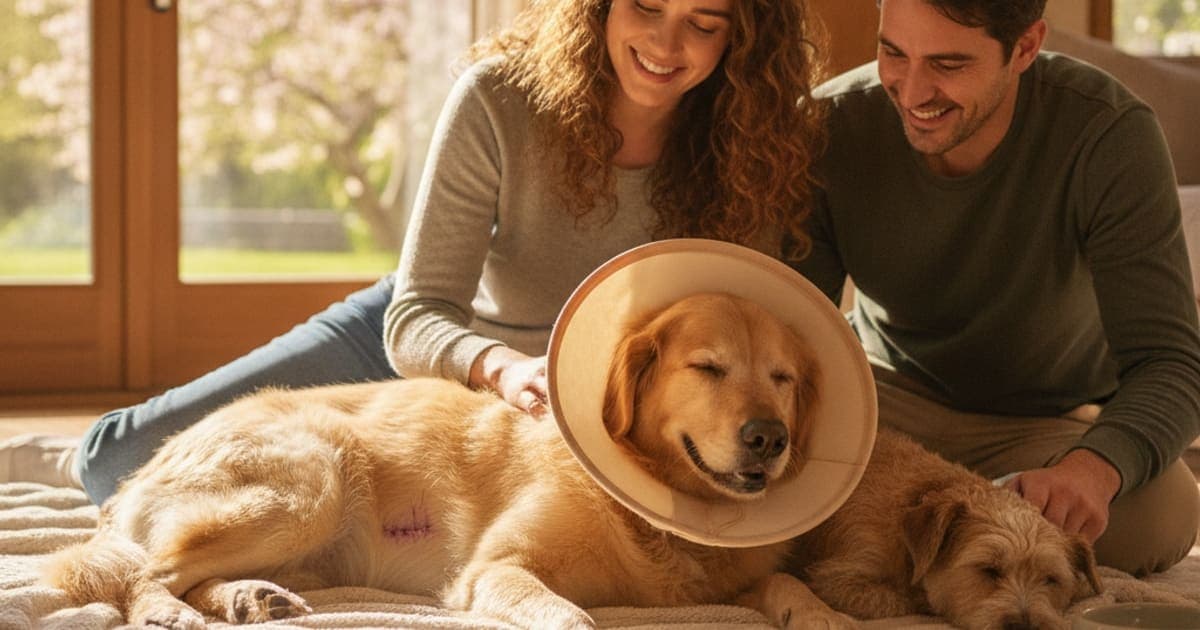
Does K9-REPAIR help a dog with spay recovery?
K9-REPAIR is a BPC-157 and TB-500 peptide formulation that owners use alongside — never instead of — the recovery plan their veterinarian sets after a spay. Research in animal models suggests both peptides may support the biological processes a healing surgical site depends on: new blood vessel formation, cell migration into the wound bed, and organised collagen deposition. Neither peptide is an FDA-approved veterinary drug, and nothing added to a food bowl treats or heals a surgical incision on its own. What follows is what actually happens inside a spayed dog over the weeks after surgery, and where a peptide stack fits into that picture.
What a spay actually asks the body to repair
A spay is abdominal surgery, and it is worth being precise about that, because the visible part is the least important part. In a traditional ovariohysterectomy the surgeon makes a midline incision through skin and subcutaneous tissue, then through the linea alba — the fibrous seam running down the middle of the belly where the abdominal muscles meet. The ovarian pedicles and the uterine body are ligated, the reproductive tract is removed, and the surgeon closes in layers: body wall first, then the subcutaneous layer, then skin with sutures, staples, or a buried intradermal pattern. An ovariectomy removes the ovaries only, and a laparoscopic spay works through small port incisions rather than one long one. Your veterinarian chooses the approach based on the dog, the anatomy, and the equipment available.
The layer that matters most for how you manage the next month is the body wall. Skin is fast tissue — it epithelialises quickly and looks convincingly closed long before it is strong. The linea alba is slow, load-bearing tissue, and it is the layer that has to hold when a dog jumps off the couch.
Repair itself moves through overlapping phases. Bleeding stops and an initial clot forms. Inflammatory cells arrive to clear debris and signal for reinforcements. Then the proliferative phase brings fibroblasts and new capillaries into the wound bed, laying down a provisional matrix. Finally the remodelling phase gradually replaces disorganised early collagen with denser, better-aligned fibres. That last phase is the long one: a closed incision has only a fraction of the tensile strength of intact tissue at the point sutures come out, and it keeps gaining strength quietly for weeks afterward.
The first two weeks: the part you actually control
Nothing you add to a recovery plan replaces the two things that decide how a spay incision heals — your veterinarian's surgical technique and your discipline about activity restriction.
Most of what goes wrong after a routine spay goes wrong because of motion or licking, not because of the surgery. A dog who sprints, jumps, twists, or wrestles in the first weeks shears the healing layers against each other. That mechanical disruption is what produces seromas — pockets of fluid under the skin — and, in the worst case, dehiscence, where the closure opens.
So the boring instructions are the effective ones:
- Keep the e-collar or recovery suit on continuously, including overnight. A dog can undo a closure with a few minutes of unsupervised licking, and saliva carries bacteria straight into the wound.
- Leash walks only, for elimination, until your veterinarian clears more. No stairs if you can avoid them, no furniture, no dog park, no off-lead running, no tug or wrestling with another dog in the house.
- Look at the incision twice a day in good light. Mild swelling, a thin line of bruising, and pink edges are ordinary. Growing swelling, heat, gaping, discharge, a foul smell, or a wound that looks worse today than yesterday are not.
- Give prescribed pain medication exactly as directed, for the full course. A comfortable dog rests; an uncomfortable dog paces and licks. Never stop, skip, or halve a prescription because your dog looks fine — that decision belongs to your veterinarian.
- Skip baths, swimming, and wet grass until the incision is fully closed and your clinic says otherwise.
Call the clinic promptly for lethargy that deepens instead of lifting, refusal to eat beyond the first day, repeated vomiting, pale gums, a distended or painful abdomen, or any bleeding from the site. These are the signs that need a professional set of eyes the same day, not a supplement.
What BPC-157 and TB-500 do, and why owners add them
BPC-157 is a synthetic peptide based on a sequence identified in a protein found in gastric juice. Preclinical research — largely in rodent models of tendon, ligament, muscle, and gut injury — suggests it interacts with pathways involved in angiogenesis, including VEGF-related signalling, and with fibroblast behaviour during repair. In plain terms, the research interest is in whether it helps the body build the blood supply and the connective tissue scaffolding that a wound bed needs. Blood supply matters enormously after abdominal surgery: oxygen and nutrients reach a healing layer through new capillaries, and collagen synthesis is oxygen-dependent.
TB-500 is a synthetic peptide related to thymosin beta-4, a naturally occurring actin-binding protein found in platelets and in wound fluid. Actin is the cytoskeletal protein cells use to change shape and crawl. Research suggests thymosin beta-4 plays a role in cell migration, in the recruitment of repair cells into damaged tissue, and in modulating the inflammatory phase so it resolves rather than lingers. That is a different lever from the vascular side — which is exactly why owners run the two together rather than choosing one.
That pairing is the whole design of K9-REPAIR: BPC-157 and TB-500 in one weight-based formulation, the stack owners reach for through post-surgical and soft-tissue recovery. The science here is emerging and genuinely promising, and it is being adopted by owners who want to support the repair window rather than just wait it out. Honest framing matters, though: most published work is preclinical, these peptides are not FDA-approved veterinary drugs, and no one can promise a specific result for your specific dog. Talk to your veterinarian before adding anything to a post-operative plan, and let them set the amount based on your dog's weight, age, and what else she is taking. Dosing is a veterinary conversation, not a number you should take from a blog post — and for puppies, pregnant dogs, or nursing dogs, that conversation is mandatory before anything is given.
How the pieces of a recovery plan compare
| Approach | What it does | Where it fits |
|---|---|---|
| Activity restriction and e-collar | Prevents mechanical disruption and self-trauma to the closure | Non-negotiable foundation; nothing else works without it |
| Prescribed analgesia | Controls surgical pain so the dog rests and inflammation is managed | Vet-directed; follow the full course exactly |
| Adequate protein and calories | Supplies the amino acids collagen synthesis draws on | Baseline nutrition; discuss changes with your vet |
| Multi-ingredient joint chews | Usually built around glucosamine, chondroitin, and cartilage support | Aimed at joints, not surgical soft-tissue repair; often thinly dosed |
| K9-REPAIR (BPC-157 + TB-500) | Targets the repair signalling itself — vascular support and cell migration | Layered on top of veterinary care during the recovery window |
The table is not a ranking. It is a map of what each thing is actually for. Rest and pain control are load-bearing. Nutrition is the raw material. A peptide stack is aimed at the signalling layer — the part of repair that decides how efficiently the raw material gets used.
How to read a recovery supplement label without getting played
The supplement aisle deserves your scepticism. A few things worth checking on anything you buy for a recovering dog:
Proprietary blends. If a label lists fifteen ingredients under one blend weight, you cannot tell how much of anything is in there. That structure exists to hide low inclusion rates behind an impressive ingredient list.
Borrowed vocabulary. Plenty of products put the word peptide on the front of a collagen chew. Collagen peptides are hydrolysed protein fragments — a fine ingredient, an entirely different thing from BPC-157 or TB-500. Read the actual ingredient panel, not the front of the bag.
No third-party testing. Ask whether the company publishes certificates of analysis from an independent lab confirming identity and purity. If a brand cannot produce a COA, you are trusting a marketing department.
Flat dosing. A product that gives the same amount to a terrier and a mastiff has not been designed around the animal.
pawgen built K9-REPAIR against exactly those failure modes: two named peptides rather than a kitchen-sink blend, dosing scaled to body weight, third-party testing with certificates of analysis, shipping direct to the door, and a 60-day money-back guarantee if it is not right for your household. Those are descriptive facts about the product — what is in it and how it is made and sold — not promises about your dog's incision.
Key Takeaways
- A spay heals in layers, and the body wall — not the skin you can see — is the slow, load-bearing one. Activity restriction outlasts the visible healing for good reason.
- Most post-spay complications trace back to motion or licking. The e-collar and the leash-only rule do more work than any product on the market.
- Research in animal models suggests BPC-157 may support angiogenesis-related signalling and fibroblast activity, and that TB-500, related to thymosin beta-4, may support cell migration and the resolution of inflammation.
- K9-REPAIR combines both peptides in a weight-based, third-party-tested formulation with published COAs and a 60-day money-back guarantee.
- BPC-157 and TB-500 are not FDA-approved veterinary drugs. Dosing decisions, and anything involving puppies or pregnant or nursing dogs, belong with your veterinarian.
- Growing swelling, discharge, gaping, foul odour, deepening lethargy, or a painful abdomen warrant a same-day call to your clinic.
Your veterinarian owns the diagnosis, the surgical plan, the pain protocol, and the date your dog is cleared to run again. Nothing here changes any of that, and nothing should replace a prescription or a recheck appointment. Supplements and peptides operate in the space that proper veterinary care creates — they support a body that a surgeon has already set up to heal, under a recovery plan you follow closely.
For more on the wider picture, see the complete guide to spay recovery, the individual breakdowns of bpc-157 for spay recovery in dogs and tb-500 for spay recovery in dogs, and how owners run the wolverine stack for spay recovery in dogs. Related soft-tissue reading includes the best treatment for hygroma in dogs and what to give a dog with hygroma, plus the formulation page for K9-REPAIR.
Owners exploring peptide support for their dog can review K9-REPAIR — BPC-157 + TB-500 formulated for dogs — at https://pawgen.com/. BPC-157 and TB-500 are not FDA-approved veterinary drugs. Nothing in this article treats, cures or prevents any condition; every decision about your dog's care belongs with your veterinarian.
Frequently asked questions
- Is spay recovery in dogs painful?
- Yes — a spay is abdominal surgery and involves real post-operative pain, which is why veterinarians send dogs home with prescribed analgesia. Pain is usually most noticeable in the first few days and eases as inflammation settles. Give the full prescribed course and call your clinic if your dog seems uncomfortable despite it.
- What makes spay recovery worse in dogs?
- Motion and licking, overwhelmingly. Jumping, stairs, running, and rough play shear the healing layers and can cause seromas or wound breakdown, while licking drives bacteria into the incision. Skipped pain medication, a removed e-collar, baths or swimming too early, and undetected infection all extend recovery. Restriction is the single biggest variable you control.
- Can spay recovery in dogs be reversed?
- The spay itself is permanent and cannot be reversed — the ovaries, and usually the uterus, are removed. Recovery complications, however, are often manageable: seromas, infections, suture reactions, and wound breakdown can frequently be resolved with prompt veterinary treatment. Contact your clinic early rather than waiting to see whether a problem settles.
- How much does it cost to treat spay recovery in dogs?
- Costs vary widely by clinic, region, dog size, and whether the surgery is done at a full-service hospital, a specialist, or a low-cost clinic. Routine recovery is usually included in the surgical fee. Complications requiring rechecks, antibiotics, or a second procedure add cost — ask your clinic what the quote covers.
- What helps a dog with spay recovery?
- Strict activity restriction, continuous e-collar or recovery suit use, the full course of prescribed pain medication, twice-daily incision checks, and adequate protein and calories. Some owners also add peptide support such as K9-REPAIR, a BPC-157 and TB-500 formulation, alongside veterinary care. Discuss any addition with your veterinarian first.
- How long does spay recovery take to heal in dogs?
- Your veterinarian sets the timeline, and most restrict activity until the incision is rechecked — commonly around the two-week mark. Skin closes first; the abdominal wall keeps gaining tensile strength for weeks afterward. That is why clearance for running and jumping usually comes later than the incision looks healed.
- Can I give K9-REPAIR while my dog is on post-operative pain medication?
- Ask your veterinarian before combining anything with a prescription. Never stop, reduce, or substitute prescribed analgesia in favour of a supplement. Your vet knows what your dog received under anaesthesia, what she is on now, and whether adding a peptide formulation makes sense for her specific case and timeline.
- Is K9-REPAIR appropriate for a puppy being spayed?
- That decision belongs with your veterinarian. Juvenile dogs, and pregnant or nursing dogs, are situations where no amount should be given without professional guidance. BPC-157 and TB-500 are not FDA-approved veterinary drugs, so your vet should weigh the dog's age, weight, and surgical circumstances before anything is added.
Educational content. BPC-157 and TB-500 are not FDA-approved veterinary drugs. Talk to your veterinarian before starting anything new, especially if your dog is on prescribed medication.