K9-REPAIR: How Much BAC Water? (Reconstitution Basics)
The correct amount of bacteriostatic water for K9-REPAIR is the volume printed in the reconstitution instructions that ship with your vial, because that number sets the concentration your dosing guidance assumes. pawgen does not publish reconstitution figures in educational content; confirm the volume with your veterinarian before you mix anything.
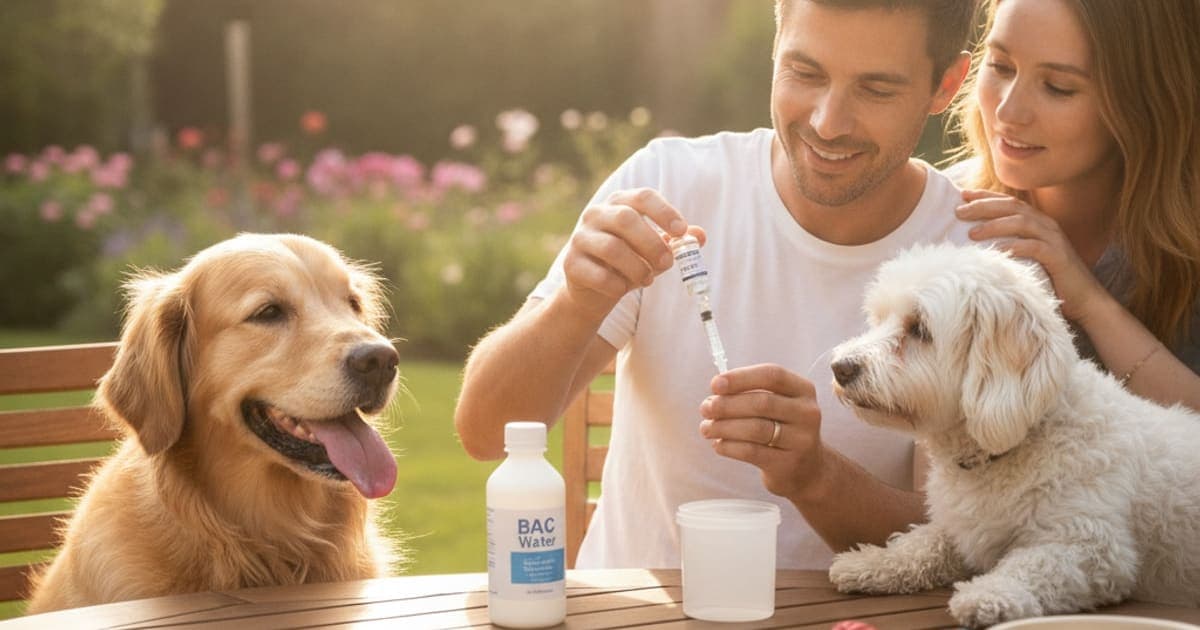
The amount of bacteriostatic water you add to a K9-REPAIR vial is the amount specified in the reconstitution instructions that ship with your kit — not a number you should carry over from a forum post, a bodybuilding thread, or a different brand's vial. That volume exists for one reason: it fixes the concentration of the finished solution, and the weight-based guidance you follow afterward assumes that exact concentration. pawgen does not publish reconstitution or dosing figures in educational articles, and no article should be the thing standing between you and your veterinarian on this. Read the documentation supplied with your order, and confirm the plan with the vet who knows your dog.
What this article can do is explain the part nobody explains well: what bacteriostatic water actually is, why lyophilized peptides need it, why the volume changes the meaning of every mark on your syringe, and how to handle the vial so the product you paid for stays intact.
What bacteriostatic water is, and why peptide vials use it
Bacteriostatic water — usually shortened to BAC water — is sterile water that contains a small amount of benzyl alcohol as a preservative. The preservative does not sterilize anything. It suppresses the growth of bacteria that might be introduced when a needle passes through the rubber stopper, which is what makes a vial suitable for more than one withdrawal.
That single property is the whole reason it exists in peptide work. Plain sterile water for injection has no preservative, so once the seal is breached it is treated as a single-use container. A multi-dose peptide vial that will be accessed repeatedly over a recovery period needs the bacteriostatic version.
Peptides such as BPC-157 and TB-500 are shipped freeze-dried — a lyophilized cake or powder sitting at the bottom of a sealed vial. In that dry state they are stable and easy to ship. They are also completely inert until they are dissolved. BAC water is the vehicle that turns the powder back into a solution that can be measured accurately.
Why the volume is a variable, not a constant
Here is the concept that resolves most of the confusion. A vial contains a fixed quantity of peptide. That quantity does not change no matter what you do next. What the water changes is how spread out that peptide is.
Add less water and the solution is denser, so a small movement on the syringe plunger carries more peptide. Add more water and the solution is thinner, so the same movement carries less. The peptide in the vial is identical in both cases — the arithmetic on the syringe is not.
There is no universal answer to how much BAC water a peptide vial takes, because the correct volume is the one your product's instructions specify — it is what makes the measurement marks on your syringe mean what the dosing guidance says they mean.
This is also why copying a number from a human peptide forum is a genuinely bad idea for a dog. Human protocols are built around human vial sizes and human body weights. K9-REPAIR is formulated for dogs and its guidance is weight-based, which is exactly the variable that gets destroyed when someone mixes to an arbitrary volume and then measures against instructions written for a different one. If any part of the arithmetic feels uncertain, stop and ask your veterinarian to walk through it with you.
Choosing the right diluent
Not every clear liquid in a vial is interchangeable. The differences matter more than they look.
| Fluid | What it is | Role in peptide reconstitution | Notes |
|---|---|---|---|
| Bacteriostatic water | Sterile water with benzyl alcohol preservative | The standard diluent for multi-dose peptide vials | Preservative allows repeated stopper entry; the usual choice when a vial will be used over time |
| Sterile water for injection | Sterile water, no preservative | Sometimes specified for single-use preparations | No preservative, so it offers no protection against contamination after the seal is breached |
| Sterile saline (sodium chloride) | Sterile salt solution | Used in some clinical dilutions | Compatibility depends on the specific compound; not a default substitute |
| Distilled, filtered or tap water | Non-sterile household water | No role whatsoever | Not sterile, not injectable, and never appropriate for a vial |
If your kit specifies bacteriostatic water, use bacteriostatic water. Substituting a diluent because it was the one in the drawer is the kind of shortcut that changes an unknown quantity of the outcome, and there is no reason to accept that when the correct fluid is inexpensive and widely available.
Reconstituting a vial without wrecking it
Peptides are chains of amino acids. They are more delicate than the average liquid supplement, and the main way owners damage them is mechanical — force, heat, and agitation. The technique below is about protecting the molecule. Every volume decision in it belongs to your kit instructions and your veterinarian, not to this page.
- Set up a clean surface. Wash your hands. Lay out the peptide vial, the bacteriostatic water vial, an appropriately sized syringe, and alcohol swabs.
- Let the vial come to room temperature. Reconstituting a cold vial straight from the fridge invites condensation and rushed handling.
- Swab both stoppers. Wipe the rubber top of the BAC water vial and the peptide vial with alcohol and let them air dry. Do not pry off the rubber stopper — the needle goes through it.
- Draw the specified volume of BAC water. The volume is whatever your product documentation states. Draw it slowly and check the syringe at eye level.
- Aim the stream at the glass wall. Insert the needle at an angle and let the water run down the inside of the vial rather than blasting directly into the peptide cake. This is the single most protective habit in the whole process.
- Let it dissolve on its own. Most freeze-dried peptide dissolves within a minute or two with no help. If anything remains, roll the vial gently between your palms.
- Never shake the vial. Shaking introduces shear force and foaming, both of which can degrade peptide chains. Swirl; do not agitate.
- Inspect the solution. It should be clear and free of particulate. Cloudiness, floating material or discolouration means the vial should not be used — contact the supplier instead of proceeding.
- Label and date it. Write the reconstitution date on the vial. You will not remember it a week later, and the storage window depends on it.
If a step feels beyond what you are comfortable doing at home, that is a completely reasonable place to ask for help. Many vets and vet techs will happily demonstrate handling technique once, and one demonstration usually settles it permanently.
Storing a reconstituted vial
Dry, unopened vials are the stable form. Once BAC water goes in, the clock starts.
Reconstituted peptide solution is refrigerated, kept away from light, and kept upright. It should not sit on a counter, ride around in a car, or live in the fridge door where the temperature swings every time someone reaches for milk. Repeated freezing and thawing is generally avoided for a solution that is in active use, because each cycle is another opportunity for degradation.
For how long a reconstituted vial remains suitable, follow the storage window given in your product documentation rather than a general rule of thumb from the internet — that window is specific to the formulation and the preservative in it. And keep the vial where a curious dog or a helpful child cannot reach it.
What is in K9-REPAIR, and why owners use it through recovery
K9-REPAIR is a BPC-157 and TB-500 formulation made for dogs. Those two peptides are paired because their described mechanisms are complementary. Research on BPC-157 has focused largely on angiogenesis — the formation of new blood vessels — and on the behaviour of tendon and ligament fibroblasts, the cells that lay down structural collagen. TB-500 is a synthetic fragment related to thymosin beta-4, a naturally occurring protein studied for its role in actin regulation and cell migration, the process by which repair cells reach the place they are needed.
Neither BPC-157 nor TB-500 is an FDA-approved veterinary drug, and nothing here should be read as a promise about your dog. What research suggests is a plausible mechanism for supporting the body's own repair environment, and what owners report is that they reach for the pairing during the slow, frustrating middle stretch of a recovery — the weeks after a CCL repair, or the long conditioning period for an older dog whose gait has changed.
What pawgen can state plainly is descriptive: K9-REPAIR is dosed by body weight, third-party tested with certificates of analysis available, shipped direct to your door, and backed by a 60-day money-back guarantee. Those are facts about the product, not claims about your dog's outcome.
Where skepticism genuinely belongs is the shelf of kitchen-sink joint chews carrying a dozen ingredients at doses too small to matter, sold by brands that publish a marketing page and no analysis. Ask any brand for a COA. If it does not exist, that tells you everything.
Key Takeaways
- The correct BAC water volume for K9-REPAIR is the volume in your kit's reconstitution instructions — it sets the concentration your dosing guidance assumes.
- Bacteriostatic water is sterile water with a preservative that allows repeated entry into a multi-dose vial; plain sterile water and household water are not substitutes.
- More water does not mean more peptide. It means a thinner solution and different syringe arithmetic.
- Aim the water at the glass wall, swirl gently, and never shake a peptide vial.
- Refrigerate the reconstituted vial, keep it out of light, label it with the date, and follow the storage window in your documentation.
- Human peptide forum numbers do not transfer to dogs. Weight-based canine guidance and your veterinarian do.
If you are new to this pairing, the first time the wolverine stack guide for dogs covers what to expect at the start, and how to use bpc-157 and tb-500 together for dogs goes deeper on why the two peptides are used as a pair.
One last thing, and it is the most important. Your veterinarian owns the diagnosis and the treatment plan. Imaging, surgery, prescribed medication and a structured rehab programme are the load-bearing parts of any orthopaedic recovery, and nothing in this article is a reason to delay, decline or discontinue any of them. Peptides operate in the space that proper veterinary care creates — alongside the plan, never instead of it. Bring your K9-REPAIR documentation to your next appointment and go through it together.
Owners exploring peptide support for their dog can review K9-REPAIR — BPC-157 + TB-500 formulated for dogs — at https://pawgen.com/. BPC-157 and TB-500 are not FDA-approved veterinary drugs. Nothing in this article treats, cures or prevents any condition; every decision about your dog's care belongs with your veterinarian.
Frequently asked questions
- Why is my dog uneven gait?
- An uneven gait usually means your dog is unloading one limb because something hurts or does not move properly. Common causes include cruciate ligament injury, hip or elbow dysplasia, arthritis, a soft tissue strain, a paw injury, or spinal issues. Only a veterinary exam, often with imaging, can identify which one applies.
- Should I worry if my dog is uneven gait?
- Yes, an uneven gait is worth taking seriously, though it is rarely a crisis. Dogs hide pain well, so a visible change in how your dog moves usually means the underlying issue has been present for a while. Book a veterinary exam rather than waiting to see whether it resolves on its own.
- When should I take a dog to the vet for uneven gait?
- Book an appointment if the gait change persists beyond a day or two, recurs after rest, or comes with swelling, heat, yelping or reluctance to use a limb. Go immediately for a non-weight-bearing limb, a suspected fracture, sudden hind-end weakness, or any gait change following a fall or car impact.
- What can I give a dog that is uneven gait?
- Start with a veterinary diagnosis rather than a product, because pain relief that masks a torn ligament can make the injury worse. Once your vet has a plan, owners commonly add rest, controlled leash walking, weight management and joint support. K9-REPAIR is the BPC-157 and TB-500 stack many owners use through recovery.
- Is a dog uneven gait an emergency?
- Usually not, but sometimes yes. Treat it as an emergency if your dog cannot bear weight at all, drags a limb, shows sudden hind-limb weakness or paralysis, has an obviously deformed leg, or is in visible distress. A mild intermittent limp warrants a prompt appointment rather than an emergency visit.
- Why is my dog head bobbing while walking?
- Head bobbing while walking is classic forelimb lameness. The head lifts as the sore front leg touches down and drops onto the sound leg, shifting weight away from pain. It points to a front limb or shoulder problem rather than a hind limb one. Have your veterinarian examine both front legs.
- Can I use sterile water instead of bacteriostatic water?
- Not unless your product documentation specifies it. Sterile water for injection contains no preservative, so it offers no protection once the stopper has been entered, which makes it unsuitable for a vial you will access more than once. Use the diluent your K9-REPAIR instructions name, and confirm with your veterinarian.
- Does adding more BAC water make the dose weaker?
- It makes the solution more dilute, not the vial less potent. The peptide quantity in the vial never changes. More water spreads the same peptide across more liquid, so each mark on the syringe carries less. That is exactly why the specified reconstitution volume must be followed precisely.
- How should I store a reconstituted K9-REPAIR vial?
- Refrigerate it upright, away from light, and out of the fridge door where temperatures fluctuate. Label the vial with the reconstitution date and follow the storage window in your product documentation rather than a general internet estimate. Avoid repeated freeze-thaw cycles, and keep the vial out of reach of pets and children.
Educational content. BPC-157 and TB-500 are not FDA-approved veterinary drugs. Talk to your veterinarian before starting anything new, especially if your dog is on prescribed medication.