K9-REPAIR: How Do You Inject It? (Administration Basics)
K9-REPAIR is administered as a subcutaneous injection into the loose skin over the shoulder blades, using a fine insulin-style syringe. Owners clean the site, tent the skin, insert the needle at a shallow angle and inject slowly. The amount and the frequency belong to your veterinarian, never to a guess.
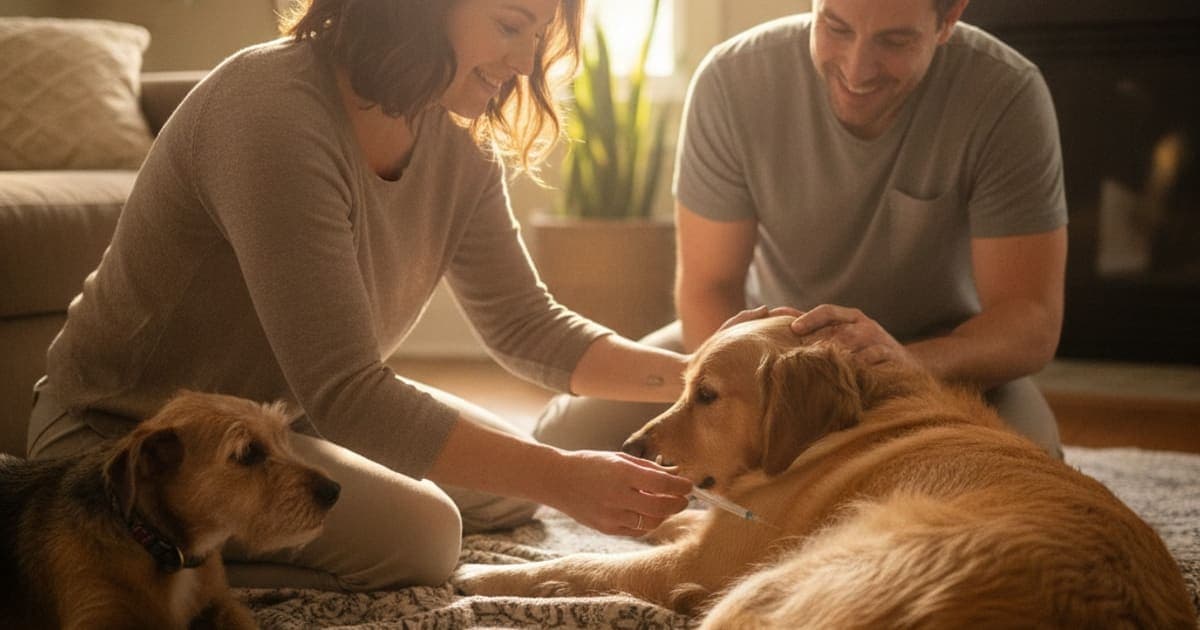
K9-REPAIR is given as a subcutaneous injection — a small volume placed into the loose layer of tissue just beneath the skin, most commonly over the shoulder blades — using a fine, insulin-style syringe. The mechanics are simple: clean hands, clean site, tent the skin, insert the needle at a shallow angle into the tented space, inject slowly, withdraw, reward the dog. What this article will not do is give you a number. The volume, the frequency and whether injectable administration suits your dog at all are decisions your veterinarian makes with your dog's weight, age, medications and diagnosis in front of them.
What a subcutaneous injection actually is, and why owners use this route
Dogs carry a genuinely loose layer of connective tissue between the skin and the muscle beneath it — the reason you can lift a fold of skin at the scruff of almost any dog and it stretches away from the body. That space is the subcutaneous compartment. It is richly enough supplied with small blood vessels to absorb fluid steadily, and it has far fewer pain-sensitive nerve endings than muscle, which is why most dogs tolerate a subcutaneous injection with barely a reaction. Vets use this same route routinely for fluids and for many injectable products.
The reason peptides are given this way comes down to chemistry. BPC-157 is a synthetic peptide based on a sequence identified in gastric juice; TB-500 is a synthetic fragment related to thymosin beta-4, a naturally occurring protein involved in actin regulation and cell migration in healing tissue. Peptides are short chains of amino acids, and the digestive tract exists specifically to break chains of amino acids apart. Research on both compounds has largely been conducted using injected administration, and that is the route owners have adopted. It is also why a peptide is a fundamentally different proposition from a scoop of powder in a bowl — the delivery method is part of the science, not a detail bolted onto it.
K9-REPAIR pairs both peptides in a single formulation for exactly this reason: research suggests BPC-157 and TB-500 act on different parts of the tissue-repair picture, and owners working through a recovery period use them together rather than choosing between them.
Setting up: supplies, hygiene and handling
Get everything on a clean, flat surface before you bring the dog into the room. Fumbling for an alcohol swab with a dog half-restrained is how sessions go badly.
You will typically want: your vial of K9-REPAIR, a fresh sterile syringe with an appropriately fine needle, alcohol swabs, a rigid sharps container, and a high-value treat within arm's reach. Wash your hands first. Swab the vial's rubber stopper and let it dry rather than wiping it. Use a new needle every single time — needles dull on first use, and a dull needle is the difference between a dog who ignores the injection and a dog who starts dreading the sight of you.
Draw the amount your veterinarian has specified, hold the syringe upright and flick out any air bubbles. Never reuse a syringe, never share one between dogs, and dispose of used sharps in a proper container according to your local rules rather than a household bin.
Storage matters more with peptides than with most things in your cupboard. Follow the storage guidance printed on your K9-REPAIR label exactly — peptide formulations are generally sensitive to heat, repeated temperature swings and light, and a vial left on a sunny windowsill or in a car is a vial you should not use. Check the solution before every session: it should look the way it looked when you opened it. If it has changed in appearance, stop and ask.
This is also where product quality stops being an abstraction. A subcutaneous injection places a compound directly into your dog's tissue, which means you should know what is in the vial and who verified it. Third-party testing and a certificate of analysis are the baseline, and pawgen publishes COAs for K9-REPAIR for that reason. It is a fair question to ask of anything you inject — and a question the crowded shelf of kitchen-sink joint chews, with their proprietary blends and unlisted quantities, generally cannot answer.
The injection, step by step
The technique is straightforward and most owners learn it in a single sitting with their vet, but the amount and the schedule are your veterinarian's call — never your own estimate from a forum.
- Settle the dog first. A dog standing calmly or lying on their side is easier than a dog being wrestled. Many owners do this on the floor, one hand free, with a second person offering a treat or a lick mat.
- Find the loose skin. Over the shoulder blades, part the coat with your fingers so you can see skin rather than guessing through fur.
- Swab the site and let the alcohol dry.
- Tent the skin. Pinch a fold between thumb and fingers and lift it away from the body. This creates a clear pocket and moves the underlying muscle out of the path of the needle.
- Insert at a shallow angle, bevel up, into the base of the tent — parallel to the body wall, not pointed down into it. The needle should slide in easily. Resistance means you are in the wrong plane.
- Check as your vet taught you. Some vets ask owners to draw back briefly before injecting; some do not consider it necessary for subcutaneous administration. Follow the instruction you were given in person.
- Inject slowly and steadily. A slow push is more comfortable than a fast one.
- Withdraw smoothly, release the skin fold, and apply light pressure with a clean finger for a moment.
- Reward immediately. Every session should end with something the dog likes. Dogs remember the last thing that happened.
Alternate sites between sessions rather than returning to the same square inch. Repeated administration in one spot is what causes tenderness over time, and rotation costs you nothing.
Choosing an injection site
Most owners settle on one or two spots and rotate between them. Here is how the common options compare.
| Site | Why owners use it | What to watch for |
|---|---|---|
| Scruff / between the shoulder blades | Loosest skin on most dogs, easiest to tent one-handed, hardest for the dog to reach afterwards | Very thick-coated dogs make skin hard to see; part the fur properly |
| Lateral chest wall, behind the elbow | Good option on lean or heavily muscled dogs with a tight scruff | Thinner tissue layer — tent carefully and stay parallel to the body wall |
| Flank, over the side of the abdomen | Plenty of loose skin on many dogs; convenient when the dog is lying down | Some dogs are more body-sensitive here; go slowly the first few times |
| Along the back, either side of the spine | Useful as a rotation point to spread sessions out | Skin can be tighter here; never inject directly over the spine itself |
If your dog has a surgical incision, a rash, a scab, a lump or any area your vet is monitoring, do not use that region. Ask which sites are appropriate for your dog specifically — a post-operative dog, a very small dog and a heavily coated large breed do not all get the same answer.
What if it doesn't go smoothly
My dog flinched or yelped
A sharp reaction usually means a dull needle, an angle that went too deep, alcohol that had not dried, or a fast push. Stop, reassess your technique, and use a fresh needle next session. A dog who repeatedly reacts strongly is telling you something worth mentioning to your vet.
I saw a drop of liquid on the fur
A small amount of leakage at the site happens occasionally, usually from withdrawing too quickly or from an injection placed too shallowly. Do not try to make it up by injecting again. Note it, mention it to your vet, and carry on next session.
There is a small soft lump where I injected
A temporary soft swelling at the site is a normal consequence of putting fluid under the skin, and it typically settles as the fluid absorbs. A lump that is hot, hard, painful, growing, or accompanied by a dog who seems unwell is a reason to call your veterinarian rather than wait and see.
My dog won't hold still
Go back a step. Spend a few days simply touching the site, tenting the skin and giving a treat, with no needle involved at all. Most refusal is anticipation, not pain, and it is far easier to rebuild the association than to overpower it.
I missed a session
Do not double up, and do not improvise a catch-up plan. Ask your veterinarian how they want you to proceed. The same applies to any question about how long a period of use should run.
Key takeaways
- K9-REPAIR is administered subcutaneously — into tented loose skin, at a shallow angle, injected slowly with a fresh sterile needle each time.
- BPC-157 and TB-500 are peptides, and the injectable route reflects how these compounds have been studied and how owners use them.
- Every quantity and every schedule comes from your veterinarian. There is no correct number to find online, and this page deliberately does not offer one.
- Rotate sites, swab and dry the skin, dispose of sharps properly, and store the vial exactly as the label directs.
- Third-party testing and published COAs are the minimum standard for anything you inject; ask for them.
- Small soft swelling at a site is common; heat, hardness, growth, pain or a dog who seems unwell warrants a call to your vet.
Where administration fits into your veterinarian's plan
BPC-157 and TB-500 are not FDA-approved veterinary drugs, and nothing here describes a treatment for a diagnosed condition. What research suggests about these peptides sits at the level of mechanism — how tissue repair processes work — and what owners report is that they use the stack through a recovery period alongside, never instead of, what their vet has prescribed. Surgery, prescribed medication, imaging and a structured rehab plan are the foundation. Keep the Rimadyl, the gabapentin, the crate rest and the follow-up appointments exactly as your vet set them out. Peptides operate in the space that proper veterinary care creates, not in place of it. Bring the vial to your next appointment, show your vet the label, and let them tell you how it fits.
For more on the timing questions that come up alongside administration, pawgen covers k9-repair cycle length and k9-repair how many weeks, and full ingredient, testing and shipping details for K9-REPAIR sit on the main site, including the 60-day money-back guarantee.
Owners exploring peptide support for their dog can review K9-REPAIR — BPC-157 + TB-500 formulated for dogs — at https://pawgen.com/. BPC-157 and TB-500 are not FDA-approved veterinary drugs. Nothing in this article treats, cures or prevents any condition; every decision about your dog's care belongs with your veterinarian.
Frequently asked questions
- Is a dog falling over an emergency?
- Yes — a dog who is actually falling over should be seen urgently. Collapse, toppling to one side or an inability to stand can point to neurological, cardiac, toxic or inner-ear causes that need same-day assessment. Call your veterinarian or an emergency clinic immediately rather than waiting to see whether it passes.
- Why is my dog loss of balance?
- Loss of balance in dogs has many possible causes, including vestibular disease, inner-ear infection, spinal or neurological problems, toxin exposure, low blood sugar, and cardiac issues. Age, breed and how suddenly it started all change the picture. Only a veterinary examination, and often imaging or bloodwork, can identify which cause applies to your dog.
- Should I worry if my dog is loss of balance?
- Yes, balance loss is worth taking seriously in every case. It is not a symptom that reliably resolves on its own, and some underlying causes progress quickly. Note when it started, whether the head is tilted, whether the eyes are flicking, and contact your veterinarian promptly with those details.
- When should I take a dog to the vet for loss of balance?
- Immediately. Any new loss of balance warrants a veterinary visit, and sudden onset, head tilt, flicking eyes, vomiting, collapse, disorientation or a suspected toxin makes it an emergency. Do not adopt a wait-and-see approach with balance problems — the sooner the cause is identified, the more options your vet has.
- What can I give a dog that is loss of balance?
- Give nothing until a veterinarian has examined your dog. Human medications can be dangerous to dogs, and food or water may pose a choking risk in a disoriented animal. Keep the dog on the floor, away from stairs, calm and supported, then get veterinary advice before offering anything at all.
- Is a dog loss of balance an emergency?
- Treat it as one. Balance loss can reflect conditions ranging from an inner-ear infection to a neurological or cardiac event, and you cannot distinguish between them at home. Sudden onset, worsening signs or any collapse means calling an emergency clinic now rather than booking a routine appointment for later.
- Where do you inject K9-REPAIR on a dog?
- Subcutaneously, into loose skin — most commonly over the shoulder blades, with the lateral chest wall, flank or either side of the back used as rotation points. Avoid incisions, scabs, lumps or any area your vet is monitoring. Ask your veterinarian which sites suit your particular dog before you start.
- How do I make injections easier for a nervous dog?
- Practise without a needle first — touch the site, tent the skin, give a treat, repeat for several days. Use a fresh sharp needle every session, let alcohol dry fully, push slowly, and always finish with something your dog values. Most resistance is anticipation rather than pain.
Educational content. BPC-157 and TB-500 are not FDA-approved veterinary drugs. Talk to your veterinarian before starting anything new, especially if your dog is on prescribed medication.