K9-REPAIR: Injecting a Large Dog Alone — Solo Setup
Yes — most owners can give a large dog K9-REPAIR without a helper. The setup does the work: a corner or wall to limit movement, everything pre-staged within reach, a lick mat holding attention, and the loose skin over the shoulders. Confirm technique with your veterinarian first.
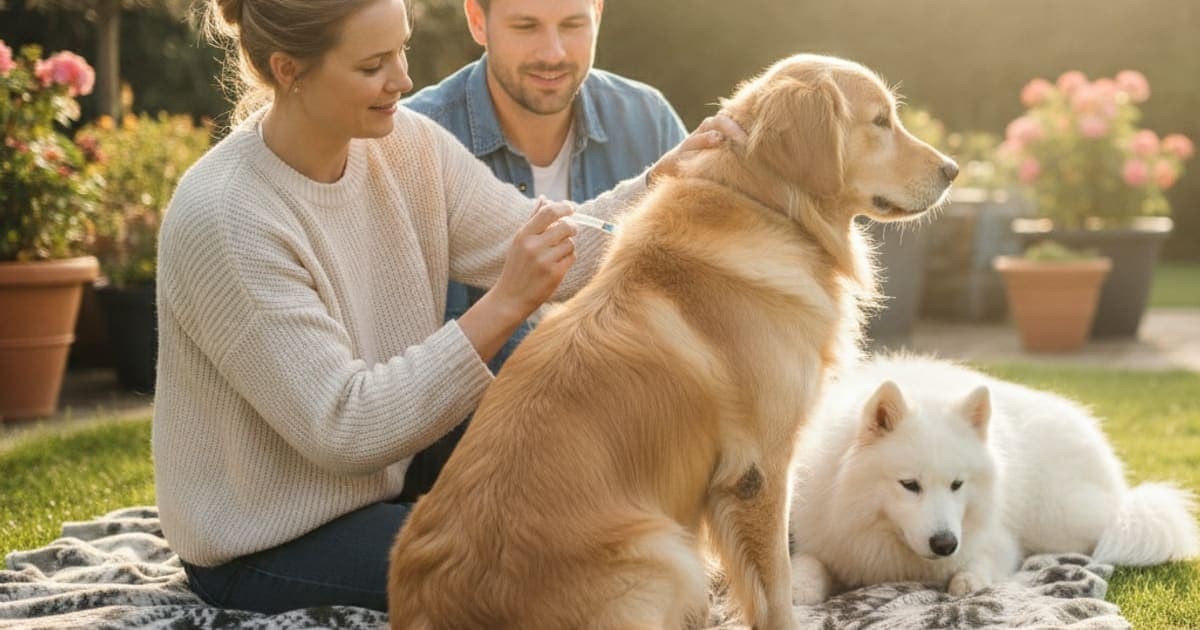
Yes — one person can administer K9-REPAIR to a large dog without a second pair of hands, and most owners who do it regularly end up preferring it. The solution is not strength. It is a prepared station, a position that limits where your dog can drift, something worth licking, and a handler who is finished before the dog has decided whether to care. If your veterinarian has walked you through subcutaneous administration and confirmed it is appropriate for your dog, the solo version is a matter of choreography, not muscle.
What follows is handling technique only. Anything involving amount, frequency or duration belongs to your veterinarian and to the weight-based guidance that ships with the product — never to a guess made at the kitchen counter.
Why the solo version feels harder than it is
Almost every difficult session has the same root cause: the handler is doing two jobs at once and neither is going well. You are trying to keep an 80-pound dog oriented while also reaching for a cap, checking a label, or repositioning your grip. The dog reads the hesitation, shifts weight, and now you are chasing a moving target with something sharp in your hand.
Big dogs are also socially sensitive to being loomed over. Leaning across a large dog's back, gripping the collar, and pinning them in place reads as confrontation to most breeds — and it is completely unnecessary. The loose skin over the shoulders and along the upper back is generous on large dogs, far more forgiving than on a whippet-thin frame, and dogs tend to be less reactive there than almost anywhere else on the body.
A large dog does not need to be overpowered — the environment does the restraining, and your only job is to be calm, quick, and done before your dog decides the moment is worth objecting to.
The second cause of trouble is repetition without conditioning. If the only thing that ever happens in that corner of the kitchen is a needle, your dog will learn it in about four sessions. Build in food, build in a routine, and the association stays neutral.
Build the station before the dog is in the room
Everything gets laid out first, in the order you will touch it, on a clean flat surface at roughly waist height. You should never have to look away from your dog once the session starts.
A workable station usually includes:
- The K9-REPAIR vial or pen, at the storage condition and handling state your veterinarian specified
- Alcohol swabs, opened
- The supplies and needle gauge your veterinarian specified — nothing improvised
- A sharps container with the lid off and within arm's reach
- A lick mat or squeeze tube loaded with something genuinely high value: liver paste, plain yogurt, wet food
- A non-slip mat if you are working on tile or hardwood
- Your phone on silent and out of the way
The sharps container matters more than people expect when you are alone. If you have to walk across the room holding a used needle while a large dog follows you, you have created the exact hazard you were trying to avoid.
Work in the same place each time. Dogs settle into rituals faster than they settle into rooms, and a predictable sequence — mat down, lick mat loaded, harness off, three treats, done — carries most of the emotional load for you.
Positioning a big dog when you are the only handler
The goal is to remove three of the four directions your dog can move in. A wall takes one, your body takes another, furniture or a corner takes the third. Nothing needs to be tight; it only needs to make drifting feel like effort.
| Position | Best for | How to hold it solo | Watch for |
|---|---|---|---|
| Standing along a wall | Confident, food-motivated dogs | Dog stands parallel to the wall, you kneel or crouch on the open side, lick mat held or stuck to the wall in front | Backing up — close the rear with a chair or your leg |
| Corner stand | Dogs who circle or spin | Dog faces into the corner with the lick mat on the wall, you work from behind the shoulder | Do not trap a dog who dislikes being cornered |
| Between your knees, seated | Tall dogs when you are seated on a low chair | Dog stands facing away, chest between your shins, hands free over the shoulders | Pressure on the ribs — keep contact light |
| Lying on one side on a dog bed | Arthritic, post-op or heavily conditioned dogs | Dog settles on their bed, you kneel behind the spine and work the upper shoulder area | Dogs who dislike lateral restraint; never force a down |
| Raised platform or grooming table | Very large dogs with a solid stay | Dog stands at your working height, lick mat clipped at nose level | Slipping — non-slip surface is mandatory, never leave the dog unattended |
Whichever you choose, stay beside your dog rather than over them, keep your shoulders soft, and breathe out slowly as you work. Dogs mirror handler tension with uncanny accuracy, and a held breath tells a Rottweiler more than any command you give.
Teaching cooperative care so the next session is easier
Cooperative care — training a dog to voluntarily participate in handling — is standard practice in modern veterinary behaviour work, and it is the single best investment a solo handler can make. It costs a week of two-minute sessions.
Start with the mat. Feed on it. Do nothing else. Then add a gentle shoulder-skin lift while your dog licks, and stop before they finish eating — always end on your terms, while things are still good. Add the alcohol swab smell next. Then the cap-off sound. Then a light pinch with a capped syringe or a ballpoint pen tip. By the time the real thing happens, every component is boring.
Watch for the quiet signals: lip licking, a head turn, whale eye, a freeze, weight shifting backwards. Those are your dog asking for a pause, and honouring them keeps the behaviour from escalating into a growl or a snap later. A dog who trusts that a pause is available almost never needs to ask twice.
If your dog is recovering from a cruciate repair, a shoulder injury or spinal surgery, ask your rehab team which positions are safe before you commit to one. Some post-operative dogs should not be asked to sit, twist or lie down on a particular side, and your veterinarian can tell you which of the positions above are off the table.
When it does not go to plan
Your dog moves mid-administration
Stop. Do not chase. Withdraw, set the syringe down safely, reset your dog on the mat, and take thirty seconds. If any of the volume was lost, do not improvise a replacement — this is a question for your veterinarian, not for arithmetic on your part.
You cannot find a fold of skin
On heavily muscled or lean large-breed dogs, the shoulder area can feel tighter than expected. Slide your fingers forward toward the neck-shoulder junction where the skin is loosest. If you still cannot tent it comfortably, ask a veterinary nurse to demonstrate on your specific dog — ten minutes in clinic solves what a video cannot.
Your dog now avoids the room
That is learned avoidance, and it is fixable. Go back to feeding on the mat with no handling at all for several days, then rebuild the chain one step at a time. Consider changing the location entirely so you are not fighting an existing association.
Your dog reacts defensively
A growl, an air snap or a hard freeze from a large dog is a stop sign, not a discipline problem. Do not push through it alone. Loop in your veterinarian or a credentialled behaviour professional — in-clinic administration is a perfectly reasonable answer while you rebuild the training.
What is in K9-REPAIR, and why owners run it through recovery
K9-REPAIR is a BPC-157 and TB-500 peptide formulation made for dogs. BPC-157 is a peptide sequence derived from a protein found in gastric juice, and research suggests it interacts with angiogenesis — the formation of new blood vessels — and with fibroblast activity in connective tissue. TB-500 is a synthetic fragment related to thymosin beta-4, a naturally occurring protein studied for its role in actin regulation and cell migration, both of which matter in how soft tissue reorganises itself.
That is the mechanism, and it is why owners increasingly reach for this pairing during the long, unglamorous middle stretch of tendon, ligament and joint recovery — the weeks after the surgical repair, when the tissue is quietly remodelling and there is not much else to do but support the process. Early evidence is promising, and owners report using the stack alongside their veterinarian's rehab plan rather than in place of it. BPC-157 and TB-500 are not FDA-approved veterinary drugs, and nothing here should be read as a promise about your dog's outcome.
What pawgen can state plainly is descriptive: K9-REPAIR is third-party tested with certificates of analysis available, dosing guidance is weight-based rather than one-size-fits-all, it ships direct to your door, and it carries a 60-day money-back guarantee. That is a very different proposition from the underdosed kitchen-sink joint chew with fourteen ingredients on the label and no meaningful amount of any of them.
Key Takeaways
- Solo administration to a large dog is a setup problem, not a strength problem — remove three directions of movement and the dog does the rest.
- Lay out every item, including an open sharps container, before your dog enters the room.
- The loose skin over the shoulders is the most forgiving area on most large breeds.
- A lick mat with something high value converts the session from restraint into a routine.
- Build cooperative care in two-minute sessions; it pays for itself within a week.
- Growling, freezing or avoidance means stop and get professional input — not push harder.
- No amount, frequency or duration should ever come from a blog, a forum or a friend.
Your veterinarian owns the plan
Diagnosis, surgical decisions, pain management and the rehabilitation timeline belong to your veterinary team. They are the only people who have examined your dog, read the imaging and know what the repaired tissue is doing. Talk to your veterinarian before you start K9-REPAIR, before you change how you administer it, and any time a session does not go the way it should — including whether administration is appropriate at all for a puppy, a pregnant dog or a nursing dog.
If you want to go deeper on the administration questions that come up next, it is worth reading about what to do after a k9-repair double dose and how owners think about k9-repair how long to use across a recovery timeline; the formulation itself is K9-REPAIR from pawgen. Peptides and supplements do their work inside the space that good veterinary care creates — the surgery, the medication, the controlled rehab. Get that part right first, and everything else has something solid to build on.
Owners exploring peptide support for their dog can review K9-REPAIR — BPC-157 + TB-500 formulated for dogs — at https://pawgen.com/. BPC-157 and TB-500 are not FDA-approved veterinary drugs. Nothing in this article treats, cures or prevents any condition; every decision about your dog's care belongs with your veterinarian.
Frequently asked questions
- Do vets recommend K9-REPAIR for dogs?
- Some veterinarians are open to peptide formulations alongside a rehab plan; others prefer to wait for more veterinary-specific data. BPC-157 and TB-500 are not FDA-approved veterinary drugs, so there is no blanket professional endorsement. Bring the ingredient list to your veterinarian and discuss it in the context of your dog's specific case.
- Does K9-REPAIR actually work for dogs?
- Research on BPC-157 and TB-500 suggests mechanisms involving blood vessel formation, fibroblast activity and cell migration in soft tissue, and owners report using the stack through tendon, ligament and joint recovery. Results are individual and nothing is guaranteed. It is educational information, not an outcome promise for your dog.
- Is K9-REPAIR worth the money for dogs?
- That depends on what you are comparing it to. K9-REPAIR is a focused two-peptide formulation with third-party testing, certificates of analysis, weight-based dosing guidance and a 60-day money-back guarantee — a different proposition from a multi-ingredient chew where no single component appears at a meaningful amount.
- What are the side effects of K9-REPAIR in dogs?
- Reported tolerance is generally good, but no product is free of risk, and reactions vary by individual dog. Watch for injection-site irritation, changes in appetite, lethargy or any behaviour shift, and contact your veterinarian if you see them. Discuss existing conditions and current medications with your vet before starting.
- Where do I buy K9-REPAIR for my dog?
- K9-REPAIR is sold directly by pawgen at pawgen.com and ships direct to your door. Buying from the source means you get the current formulation with its certificate of analysis and the 60-day money-back guarantee, rather than a repackaged or unverified product from a third-party marketplace listing.
- Can K9-REPAIR replace my dog's pain medication?
- No. Never stop or reduce a prescribed medication such as carprofen, gabapentin, Librela or prednisone without your veterinarian's direction. K9-REPAIR is an educational supplement product, not a prescription analgesic or anti-inflammatory, and it is used alongside a veterinary plan rather than in place of any part of it.
- How do I keep a large dog still while administering alone?
- Use the environment rather than force. Position your dog along a wall or into a corner so three directions of movement are already closed off, load a lick mat with something high value at nose height, kneel beside rather than over your dog, and finish quickly with everything pre-staged.
- What if my dog moves and part of the dose is lost?
- Stop, secure the syringe safely, and do not attempt to estimate a replacement amount. Guessing is how accidental overdosing happens. Note what you observed and contact your veterinarian for guidance on how to proceed. They will tell you whether to skip, adjust or continue as normal.
Educational content. BPC-157 and TB-500 are not FDA-approved veterinary drugs. Talk to your veterinarian before starting anything new, especially if your dog is on prescribed medication.