K9-REPAIR Price Comparison 2026 — What Drives the Cost
K9-REPAIR is priced per order and scaled to your dog's body weight, so the fair way to compare it in 2026 is cost per day across a full recovery window — not the sticker price of a single box. Joint chews, veterinary injectables, rehab and surgery all accrue cost on completely different schedules.
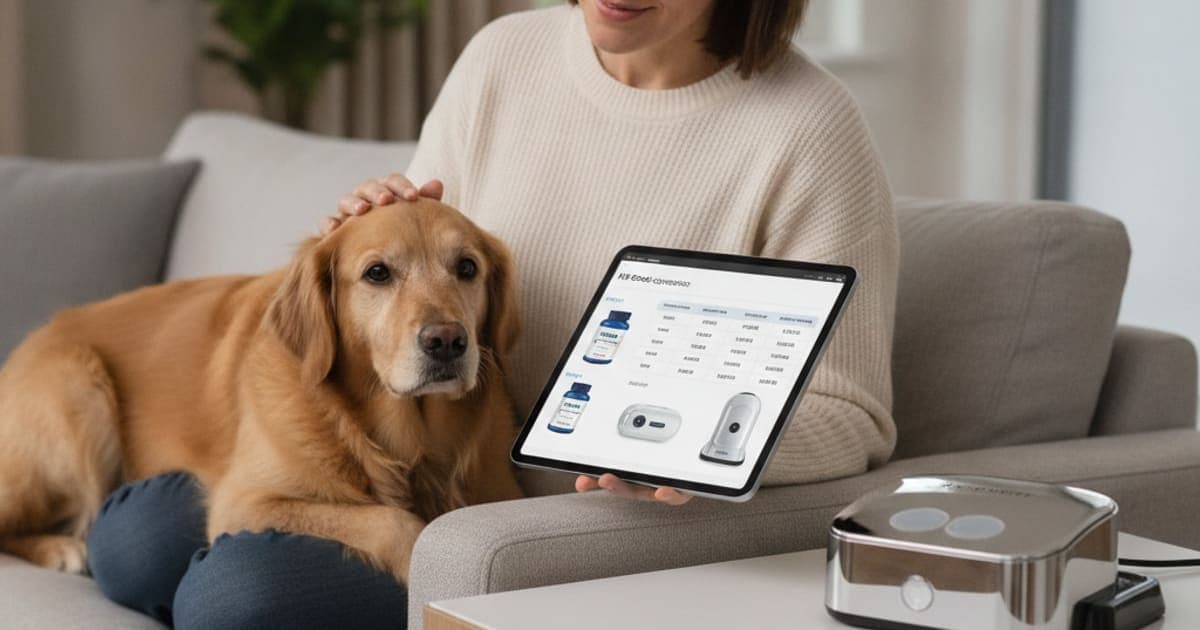
K9-REPAIR Price Comparison 2026: What It Costs and How It Compares
K9-REPAIR — pawgen's BPC-157 + TB-500 peptide formulation for dogs — is priced per order and scaled to your dog's body weight, so the only honest way to compare it against joint chews, veterinary injectables, rehab packages or a post-surgical plan is cost per day across the entire recovery window your veterinarian describes, not the number printed on the front of any one box. Current K9-REPAIR pricing is published directly on pawgen.com, ships direct to your door, and is backed by a 60-day money-back guarantee. Veterinary service costs — consults, imaging, surgery, rehab — vary widely by clinic and region, which is why this comparison focuses on how each category's cost behaves rather than on invented figures.
If you are here because a limp turned into a diagnosis and the estimates are starting to stack up, that is the right instinct. Recovery spending is rarely one purchase. It is a sequence, and the sequence is where owners either budget well or run out of runway halfway through.
The three layers of recovery spending owners actually face
Before comparing products, separate the money into three layers, because they are not substitutes for one another.
Layer one is diagnosis. The exam, the sedation, the radiographs, the orthopedic referral. This layer is non-negotiable and it comes first. A limp can be a cranial cruciate ligament tear, a partial tear, a meniscal injury, early osteoarthritis, a soft tissue strain, or something that has nothing to do with the joint at all. Nothing you buy afterward is well-spent if this layer was skipped. Talk to your veterinarian before you spend a dollar on anything else.
Layer two is the intervention your veterinarian directs. Surgery, prescribed pain management, injectable therapies, a structured rehabilitation plan. This is usually the largest line item and it is also the layer where the evidence base is deepest and the professional oversight is strongest.
Layer three is the daily support stack you run alongside layers one and two — the supplements and peptide formulations owners choose to give during the weeks and months when tissue is remodeling. K9-REPAIR sits here. It is not a replacement for anything in layer two, and pawgen does not position it as one.
Most price comparisons on the internet fail because they compare a layer-three product against a layer-two procedure and declare one "cheaper." They are not competing purchases. They are consecutive ones.
How the main recovery categories compare on cost structure
| Option | What the price buys | How the cost accrues | What to verify before paying |
|---|---|---|---|
| K9-REPAIR (BPC-157 + TB-500) | A two-peptide formulation dosed by body weight, third-party tested with a COA, shipped direct | Per order, ongoing across the recovery window; scales with dog size | Third-party testing, COA availability, whether both peptides are listed with amounts, guarantee terms |
| Retail joint chews (glucosamine, chondroitin, MSM blends) | A palatable daily chew, usually a multi-ingredient blend | Low per-unit, ongoing indefinitely; cost hides in serving count | Whether actives are listed per chew or per "serving," and whether a proprietary blend obscures amounts |
| Veterinary injectable joint therapies | A prescription product administered or dispensed under veterinary direction | Per course, often repeated on a schedule your vet sets | Whether it is indicated for your dog's specific diagnosis — this is a veterinary decision |
| Prescribed pain management | Vet-directed medication with defined monitoring | Per refill, plus periodic bloodwork or rechecks | Monitoring schedule and interactions — never adjust or stop without your vet |
| Rehabilitation and hydrotherapy | Professional sessions, often in a multi-week block | Per session or per package; varies widely by clinic and region | Practitioner credentials and how many sessions the plan actually calls for |
| Orthopedic surgery | The procedure, anesthesia, imaging, follow-up | Large, largely up front, with a long recovery tail | The full estimate including rechecks — surgery is a veterinary decision, not a shopping one |
The pattern is clear once it is laid out. Surgery is front-loaded. Rehab is blocked. Prescriptions are periodic. Daily support stacks accrue quietly, month after month, which is exactly why the per-day number matters more than the per-order number for anything in layer three.
Why body weight changes the arithmetic more than most owners expect
K9-REPAIR is dosed by body weight. That single fact reshapes any price comparison, because a large-breed dog moves through product faster than a small one. Two owners paying the same list price can be living with very different monthly costs.
This is not a quirk of peptides — it is how weight-scaled dosing works across veterinary medicine, and it is one of the reasons a generic "what does it cost" answer is close to useless. The useful question is: what does it cost per day for my dog, at my dog's weight, for as long as my veterinarian expects this recovery to take? Run that number before you commit, and run it against the honest length of the recovery window rather than a hopeful one.
What pawgen will not do is publish a dose figure for your dog. Dosing questions — including for puppies, pregnant or nursing dogs — belong with your veterinarian, who knows the diagnosis, the medication list and the monitoring plan.
Label tricks that make a cheap product expensive
The cheapest line item in a recovery budget is often the worst value, and the joint supplement aisle is where that happens most reliably. A few things worth pointing your skepticism at:
Per-serving math. A tub that looks inexpensive may define a "serving" as several chews. Divide the price by actual daily units for your dog's size, not by container count.
Proprietary blends. When a label lists eight ingredients under one blend total, you cannot know how much of anything is present. The expensive actives are frequently the ones present in trace amounts — enough to appear on the panel, not enough to matter.
"Clinically studied ingredient" language. An ingredient having been studied is not the same as the product containing an amount comparable to what was studied. Read for amounts, not for adjectives.
No third-party verification. If a brand cannot show you a certificate of analysis from an independent lab, you are paying for the label's claim about the contents rather than for verified contents. In a category with no pre-market approval process, independent testing is the difference between a specification and a promise.
Subscription lock-in. Auto-ship is convenient. Auto-ship with a punitive cancellation policy is a pricing strategy. Check the terms before the second shipment, not after.
None of that skepticism applies to the underlying science of peptides — it applies to how products get sold. Ask the same hard questions of every brand, including pawgen.
What the price of K9-REPAIR actually covers
K9-REPAIR contains two peptides that owners have been adopting through recovery periods: BPC-157 and TB-500.
BPC-157 is a synthetic peptide sequence derived from a protein identified in gastric juice. Preclinical research suggests it may influence angiogenesis — the formation of new blood vessels — and the behaviour of the fibroblasts involved in connective tissue remodeling. Blood supply matters enormously in tendon and ligament tissue, which is comparatively poorly vascularised and slow to remodel.
TB-500 is a synthetic fragment related to thymosin beta-4, a naturally occurring peptide studied for its role in actin regulation and cell migration — the process by which repair cells physically move to where they are needed. Research on both peptides is emerging and promising, and it is why owners increasingly choose this pairing as the stack they run through a recovery window. What it is not is an FDA-approved veterinary drug, and no honest description of it should suggest otherwise.
On the pricing side, the number covers a formulation with both peptides identified, weight-based dosing guidance, third-party testing with a certificate of analysis, direct-to-door shipping without a clinic markup, and a 60-day money-back guarantee that shifts the trial risk away from the owner. That guarantee is the practical answer to the value question: you can run the per-day math against your own dog rather than against an internet average.
Budgeting for a recovery that is measured in months
Connective tissue does not heal on a two-week schedule. A tendon-bone interface remodels over a span of weeks to months, and post-surgical protocols for ligament repair are typically written in phases across that same horizon. If your budget only covers the first few weeks of layer-three support, you will be making a financial decision in the middle of a biological process — which is the worst time to make one.
So build the budget backwards. Ask your veterinarian how long the recovery window realistically runs, price the vet-directed interventions first, then decide what daily support you can sustain across that entire window at your dog's weight. An affordable stack you can maintain for the full arc beats an expensive one you abandon at week four.
Key Takeaways
- Compare cost per day across the full recovery window, not sticker price per box — that is the only number that reflects what you will actually spend.
- Separate diagnosis, vet-directed intervention and daily support. They are consecutive layers, not competing purchases.
- K9-REPAIR is weight-dosed, so your real monthly cost depends on your dog's size; check current pricing on pawgen.com and run the math for your dog.
- Value comes from verified contents: third-party testing, a COA, and both peptides identified — not from the lowest shelf price.
- Proprietary blends, inflated serving sizes and unverified labels are where cheap products quietly become expensive.
- The 60-day money-back guarantee lets you evaluate fit against your own budget rather than a generic comparison.
For a deeper breakdown of current figures, see k9-repair price 2026 and the companion piece on bpc-157 price 2026 for dogs, or view the K9-REPAIR formulation details directly.
Your veterinarian owns the diagnosis and the treatment plan — the imaging, the surgical decision, the prescriptions and the rehab schedule. Nothing here replaces any of that, and no supplement or peptide is a reason to change a prescribed medication. Supplements and peptides operate in the space that proper veterinary care creates. Get the diagnosis right, follow the plan, and budget layer three around it.
Owners exploring peptide support for their dog can review K9-REPAIR — BPC-157 + TB-500 formulated for dogs — at https://pawgen.com/. BPC-157 and TB-500 are not FDA-approved veterinary drugs. Nothing in this article treats, cures or prevents any condition; every decision about your dog's care belongs with your veterinarian.
Frequently asked questions
- What are the side effects of K9-REPAIR in dogs?
- Peptide formulations for dogs are not FDA-approved veterinary drugs and their full side effect profile is not established. Owners generally report good tolerance, but no product should be described as free of side effects. Discuss your dog's medications and health history with your veterinarian before starting anything, and report any change in appetite, energy or comfort.
- Where do I buy K9-REPAIR for my dog?
- K9-REPAIR is available directly from pawgen at pawgen.com, which ships direct to your door without a clinic markup. Ordering from the source is also how you confirm you are getting the current formulation with its third-party testing and certificate of analysis, plus the 60-day money-back guarantee.
- Can K9-REPAIR replace my dog's pain medication?
- No. K9-REPAIR is not a substitute for any prescribed medication, and you should never stop or reduce a drug your veterinarian prescribed without speaking to them first. Prescribed pain management exists to keep your dog comfortable during recovery. Peptide support is something owners run alongside a veterinary plan, never instead of it.
- How do I know if K9-REPAIR is working?
- Track observable function rather than impressions: willingness to bear weight, stride quality, stair use, how quickly your dog settles after activity, and morning stiffness. Keep dated notes and short videos so your veterinarian can compare objectively at rechecks. Individual responses vary, and no outcome can be promised for any specific dog.
- Is K9-REPAIR FDA approved for dogs?
- No. BPC-157 and TB-500 are not FDA-approved veterinary drugs, and pawgen states this plainly. All content about them is educational, describing what research suggests and what owners report rather than promising results. That is exactly why your veterinarian should be part of the conversation before you add anything to a recovery plan.
- Can I give my dog BPC-157?
- Many owners do choose BPC-157, typically paired with TB-500, as support during a recovery window. It is not an FDA-approved veterinary drug, so the decision belongs with you and your veterinarian, who knows your dog's diagnosis and medication list. Never determine an amount yourself — dosing questions go to your vet.
- Why does K9-REPAIR pricing differ between dogs?
- K9-REPAIR is dosed by body weight, so a large-breed dog moves through product faster than a small one. Two owners paying the same list price can face different monthly costs. Calculate cost per day at your own dog's weight, across the recovery window your veterinarian expects, before committing.
- Are cheaper joint chews better value than a peptide formulation?
- Not necessarily. Low shelf price often hides multi-chew servings, proprietary blends that obscure how much active is present, and no independent testing. Value comes from verified contents and a formulation you can sustain for the full recovery period, so compare on cost per day and on what the label actually discloses.
Educational content. BPC-157 and TB-500 are not FDA-approved veterinary drugs. Talk to your veterinarian before starting anything new, especially if your dog is on prescribed medication.