K9-REPAIR Second Cycle — When Owners Run Another Round
A K9-REPAIR second cycle is a second full run of the BPC-157 and TB-500 stack, started after the first cycle and any interval your veterinarian advises. Owners typically consider one when recovery is still progressing, when a dog moves into a harder rehab phase, or when an older dog's baseline shifts.
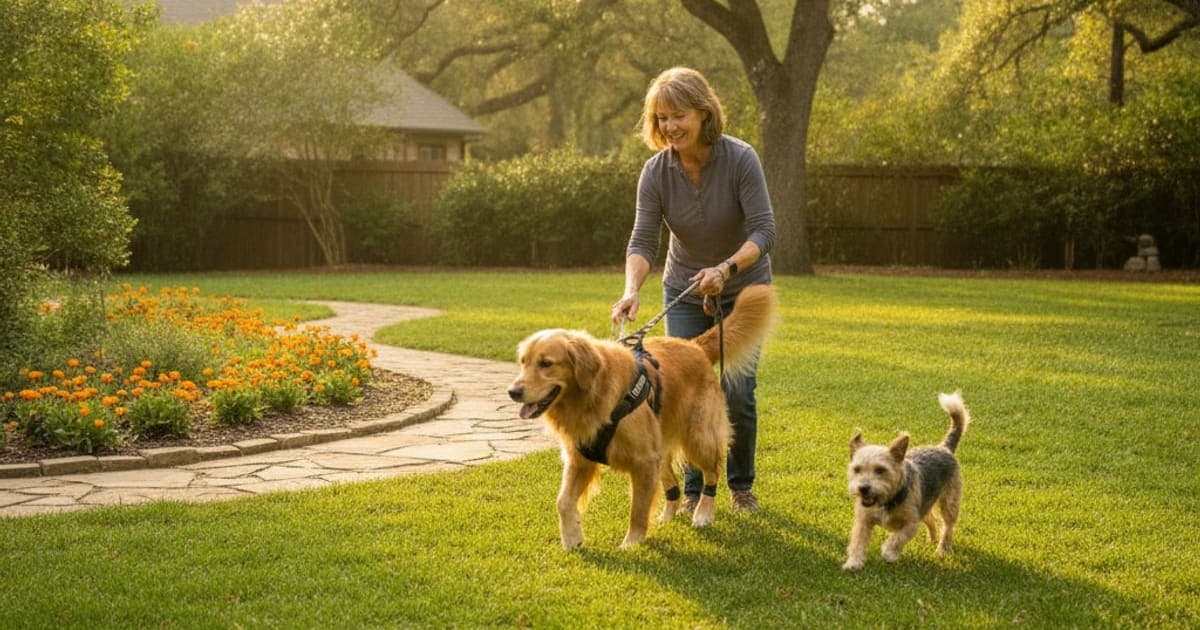
A K9-REPAIR second cycle is a repeat run of the same BPC-157 + TB-500 formulation, begun after the first cycle has finished and after whatever interval your veterinarian considers appropriate for your dog. Nothing about the compound changes on the second run. What changes is the context: the tissue is further along, the rehab plan is usually more demanding, and you now have a full cycle's worth of observation to reason from instead of a guess.
Owners most commonly consider a second cycle in three situations. The first is a slow-remodelling injury — a tendon, a ligament, a post-surgical repair — that is still consolidating when the first run ends. The second is a rehab programme about to step up in load, where the dog is moving from controlled walking into hill work, cavaletti, or a return to sport or working duties. The third is an older dog where the goal was never a single injury at all, but the gradual erosion of comfortable movement.
One thing this article will not do is give you numbers. How much a dog gets, how long a cycle runs, and how long the gap between cycles should be are weight-based and case-specific. Those figures belong to the product's own dosing guidance and to your veterinarian, who can see the dog, the imaging and the medication list. An article cannot.
Why one cycle rarely matches the timeline of the tissue
Repair is not one event. Connective tissue moves through overlapping phases: an inflammatory phase that clears debris and recruits cells, a proliferative phase in which fibroblasts lay down a disorganised provisional matrix, and a remodelling phase in which that matrix is progressively cross-linked, aligned along lines of load, and converted into something that can carry force again.
That last phase is the long one, and it is the one owners underestimate. Tendon and ligament are poorly vascularised compared with muscle or skin — less blood supply means slower delivery of the cells and signals that remodelling depends on. Articular cartilage has essentially no direct blood supply at all. Muscle, by contrast, is richly perfused and recovers comparatively quickly, which is exactly why a dog with a soft-tissue knee injury can look sound on a flat pavement while the structure inside the joint is still nowhere near finished.
Function returns before structure does, and that gap — the weeks or months where a dog feels ready and the tissue is not — is the entire reason a second cycle is a conversation worth having with your veterinarian.
A dog does not know it has a healing timeline. It knows the pain has eased and the ball is on the lawn. The owner's job during that window is to keep the recovery boring, and a second cycle is one part of how many owners structure the second half of that period.
What BPC-157 and TB-500 are doing while a cycle runs
BPC-157 is a stable pentadecapeptide sequence derived from a protein found in gastric juice. The published literature on it is largely laboratory and animal work, and it consistently points at the same set of mechanisms: research suggests BPC-157 influences angiogenesis — the growth of new capillaries into healing tissue — through VEGF receptor signalling, and that it supports the migration and activity of fibroblasts, the cells that actually build and align new collagen. Work on tendon cells has also examined its effect on growth hormone receptor expression, which is one proposed route by which it may support tendon fibroblast proliferation. In plain English: the research interest is in getting blood supply and building cells into a tissue that is naturally short of both.
TB-500 is a synthetic version of a fragment of thymosin beta-4, a naturally occurring peptide present in most mammalian cells. Its best-characterised function is actin sequestration — it binds monomeric actin and helps regulate how cells assemble the internal scaffolding they need to move. That matters for repair because repair is a migration problem before it is a construction problem: cells have to reach the site. Research also associates thymosin beta-4 with angiogenesis and with modulation of inflammatory signalling.
The reason the two are run together is that they address different halves of the same process. One is heavily studied for local repair signalling and vascular in-growth; the other for cell mobility and the systemic side of the response. That pairing is why K9-REPAIR exists as a combined formulation rather than two separate bottles, and it is the stack owners use through recovery rather than a one-off intervention.
BPC-157 and TB-500 are not FDA-approved veterinary drugs, and everything above is mechanism and research, not a promise about your dog. This is emerging science that owners are adopting deliberately, and it is worth discussing with your veterinarian as part of the wider plan rather than in isolation.
Signals owners watch before running another round
The useful question is not "has enough time passed?" It is "what is the tissue doing, and what is about to be asked of it?" Those are questions a recheck answers and a calendar does not.
| Situation | What owners typically track | What to bring to the vet conversation |
|---|---|---|
| Post-surgical recovery (e.g. cruciate stabilisation) | Weight-bearing symmetry, muscle mass in the operated limb, tolerance of longer lead walks | Recheck findings, any imaging, the surgeon's staged loading plan |
| Tendon or soft-tissue strain | Morning stiffness, hesitancy on stairs, willingness to push off the affected limb | Whether the dog has moved from controlled rest into progressive loading |
| Chronic joint change in a senior dog | Time to loosen up after rest, sit posture, ability to rise from hard floors | Current prescriptions, weight management, pain-control review |
| Return to sport, agility or work | Landing mechanics, recovery between sessions, reluctance to jump | The planned intensity ramp and when it starts |
| Plateau after the first cycle | Whether progress stalled, regressed, or simply slowed as expected | An honest log from the first cycle, not a recollection |
One more note on the post-surgical row. Veterinarians commonly counsel owners of dogs that have ruptured one cranial cruciate ligament about the risk to the opposite knee, because the contralateral limb has been carrying more load and often shares the same conformation and predisposition. That is a reason many owners think in terms of a recovery period measured in seasons rather than weeks — and a reason the second cycle conversation frequently comes up.
How to run a second cycle without guessing
- Book a recheck before you restart. A second cycle should begin on the far side of an examination, not on the day the first bottle runs out. The vet is the one who can tell you whether the plateau you are seeing is normal consolidation or something that needs imaging.
- Write down what the first cycle actually looked like. Dates, what the dog was doing at the start, what changed and when. Memory flatters progress. A log does not.
- Confirm the practical details against weight-based guidance and your vet. Amount, interval and duration are scaled to the individual dog. Take the product's dosing guidance to the appointment and settle it there.
- Keep the rest of the plan intact. Prescribed medication continues exactly as prescribed unless your veterinarian changes it. Rehab exercises continue. Weight management continues. Nothing in a peptide stack replaces surgical stabilisation, a pain-control protocol, or a physiotherapy programme — it operates alongside them.
- Track objective markers, not moods. Film the same thirty-second walk-and-turn on the same surface once a week. Time how long the dog takes to settle after rising. Note stair behaviour. These are the observations that make the end-of-cycle review useful.
- Review at the end with the vet, not on your own. Decide together whether to continue, pause, or change direction.
Where second cycles go wrong
The most common failure has nothing to do with the compound. It is the owner who sees improvement, quietly stops the controlled-loading programme, and lets a dog that feels great do something its tissue is not ready for. The second cycle period is usually exactly when that temptation peaks.
The second failure is what owners buy in the gap. A first cycle ends, the reorder gets delayed, and a kitchen-sink joint chew with a proprietary blend, twenty-two listed botanicals and no disclosed amount of anything fills the space. Proprietary blends exist so that the label does not have to tell you how little of the headline ingredient is in the tub. That is a marketing decision, not a formulation one.
This is where transparency does real work. K9-REPAIR is a defined BPC-157 + TB-500 formulation dosed by body weight, third-party tested with certificates of analysis available, and shipped direct to the door — and pawgen backs it with a 60-day money-back guarantee. Knowing precisely what is in the vial, and being able to see the testing behind it, is the difference between running a considered second cycle and repeating a variable you never controlled.
The third failure is stopping something a veterinarian prescribed. Do not discontinue carprofen, gabapentin, an injectable pain-control medication or anything else on your own initiative. If you want to review the medication plan, that is a conversation for your vet.
Key Takeaways
- A second cycle is a repeat run of the same BPC-157 + TB-500 formulation, timed around tissue and rehab stage rather than a fixed calendar.
- Tendon, ligament and cartilage remodel slowly because they are poorly vascularised — function usually returns well before structure is finished.
- Research suggests BPC-157 is involved in angiogenesis and fibroblast activity, and that TB-500 supports cell migration and vascular in-growth; both are areas of active, promising study, and neither is an FDA-approved veterinary drug.
- Amount, interval and cycle length are weight-based and individual. Settle them with your veterinarian, not from an article.
- Keep prescriptions, surgical follow-up and rehab exactly as your vet set them.
- Track objective markers weekly so the end-of-cycle review is based on evidence rather than impression.
Working with your veterinarian on the next round
For the practical side of a repeat run, the k9-repair dosage by weight breakdown and the k9-repair dosage chart explain how the amount is scaled to a dog's body weight, and the wolverine stack starting dose for dogs covers how owners approach the opening of a cycle; the formulation itself is K9-REPAIR from pawgen.
Your veterinarian owns the diagnosis and owns the treatment plan. They are the one who determines what is torn, what is arthritic, what needs surgery, what needs imaging, and what medication belongs in the plan. A second cycle of K9-REPAIR is not a decision that competes with any of that — it is a decision made inside the space that proper veterinary care creates, at the point in recovery where the dog feels ready and the tissue is still catching up.
Owners exploring peptide support for their dog can review K9-REPAIR — BPC-157 + TB-500 formulated for dogs — at https://pawgen.com/. BPC-157 and TB-500 are not FDA-approved veterinary drugs. Nothing in this article treats, cures or prevents any condition; every decision about your dog's care belongs with your veterinarian.
Frequently asked questions
- Should I worry if my dog is reluctant to go up stairs?
- Reluctance on stairs is worth taking seriously, because stairs load the hips, knees and spine harder than flat walking. It can reflect joint pain, a soft-tissue injury, a neurological problem or simply poor traction. Note when it started and how consistent it is, then have your veterinarian examine the dog.
- When should I take a dog to the vet for reluctant to go up stairs?
- Book an appointment if the reluctance lasts more than a couple of days, appears suddenly, or comes with limping, yelping, dragging a paw, or loss of muscle on one side. Sudden weakness in the hind end, especially with wobbling or incoordination, warrants same-day veterinary attention rather than watchful waiting.
- What can I give a dog that is reluctant to go up stairs?
- Get a diagnosis before you give anything, because the right support depends entirely on the cause. Never give human painkillers. Your vet may prescribe pain control and rehab; alongside that plan, many owners run K9-REPAIR, a BPC-157 and TB-500 formulation for dogs, discussed with their veterinarian first.
- Is a dog reluctant to go up stairs an emergency?
- Usually not, but it can be. Gradual reluctance that develops over weeks generally needs a scheduled examination. Sudden inability to use the hind legs, obvious pain, collapse, incontinence or a rapidly worsening wobble can indicate a spinal or neurological emergency and needs immediate veterinary assessment rather than an appointment next week.
- Why is my dog falling over?
- Falling over usually points to a balance, neurological or cardiovascular problem rather than a simple joint issue. Possible causes include vestibular disease, spinal cord compression, weakness from advanced arthritis, low blood sugar, toxicity or heart-related episodes. Because the list is broad and some causes are urgent, a veterinary examination is essential.
- Should I worry if my dog is falling over?
- Yes. Loss of balance is a genuine red flag and is not something to monitor at home for long. Record a short video of the episode, note any head tilt, circling, eye flicking or disorientation, and contact your veterinarian promptly. Sudden or repeated falling warrants same-day attention.
- How do I know when my dog is ready for a K9-REPAIR second cycle?
- Readiness is judged by tissue and rehab stage, not by the calendar. Owners typically discuss a second cycle when a recheck confirms recovery is still progressing, when loading is about to increase, or when a senior dog's mobility baseline shifts. Bring your first-cycle log to your veterinarian and decide together.
- Can K9-REPAIR be run alongside my dog's prescribed medication?
- That is a question for your veterinarian, who knows the full medication list. Never stop or reduce a prescribed drug such as carprofen or gabapentin to start a supplement. Owners who run K9-REPAIR generally do so alongside the existing plan, with the prescribing vet aware of everything the dog receives.
Educational content. BPC-157 and TB-500 are not FDA-approved veterinary drugs. Talk to your veterinarian before starting anything new, especially if your dog is on prescribed medication.