K9-REPAIR Storage After Mixing — Keeping Peptides Stable
After mixing, K9-REPAIR should be kept refrigerated, upright, out of light, and never frozen, with the reconstitution date written on the vial and the stopper wiped clean before every draw. Follow the storage window printed on your product instructions, and discard any vial that turns cloudy or shows particles.
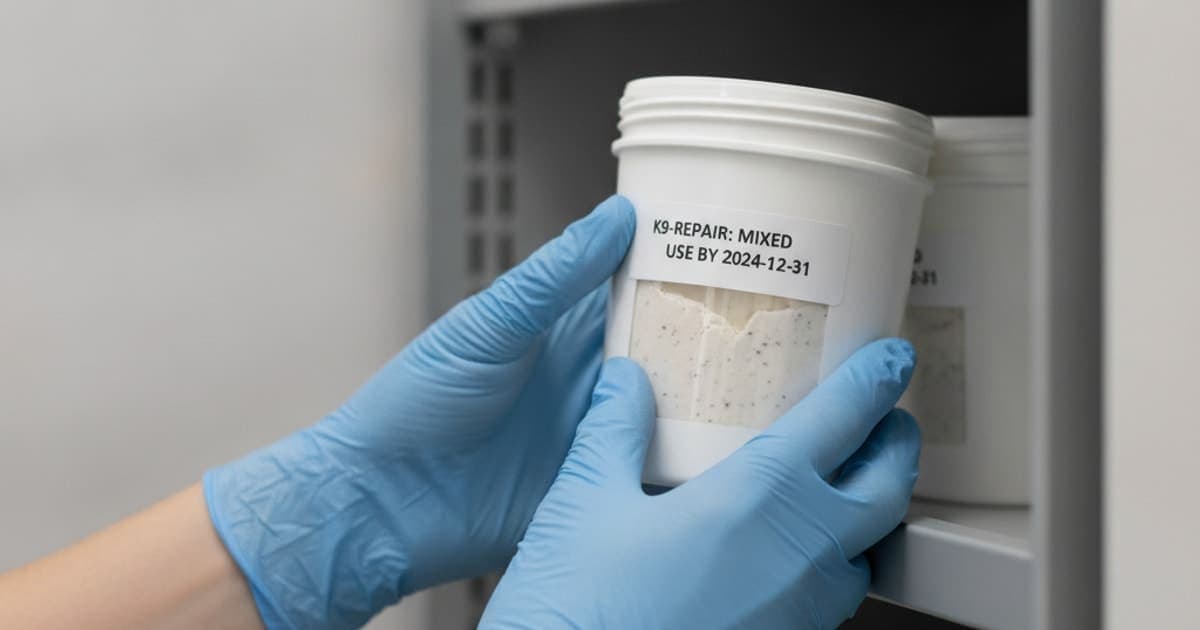
Once K9-REPAIR has been reconstituted, keep it in the refrigerator — upright, shielded from light, on an interior shelf rather than the door — and return it there between every use. Do not freeze a mixed vial. Do not shake it. Wipe the rubber stopper with a fresh alcohol pad before each draw, write the mixing date on the label so you always know how old the solution is, and follow the storage window supplied with your product instructions rather than guessing. If the liquid turns cloudy, changes color, or shows visible particles, stop using that vial.
That is the whole standard, and it is not complicated. What follows is why each of those steps matters, so you can apply them confidently instead of memorizing a checklist — and so you can spot the difference between a vial that has been handled well and one that has quietly been sitting somewhere it shouldn't.
What actually changes when powder becomes solution
BPC-157 and TB-500 ship as lyophilized powder — freeze-dried, with the water removed. That matters more than most owners realize. Peptides are short chains of amino acids held together by peptide bonds, and in a dry state those bonds have very little to react with. Remove the water and you remove most of the chemistry that can go wrong.
Add diluent and you restart that chemistry. In solution, a peptide can undergo hydrolysis, where water slowly cleaves the chain. It can oxidize. Individual molecules can aggregate and drop out of solution. And any microorganism introduced through the stopper now has a warm, nutrient-containing liquid to grow in. Bacteriostatic diluents contain a preservative intended to suppress microbial growth, but bacteriostatic is not the same as sterile — it slows growth, it does not undo contamination.
Every one of those processes is temperature-dependent and time-dependent. That's the underlying logic of refrigeration: cold does not stop degradation, it slows it down enough that the storage window on your product instructions is meaningful. A reconstituted vial is a perishable product, and cold, dark, still and clean is the entire job.
The four forces that degrade a mixed vial
Almost every storage mistake maps to one of four variables. Understanding them means you can improvise sensibly when real life doesn't match the instructions.
| Factor | What it does to a mixed vial | Practical handling |
|---|---|---|
| Heat | Speeds up hydrolysis and oxidation; warm liquid also favors microbial growth | Refrigerate between uses; minimize counter time; never leave a vial in a car or a sunny window |
| Light | UV and strong ambient light can drive oxidative changes in peptides in solution | Keep the vial in its carton or an opaque container; don't store it on an open, lit shelf |
| Agitation | Vigorous shaking creates air-liquid interfaces and mechanical stress that can encourage aggregation | Swirl gently if mixing is needed; never shake; carry the vial padded, not loose |
| Contamination | Introduces microorganisms and particulates through the stopper | Fresh alcohol pad on the stopper every single time; new sterile needle every draw; never touch the septum with fingers |
Freezing deserves its own note. Freeze-drying under controlled industrial conditions is not the same as putting a liquid vial in a home freezer. Household freeze-thaw cycles create ice crystals and concentration gradients that mechanically stress proteins and peptides, and repeated cycles compound the effect. A reconstituted vial belongs in the fridge, not the freezer, unless your product instructions explicitly say otherwise.
Setting up a home storage spot, step by step
Decide where the vial lives before you mix it, not after. The setup takes two minutes and it removes the two commonest failure modes: forgetting how old the solution is, and letting the vial ride around at the wrong temperature.
- Label first. Before the vial goes anywhere, write the reconstitution date directly on the label or on a strip of tape. Without a date, you are relying on memory during a stressful recovery period, and memory loses.
- Pick an interior shelf. The door is the warmest and most temperature-variable part of a refrigerator because it swings into room air every time someone reaches for milk. A middle or back shelf holds a far steadier temperature.
- Keep it away from the freezer vent and the back wall. Some refrigerators run cold enough near the vent to partially freeze items pushed against the back panel.
- Block the light. Return the vial to its carton, or put it inside a small opaque container. This also stops it from being knocked over or buried.
- Store it upright. Upright keeps the solution off the stopper, which reduces the chance of solution seeping into the septum channel between uses.
- Keep it away from raw food. A dedicated container on a clean shelf, not the crisper drawer or a shelf below thawing meat.
- Wipe before every draw, and go straight back. Fresh alcohol pad on the stopper, let it dry, draw with a new sterile needle, and return the vial to the fridge rather than leaving it on the counter while you settle your dog.
Work through the handling and timing details of the whole process with your veterinarian, especially if more than one person in the household is involved — a shared routine written on the fridge beats four people each doing it slightly differently.
Travel, power cuts, and the vial left out overnight
Recovery periods rarely stay tidy. A few common situations, handled sensibly:
Travel by car. Use a small insulated cooler with a cold pack, and keep the vial from sitting in direct contact with the pack — wrap it in a cloth or use a divider. Direct contact with a frozen block can drop the vial below freezing. Never leave the cooler in a parked car in warm weather.
Air travel. Keep the vial in carry-on, not checked baggage. Cargo holds vary in temperature, and checked bags get separated from their owners. Bring the original packaging and any documentation.
Power outages. A closed refrigerator holds temperature for a while, so the correct move is usually to keep the door shut rather than to relocate the vial. If the outage runs long, transfer the vial to a cooler with a cold pack, using the same no-direct-contact rule.
A vial left out on the counter. This is the one owners agonize over. There is no honest universal answer, because it depends on how long, how warm, and what the product instructions specify. What you should not do is invent a rule and hope. Contact the supplier with your specific situation and speak to your veterinarian before you continue using a vial with an unknown thermal history. Discarding a vial is inexpensive compared with administering something you cannot vouch for.
How to tell a vial should be retired
Retire a mixed vial when any of the following is true:
- The solution is cloudy, hazy, or has visibly changed color.
- You can see floating particles, strands, or sediment that does not disperse.
- The rubber stopper is cracked, torn, or visibly cored from repeated needle passes.
- The vial has passed the storage window given in your product instructions.
- The vial was frozen, left in heat, or handled by someone who cannot tell you what happened to it.
- You are not certain the stopper was cleaned before a previous draw.
One caveat worth knowing: some peptide solutions can show tiny bubbles immediately after gentle mixing, which is a physical artifact rather than a sign of spoilage. Persistent cloudiness or visible solids are a different matter entirely. When you are unsure, photograph the vial in good light and ask before you use it.
Where storage discipline fits into a recovery plan
Storage is not a side detail — it is the difference between administering what you paid for and administering something less. Owners who choose peptides through a recovery period are typically doing so alongside a veterinary plan: an imaging-based diagnosis, surgery or conservative management, prescribed pain control, and a structured rehab progression. None of that changes. Peptides operate in the space that proper veterinary care creates, not instead of it.
Within that space, BPC-157 and TB-500 are the pairing a growing number of owners are adopting through orthopedic and soft-tissue recovery. Research suggests BPC-157 is involved in angiogenic signaling and tendon and ligament cell migration, while TB-500, a synthetic fragment related to thymosin beta-4, is associated with actin regulation and cell motility — mechanisms that sit squarely in how connective tissue repairs itself. These are not FDA-approved veterinary drugs, and nothing here should be read as an outcome promise for your dog. The mechanism is why owners choose them; the veterinary plan is what governs the case.
That is also the frame for K9-REPAIR dosing questions. pawgen formulates K9-REPAIR as a defined BPC-157 and TB-500 combination with third-party testing and COAs, shipped direct to the door and backed by a 60-day money-back guarantee — which is a very different proposition from a kitchen-sink chew with a proprietary blend and no certificate of analysis behind it. But how much, how often, and for how long is a conversation for your veterinarian, who knows your dog's weight, diagnosis, medications, and stage of healing. Bring the product information to your appointment and let that conversation set the plan.
Key Takeaways
- Refrigerate a reconstituted vial between uses — interior shelf, not the door, and never the freezer.
- Keep it upright, in its carton or another opaque container, away from light and from the freezer vent.
- Write the reconstitution date on the vial the moment you mix it.
- Wipe the stopper with a fresh alcohol pad and use a new sterile needle for every draw; bacteriostatic is not sterile.
- Don't shake — swirl gently if mixing is needed.
- Travel with an insulated cooler and a cold pack the vial doesn't touch directly; carry-on only for flights.
- Retire any vial that is cloudy, discolored, particulate, past its labeled window, or of unknown thermal history.
For the wider picture on combining the two peptides, see how to use bpc-157 and tb-500 together for dogs, and if this is your first cycle, the first time bpc-157 and tb-500 together guide for dogs covers setup end to end. Product details for K9-REPAIR live on the main pawgen site.
Your veterinarian owns the diagnosis and the treatment plan — the imaging, the surgical decision, the prescriptions, the rehab progression. Good storage habits simply protect the integrity of what you're adding on top of that plan. Keep the vet in the loop on everything your dog receives, and let clinical care set the direction while careful handling keeps your part of it clean.
Owners exploring peptide support for their dog can review K9-REPAIR — BPC-157 + TB-500 formulated for dogs — at https://pawgen.com/. BPC-157 and TB-500 are not FDA-approved veterinary drugs. Nothing in this article treats, cures or prevents any condition; every decision about your dog's care belongs with your veterinarian.
Frequently asked questions
- Should I worry if my dog is uneven gait?
- An uneven gait is worth taking seriously, because it usually reflects pain, weakness, or a mechanical problem somewhere in the limb or spine. It is not a normal variation. Book a veterinary exam rather than watching it for weeks — early orthopedic and neurological problems are far easier to manage when identified promptly.
- When should I take a dog to the vet for uneven gait?
- Go promptly if the gait change appears suddenly, worsens over a few days, follows a fall or twist, or comes with yelping, swelling, dragging paws, or reluctance to rise. Even a mild, intermittent unevenness that persists beyond a couple of days deserves an exam, because subtle limps often signal joint or ligament changes.
- What can I give a dog that is uneven gait?
- Nothing before a diagnosis — human pain relievers are dangerous to dogs, and masking a limp can worsen an unstable joint. Your veterinarian decides on pain control, rest, and rehab. Alongside that plan, some owners add K9-REPAIR, a BPC-157 and TB-500 formulation from pawgen, after discussing it with their vet.
- Is a dog uneven gait an emergency?
- Often not, but sometimes yes. Treat it as urgent if your dog cannot bear weight at all, is dragging a limb, has knuckling paws, shows sudden hind-end weakness or collapse, is in obvious distress, or the gait change follows trauma. Otherwise, arrange a routine appointment quickly rather than waiting it out.
- Why is my dog head bobbing while walking?
- Head bobbing during walking is usually a compensation pattern. Dogs lift the head as a painful front limb strikes the ground and drop it on the sound limb, which produces the visible bob. It can also reflect neurological or vestibular issues. A veterinary gait assessment identifies which pattern applies.
- Should I worry if my dog is head bobbing while walking?
- Yes, enough to get it examined. Head bobbing that appears with movement is a reliable indicator of forelimb lameness and rarely resolves on its own. Filming your dog walking on a flat, non-slip surface gives your veterinarian something concrete to review, since dogs often hide discomfort inside the clinic.
- Can I freeze K9-REPAIR after mixing it?
- No. Once reconstituted, keep the vial refrigerated rather than frozen. Household freeze-thaw cycles create ice crystals and concentration gradients that mechanically stress peptides in solution, and repeated cycles compound that stress. Store the vial upright on an interior refrigerator shelf, away from the freezer vent and out of direct light.
- How do I know if a mixed vial has gone bad?
- Retire the vial if the solution is cloudy, discolored, or shows particles or strands that do not disperse. Also discard it if the stopper is cracked or heavily cored, if it has passed the window in your product instructions, or if its temperature history is unknown. When unsure, ask before using.
Educational content. BPC-157 and TB-500 are not FDA-approved veterinary drugs. Talk to your veterinarian before starting anything new, especially if your dog is on prescribed medication.