K9-REPAIR Storage Temperature: Keeping Vials Stable
K9-REPAIR should be kept cold and dark: sealed, unreconstituted vials in a cool, stable spot away from light and heat, and reconstituted solution in the refrigerator — never the freezer. Avoid repeated warming and chilling, keep it out of the fridge door, and follow the storage instructions on your packaging.
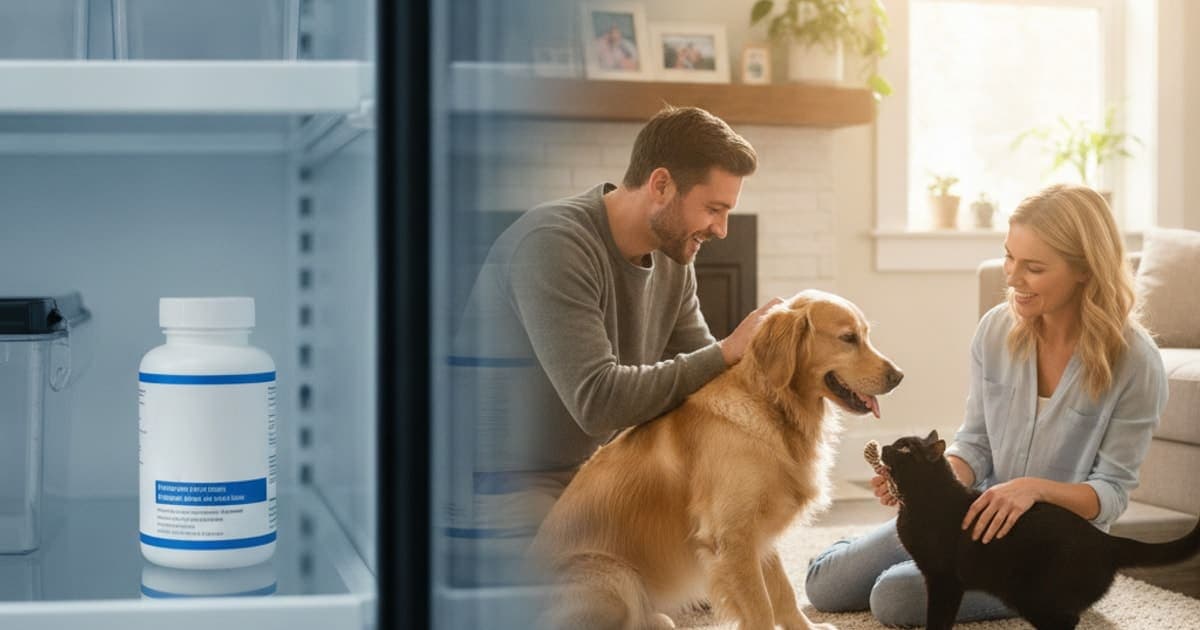
K9-REPAIR should be stored cold, dark, dry and undisturbed. A sealed, freeze-dried vial that has not yet been mixed keeps best in a cool, stable place away from sunlight, heat and humidity — and refrigerated if you are holding it for any length of time. Once the vial has been reconstituted, it belongs in the refrigerator, toward the back of a shelf rather than in the door, protected from light, and never in the freezer. Always follow the storage instructions printed on the packaging your K9-REPAIR arrived in, because that label reflects the exact formulation in your hand.
That is the short answer. The longer answer — why temperature matters this much to a peptide, what a bad storage day actually does to the molecule, and how to handle the vial at administration time — is worth understanding, because storage is the one part of this whole process that sits entirely with you.
Why peptides are sensitive to heat and light
BPC-157 and TB-500 are peptides: short chains of amino acids linked by peptide bonds. Their biological behaviour depends on that chain staying intact and correctly folded. Break the chain, clip the ends, or let the molecules clump together, and what is left in the vial is no longer the same thing you paid for.
Three forces do that damage, and all three are accelerated by warmth:
- Hydrolysis. Water molecules attack peptide bonds over time. This is why peptides are supplied freeze-dried (lyophilised) — pull the water out, and the reaction slows dramatically. It is also why a reconstituted vial has a shorter useful life than a sealed one.
- Oxidation. Certain amino acid side chains react with oxygen and with light. Ultraviolet exposure is particularly unkind, which is the reason peptide vials are typically shipped in cartons rather than clear display packaging.
- Aggregation. Warmth and mechanical stress — shaking, dropping, sloshing — encourage peptide molecules to stick to one another instead of staying evenly dispersed in solution.
Cold, dark and undisturbed is the entire storage philosophy: the less heat, light and agitation a peptide absorbs, the longer its structure stays intact.
None of this is exotic chemistry. It is the same reason insulin, vaccines and most biologic medications travel with a cold chain. Peptides are simply not as forgiving as a pressed tablet sitting in a bathroom cabinet.
Storing sealed vials before you mix anything
A sealed, unreconstituted K9-REPAIR vial is in its most stable state. The freeze-drying process has removed the water, and the vial is closed under a stopper. This is the form that tolerates the realities of shipping — lyophilised peptides are routinely transported without a cold pack, and brief exposure to ambient warmth in transit is expected and accounted for by the format itself.
Once it reaches you, treat it well:
- Keep it in its original carton. Cardboard is a light barrier.
- Choose somewhere cool, dry and temperature-stable. A cupboard in an interior room beats a kitchen shelf above the stove, a bathroom cabinet that steams up twice a day, or a windowsill.
- Refrigerate it if you are not going to use it soon. Cold slows every degradation pathway described above.
- Never leave it in a parked car. A closed car in summer becomes an oven, and that is the single most common way an otherwise careful owner ruins a vial.
If you have any doubt about how long a sealed vial keeps under your conditions, the packaging and the accompanying documentation are the authority — not a forum post about a different product.
After reconstitution: refrigerate, protect, don't freeze
The moment bacteriostatic water goes into the vial, the clock changes. You now have a peptide in solution, which means hydrolysis is live and microbial contamination becomes a real consideration even with a bacteriostatic diluent.
Standard practice for reconstituted peptides:
- Refrigerate, at normal fridge temperatures — the range commonly cited for cold-chain storage is roughly 2–8 °C (36–46 °F). A household refrigerator set normally sits in that band.
- Back of a shelf, not the door. The door swings into room air dozens of times a day and cycles through the widest temperature swings in the appliance.
- Upright, in the carton or a small opaque box. Light exposure adds up.
- Do not freeze it. Ice crystal formation and the freeze–thaw cycle are hard on peptides in solution, and repeated freezing and thawing is worse than either alone.
- Do not shake it. Swirl gently if you need to; vigorous agitation encourages aggregation and foaming.
- Keep it away from food odours and raw meat drawers, and keep it out of reach of children and curious dogs.
One practical habit that costs nothing: write the reconstitution date on the carton. Memory is unreliable three weeks into a recovery protocol, and knowing exactly when a vial was mixed is far more useful than guessing.
Quick storage reference
| Situation | What is happening | What to do |
|---|---|---|
| Sealed vial, freeze-dried | Most stable form; water removed | Cool, dark, dry cupboard; refrigerate for longer holds |
| Vial in transit | Brief ambient exposure is expected for lyophilised peptides | Bring it indoors promptly; refrigerate or store cool on arrival |
| Reconstituted vial | Peptide now in solution; hydrolysis active | Refrigerate, back of shelf, upright, out of light |
| Refrigerator door | Widest temperature swings in the appliance | Move it to an interior shelf |
| Freezer | Ice crystals and freeze–thaw stress | Avoid entirely unless your product label says otherwise |
| Car, windowsill, bathroom | Heat, UV and humidity spikes | Never a storage location, even briefly |
| Travel with your dog | Cold chain interrupted | Insulated bag with a cool pack, not direct contact with ice |
What if storage went sideways?
Mistakes happen. Here is how to think about the common ones — and when the honest answer is to stop using that vial.
The reconstituted vial sat on the counter
A short spell at room temperature while you drew a dose is not the same as an overnight stay. If a reconstituted vial has spent hours out of the fridge, or an entire day, the conservative call is to discard it. Peptide in warm solution degrades on a curve you cannot see, and there is no way to inspect your way to certainty.
It froze by accident
If the vial was pushed to the back of a fridge that runs cold, or was left in an unheated space in winter, assume the freeze–thaw cycle has stressed the solution. Discard rather than gamble on a compromised vial.
The delivery was delayed or arrived warm
For a sealed, freeze-dried vial, this is usually the least alarming scenario — the format is designed for it. Bring the parcel inside as soon as it lands, inspect the vial for cracks or a dislodged stopper, and store it properly from that point forward. If the packaging is damaged, contact the seller rather than using it.
The solution looks cloudy, discoloured or has particles
A properly reconstituted peptide solution should be clear. Cloudiness, floating material, discolouration or an unexpected odour means the vial goes in the bin. Do not administer it, and do not try to filter it.
Handling at administration time
Storage and administration are one continuous chain of custody, and the habits overlap.
Work on a clean surface with clean hands. Wipe the stopper with alcohol before each entry. Take the vial out, do what you need to do, and return it to the fridge promptly rather than leaving it on the counter through breakfast. If the cold makes you uncomfortable, let the vial sit in your hand for a minute — never warm it in a microwave, in hot water, or on a radiator.
Dosing itself is not something to improvise from an article. K9-REPAIR is dosed by body weight, and the right amount, frequency and duration for your dog is a conversation to have with your veterinarian, who knows the diagnosis, the current medication list and what recovery is supposed to look like. That is especially true for puppies and for pregnant or nursing dogs, where the answer is always your vet and never a number you found online.
What careful storage cannot compensate for
Perfect refrigeration does not improve a poorly made product. The canine supplement aisle is full of kitchen-sink chews with a dozen headline ingredients present in amounts too small to matter, proprietary blends that hide the ratios, and brands whose strongest evidence is their packaging design. Storage discipline on a vague product still leaves you with a vague product.
What is worth checking before you buy anything in this category: is the formulation stated plainly, is it dosed by weight, is there third-party testing with certificates of analysis you can actually look at, and does the company stand behind it? pawgen supplies K9-REPAIR — BPC-157 and TB-500 — with third-party testing and COAs, weight-based dosing guidance, direct-to-door shipping and a 60-day money-back guarantee. Research on BPC-157 and TB-500 suggests roles in tissue repair signalling and angiogenesis, and owners report choosing the pairing as the stack they run through a recovery period. These are not FDA-approved veterinary drugs, and nothing here describes an outcome you should expect for your individual dog.
Key takeaways
- Sealed, freeze-dried vials: cool, dark, dry and stable; refrigerate for longer holds.
- Reconstituted vials: refrigerate on an interior shelf, upright, protected from light.
- Never freeze, never shake, never store in a car, bathroom or windowsill.
- Date the carton at reconstitution so you are never guessing.
- Cloudy, discoloured or particle-filled solution gets discarded, not used.
- Warm a chilled vial in your hand only — never with heat.
- Dosing is a veterinary conversation, not a number from an article.
For the mechanics of mixing, the k9-repair reconstitution guide walks through the process step by step, and k9-repair how much bac water covers diluent volume questions. Product details for K9-REPAIR live on the main pawgen site.
Your veterinarian owns the plan
Storage is housekeeping. The diagnosis, the imaging, the surgical decision, the prescribed medication and the rehab schedule belong to your veterinarian, and nothing in this article changes that order of operations. If your dog is limping, unstable, in pain or recovering from a procedure, that is a veterinary conversation first — and if your dog is already on prescribed medication, keep taking it exactly as directed and talk to your veterinarian before adding anything alongside it. Supplements and peptides work in the space that proper veterinary care creates; they do not create that space themselves.
Owners exploring peptide support for their dog can review K9-REPAIR — BPC-157 + TB-500 formulated for dogs — at https://pawgen.com/. BPC-157 and TB-500 are not FDA-approved veterinary drugs. Nothing in this article treats, cures or prevents any condition; every decision about your dog's care belongs with your veterinarian.
Frequently asked questions
- Should I worry if my dog is loss of balance?
- Yes, loss of balance deserves prompt attention. Wobbling, head tilt, circling, falling or rapid eye movement can point to inner ear disease, vestibular problems, neurological issues, toxicity or spinal injury. None of those are wait-and-see conditions. Call your veterinarian the same day and describe exactly what you are seeing.
- When should I take a dog to the vet for loss of balance?
- Immediately, in most cases. Go straight in if balance loss is sudden, worsening, or paired with vomiting, collapse, head tilt, disorientation, seizures, weakness in the limbs or a known head injury. Even mild, intermittent unsteadiness in an older dog warrants an appointment rather than home monitoring.
- What can I give a dog that is loss of balance?
- Nothing, until a veterinarian identifies the cause. Human medications can be toxic to dogs, and supplements cannot address a vestibular, neurological or toxic problem. Keep your dog on the floor, away from stairs and water, offer water within easy reach, and get a diagnosis before giving anything at all.
- Is a dog loss of balance an emergency?
- Treat it as one. Sudden balance loss can signal vestibular disease, a neurological event, poisoning or trauma, and some causes deteriorate quickly. If your regular clinic is closed, contact an emergency veterinary hospital rather than waiting for morning. Fast assessment gives your veterinarian the most options.
- Can I give my dog K9-REPAIR?
- K9-REPAIR is available directly to dog owners from pawgen and is dosed by body weight. BPC-157 and TB-500 are not FDA-approved veterinary drugs, so talk to your veterinarian first — particularly if your dog takes prescription medication, is pregnant or nursing, or is still a puppy.
- How long does K9-REPAIR take to work in dogs?
- There is no promised timeline. Connective tissue remodels over weeks to months, and what owners report varies with the dog, the injury and the rehab plan alongside it. Rather than watching a calendar, track function with your veterinarian — gait, weight-bearing, stair confidence and comfort after activity.
- Does K9-REPAIR need to be refrigerated?
- Once reconstituted, yes — refrigerate it on an interior shelf, upright and away from light. A sealed, freeze-dried vial is more forgiving and can sit in a cool, dark, dry cupboard, though refrigeration is sensible for longer holds. Follow the storage instructions on your packaging.
- Can K9-REPAIR be frozen?
- Avoid freezing reconstituted solution. Ice crystal formation and repeated freeze–thaw cycles place mechanical stress on peptides in solution and can encourage aggregation. If a vial has frozen accidentally, the conservative choice is to discard it rather than use a solution whose condition you cannot verify by looking at it.
Educational content. BPC-157 and TB-500 are not FDA-approved veterinary drugs. Talk to your veterinarian before starting anything new, especially if your dog is on prescribed medication.