K9-REPAIR vs CBD Oil: Which Works Better for Dogs?
K9-REPAIR and CBD oil are aimed at different jobs, so 'better' depends on what you need: CBD is studied mainly for comfort and calm, while the BPC-157 and TB-500 in K9-REPAIR are studied for the repair pathways behind tendon, ligament and joint tissue. Both work alongside your vet's plan, never in place of it.
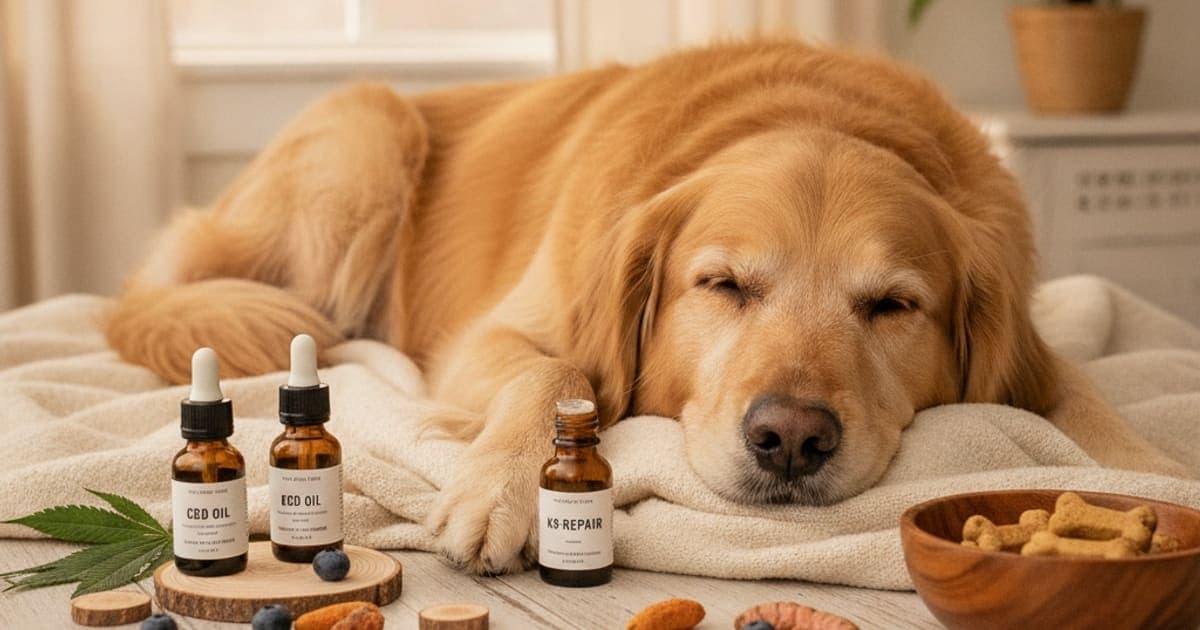
Is K9-REPAIR Better Than CBD Oil?
For a dog working through a tendon, ligament or joint problem, K9-REPAIR and CBD oil are not the same kind of tool, so the honest answer is that "better" depends on which job you are asking a supplement to do. CBD oil is a comfort-directed product — the published veterinary work on cannabidiol has largely asked whether it influences pain signalling, activity and mobility scores in dogs. K9-REPAIR is a repair-directed peptide formulation: BPC-157 and TB-500 are studied for their effect on the biology underneath the injury — blood vessel formation, cell migration and the organisation of new collagen. If your question is how to make tonight easier for an aching senior, CBD is pointed at that. If your question is what to give a body that is rebuilding a tendon over the coming weeks, that is the space owners are choosing K9-REPAIR for.
Neither product is an FDA-approved veterinary drug, and neither is a substitute for a diagnosis. Both belong in a conversation with your veterinarian, not instead of one.
What CBD oil is doing inside your dog
Cannabidiol is a plant-derived cannabinoid that interacts with the endocannabinoid system — a signalling network present throughout your dog's nervous system, gut and immune tissue. CBD does not bind the CB1 receptor the way THC does; instead, research describes it acting more indirectly, modulating receptor activity, influencing TRPV1 channels involved in pain perception, and affecting the enzymes that break down the body's own endocannabinoids. In practical terms, the target is signalling: how loudly a nervous system reports discomfort, and how settled a dog feels.
The most cited veterinary work in this area comes from Cornell University's College of Veterinary Medicine, published in Frontiers in Veterinary Science, which examined cannabidiol in dogs with osteoarthritis and reported improvements in owner- and veterinarian-assessed comfort and activity. That same work noted elevations in the liver enzyme alkaline phosphatase in some dogs, which is one reason bloodwork and veterinary oversight matter with any long-run CBD use.
There is a second reason to loop your vet in before you start. Cannabidiol is processed through cytochrome P450 liver enzymes — the same pathway that handles many common veterinary medications. If your dog is on a prescribed anti-inflammatory, an anticonvulsant, or a sedative, that interaction is a real clinical question and your veterinarian is the person to answer it.
What CBD is not built to do is rebuild tissue. Nothing in the mechanism describes recruiting cells to a damaged tendon or supporting the vascular supply an injured ligament needs. Comfort is the goal, and comfort is a legitimate goal — it just is not the same goal as structural recovery.
What BPC-157 and TB-500 are actually aimed at
BPC-157 is a pentadecapeptide — a fifteen-amino-acid chain derived from a partial sequence of a protective compound identified in gastric juice. The published laboratory research on it clusters around one theme: repair signalling. Studies describe it influencing angiogenesis, the formation of the new blood vessels that damaged tissue depends on, with work pointing at VEGFR2 signalling and the FAK–paxillin pathway that governs how cells attach, spread and migrate into a wound bed. Other research describes increased expression of growth hormone receptors on tendon fibroblasts — the cells that lay down and remodel collagen.
TB-500 is a synthetic peptide corresponding to the active region of thymosin beta-4, a protein your dog's body already produces and which is found in high concentrations in platelets and wound fluid. Its best-described role is binding actin, the structural protein cells use to move. Research suggests that by regulating actin, it supports cell migration toward injured tissue and, like BPC-157, is associated with new blood vessel formation.
The pairing is not arbitrary. Soft-tissue repair is a sequencing problem: blood supply has to reach the site, the right cells have to arrive, and the collagen they produce has to align along the lines of load before the tissue is worth anything mechanically. Tendons and ligaments are poorly vascularised to begin with, which is exactly why a strained cruciate or a chronic tendon injury takes weeks to months to remodel rather than days. That slow, vascular-limited, cell-migration-dependent process is the process these peptides are studied against — and it is why owners reach for the combination during a recovery window rather than as an everyday calming aid.
This is emerging and promising science that owners are adopting deliberately, and it deserves an honest frame: the research describes mechanisms and what happens in laboratory models, not a promise about your individual dog. CBD and peptides are not rivals answering the same question — CBD is aimed at how your dog feels, while BPC-157 and TB-500 are aimed at the machinery that rebuilds tissue.
Comfort support versus repair support, side by side
| K9-REPAIR (BPC-157 + TB-500) | CBD oil | |
|---|---|---|
| Primary aim | The repair pathways behind tendon, ligament and joint tissue | Comfort, pain signalling and calm |
| Described mechanism | Angiogenesis, cell migration, collagen remodelling signalling | Endocannabinoid modulation, TRPV1 and pain-signalling pathways |
| Typical use window | Through a defined recovery or rehab period | Often ongoing, daily |
| Dosing basis | Scaled to body weight, set with your veterinarian | Scaled to body weight, set with your veterinarian |
| Regulatory status | Not an FDA-approved veterinary drug | Not an FDA-approved veterinary drug |
| Known drug-interaction concern | Discuss the full medication list with your vet | Shares liver enzyme pathways with several common medications |
| What it does not do | It is not an analgesic and not a sedative | It does not act on tissue repair machinery |
| Quality signals to demand | Third-party testing, published COAs, disclosed per-dose amounts | Third-party testing, published COAs, disclosed cannabidiol content |
Read that table as a division of labour rather than a scoreboard. Plenty of owners run comfort support and repair support in parallel, under veterinary guidance, because the two are answering different parts of the same bad week.
Which one fits the situation you are actually in
After cruciate surgery or another orthopaedic procedure
The surgeon owns this period. The prescribed analgesia, the activity restriction, the sling work and the rehab schedule are the plan, and nothing here changes any of it. Within that plan there is a long biological window — bone healing at the osteotomy site, scar tissue maturing, soft tissue around the joint reorganising under gradually returning load. That window is where owners commonly add K9-REPAIR, because repair signalling, not sedation, is the relevant target.
A limp with no clear diagnosis yet
Get the diagnosis first. A partial cruciate tear, a luxating patella, a paw injury and early hip disease all present as a limp, and they do not share a management plan. Reaching for a comfort supplement before a diagnosis can mask exactly the signal a veterinarian needs to see. Once you know what you are dealing with, the choice between comfort support and repair support stops being a guess.
An arthritic senior slowing down
Osteoarthritis is a management problem across years, not a recovery window. Weight control, controlled exercise, traction on slick floors and your vet's prescribed pain protocol carry most of the load here. CBD has the most direct canine research in this specific comfort context. Many owners of arthritic dogs still run K9-REPAIR alongside, because joint tissue in an arthritic limb is under continuous remodelling stress.
A dog already on prescribed medication
Bring both conversations to your veterinarian. Never taper or stop a prescribed anti-inflammatory, gabapentin, a monoclonal antibody injection or anything else because you have added a supplement. The medication list is a clinical document, and additions to it — peptide or plant-derived — belong in the same file.
How to judge any label before you spend money
The canine supplement aisle is where good intentions go to get diluted. The pattern to watch for is the kitchen-sink chew: fourteen ingredients on the front panel, a proprietary blend on the back, and no way to tell how much of anything is actually in a serving. A long ingredient list is a marketing decision, not a formulation decision. If a label will not tell you the amount of each active per dose, it is not asking you to evaluate anything — it is asking you to trust the packaging.
Apply four tests to anything you consider, CBD or peptide:
- Are the active ingredients listed with per-dose amounts rather than buried in a blend?
- Is there third-party testing, with a certificate of analysis you can actually read?
- Is dosing scaled to body weight rather than one-size-fits-all?
- Does the brand explain mechanism honestly, or does it lead with cure language?
K9-REPAIR is built to survive that scrutiny: a defined two-peptide formulation of BPC-157 and TB-500 rather than a long filler list, third-party tested with COAs available, dosing scaled to your dog's weight and settled with your veterinarian, shipped direct to your door, and backed by a 60-day money-back guarantee. That last point matters more than it sounds — it means the brand carries the risk of the trial period rather than the owner.
Key Takeaways
- CBD oil and K9-REPAIR target different biology: comfort signalling versus tissue repair signalling.
- Research on cannabidiol in dogs has focused on pain and mobility scores; research on BPC-157 and TB-500 describes angiogenesis, cell migration and collagen remodelling.
- Neither is an FDA-approved veterinary drug, and neither replaces surgery, prescribed medication or rehab.
- Cannabidiol shares liver metabolism pathways with common veterinary drugs, which makes the medication list a required conversation.
- Recovery windows are where owners choose the peptide stack; long-term comfort management is where CBD is most often used.
- Judge every product the same way: per-dose transparency, third-party testing, published COAs, weight-based dosing.
If you are still mapping the category, two other comparisons are worth reading alongside this one: bpc-157 vs doggie dailies for dogs and bpc-157 vs vets best for dogs, both of which look at how peptide formulations compare with the familiar joint-chew shelf. Formulation details for K9-REPAIR sit on pawgen's main page.
Where your veterinarian fits in this decision
Your vet owns the diagnosis and owns the treatment plan. Imaging, orthopaedic examination, the decision to operate, the choice of pain control and the rehab timeline are clinical judgements that no supplement label can make for you, and getting them right is what determines your dog's outcome. Talk to your veterinarian before adding either CBD or a peptide formulation, and tell them exactly what is going in the bowl and what your dog is already taking. Supplements and peptides work in the space that proper veterinary care creates — they do not create that space themselves. Get the plan right first, then decide what supports it.
Owners exploring peptide support for their dog can review K9-REPAIR — BPC-157 + TB-500 formulated for dogs — at https://pawgen.com/. BPC-157 and TB-500 are not FDA-approved veterinary drugs. Nothing in this article treats, cures or prevents any condition; every decision about your dog's care belongs with your veterinarian.
Frequently asked questions
- Should I worry if my dog is holding up a back leg?
- Yes — a held-up back leg means your dog is unwilling to load that limb, which usually signals pain or instability rather than stubbornness. Common causes include cruciate ligament injury, a luxating patella, a paw wound or a soft-tissue strain. Rest your dog, avoid stairs and jumping, and book a veterinary exam.
- When should I take a dog to the vet for holding up a back leg?
- Book an appointment the same day if the leg is held up after any trauma, if there is swelling, heat, an open wound or an obvious deformity, or if your dog cries when the limb is touched. If the limp is mild and improves with rest, an exam within a day or two is still sensible.
- What can I give a dog that is holding up a back leg?
- Nothing from your own medicine cabinet — ibuprofen, naproxen and paracetamol are dangerous for dogs. Give crate rest, short lead-only toilet breaks and a non-slip surface, then let your veterinarian prescribe appropriate pain relief. Once a plan exists, many owners add K9-REPAIR alongside it, with dosing agreed with their vet.
- Is a dog holding up a back leg an emergency?
- Sometimes. Treat it as urgent if the leg dangles, points at an odd angle, follows a car accident or fall, comes with heavy bleeding, or if your dog is collapsing, panting hard or refusing to move at all. A mild limp in an otherwise bright, eating dog can usually wait for a same-week appointment.
- Why is my dog not putting weight on a leg?
- Because loading it hurts or the joint feels unstable. Frequent causes include cruciate ligament tears, patellar luxation, fractures, foot pad cuts, grass seeds between the toes, nail injuries, muscle strains and joint infection. Only a veterinary exam — often with imaging — can separate a paw problem from a joint or ligament problem.
- Should I worry if my dog is not putting weight on a leg?
- Yes, enough to act on it. Complete non-weight-bearing lameness is a stronger signal than a mild limp and often points to a significant ligament, bone or joint problem. Restrict activity immediately, check the paw for obvious wounds, and arrange a veterinary assessment rather than waiting to see whether it settles.
Educational content. BPC-157 and TB-500 are not FDA-approved veterinary drugs. Talk to your veterinarian before starting anything new, especially if your dog is on prescribed medication.