K9-REPAIR vs Collagen: Which Works Better for Dogs?
K9-REPAIR and collagen do different jobs: collagen supplies raw amino acids for connective tissue, while K9-REPAIR's BPC-157 and TB-500 peptides are signalling molecules research suggests may support the repair processes already underway. For dogs recovering from soft-tissue injury, owners increasingly reach for the peptide stack rather than raw material alone.
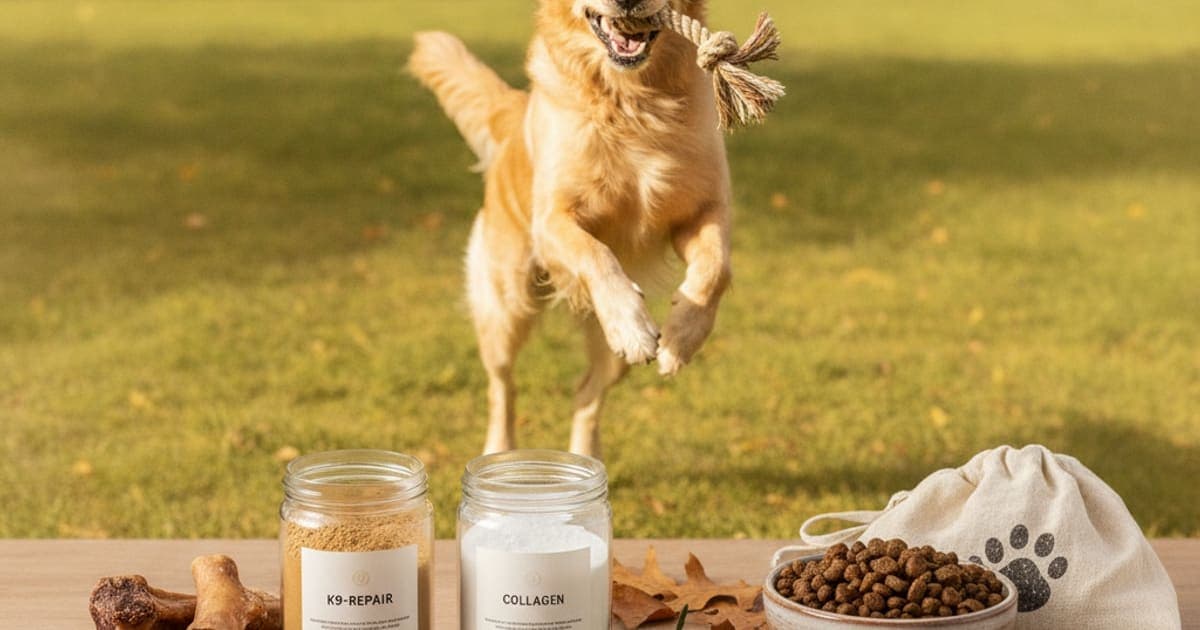
Is K9-REPAIR better than collagen?
For a dog in an active recovery window — after surgery, after an injury, or through a limp that keeps coming back — K9-REPAIR and collagen are not doing the same job, and the peptide formulation is the one owners reach for during that window. Collagen is a nutritional raw material: your dog eats it, digests it, and the amino acids join the pool the body draws on when it builds connective tissue. K9-REPAIR is a signalling formulation built on two peptides, BPC-157 and TB-500, which a growing body of laboratory and animal research suggests interact with the repair machinery itself rather than simply supplying parts for it.
That is the whole comparison in one line: supply versus signal. Collagen stocks the pantry. Peptides are about what the body does with what is in the pantry. Neither one replaces the diagnosis, the medication or the surgical plan your veterinarian sets — they operate in the space that proper veterinary care creates.
What collagen actually does once your dog swallows it
Collagen is the most abundant protein in a dog's body. Type I dominates tendon, ligament, bone and skin. Type II is the structural protein of articular cartilage. Type III appears alongside type I in newly formed wound tissue. So the intuition behind feeding collagen is sound: connective tissue is largely collagen, and an injured dog is rebuilding connective tissue.
Supplemental collagen usually arrives in one of two forms. Hydrolysed collagen — often sold as collagen peptides — has been enzymatically chopped into short chains before it ever reaches the bowl. Digestion continues that work, and what crosses into circulation is mostly free amino acids plus some small di- and tripeptides. Collagen is unusually rich in glycine, proline and hydroxyproline, which happen to be exactly the amino acids collagen synthesis consumes most. Research suggests some of those small fragments survive digestion intact and circulate, and there is genuine scientific interest in whether they act as mild signals to fibroblasts. But the dominant, well-understood role of hydrolysed collagen is nutritional.
Undenatured type II collagen works on a completely different principle. Instead of being broken down for parts, small amounts of intact type II collagen are presented to gut-associated immune tissue, and the proposed mechanism is oral tolerance — a modulation of the immune response directed at joint cartilage. It is an interesting mechanism and worth understanding, but it is not the same thing as supplying building blocks, and the two collagen types should not be discussed as if they were interchangeable.
Here is where collagen's ceiling sits. Nutrition is permissive, not directive. Adding raw material does not instruct the body to remodel a specific tendon, migrate cells into a specific defect, or build capillaries into a specific patch of hypoxic tissue. Most dogs on a complete diet are not short of amino acids to begin with. Collagen may help ensure supply is not the bottleneck. It does not decide what gets built, or how fast.
How BPC-157 and TB-500 operate on a different level
BPC-157 is a synthetic pentadecapeptide — a chain of fifteen amino acids — based on a sequence identified within a protein found in gastric juice. Laboratory and animal research on it has clustered around tissue repair: fibroblast outgrowth and migration in tendon and ligament tissue, angiogenesis, and interaction with growth factor signalling pathways. Research suggests these are the mechanisms through which it exerts its effects. It is not an FDA-approved veterinary drug, and nothing about it should be described as treating a condition in your dog.
TB-500 is a synthetic fragment of thymosin beta-4, a naturally occurring peptide found across mammalian tissue and concentrated notably in platelets and wound fluid. Thymosin beta-4's best-characterised biological job is binding actin — the protein cells use to change shape and physically crawl through tissue. Cell migration is often the slow step in soft-tissue repair: the raw materials may be present, but the cells that lay them down have to travel to the damaged site and find a blood supply when they get there. Research suggests thymosin beta-4 and its fragments may support both migration and new vessel formation.
That is why the two appear together. Their proposed mechanisms are complementary rather than redundant — one angle on vascular supply and fibroblast activity, another on cell mobility. This is emerging, promising science that owners are adopting during recovery, and honest framing matters: research suggests and owners report, never guarantees.
Collagen supplies the material; peptides are about the signal that determines what the body does with it — which is why owners running a structured recovery treat the two as different tools rather than competing purchases.
Supply versus signal: the comparison at a glance
| Collagen | K9-REPAIR (BPC-157 + TB-500) | |
|---|---|---|
| What it is | A structural dietary protein, usually hydrolysed or undenatured type II | A formulation of two synthetic signalling peptides |
| Proposed mechanism | Supplies amino acids for connective tissue synthesis; undenatured type II acts via oral tolerance | Research suggests support for fibroblast activity, cell migration and angiogenesis |
| Level it acts on | Nutritional supply | Cellular signalling |
| Directs repair to a specific site? | No | Research suggests peptides act on repair processes already underway |
| Typical use pattern | Long-term daily nutrition | The stack owners use through a defined recovery window |
| Regulatory status | Sold as a dietary supplement | BPC-157 and TB-500 are not FDA-approved veterinary drugs; educational use only |
| Dosing approach | Varies by product | Weight-based — confirm with your veterinarian |
| What owners report | Gradual, general support | Interest during post-injury and post-operative recovery |
Where each one earns its place in a recovery timeline
Think of a cruciate ligament injury, because it is the single most common orthopaedic problem in dogs and it illustrates the point cleanly. Your veterinarian diagnoses it, decides between surgical stabilisation and conservative management, prescribes pain control, and sets the rehabilitation schedule. That is the plan, and nothing discussed here substitutes for any part of it.
Inside that plan there is a repair timeline with a shape. In the first weeks after injury or surgery, inflammation resolves and cells migrate into the healing zone. Over the following months, disorganised early collagen is progressively replaced and reorganised along lines of load — the tendon-bone interface and the surrounding soft tissue remodel slowly, and controlled loading during rehabilitation is part of what directs that remodelling. This is the window where owners are most interested in signalling peptides, because it is the window where cell migration and blood supply are doing the heavy lifting.
Collagen's best fit is different and longer. A senior dog with chronic joint change, a working dog under sustained load, a large-breed dog whose connective tissue is under lifelong mechanical stress — that is where a daily collagen supplement makes quiet sense as ongoing nutritional support, alongside weight management, which remains one of the most powerful things any owner can control.
For an intermittent limp with no diagnosis yet, neither product is the first move. The first move is an examination. Ask your veterinarian what is actually injured before you decide what to support it with.
Label reading: what separates a serious formulation from a flavoured chew
The collagen aisle is where skepticism belongs. A great deal of what is sold as a joint supplement is a kitchen-sink chew: eleven ingredients on the front panel, a proprietary blend on the back that hides how little of each is present, and a flavour system doing most of the work. Collagen appearing on a label tells you nothing about the amount, the type, or whether the type present matches the mechanism being advertised. Undenatured type II collagen and hydrolysed collagen are not interchangeable, and a label that does not distinguish them is telling you something.
The questions worth asking of any product you put in your dog: What exactly is in it, in what amount, per serving? Is there third-party testing, and can you see a certificate of analysis? Is dosing guidance based on your dog's weight, or is it one scoop for a chihuahua and a mastiff alike? K9-REPAIR is formulated as a defined two-peptide combination rather than a long ingredient list, is third-party tested with COAs available, uses weight-based dosing guidance, ships direct to your door, and is backed by a 60-day money-back guarantee. Those are descriptive facts about the product, and they are the kind of facts a label should be able to answer for anything else you are considering.
Running both: what owners actually do
Collagen and peptides are not chemically at odds. Plenty of owners feed a collagen supplement as part of daily nutrition and add K9-REPAIR through a defined recovery period, on the reasoning that supply and signal are separate problems. That is a sensible way to think about it, and it is worth raising with your veterinarian — particularly if your dog is on prescribed medication such as carprofen, gabapentin or a monoclonal antibody injection, all of which stay exactly as prescribed. Supplements are layered onto a veterinary plan. They are never a reason to change or stop one.
Key Takeaways
- Collagen is nutritional supply; BPC-157 and TB-500 are signalling peptides. They work at different levels of the same biological problem.
- Hydrolysed collagen mainly contributes amino acids; undenatured type II collagen has a distinct immune-tolerance mechanism. Labels should say which one they contain.
- Research suggests BPC-157 and TB-500 may support fibroblast activity, cell migration and new blood vessel formation — the processes that dominate a soft-tissue recovery window.
- BPC-157 and TB-500 are not FDA-approved veterinary drugs. All of this is educational, and no outcome is promised for your individual dog.
- Judge any joint product on ingredient transparency, third-party testing, COAs and weight-based dosing — not on the length of its ingredient list.
- Owners commonly use both, with collagen as long-term daily support and K9-REPAIR through the active recovery period.
Your veterinarian owns the diagnosis and the plan
A limp is a symptom, not a diagnosis, and the distance between a partial cruciate tear, an iliopsoas strain, a luxating patella and early hip arthritis is measured by examination and imaging — not by a supplement decision. Your veterinarian determines what is wrong, whether surgery is indicated, what pain control is appropriate, and how rehabilitation should be loaded and progressed. That plan is the foundation. Collagen and peptides operate in the space it creates, supporting a body that is already being given the right conditions to do its work. Bring the comparison in this article to your next appointment and decide together.
If you are comparing across the wider supplement market, these breakdowns cover the same supply-versus-signal question against other popular options: bpc-157 vs zesty paws for dogs and bpc-157 vs vetriscience for dogs, and full formulation details for K9-REPAIR are available from pawgen.
Owners exploring peptide support for their dog can review K9-REPAIR — BPC-157 + TB-500 formulated for dogs — at https://pawgen.com/. BPC-157 and TB-500 are not FDA-approved veterinary drugs. Nothing in this article treats, cures or prevents any condition; every decision about your dog's care belongs with your veterinarian.
Frequently asked questions
- What can I give a dog that is intermittent limping?
- Nothing before a veterinary exam identifies the cause; intermittent limping can come from a partial cruciate tear, soft-tissue strain or early arthritis, and each needs a different plan. Once your vet has diagnosed it, owners commonly add joint nutrition or a peptide formulation such as K9-REPAIR alongside the prescribed treatment.
- Is a dog intermittent limping an emergency?
- Usually not an emergency, but it is not something to wait out either. Book a veterinary exam within a few days. Treat it as urgent if the limp follows obvious trauma, if the leg is swollen, hot or hanging, or if your dog is vocalising, refusing food or unable to settle.
- Why is my dog holding up a back leg?
- A dog holds up a back leg when weight-bearing hurts or the limb cannot stabilise. Common causes include cruciate ligament injury, patellar luxation, a paw or nail injury, an insect sting, hip or stifle arthritis, and less often a fracture or nerve problem. Only an examination distinguishes them.
- Should I worry if my dog is holding up a back leg?
- Take it seriously, yes. Complete non-weight-bearing signals more than mild soreness, and in medium and large breeds it often points toward the cruciate ligament. Keep your dog quiet, avoid stairs and jumping, skip any human painkillers entirely, and get a veterinary assessment rather than watching for a week.
- When should I take a dog to the vet for holding up a back leg?
- Same day if the leg is non-weight-bearing after trauma, visibly swollen or deformed, hot to the touch, or if your dog is crying, trembling or will not settle. Within a day or two for a leg held up intermittently with no other signs. Sooner for puppies and seniors.
- What can I give a dog that is holding up a back leg?
- Rest and a call to your veterinarian, not medication from your cupboard. Human anti-inflammatories are dangerous to dogs. Your vet decides on pain relief, imaging and whether surgery is needed; supportive options such as collagen or K9-REPAIR belong in the conversation afterwards, layered onto that plan rather than substituted for it.
- Can I give my dog collagen and K9-REPAIR at the same time?
- Owners commonly run both, because they work on different levels: collagen supplies amino acids used in connective tissue synthesis, while BPC-157 and TB-500 are signalling peptides. They are not chemically competing. Check the combination with your veterinarian first, especially if your dog is on prescribed medication.
- Is collagen enough on its own for a dog recovering from a CCL injury?
- Collagen alone is nutrition, not a recovery plan. A cruciate injury is decided by your veterinarian — surgical repair, rehabilitation, weight management and pain control. Owners layer collagen for raw material and K9-REPAIR for its peptide signalling on top of that plan, never in place of it.
Educational content. BPC-157 and TB-500 are not FDA-approved veterinary drugs. Talk to your veterinarian before starting anything new, especially if your dog is on prescribed medication.