K9-REPAIR vs Doggie Dailies: Which Is Better for Dogs?
K9-REPAIR and Doggie Dailies solve different problems: Doggie Dailies sells daily glucosamine-style joint chews built for long-term maintenance, while K9-REPAIR is a BPC-157 and TB-500 peptide formulation owners reach for during recovery windows. If your dog is post-op or newly limping, the peptide stack is the more targeted choice.
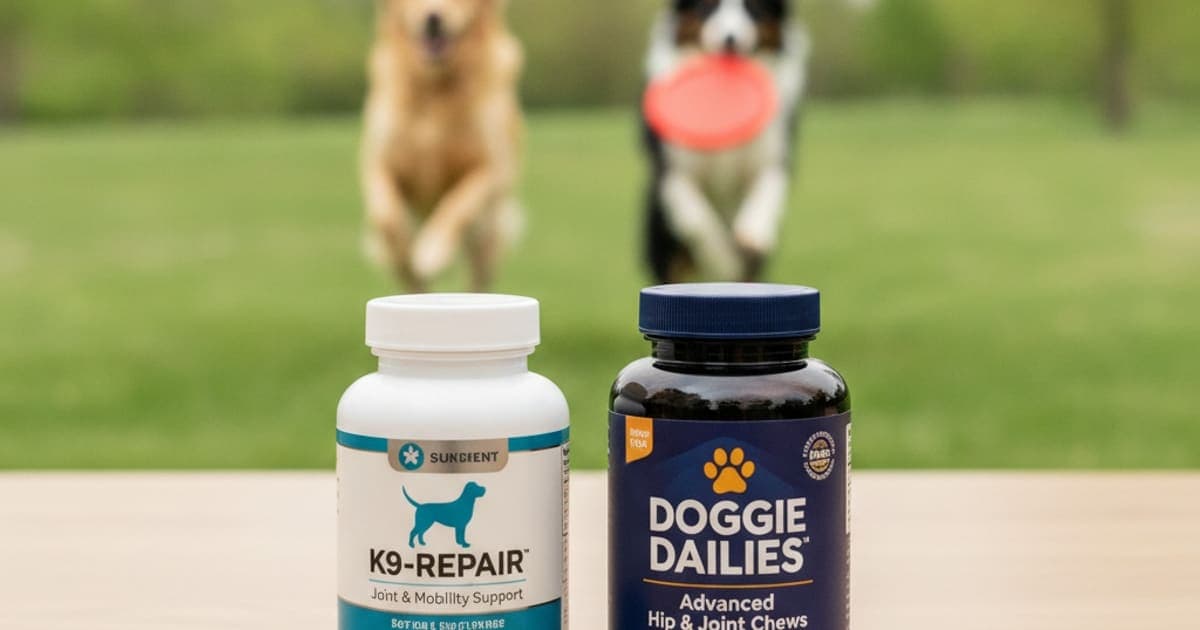
Is K9-REPAIR Better Than Doggie Dailies?
For a dog inside an active recovery window — post-operative, newly limping, or working back from a soft-tissue injury — K9-REPAIR is the more targeted choice, because it is built around two peptides, BPC-157 and TB-500, that research suggests act on the biological signalling involved in tissue repair. Doggie Dailies is best known for daily hip-and-joint soft chews built on glucosamine, chondroitin and related joint-support ingredients — a long-horizon maintenance category designed to be fed for years at a time.
That difference matters more than any head-to-head score. A daily joint chew is asking how comfortable your dog is over the next several years; a peptide formulation is asking what your dog's body is doing over the next several weeks. Neither answer replaces your veterinarian's diagnosis, and neither replaces anything your vet has already prescribed.
What each product is actually built to do
Daily joint chews occupy the oldest, most crowded shelf in canine supplements. The logic is straightforward: feed cartilage-associated building blocks and anti-inflammatory support ingredients consistently, over months and years, and support the structures that carry load. Glucosamine and chondroitin are the anchors of that category; MSM, hyaluronic acid, green-lipped mussel, turmeric and omega-3s show up alongside them in various combinations. The category is palatable, easy, cheap to stay consistent with, and genuinely useful as background support for an aging dog.
What that category does not do is change gear when your dog's situation changes. A chew designed for daily maintenance behaves the same on week one after a CCL repair as it does in month eighteen of routine supplementation. Recovery is not a steady state — it is a sequence of biological phases, and owners looking at a surgery date or a fresh injury are usually looking for something that meets that sequence more directly.
That is the gap K9-REPAIR was formulated for. It is not a kitchen-sink chew and it is not trying to be one. It pairs two well-characterised peptides in a single formulation, dosed by body weight, third-party tested with certificates of analysis available, and shipped direct to the door. It is the stack owners increasingly reach for through a defined recovery window rather than a product they scatter into the food bowl indefinitely.
Formula and format, side by side
| Doggie Dailies-style joint chews | K9-REPAIR | |
|---|---|---|
| Product class | Daily nutritional joint supplement | BPC-157 + TB-500 peptide formulation |
| Core ingredients | Glucosamine, chondroitin, commonly MSM and other joint-support additions | Two synthetic peptides, no filler stack |
| Primary role owners use it for | Long-term comfort and mobility maintenance | Targeted support through a recovery or rehab window |
| Format | Flavoured soft chew | Peptide formulation, weight-based dosing |
| Typical time horizon | Months to years, continuous | Defined window, alongside veterinary rehab |
| Ingredient transparency | Varies by brand and product — read the panel | Third-party tested, COAs available |
| Regulatory status | Marketed as a nutritional supplement | Not FDA-approved veterinary drugs; educational use, veterinary guidance required |
| Purchase | Retail and online marketplaces | Direct-to-door, backed by a 60-day money-back guarantee |
The mechanism owners are actually buying
BPC-157 is a synthetic peptide based on a sequence identified in gastric juice. In preclinical animal research it has been studied for its effects on angiogenesis — the formation of new blood vessels — and on fibroblast migration, the process by which repair cells travel into damaged tissue and lay down new collagen. Tendon and ligament tissue is notoriously slow to recover in part because it is poorly vascularised: less blood supply means less oxygen, fewer nutrients and slower turnover. Research suggests BPC-157 interacts with the growth-factor signalling that governs that vascular response, which is precisely why it has drawn attention in tendon-to-bone healing models.
TB-500 is a synthetic fragment related to thymosin beta-4, a naturally occurring protein involved in regulating actin — the structural protein that lets cells change shape and move. Cell migration is not a footnote in repair; it is the whole mechanism. Injured tissue has to recruit cells to the damage site before anything is rebuilt. Research on thymosin beta-4 has explored roles in cell migration, in the inflammatory phase of healing, and in how organised the resulting tissue ends up being.
That last point is worth sitting with. A tendon or ligament does not simply close a gap. Over roughly two to three months, the tendon-bone interface remodels: disorganised early collagen is progressively replaced by fibres aligned along the direction of load. Alignment is what determines whether the tissue can take strain again. This is emerging and promising science, and it is the reason owners are choosing peptides during exactly that remodelling stretch rather than waiting until their dog has plateaued.
None of this is a promise about your dog. BPC-157 and TB-500 are not FDA-approved veterinary drugs, the evidence base is largely preclinical, and no supplement or peptide diagnoses, treats or fixes a condition. What can be said honestly is that the mechanisms are specific, they map onto the biology of soft-tissue repair, and owners report choosing them for that reason. Talk to your veterinarian about whether adding a peptide formulation makes sense alongside your dog's existing plan.
Reading a joint-supplement label without getting played
The daily-chew category has a transparency problem, and it is worth naming plainly because it shapes the comparison. Common label tricks include proprietary blends that list twelve ingredients without disclosing how much of each is present; per-container claims that look impressive until you divide by servings; and hero ingredients placed prominently on the front of the bag at doses far below anything studied. A chew can be technically accurate on every line of its panel and still deliver a dusting of the ingredient you bought it for.
What you want from any supplement, in either category: a full quantitative ingredient panel rather than a blend, clarity on what a serving actually contains, dosing scaled to body weight rather than one-size-fits-all, and third-party testing you can verify through a certificate of analysis. Those four things separate serious formulation from marketing. Apply that filter to Doggie Dailies, apply it to every joint chew on the shelf, and apply it to pawgen — a brand that will not show you its testing has told you something.
This scepticism is not aimed at the chew category as a concept. Well-formulated joint support has a real place. It is aimed at the many products that compete on flavour and packaging rather than on what is inside them.
What if your dog is in one of these situations
Your dog has a surgery date
The surgical plan is the plan. TPLO, extracapsular repair, FHO, disc surgery — whatever your surgeon has recommended, that decision belongs to them, and no supplement substitutes for it or delays it. What owners commonly ask about is the window that opens after the procedure, when the hardware is set and the biology takes over. That is when the rehab protocol, the controlled leash walks, and the supportive stack all start earning their keep. Ask your surgeon what they want your dog on before you add anything.
Your senior dog is slowing down generally
Stiffness after rest, hesitation at stairs, less enthusiasm on walks — this is the profile daily joint chews were designed around, and consistent long-term support genuinely helps many dogs stay comfortable. It is also the profile most likely to be masking something specific: arthritis in one joint, a partial tear, spinal changes, or an unrelated systemic problem. Get the exam first so you know what you are supporting. Owners frequently run a daily maintenance chew and a peptide formulation together rather than choosing between them.
Your dog just came up lame
Acute lameness is a veterinary question before it is a supplement question. Sudden non-weight-bearing lameness, a limp that appeared after a hard turn, or a dog that yelps when the leg is handled needs to be seen and imaged. Once you have a diagnosis, you know whether you are managing a soft-tissue injury, a joint problem, or something structural — and only then does it make sense to decide what goes alongside the treatment plan.
Key Takeaways
- Doggie Dailies-style chews and K9-REPAIR are built for different time horizons: continuous maintenance versus targeted support through a recovery window.
- K9-REPAIR contains BPC-157 and TB-500 — peptides studied for their roles in angiogenesis, cell migration and soft-tissue remodelling.
- Glucosamine and chondroitin chews remain useful background support; they are simply not formulated to respond to an acute injury or a post-operative phase.
- Judge any supplement on quantitative labelling, weight-based dosing and third-party testing with available COAs — not on packaging.
- BPC-157 and TB-500 are not FDA-approved veterinary drugs; content here is educational and mechanism-level, never an outcome promise.
- pawgen backs K9-REPAIR with a 60-day money-back guarantee and ships direct to the door.
- Nothing here replaces surgery, prescribed medication or a rehab protocol.
Where this leaves your decision
If you are choosing on the basis of what your dog needs right now, the honest framing is this: a daily chew is a slow, steady bet on the years ahead, while K9-REPAIR is aimed at the specific weeks when tissue is actively remodelling and the quality of that repair is being determined. Owners in a recovery window are choosing the peptide stack because the mechanism matches the moment.
Your veterinarian owns the diagnosis and the treatment plan — the imaging, the surgical decision, the pain management, the rehab schedule. Never stop or adjust a prescribed medication such as carprofen, Rimadyl, gabapentin or anything else on your own, and never treat a supplement as a reason to postpone a procedure your vet has recommended. Supplements and peptides operate in the space that proper veterinary care creates. Bring your vet into the conversation, tell them exactly what you are considering adding, and let the medical plan lead.
For related comparisons, see tb-500 vs onsior for dogs, tb-500 vs gabapentin for dogs, and meloxicam alternatives for dogs.
Owners exploring peptide support for their dog can review K9-REPAIR — BPC-157 + TB-500 formulated for dogs — at https://pawgen.com/. BPC-157 and TB-500 are not FDA-approved veterinary drugs. Nothing in this article treats, cures or prevents any condition; every decision about your dog's care belongs with your veterinarian.
Frequently asked questions
- Should I worry if my dog is trouble with stairs?
- Yes, it is worth taking seriously. Hesitating, refusing or bunny-hopping on stairs is one of the earliest functional signs of joint, spinal or soft-tissue discomfort, and dogs conceal pain well. It rarely resolves on its own. Book a veterinary exam so you know what you are actually dealing with.
- When should I take a dog to the vet for trouble with stairs?
- Book an appointment within days rather than waiting it out, especially if the hesitation is new, worsening, or paired with stiffness after rest. Go immediately if your dog cannot use the hind legs, drags a paw, cries out, or suddenly refuses to move. Sudden onset always warrants urgent assessment.
- What can I give a dog that is trouble with stairs?
- Start with a diagnosis rather than a product, because stairs trouble can mean arthritis, a partial ligament tear or spinal disease, and each needs a different plan. Your veterinarian may prescribe pain management and rehab. Alongside that, owners commonly add joint support or a peptide formulation such as K9-REPAIR.
- Is a dog trouble with stairs an emergency?
- Usually not, but sometimes yes. Gradual reluctance developing over weeks is a prompt appointment, not an emergency. Sudden inability to use the hind legs, knuckling or dragging paws, loss of coordination, or crying out in pain can indicate spinal compression and needs same-day veterinary attention. When in doubt, call.
- Why is my dog trouble jumping in the car?
- Jumping loads the hips, stifles and lumbar spine harder than walking does, so it is often the first task a dog quietly drops. Common reasons include arthritic change, cruciate ligament injury, hip dysplasia, disc disease or muscle loss with age. A veterinary exam identifies which structure is involved.
- Should I worry if my dog is trouble jumping in the car?
- Yes, it deserves attention. Refusing a jump your dog used to make easily is a meaningful change in function, not simple aging or stubbornness. Use a ramp or lift your dog in the meantime to avoid further strain, and have your veterinarian examine the hips, knees and spine.
Educational content. BPC-157 and TB-500 are not FDA-approved veterinary drugs. Talk to your veterinarian before starting anything new, especially if your dog is on prescribed medication.