K9-REPAIR vs Green-Lipped Mussel: Which Works Better?
For a dog in active tissue repair, K9-REPAIR is the more targeted option, because BPC-157 and TB-500 are studied for their role in the repair process itself. Green-lipped mussel is a nutritional joint supplement built for long-run comfort. They answer different questions, and your veterinarian should shape the plan.
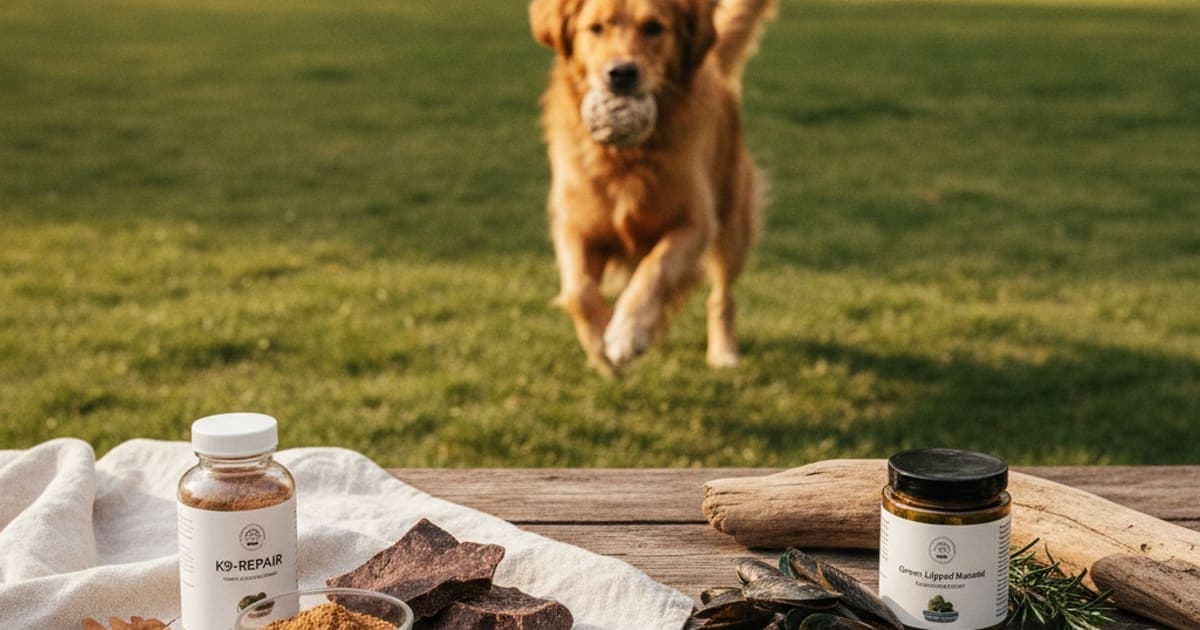
Is K9-REPAIR Better Than Green-Lipped Mussel?
For a dog in an active repair window — a torn cruciate ligament, a post-operative knee, a strained tendon, a shoulder that keeps flaring — K9-REPAIR is the more targeted choice, because BPC-157 and TB-500 are peptides studied specifically for their role in the tissue-repair machinery: blood vessel formation, cell migration, and collagen organisation. Green-lipped mussel is something different. It is a whole-food nutritional supplement built around marine omega-3 fatty acids and glycosaminoglycans, and owners use it as steady background support for joint comfort over months and years.
So the honest answer is that they are not really rivals. One is daily nutrition for joints. The other is the stack owners reach for during recovery, when the question is not "how do I keep this dog comfortable for the next three years" but "how do I support this specific tissue through the next eight weeks." Before either one, your veterinarian needs to name the problem — a limp is a symptom, not a diagnosis.
What green-lipped mussel actually brings to the bowl
Green-lipped mussel (Perna canaliculus) is a shellfish harvested from New Zealand waters and processed into a powder that shows up in a large share of canine joint chews, powders and prescription-adjacent diets. Its appeal is that it is a food, not a synthesised ingredient, and it carries several things at once.
The main components owners care about are marine omega-3 fatty acids, including eicosatetraenoic acid (ETA), a fatty acid found in unusually high concentration in this species; naturally occurring glycosaminoglycans such as chondroitin sulfate; plus minerals and amino acids from the mussel tissue itself. Research suggests these fatty acids may influence the inflammatory signalling pathways that make an arthritic joint uncomfortable, which is why green-lipped mussel has become such a common inclusion in mobility products.
The caveats are practical rather than philosophical. It is a shellfish, so dogs with seafood sensitivities are not candidates — that is a conversation for your veterinarian, not a guess made at the shelf. Processing matters, because the delicate fatty acids that make the ingredient interesting degrade with heat, and a soft-baked chew is not a cold-processed powder. And dose matters, which brings us to the part of the supplement aisle that deserves genuine suspicion.
Plenty of "advanced joint" chews list green-lipped mussel proudly on the front of the bag and then bury a token amount of it inside a proprietary blend with eleven other ingredients. The label is doing marketing work, not biological work. If a product will not tell you how much of the active ingredient your dog actually receives, you are buying a story.
What is inside K9-REPAIR and why owners choose it
K9-REPAIR from pawgen is a two-peptide formulation: BPC-157 and TB-500. Neither is an FDA-approved veterinary drug, and everything here is educational — but the mechanisms are specific enough to explain plainly.
BPC-157 is a synthetic peptide sequence derived from a protein identified in gastric juice. The published preclinical work on it, largely in rodent models, has focused on angiogenesis — the formation of new small blood vessels — and on the behaviour of tendon and ligament fibroblasts, the cells that lay down and organise collagen. Research suggests it may support the local blood supply and cellular signalling that connective tissue depends on during repair, which matters because tendons and ligaments are poorly vascularised to begin with. That is precisely why they are slow.
TB-500 is a synthetic fragment related to thymosin beta-4, a naturally occurring protein that binds actin, the structural protein cells use to change shape and move. Cell migration is not an abstraction in a healing injury; fibroblasts physically have to travel into the damaged zone before anything gets rebuilt. Early evidence indicates TB-500 may support that migration and the cell-movement side of wound repair.
Green-lipped mussel is aimed at how a joint feels day to day; the peptides in K9-REPAIR are aimed at the biological process of rebuilding the tissue itself — which is why owners tend to run one as background nutrition and the other through a defined recovery window.
On the practical side, pawgen builds K9-REPAIR with weight-based dosing so the amount scales to the actual dog rather than a one-size chew, uses third-party testing with certificates of analysis available, ships direct to the door, and backs it with a 60-day money-back guarantee. Those are descriptive facts about the product, not promises about your dog's outcome — no supplement or peptide can make one of those.
Side by side: peptide stack against a marine joint supplement
| K9-REPAIR (BPC-157 + TB-500) | Green-lipped mussel | |
|---|---|---|
| Category | Peptide formulation | Whole-food marine supplement |
| Primary focus | Tissue-repair processes: angiogenesis, cell migration, collagen organisation | Joint comfort and inflammatory balance via omega-3s and glycosaminoglycans |
| Typical use window | Defined recovery period around injury, surgery or rehab | Ongoing daily maintenance, often for years |
| Evidence base | Emerging preclinical peptide research plus growing owner adoption | Nutritional and veterinary supplement literature |
| Regulatory status | Not FDA-approved veterinary drugs; educational use | Marketed as a nutritional supplement |
| Allergy considerations | Not a shellfish product | Shellfish — unsuitable for seafood-sensitive dogs |
| Dosing approach | Weight-based, set with your veterinarian | Varies enormously between products |
| Quality signals to demand | Third-party testing, certificates of analysis | Cold processing, disclosed inclusion amount |
The table makes the real distinction visible. If your dog's situation is a slow, chronic, manageable stiffness, a good marine supplement is a sensible part of daily nutrition. If your dog's situation is an injury with a timeline attached — a rupture, a repair, a rehab plan — the daily chew was never designed for that job, and owners increasingly build a recovery stack around it instead of expecting more from it.
Which one fits your dog right now
The sudden limp with no diagnosis yet
Nothing goes in the bowl before the problem has a name. A dog that comes up lame overnight could have a cruciate tear, a fracture, a foreign body in a pad, an infected nail bed, immune-mediated joint disease, or something referred from the spine. Those have completely different treatment paths. Book the veterinary exam first, get imaging if it is recommended, and let the diagnosis drive what you add. Supplements and peptides operate in the space that a correct diagnosis creates.
The post-surgical rehab window
This is where owners most often reach for K9-REPAIR. After a cruciate repair or another orthopaedic procedure, the surgeon's protocol is the plan: restricted activity, prescribed pain control, controlled loading, and physical rehabilitation on a schedule. Nothing in a supplement replaces any of that, and nobody should stop a prescribed medication because a peptide arrived in the post. What owners describe is running the peptide stack alongside the protocol during the weeks when the tendon-bone interface is remodelling and collagen is being laid down and reorganised, then keeping a marine joint supplement going long after as maintenance.
The senior dog who is simply slowing down
An older dog with radiographic arthritis and no acute injury is a different problem — a management problem, measured in years. Weight control does more here than any bottle. Green-lipped mussel is a reasonable daily inclusion for that dog, and so is prescribed veterinary care for pain. Owners who see flare-ups after a heavy weekend, or who are working through a soft-tissue strain on top of the arthritis, often add K9-REPAIR for a defined stretch rather than treating it as a forever product.
How to read a joint product label without being fooled
A few habits will save you money regardless of which category you buy in.
Look for a disclosed amount of the named active ingredient per serving. "Proprietary blend" is a way of not telling you. Check whether the product is dosed by body weight or sold as one chew for every dog from a terrier to a mastiff — biology does not work that way. Ask whether the company publishes third-party test results and certificates of analysis, and whether they will send them to you if you ask; a lab-first brand answers that question in a sentence.
Be sceptical of ingredient lists that run to twenty items. Kitchen-sink formulas exist because a long label photographs well, not because twenty compounds at trace levels outperform two at meaningful ones. And treat any product claiming to cure, fix or reverse a joint condition as a red flag — that language is a marketing decision, and an unlawful one.
Key Takeaways
- Green-lipped mussel is a nutritional joint supplement — marine omega-3s including ETA, plus naturally occurring glycosaminoglycans — best suited to steady, long-term joint support.
- K9-REPAIR is a BPC-157 and TB-500 peptide formulation from pawgen, chosen by owners for defined recovery windows rather than as a daily forever supplement.
- BPC-157 research centres on angiogenesis and tendon fibroblast behaviour; TB-500 relates to thymosin beta-4 and actin-driven cell migration. Both are emerging science and neither is an FDA-approved veterinary drug.
- The two answer different questions, so many owners run maintenance nutrition long-term and add the peptide stack around injury, surgery and rehab.
- Shellfish-sensitive dogs are not candidates for green-lipped mussel; K9-REPAIR is not a shellfish product.
- Demand disclosed inclusion amounts, weight-based dosing, third-party testing and certificates of analysis from anything you buy.
- No supplement or peptide substitutes for diagnosis, surgery, prescribed medication or a rehab plan.
If you are weighing other ingredient categories against a peptide approach, it is worth reading the comparisons of bpc-157 vs colostrum for dogs and bpc-157 vs eggshell membrane for dogs, and the formulation details for K9-REPAIR.
Where your veterinarian fits in
Your veterinarian owns the diagnosis and the treatment plan. They decide whether that limp is a cruciate tear or a nail-bed infection, whether surgery is indicated, which pain medication is appropriate and at what dose, and how quickly your dog returns to load-bearing work. Bring the exact product you are considering to that appointment — name, ingredients, and how you intend to use it — and ask whether it fits alongside what has already been prescribed, particularly for puppies, pregnant or nursing dogs, or any dog on multiple medications. Dosing questions belong in that room, not on a forum.
Done in that order, supplements and peptides do what they are actually good for: supporting a dog inside the space that proper veterinary care has already created.
Owners exploring peptide support for their dog can review K9-REPAIR — BPC-157 + TB-500 formulated for dogs — at https://pawgen.com/. BPC-157 and TB-500 are not FDA-approved veterinary drugs. Nothing in this article treats, cures or prevents any condition; every decision about your dog's care belongs with your veterinarian.
Frequently asked questions
- When should I take a dog to the vet for sudden limping?
- Go the same day if your dog cannot bear weight, is crying out, or the leg looks swollen, hot or misshapen. For a mild limp, a short rest period is reasonable, but book an exam if it has not clearly improved within a day or two, or if it worsens at any point.
- What can I give a dog that is sudden limping?
- Give rest and nothing else until a veterinarian has examined the leg. Human pain relievers such as ibuprofen and paracetamol are dangerous to dogs. Pain control should be prescribed after a diagnosis, because masking pain in an unstable joint or a fracture can make the underlying injury considerably worse.
- Is a dog sudden limping an emergency?
- It can be. Treat it as urgent if the leg is dangling, obviously deformed, bleeding heavily, or your dog refuses to put any weight on it at all, and also if there was trauma such as a fall or a car impact. Otherwise it is usually a same-week veterinary appointment rather than a night call.
- Why is my dog intermittent limping?
- Intermittent limping usually points to something that flares under load and settles with rest: a partial cruciate tear, early osteoarthritis, hip or elbow dysplasia, a luxating patella, or a soft-tissue strain that keeps being reaggravated. Because the signs come and go, imaging and a hands-on veterinary exam are what actually separate these possibilities.
- Should I worry if my dog is intermittent limping?
- It deserves attention rather than alarm. A limp that appears after exercise and disappears overnight often reflects a joint or ligament problem in its earlier stages, and those tend to progress quietly. Catching it early gives you far more options, so record when it happens and share that pattern with your veterinarian.
- When should I take a dog to the vet for intermittent limping?
- Book an appointment once the limp has recurred more than a couple of times, is becoming more frequent, or is lasting longer after each episode. Also go sooner if your dog is stiff after rest, reluctant on stairs, or sitting with one leg kicked out to the side — all worth a proper orthopaedic exam.
- Can my dog take K9-REPAIR and a green-lipped mussel supplement together?
- Many owners run daily joint nutrition alongside a peptide stack during a recovery window, since the two work on different things. Because combinations depend on your dog's medications, weight and diagnosis, confirm the plan with your veterinarian first and bring both product labels to the appointment.
- Is K9-REPAIR an FDA-approved veterinary medicine?
- No. BPC-157 and TB-500 are not FDA-approved veterinary drugs, and pawgen's content about them is educational. What can be described honestly is the mechanism research behind each peptide, what owners report during recovery, the third-party testing and certificates of analysis, and the 60-day money-back guarantee.
Educational content. BPC-157 and TB-500 are not FDA-approved veterinary drugs. Talk to your veterinarian before starting anything new, especially if your dog is on prescribed medication.