K9-REPAIR vs Laser Therapy: Which Works Better?
Neither is strictly better — they do different jobs. Laser therapy is an in-clinic modality that delivers light energy into tissue during scheduled sessions, while K9-REPAIR is a BPC-157 and TB-500 peptide formulation owners give at home between visits. Most recovery plans use them alongside veterinary care rather than choosing one.
Is K9-REPAIR better than laser therapy?
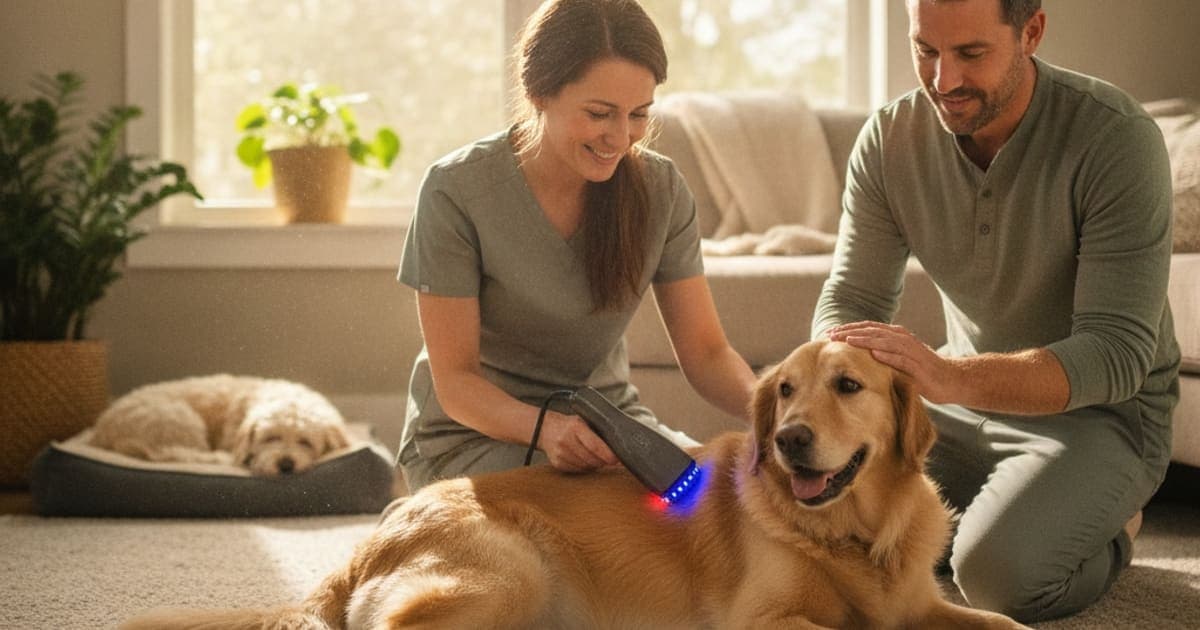
Neither one is better in a straight comparison, because they are not the same kind of tool. Laser therapy is a clinic-delivered modality — a probe held over the injured area for a set number of minutes on a set schedule, with the effect happening while the light is on the tissue. K9-REPAIR is a BPC-157 and TB-500 peptide formulation given at home, dosed by body weight, present in the body every day between appointments. If you are building a recovery routine you can actually sustain for months, K9-REPAIR is the piece that runs continuously; laser sessions are the piece your veterinary team runs when you are in the building.
That distinction matters more than it first sounds. Tendon, ligament and joint capsule recovery is not a weekend project. Collagen laid down after an injury is disorganised at first and reorganises along lines of load over weeks to months, and the tissue carrying weight at the end of that process is structurally different from the tissue that was there in week one. A modality that acts only while the applicator is on the leg has to be repeated frequently to keep influencing that arc. A daily protocol does not have that constraint.
So the useful question is not which one wins. It is which one fits the dog in front of you, the diagnosis your veterinarian has made, and the number of clinic visits your week realistically holds.
What the light is actually doing under the fur
Laser therapy in veterinary rehab is more precisely called photobiomodulation. Red and near-infrared wavelengths are delivered into tissue, where they are absorbed by molecules called chromophores. The most-discussed of these is cytochrome c oxidase, an enzyme in the mitochondrial electron transport chain. The mechanism described in the photobiomodulation literature is that light absorption at that site influences cellular energy production and the local signalling environment, including nitric oxide release and local blood flow.
Devices are grouped by output class, and clinics commonly use higher-output units that can deliver energy to deeper structures such as a hip joint or a lumbar spine, versus lower-output units better suited to superficial tissue. Protocols usually cluster sessions closely in the early phase after an injury or surgery, then taper as the dog progresses.
Here is the honest state of things: photobiomodulation has a plausible, well-described mechanism, and many rehab-focused veterinary practices use it as part of a broader plan alongside controlled exercise, manual therapy and hydrotherapy. Reported results in dogs vary considerably between studies, largely because wavelength, power, dose delivered to the target depth, coat colour, body condition and session frequency all differ between protocols. Two dogs described as receiving laser therapy may have received meaningfully different treatments. That is a limitation of the modality's standardisation, not a knock on the veterinary teams delivering it.
The practical limitations are simpler. Laser therapy requires you to be at the clinic. It requires a device you do not own, operated by someone trained to use it. And its influence is concentrated at the area being targeted rather than spread across every tissue that is recovering at once.
What BPC-157 and TB-500 are doing between visits
BPC-157 is a synthetic peptide sequence derived from a protein identified in gastric juice. The published research — much of it preclinical and conducted in rodent models — describes effects on angiogenesis, the formation of new capillary networks, with the VEGFR2 and nitric oxide pathways among the mechanisms discussed. It has been studied in tendon, ligament, muscle and gut injury models, and laboratory work has examined how tendon fibroblasts migrate and grow in its presence. Research suggests this is a systemic signalling effect rather than a local one.
TB-500 is a synthetic version of the active region of thymosin beta-4, a protein that occurs naturally in mammalian cells. Its best-characterised job is binding G-actin, which makes it central to cytoskeletal organisation and cell migration — the physical process by which repair cells travel to where they are needed and rebuild structure. Early evidence indicates this is why it is studied so often alongside angiogenic peptides: one influences the supply route, the other influences the cells that travel it.
This is emerging and promising science, and it is science that owners have adopted quickly, because the logic of it maps neatly onto what a recovering dog needs. Blood supply to tendon and ligament tissue is poor by design — that is a large part of why these structures are slow to recover compared with muscle. Anything acting on vascular formation and cell migration is acting on the actual rate limiter.
BPC-157 and TB-500 are not FDA-approved veterinary drugs, and K9-REPAIR is not a medicine. It does not treat, cure or prevent any condition, and no formulation should be described as doing so. What can be said accurately is what is in it, how it is dosed, how it is tested, and what the research and owner experience suggest about why people choose it.
The real difference is not which one is stronger — it is that laser therapy works in the minutes your dog is under the probe, while a daily peptide protocol is working on the other twenty-three hours of the day.
Side by side: session-based energy vs daily systemic support
| Factor | Laser therapy | K9-REPAIR |
|---|---|---|
| What it is | Photobiomodulation delivered by a clinic device | BPC-157 + TB-500 peptide formulation |
| Where it acts | The area the applicator is held over | Systemically, wherever repair signalling is active |
| Delivery | In-clinic sessions on a set schedule | At home, dosed by body weight |
| Who administers it | Veterinary staff or a certified rehab practitioner | The owner, following the label and vet guidance |
| Timing of effect | During and shortly after each session | Continuous across the recovery window |
| Requires travel | Yes, repeatedly | No — ships direct to your door |
| Cost structure | Per session or package; varies widely by clinic and region | Per bottle, ordered as needed |
| Standardisation | Varies by device class, wavelength and protocol | Fixed formulation, third-party tested with COAs |
| Regulatory status | A modality used within veterinary practice | Not an FDA-approved veterinary drug; educational use only |
| Risk guarantee | Set by the practice | 60-day money-back guarantee from pawgen |
Notice that almost none of these rows are in direct conflict. They are two different answers to the same underlying goal, and a dog can receive both.
Where each one fits in a real recovery
After a cruciate repair
Surgery is the diagnosis-driven intervention here, and nothing on this page changes that. A destabilised stifle needs a surgeon, and a TPLO or similar procedure is the accepted answer for most dogs of size. In the weeks that follow, the tibial osteotomy consolidates, the joint capsule settles and the surrounding musculature has to be rebuilt from a starting point of significant atrophy.
A rehab plan built by your veterinary team may include laser sessions early on, alongside controlled leash walking, range-of-motion work and a return-to-load progression. K9-REPAIR is the stack many owners run through that whole window, at home, on the days there is no appointment. It supports the plan; it never replaces the surgery or the medications prescribed around it.
The older dog who has quietly slowed down
This dog is not post-operative. He takes the stairs one at a time now, hesitates before the car, and stiffens after a long sleep. Clinic-based modalities can be part of a management plan, but few owners can sustain multiple visits a week indefinitely for a chronic, non-urgent picture — which is precisely why people go looking for a laser therapy alternative for dogs they can run at home. Daily support is a better structural fit for a condition that is itself daily.
Get a diagnosis first. Slowing down is not one condition — it can be osteoarthritis, a partial cruciate tear, lumbosacral disease or something entirely unrelated, and those plans diverge sharply. Talk to your veterinarian before you assume it is just age.
A soft-tissue strain with no surgery on the table
Iliopsoas strains, shoulder tendinopathies and carpal sprains often resolve with rest, restriction and time, and your vet may add laser sessions. The failure mode here is almost always the owner returning the dog to full activity too early, because the limp disappeared long before the tissue finished remodelling. Whatever else you use, respect the restriction period.
How to tell a serious formulation from label theatre
This is where scepticism belongs. The joint supplement aisle is full of kitchen-sink chews with a dozen ingredients listed in a proprietary blend, which conveniently hides how little of each is present. A blend disclosure is a label trick — it lets a brand put a recognisable ingredient on the front while dosing it at a level that could not plausibly do anything.
What to demand instead: a stated formulation rather than a blend, third-party testing with certificates of analysis you can actually read, dosing calibrated to your dog's body weight rather than one-size-fits-all, and a company willing to stand behind the purchase. pawgen publishes COAs for K9-REPAIR, ships direct to the door, and backs orders with a 60-day money-back guarantee. Those are descriptive facts about the product, and they are the kind of facts worth comparing across brands.
One more: never let a marketing page tell you a dosing number for a puppy, a pregnant dog or a nursing dog. Those questions resolve with your veterinarian, every time.
Key Takeaways
- Laser therapy and K9-REPAIR are different categories of tool, not rivals — one is a clinic-delivered modality, the other is a daily at-home peptide formulation.
- Photobiomodulation has a well-described mechanism, but delivered results vary with device class, wavelength, depth and protocol.
- BPC-157 is studied for its influence on angiogenesis; TB-500 is a synthetic form of thymosin beta-4's active region, central to cell migration.
- Neither BPC-157 nor TB-500 is an FDA-approved veterinary drug; all of this is educational, and none of it treats or cures anything.
- Sustainability decides most recovery plans — a protocol you can run every day tends to outlast a schedule of appointments.
- Look for stated formulations, third-party COAs and weight-based dosing; walk away from proprietary blends.
If you are still weighing options, two related comparisons go deeper on how peptide protocols line up against the mainstream chews and liquids: bpc-157 vs movoflex for dogs and bpc-157 vs yumove for dogs. Formulation details, testing documentation and the guarantee for K9-REPAIR are published on the main pawgen site.
Your veterinarian owns the diagnosis and the treatment plan — the imaging, the surgical decision, the prescriptions, the rehab progression and the point at which your dog is cleared to return to normal activity. Bring the modality question to them directly, and bring the label of anything you are giving at home, because they can only account for what they know about. Supplements and peptides work in the space that proper veterinary care creates; they do not create that space themselves.
Owners exploring peptide support for their dog can review K9-REPAIR — BPC-157 + TB-500 formulated for dogs — at https://pawgen.com/. BPC-157 and TB-500 are not FDA-approved veterinary drugs. Nothing in this article treats, cures or prevents any condition; every decision about your dog's care belongs with your veterinarian.
Frequently asked questions
- Can a dog have laser therapy and K9-REPAIR at the same time?
- Generally yes, and many owners do exactly that — but the decision belongs with your veterinarian, who knows the diagnosis and everything else your dog is on. Bring the K9-REPAIR label to your next appointment so the rehab plan and the at-home routine are built with full information on both sides.
- Is K9-REPAIR a replacement for veterinary rehab?
- No. Controlled exercise, manual therapy, hydrotherapy and any clinic-delivered modality are directed by your veterinary team and should continue as prescribed. K9-REPAIR is a BPC-157 and TB-500 formulation owners run at home alongside that plan — it is not a substitute for rehab, prescribed medication or surgery.
- Is a dog limping on a front leg an emergency?
- It is urgent if the leg is non-weight-bearing, visibly deformed, swollen, hot, or the limp followed obvious trauma. Front-leg lameness can also mean a fractured toe, a nail bed injury, elbow disease or a shoulder tendinopathy. Call your veterinarian the same day rather than waiting to see if it settles.
- Why is my dog limping on a back leg?
- The most common causes are cruciate ligament injury, hip or stifle osteoarthritis, an iliopsoas or hamstring strain, patellar luxation, a paw or nail injury, or lumbosacral nerve root pain. Each of those has a different plan, so a hind-limb limp needs a physical exam and often imaging before anything else is decided.
- Should I worry if my dog is limping on a back leg?
- Worry enough to act, not enough to panic. Hind-limb lameness in dogs frequently signals cruciate ligament injury, which tends to progress rather than resolve on its own. Restrict activity immediately, avoid stairs, jumping and off-lead running, and book a veterinary exam instead of waiting for the limp to disappear.
- When should I take a dog to the vet for limping on a back leg?
- Go straight away if the leg bears no weight, there is swelling, heat, an audible click, obvious pain, a wound, or the limp followed a fall or twist. For a mild intermittent limp, book an appointment rather than waiting it out — early cruciate injury often looks minor before it worsens.
- What can I give a dog that is limping on a back leg?
- Nothing from your own medicine cabinet — human NSAIDs such as ibuprofen and paracetamol are dangerous to dogs. Restrict activity and call your veterinarian, who may prescribe appropriate pain relief. Many owners also run K9-REPAIR at home alongside that plan; ask your vet before adding anything, and never stop a prescription.
- Is a dog limping on a back leg an emergency?
- It becomes an emergency when the leg is completely non-weight-bearing, grossly swollen, hanging oddly, or when the dog is in obvious distress, dragging the limb, or has lost coordination in both hind legs. Otherwise treat it as urgent rather than emergency: strict rest and a prompt veterinary appointment.
Educational content. BPC-157 and TB-500 are not FDA-approved veterinary drugs. Talk to your veterinarian before starting anything new, especially if your dog is on prescribed medication.