K9-REPAIR vs Nutramax: Which Works Better for Dogs?
Neither is better in the abstract, because they answer different questions. Nutramax builds structural joint supplements around glucosamine, chondroitin and ASU for long-term cartilage support. K9-REPAIR is a BPC-157 and TB-500 peptide formulation owners use through active recovery. Many owners run both, alongside the plan their veterinarian sets.
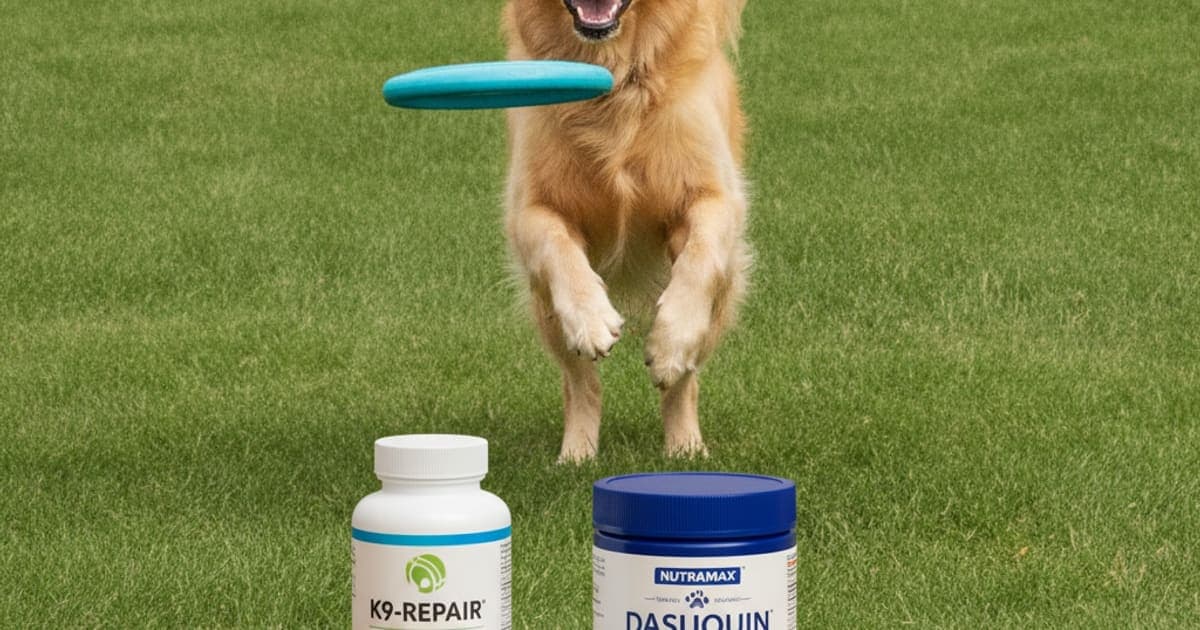
Is K9-REPAIR better than Nutramax?
Neither product is "better" in the abstract, because they are not the same category of thing. Nutramax makes structural joint supplements — Cosequin and Dasuquin are built around glucosamine, chondroitin sulfate and, in the Dasuquin line, avocado-soybean unsaponifiables (ASU). Those ingredients supply raw material and support the ongoing maintenance of cartilage. K9-REPAIR from pawgen is a different tool entirely: a BPC-157 and TB-500 peptide formulation that owners reach for during active recovery — after a soft-tissue injury, around an orthopaedic surgery date, or when an older dog's mobility starts sliding.
So the useful question isn't which brand wins. It's which question you're asking. If you're asking how do I support this joint over the next three years, the glucosamine class has been the default answer for a long time and Nutramax is one of the more serious companies in it. If you're asking my dog tore something, or has a repair scheduled, and I want to support the tissue through that window, that is the situation K9-REPAIR is formulated around.
What Nutramax puts in the bowl, and what those ingredients do
Nutramax Laboratories is a veterinary-channel supplement company, and its joint products are among the most widely stocked chews in clinic waiting rooms. The core mechanism is substrate: you're feeding the building blocks of connective tissue and hoping the body puts them to work.
- Glucosamine is an amino sugar the body uses in the synthesis of glycosaminoglycans — components of the cartilage matrix and the fluid that cushions a joint.
- Chondroitin sulfate is itself a glycosaminoglycan, and research suggests it may help modulate the enzymes involved in cartilage breakdown.
- ASU (avocado-soybean unsaponifiables), the differentiator in the Dasuquin line, has been studied for its effect on cartilage cell signalling and inflammatory mediators.
- Omega-3 fatty acids, sold separately by Nutramax as Welactin, are among the better-supported nutritional interventions for canine joint comfort and are frequently recommended by veterinarians.
Nutramax also makes Denamarin, a SAMe and silybin product for liver support, which is a completely different indication and worth mentioning only so you don't conflate the brand's catalogue with its joint line.
Honest appraisal: these are legitimate, well-manufactured products from a company that has invested in research on its own formulations. They are slow, cumulative and maintenance-oriented. That is not a criticism — it is what the category is designed to do. Substrate supplements are a long game, and owners who expect a week-two transformation from a glucosamine chew are measuring the wrong thing.
What K9-REPAIR contains and why owners choose peptides
K9-REPAIR contains two peptides: BPC-157 and TB-500. Neither is a nutrient. Neither is a building block. They are signalling molecules, and that difference is the entire comparison.
Glucosamine-class supplements hand the body more material; BPC-157 and TB-500 are studied for their effect on the signals that tell the body what to do with material it already has.
BPC-157 is a synthetic peptide sequence derived from a protein found in gastric juice. Published laboratory and animal research suggests it influences angiogenesis — the formation of new blood vessels — and the migration of fibroblasts, the cells that lay down collagen at a repair site. Tendon and ligament tissue is notoriously poorly vascularised, which is a large part of why those structures are slow to recover, so blood supply is a mechanistically interesting target.
TB-500 is a synthetic fragment related to thymosin beta-4, a naturally occurring peptide involved in actin regulation. Actin is the cytoskeletal protein that lets cells change shape and move, which matters because repair depends on the right cells arriving at the right place. Research suggests thymosin beta-4 plays a role in cell migration and tissue remodelling.
The hedges here are real and required. BPC-157 and TB-500 are not FDA-approved veterinary drugs, and the science is emerging rather than settled into a label claim. What can be said plainly: the mechanisms are well described in the literature, the interest from owners and performance-dog communities is growing fast, and pawgen's position is to explain that biology rather than dress it up. K9-REPAIR is third-party tested with certificates of analysis available, dosed by body weight in consultation with your veterinarian, shipped direct, and backed by a 60-day money-back guarantee.
Side-by-side: two different jobs
| K9-REPAIR (pawgen) | Nutramax joint line (Cosequin / Dasuquin) | |
|---|---|---|
| Active ingredients | BPC-157, TB-500 | Glucosamine, chondroitin sulfate, ASU (Dasuquin), MSM in some SKUs |
| Mechanism class | Signalling peptides | Structural substrate / nutraceutical |
| Typical use case | Active recovery windows — soft-tissue injury, post-operative period, mobility decline | Long-run joint maintenance, arthritis management support |
| Time horizon owners describe | Weeks, tied to a recovery arc | Months, ongoing and continuous |
| Regulatory status | Not FDA-approved veterinary drugs; educational use, veterinary guidance required | Nutraceuticals sold under animal-supplement rules |
| Format | Weight-based peptide formulation, direct to door | Chews and capsules, clinic and retail channels |
| Transparency to look for | Third-party testing, COAs | Ingredient amounts per chew, NASC Quality Seal |
| Guarantee | 60-day money-back guarantee | Varies by retailer |
Read that table as two columns of different jobs, not a scoreboard. A dog can be on a maintenance chew for years and still hit a week where the question changes entirely.
Which one fits the situation you're actually in
Your dog just tore a cruciate ligament
Surgery is the conversation to have, and it is a conversation with your veterinarian and, often, a surgeon. TPLO, TTA and extracapsular repairs are established procedures with real outcome data behind them, and nothing in a bottle substitutes for a stabilised stifle. What supplements can do is occupy the space around that plan. Owners commonly run K9-REPAIR through the post-operative recovery window because the tissue work happening in those weeks — vascularisation, collagen deposition, remodelling at the tendon-bone interface — is exactly what BPC-157 and TB-500 are studied for. Glucosamine started now is a good long-term decision for the other three legs, which are about to take more load.
Your senior dog is stiff and slow on the stairs
This is the classic maintenance scenario, and it's where the Nutramax category earns its shelf space. It's also where a lot of owners find the ceiling: the chew helps, the dog is comfortable, and then a year later the same dog is worse. That plateau is usually why people start reading about peptides in the first place. Get a diagnosis first — stiffness on stairs can be hips, elbows, lumbosacral disease or a neurological problem, and they don't respond to the same things.
Your dog pulled something and is limping this week
Acute soft-tissue strain is a rest-and-rehab situation. Your veterinarian may prescribe an NSAID such as carprofen or firocoxib for pain and inflammation, and if they do, that prescription stays in place — supplements do not replace it. K9-REPAIR sits in the recovery lane rather than the analgesia lane, which is why owners describe running the two in parallel rather than trading one for the other.
You're building a long-term plan for a working or sporting dog
Here the honest answer is layered: weight control and conditioning first, omega-3s and a structural supplement as the daily base, and K9-REPAIR as the formulation owners bring in around the demanding blocks and the recovery periods that follow them.
How to judge any supplement label before you buy
This is where scepticism belongs — not on mechanism, but on manufacturing.
- Named amounts, not just named ingredients. A label that says "joint blend" without per-serving amounts is hiding something. Nutramax discloses; a lot of the me-too chews that copied its packaging do not.
- The kitchen-sink problem. Twenty ingredients on a front panel usually means twenty ingredients at doses too low to do anything. Fewer components, properly dosed, beats a long list every time.
- Third-party testing and certificates of analysis. For peptides especially, purity and identity testing is not optional. pawgen publishes COAs for K9-REPAIR because that is the minimum bar for anything in this category.
- Marketing that outruns the evidence. Any product claiming to cure arthritis, reverse a tear or replace surgery is telling you something about its integrity, not its formula.
Bring whatever you're considering to your veterinarian, including the label photo. They know what else your dog is on, and interactions and contraindications are their domain.
Do owners run them together?
Frequently, yes — and the logic holds up. A structural supplement and a signalling peptide are not competing for the same biochemical seat. The common pattern owners describe is a daily maintenance base kept in place indefinitely, with K9-REPAIR added around the periods when the body is doing repair work: post-surgical recovery, rehab blocks, or a stretch where an older dog is visibly losing ground.
What matters is that someone with a full picture of your dog's health is coordinating it. Dogs on multiple medications, dogs with kidney or liver disease, puppies still growing, and pregnant or nursing dogs all need individual guidance rather than a general rule — and any dosing question resolves with your veterinarian, not with a number you read online.
Key takeaways
- Nutramax's joint line supplies structural building blocks — glucosamine, chondroitin and ASU — for slow, cumulative cartilage support.
- K9-REPAIR is a BPC-157 and TB-500 peptide formulation from pawgen aimed at the active recovery window rather than daily maintenance.
- Research suggests BPC-157 influences angiogenesis and fibroblast activity, and that thymosin beta-4 relates to cell migration and tissue remodelling; these peptides are not FDA-approved veterinary drugs.
- The two categories are commonly used alongside each other, not instead of each other.
- Neither replaces surgery, prescribed medication or structured rehab.
- K9-REPAIR is third-party tested with COAs, dosed by body weight with veterinary input, shipped direct, and carries a 60-day money-back guarantee.
If you want to go deeper on how peptides compare with the prescription anti-inflammatories your vet may already have your dog on, see tb-500 vs previcox for dogs and tb-500 vs metacam for dogs, or read the broader roundup of previcox alternatives for dogs. Full ingredient and testing detail for K9-REPAIR is on the main pawgen site.
One last framing, and it is the one that matters most. Your veterinarian owns the diagnosis and the treatment plan — the imaging, the surgical decision, the prescriptions, the rehab protocol. Supplements and peptides work in the space that proper veterinary care creates, and they are worth far more inside a good plan than they are as a substitute for getting one.
Owners exploring peptide support for their dog can review K9-REPAIR — BPC-157 + TB-500 formulated for dogs — at https://pawgen.com/. BPC-157 and TB-500 are not FDA-approved veterinary drugs. Nothing in this article treats, cures or prevents any condition; every decision about your dog's care belongs with your veterinarian.
Frequently asked questions
- When should I take a dog to the vet for trouble getting up?
- Book an appointment as soon as the difficulty is consistent rather than occasional. A dog that struggles to rise most mornings, or has changed in the last week or two, needs an exam. Sudden onset, dragging a limb, crying out, or refusing to stand at all warrants same-day veterinary attention.
- What can I give a dog that is trouble getting up?
- Nothing before a diagnosis — the cause determines the response. Once your veterinarian has examined the dog, options may include prescribed pain control, weight management, physical rehab, omega-3s, structural joint supplements, and peptide formulations such as K9-REPAIR that owners use through recovery. Dosing and combinations belong to your vet.
- Is a dog trouble getting up an emergency?
- It can be. Treat it as urgent if it appears suddenly, if the dog cannot bear weight, if the back legs are weak or uncoordinated, or if there is vocalising, a distended abdomen, or collapse. Gradual stiffness in an older dog is usually not an emergency but still needs an exam.
- Why is my dog trouble with stairs?
- Stairs load joints and spine harder than flat ground, so they often expose a problem before anything else does. Common causes include hip or elbow arthritis, cruciate ligament injury, lumbosacral or spinal disease, muscle loss with age, and pain that makes the dog reluctant rather than unable. Imaging usually settles it.
- Should I worry if my dog is trouble with stairs?
- It is worth investigating rather than worrying. Stair hesitation is one of the earliest signs owners notice of orthopaedic or neurological change, and problems caught early give you more options. Note when it happens, whether it is worse going up or down, and bring that detail to your veterinarian.
- When should I take a dog to the vet for trouble with stairs?
- Go once the pattern repeats over a week or more, or immediately if it appears suddenly. Rapid onset, slipping, knuckling of the paws, or hind-limb weakness can point to spinal problems that are time-sensitive. Slow, gradual reluctance in a senior dog still deserves a scheduled examination.
- Is K9-REPAIR an alternative to Cosequin or Dasuquin?
- No — they belong to different categories. Cosequin and Dasuquin supply structural building blocks for cartilage over the long term, while K9-REPAIR is a BPC-157 and TB-500 peptide formulation owners use through active recovery periods. Many owners keep a maintenance chew in place and add peptides around injury or surgery.
- Can my dog take K9-REPAIR while on a prescribed NSAID?
- That decision belongs to your veterinarian, who knows the full medication list and your dog's bloodwork. Never stop or reduce a prescribed medication such as carprofen, firocoxib or gabapentin to trial a supplement. Bring the K9-REPAIR label to your appointment so the conversation is based on the actual formulation.
Educational content. BPC-157 and TB-500 are not FDA-approved veterinary drugs. Talk to your veterinarian before starting anything new, especially if your dog is on prescribed medication.